Showing posts with label professional learning. Show all posts

Sunday, April 13, 2025

The Professional Development Paradox: Why Good Intentions Go Astray in Schools

Who doesn't look forward to PD days? While some educators do, I have the feeling that many of you cringe at the thought.  Recently, on my podcast Unpacking the Backpack, I discussed the pitfalls of professional development (PD) after revisiting a blog post I wrote in 2021. Listen on Spotify or wherever you access your favorite podcasts. You can also read the original blog post HERE. Below are some expanded thoughts on the topic.  

PD is the cornerstone of district and school culture. The idea is sound: equip educators with new skills, knowledge, and strategies to better serve their students. Yet, for many teachers and administrators, the mention of PD evokes a sigh rather than excitement. Why does this crucial investment so often fall short of its potential? The answer lies in several common pitfalls that plague PD initiatives in schools.

One significant issue is the lack of relevance and personalization. Too often, PD is a one-size-fits-all affair, delivered en masse regardless of individual needs or subject-specific challenges. A high school science teacher might find little value in a workshop focused on early literacy strategies, just as a veteran educator might feel patronized by introductory sessions on classroom management. This disconnect leads to disengagement and a feeling that time is being wasted (Darling-Hammond et al., 2017). This is compounded even more when it comes to administrators, as they rarely receive any meaningful PD on scheduled days, let alone throughout the school year. 

Another major hurdle is the "drive-by" nature of many PD sessions. A single keynote, breakout, workshop, or a short series of presentations rarely translates into lasting change in practice. Teachers, in particular, are bombarded with information but lack the time, support, and ongoing coaching needed to effectively implement new ideas in their classrooms. The knowledge gained often fades quickly without opportunities for reflection, collaboration, and practical application (Joyce & Showers, 2002). Again, as it relates to administrators, they are often forgotten and deserve quality PD.

If the above pitfalls aren’t worrisome, they are more. Insufficient follow-through and accountability can undermine even well-intentioned PD. If there's no mechanism to observe, discuss, reflect upon, and refine the implementation of learned strategies, the impact remains minimal. Teachers may feel they've ticked a box by attending, but the true measure of PD – improved student outcomes – is rarely tracked or analyzed effectively (Guskey, 2000). The same holds true for administrators at all positions.  This is where ongoing and job-embedded coaching become the optimal professional learning pathway for leaders.  

The lack of voice and ownership in the selection and design of PD is another critical flaw. When teachers feel like PD is something imposed upon them rather than something they actively participate in shaping, their embracement diminishes. Including educators in the needs assessment and planning stages can ensure that PD addresses real challenges and fosters a sense of shared responsibility for professional growth (Villegas-Reimers, 2003).

Finally, the time commitment and logistical challenges associated with PD can create significant barriers. Pulling educators away from valuable classroom time can disrupt student learning and add to already heavy workloads. Finding suitable substitutes, covering administrative duties, and scheduling sessions that accommodate everyone's needs can be a logistical nightmare, sometimes leading to rushed or poorly executed PD. Again, this is where coaching cycles provide immense value. 

While the intent behind professional development is undoubtedly positive, its effectiveness is often hampered by a lack of relevance, insufficient follow-through, limited teacher input, and logistical hurdles. To truly unlock the potential of professional learning, schools need to shift towards more personalized, ongoing, and collaborative models that empower teachers and leaders while directly addressing students' needs. Only then can we move beyond the professional development paradox and create a culture of continuous growth that benefits everyone in the educational community.

Reach out to learn about the diverse professional learning options from Aspire Change EDU. 

Darling-Hammond, L., Hyler, M. E., & Gardner, M. (2017). Effective teacher professional development. Learning Policy Institute.   

Guskey, T. R. (2000). Evaluating professional development. Corwin Press.

Joyce, B., & Showers, B. (2002). Student achievement through staff development (3rd ed.). Association for Supervision and Curriculum Development.   

Villegas-Reimers, E. (2003). Teacher professional development: An international review of the literature. UNESCO International Institute for Educational Planning.


Sunday, September 22, 2024

4 Steps for Continuous Improvement

There is a great deal on the plates of teachers and administrators.  How many of us were initially trained doesn’t carry as much weight in a world where information is readily at our fingertips. Take lesson planning, for example. Many of us recall the days when lesson plans were a labor of love or a big waste of time. We spent countless hours crafting detailed outlines, complete with objectives, activities, assessments, and even a backup plan in case of inclement weather. For some of us, lesson plans were works of art; each one was a testament to our dedication and passion for teaching. In other cases, they were a waste of time.  

Let’s now take a look at the modern era. Efficiency and flexibility are now prized above all else. Lesson plans should be more streamlined, focusing on essential learning outcomes and incorporating innovative strategies to enhance the learning experience. While we understand the value and importance of planning, a more adaptable approach allows educators to respond to students' needs in real-time. 

Yes, a plan is important. However, it does not and should not be an arduous process. Consider the following steps when it comes to continuous improvement as a teacher. If you are an administrator, consider how your learning walks and feedback protocols can support growth in these areas. 

  1. Plan standards-based lessons with measurable learning goals.
  2. Implement effective strategies to maximize time, provide an appropriate amount of challenge, and engage students. 
  3. Evaluate insights from exit tickets, assessments, adaptive tools, and/or student work to determine lesson effectiveness. 
  4. Grow by reflecting to identify gaps in practice. Then, attend and implement strategies gleaned from professional learning. You can also leverage professional learning communities (PLCs), personal learning networks (PLNs), or other growth opportunities.

Teachers and administrators are compelled to adapt to changing times where access to information is instant and flexibility is crucial. The days of rigid, labor-intensive lesson planning are behind us. Instead, streamlined, standards-based lesson plans focusing on essential learning outcomes are critical. Teachers can embrace adaptability to better respond to students’ needs in real-time while clearly focusing on measurable learning goals. Consider how this continuous improvement process can transform the teaching and learning experience, whether you are an educator or an administrator. Administrators, empower your teams by offering meaningful feedback and encouraging professional growth. By embracing flexible, outcome-driven planning, we can better meet the needs of every student and cultivate a thriving learning environment.


Sunday, March 17, 2024

Cultivating Lifelong Learners: How to Support Personalized Teacher Growth

Imagine a classroom buzzing with engaged students, actively constructing knowledge and diving deep into topics that spark their curiosity. This vibrant learning environment does not just happen by chance. It thrives under the guidance of a passionate, skilled educator who is constantly evolving alongside their students. However, like their students, teachers need personalized growth opportunities to stay engaged, motivated, and effective.

Teachers are the backbone of any thriving learning environment. Nevertheless, just like their students, educators thrive in personalized learning experiences. In a world of standardized tests and rigid curricula, fostering a culture of continuous, personalized growth for teachers allows them to stay abreast of current trends and effective strategies, maximize time, and become the best iteration of themselves for the learners they serve. 

Here is how educational leaders can champion personalized professional learning  for their teachers:


Needs Assessment: Start with the Individual

One-size-fits-all professional development (PD) is a recipe for disengagement. PD is typically done to teachers something other than what they actively want to be a part of or crave. A shift to personalized professional learning can change this dynamic. Effective leaders begin by understanding each teacher's unique needs and aspirations. Conduct individual needs assessments through surveys, goal-setting conversations, or classroom observations. This allows you to tailor professional learning opportunities that address specific skill gaps, teaching styles, and career goals (Guskey, 2000).

Embrace Choice and Variety

Move away from the traditional "sit-and-get" PD model. Offer teachers a diverse menu of learning opportunities. This could include workshops on specific instructional strategies, online courses on emerging educational technologies, or peer coaching programs that foster collaboration. Allow teachers to choose formats and topics that resonate with their individual learning preferences and goals (Desimone, 2009).

Leverage Technology for Flexibility

Technology can be a powerful tool for personalized learning. Online courses and learning modules allow educators to access content at their own pace and on their own schedules. Additionally, micro-learning opportunities through bite-sized videos, podcasts, or webinars that cater to busy schedules and allow for focused learning on specific topics should be considered (Moeller & Allen, 2017).

Empower Teacher Leadership

Teachers are a wealth of knowledge and experience. Empower them by creating opportunities for leadership within the professional development framework. Encourage them to lead workshops, share best practices with colleagues, or mentor other teachers in specific areas of expertise. This fosters a culture of collaboration, validates teachers' expertise, and fuels their intrinsic motivation to learn and grow.

Celebrate Growth and Achievement

Recognition is a powerful motivator. Regularly acknowledge and celebrate teachers' professional growth milestones. Highlight innovative practices implemented in the classroom or successful application of newly acquired skills. This public recognition reinforces the importance of continuous learning and inspires others to embark on their own personalized growth journeys.

Prioritize Reflection and Feedback

Growth does not happen in a vacuum. Create a safe space for teachers to reflect on their learning experiences. Host post-workshop discussions, provide feedback mechanisms, or encourage using professional learning communities (PLCs) where teachers can share successes, challenges, and best practices.

Invest in Teacher Wellbeing

Teacher stress and burnout are real challenges. Supporting personalized growth extends beyond professional development. Promote a healthy work-life balance by offering flexible schedules, stress management workshops, or on-site wellness programs. A well-rested and supported teacher is more receptive to learning and innovation.

By embracing these strategies, educational leaders can move away from a one-size-fits-all approach and create a continuous, personalized growth culture for their teachers. This fosters a more engaged, motivated, and ultimately, more effective teaching staff – a win-win for educators, students, and the entire learning community. Always keep in mind that the key to success with any form of professional learning is that it is part of a job-embedded and ongoing model.


Efficacy should be the goal of all professional learning. Learn more about how Aspire Change EDU helps districts, schools, and organizations personalize professional learning HERE.

Desimone, L. C. (2009). Improving teacher quality in an era of educational reform. Educational Researcher, 38(8), 649-664.

Guskey, T. R. (2000). Evaluating professional development. Thousand Oaks, CA: Corwin Press.

Moeller, S. C., & Allen, J. (2017). Microlearning for professional development: A systematic review. TechTrends, 61(3), 286-293.

Sunday, October 22, 2023

Using Feedback to Drive Professional Learning

During this school year, I have been working with Stryker Local Schools in Ohio. Like all my implementations where the work is job-embedded and ongoing, learning walks are a core component. In September, the leaders and I conducted walks in every classroom over two days. As a result, I provided them with close to 5000 words of feedback. With the suggestions in hand, the leaders were empowered to review what we had seen and my recommendations to determine the focus for an upcoming professional development day I would be facilitating. I was excited for the opportunity to provide feedback to staff through a pedagogical design process. The three-hour sessions were tailored by grade level and developed based on suggestions for growth based on the learning walks that were conducted. 

Feedback is a critical catalyst for professional learning and growth. It serves as a valuable tool for educators, schools, and districts to refine their skills and improve teaching, learning, and leadership. Whether it comes from administrators, peers, consultants, or self-assessment, feedback offers insights that help educators identify areas for improvement and build upon their strengths. In schools, feedback should not be merely a one-time event; it is an ongoing process that fosters continuous learning and development. I have found this to be a critical success indicator in all the projects I am involved with, both past and present.  

One key aspect of utilizing feedback for professional learning is creating a culture that encourages open and honest communication. When individuals feel safe and supported in sharing their observations and receiving feedback, the environment becomes conducive to growth. In the sessions I facilitated with Stryker educators, there were activities every ten minutes at five to twenty-minute intervals focused on specific areas of potential growth. This psychological safety fosters a culture of mutual respect and trust, allowing professionals to focus on their own development rather than worrying about judgment or criticism.

Moreover, feedback provides specific and actionable information for educators to set goals and make targeted improvements. Vague or generalized praise or criticism can be less effective, as it needs more specificity for meaningful change. Constructive feedback should be specific, identifying what went well or wrong and how it can be improved. This level of detail allows individuals to take concrete steps toward enhancing their practice.

Self-assessment is another valuable tool for professional learning, as it encourages individuals to take responsibility for their own development. Hence, I provided numerous opportunities to reflect before and after giving specific suggestions. By self-reflecting, educators can gain a more well-rounded understanding of their strengths and opportunities for growth. Self-assessment helps individuals identify areas where they need improvement and enables them to set personal goals for growth. It is a proactive approach to learning that empowers them to control their development.

The feedback loop is not limited to just the individual; schools and districts also benefit from using feedback to drive professional learning. When organizations gather and analyze feedback curated during learning walks, they can make informed decisions about training, development programs, and process improvements. This data-driven approach ensures that professional learning initiatives align with the needs and aspirations of their workforce, promoting a culture of continuous learning and growth. Currently and over the years, I have been blessed to partner with district and school administrators committed to this process.

Feedback is a powerful tool for driving professional learning. It promotes a culture of openness and trust, provides specific and actionable insights, encourages self-assessment, and empowers both individuals and organizations to enhance their performance. By recognizing feedback as an ongoing process and a means to facilitate growth, educators can harness its potential to improve and evolve in their craft continuously. 

Reach out if you want to learn more about what this process could look like for your school or district through Aspire Change EDU's comprehensive suite of services. 


Sunday, August 20, 2023

Introducing Aspire Change EDU

I often get asked both through social media and in person how to become a consultant. For various reasons, educators are enamored by the keynoting circuit, facilitating presentations at both national and international events, and coaching in school systems. Initially, I had to pause and reflect before responding as I wanted to be very clear on how my journey was more complex than it might seem. Now I have a standard answer. I did not wake up one day and say that this is what I aspired to do for the rest of my career. It can also be stated emphatically that I was not looking to leave New Milford High School or was forced out. Instead, the path was carved for me through the efficacy-based work that my staff and I did when I was a principal.  

In short, we vehemently focused on improving teaching, learning, and leadership through a shared vision, clarity of purpose, innovative practices, and clear evidence of impact. Our shared successes caught the eye of national media outlets as well as other systems that were curious about methodologies. What resulted were districts, schools, and organizations visiting my school from all over the world. I loved to share our successes, the challenges we overcame, student perspectives, and any other tidbits that might be valuable to those wanting to implement similar changes. During one such visit, an organization offered me a full-time position with their company. At first, I respectfully declined as I was happy where I was at in my career. However, the conversation never stopped, and I eventually decided to take a leap of faith to pursue a newfound passion in education.

It has been nine years since the consulting path was laid out for me. Over the years, I have worked with two amazing companies dedicated to helping learners succeed and traveling the globe assisting educators in various ways. While the work has been highly gratifying, there has always been an innate desire to carve out my own unique path in the education consulting space. My first step was to create an LLC during the pandemic. 

It has laid dormant until the right time, which is now. With great pride and excitement, Aspire Change EDU has moved from vision to reality.


I have ambitious goals for my company. The first was to develop a name that embodies what consulting should be about, and that is to help systems aspire to change that leads to improving and enhancing what we already know works. Educators don’t want more things to do. They crave to maximize available time, strengthen their craft, help learners succeed, and find joy in the work. The logo above, co-created by my children Isabella and Nicholas, embodies this mission and vision.

During the initial phase of the company, I will be fulfilling many of the responsibilities, including:

  • Keynotes (view topics HERE)
  • Back-to-school convocations
  • Leadership retreats
  • Breakout presentations
  • Innovative Leadership Cohort 
  • Interactive workshops
  • Strategic planning
  • Coaching (job-embedded, ongoing)
  • Asynchronous courses (more info HERE)

Leadership and pedagogy will be my primary focus, which encompasses every facet of professional learning. Currently, my work with schools assists them with Tier 1 instruction, personalization, school culture, leadership (digital, pedagogical, sustainable change), using data, branding, and the purposeful use of technology. Over time I will flesh out concrete practice areas.

The last sentence above leads to what will be a differentiator for Aspire Change EDU. I aim to create a collaborative consultancy comprising best-in-class practitioners and seasoned consultants who share similar beliefs. While my plan is to have a bench of people to serve schools, I also want to partner with other independent consultancies (and vice versa) for the benefit of districts and schools. By working together, we can provide systems with what they want, not what we feel we can do. Imagine being matched with the best possible professional learning consultant(s) aligned to virtually every focus area, technique, initiative, tool, or strategy in education. That’s the goal and one that, in my opinion, best serves schools.

Just like for our learners, professional learning needs to be personalized and differentiated. It’s nearly impossible to accomplish this without collaboration. That is something I hope to solve in the near future with the help of others. In the end, schools will win and evidence-based change will be the result. Stay tuned for more updates in the coming months.

Until then, feel free to reach out and have a conversation about your professional learning needs. Learn more on my website.

Sunday, April 9, 2023

#EDvice: Moving from PD to Professional Learning

When it comes to education training, the main pathway to improvement is through professional development. Depending on where you reside or your school system, this typically consists of a few days to begin the new academic year and a few random days going forward that are often associated with student holidays. While the premise is positive, the result doesn’t always lead to sustainable change. I have a theory as to why this is sometimes the case.  

Professional development (PD) is something that is typically "done" to educators. On the other hand, professional learning is something they actively WANT to engage in to grow. The latter involves choice, context, and practicality driven by an intrinsic desire to grow.

Think about this for a second. Most “PD” days are often scripted and, in some cases, dictated” based on mandates from various levels. What often results is little personal connection to the concepts or a feeling that there is no alignment with one’s specific role. When this happens, many people are naturally disinterested from the start. That’s not a good thing. Another glaring issue is that “PD” days often consist of one-and-done or drive-by sessions that offer little in terms of reflection, diverse perspectives, time to apply, and needed feedback afterward to see progress in the implementation of strategies covered. In this piece of #EDvice below, I dive into a mindset shift from professional development to professional learning.


Now I am not saying that PD doesn’t have value. My point is to reflect to determine if the resources and time allocated lead to evidence that educator practice is improving. It is essential to view adults just like learners in our classrooms. Thus, any professional learning should be personalized, interest-based, and aligned with a sound body of research. Below are three pathways to consider that meet these criteria:

  • Create or advocate for job-embedded coaching to complement any workshops of stand-alone days.
  • Develop a Personal Learning Network (PLN)
  • Attend events such as the Model Schools Conference, where the program focuses on educators and schools who are doing the work and have results to illustrate efficacy.
  • Move to well-structured Professional Learning Communities (PLCs) where data, research, and effective strategies are the focus. 


Learning is a process, not an event or day. Keep that in mind when developing, implementing, or participating in any growth opportunity. 

Sunday, March 5, 2023

When Growth is the Only Path Forward

No pain, no gain has been a common saying for years. Truth be told, getting better is hard work, no matter the context. When faced with adversity, we take one of two paths. The first is seeing the inherent opportunity in a challenge through a growth mindset. Sometimes that means looking beyond traditional metrics of success to find other areas where the needle can be moved. Just because you are already good at something should not hinder progress in other areas. The second option is to develop a sense of reluctance to push forward. Many factors, such as fear and comfort, can lead us in this direction. These can both stymy change efforts or develop an illusion that everything is just “peachy.”

Truth be told, when it comes to education, there is no perfection, no matter where quantitative and qualitative metrics reside. Even if you have the best test scores, graduation rates, innovative practices, and attendance numbers, growth should still be pursued. Authentic leadership is being honest and vulnerable about where you are to help others get to where they need and want to be to succeed. Whether you lead a district, organization, school, or classroom, you should always strive to get better. There is always work to be done and effective educators embrace this wholeheartedly.  

Consider the following questions when it comes to professional growth:
  • Who do we serve?
  • Why are our practices effective or not?
  • How can we improve?
  • What will tell us whether or not we are successful?
  • Where do we go from here?

A standout example of this is Quest Academy Junior High School in Utah. During the spring of 2022, I met Nicki Slaugh, who serves as principal, and many of her staff at a school system where we were all there to facilitate professional learning on Personalized Competency-Based Learning (PCBL). In typical fashion, I moved from ideas and concepts to concrete examples of evidence from my other coaching projects to illustrate practicality and efficacy. In Nicki’s words, she saw many direct connections to what she and her staff were doing at Quest, but more importantly, she saw an opportunity to grow. It was at this point that we planned longitudinal work over the course of the year, which included a book study using Disruptive Thinking in Our Classrooms. 

After several workshops, I began coaching cycles in the fall of 2022. What I immediately saw blew my mind as it was some of the best examples of personalization at scale that I have ever seen. In every classroom, I saw evidence of a vibrant culture of learning and competency-based strategies where students followed a unique path and worked at their own pace. Teachers were seen pulling students based on data for targeted support in small groups or individually in math and ELA. Rubrics were everywhere and accessible in Google Classroom. I also saw the consistent use of exit tickets and pathways to provide feedback. My brief summary does not do justice to what these teachers and their leader have accomplished. It is simply amazing. 

After reading the paragraph above, you are probably wondering why I am even supporting Quest. Well, this ties directly to the title of my post. Even though they are clicking on all cylinders in many areas, Nicki and her staff live by the mantra that growth is a never-ending journey. Collectively, we came to the consensus that there were opportunities to grow in the use of high-agency strategies, most notably voice and choice, as well as the development of customized supports schoolwide. Thus, we created a personalized coaching plan to target these focus areas. 

To date, there has been so much progress made. I have included a few pictures below, but to get a better sense of all that is happening at Quest, take a look at THIS PRESENTATION Nicki and I have facilitated for the Utah State Board of Education in person and virtually. You will see what they already had in place, but also growth in the areas of station rotation, flipped lessons, playlists, amplification of voice through technology and dry-erase surfaces, rigor, and relevance. Please note that this is only a small sampling of evidence. 

The culture of learning that Nicki has established at Quest empowers teachers to take risks and actively reflect on their practice. After each coaching session, she takes my feedback and then works with her staff to pull out the most essential parts. Growth is happening because Nicki and her teachers own the process. They change not because they necessarily have to but because they want to in an effort to serve their students better. I have been so impressed that I took my team to Quest to see firsthand what true personalization looks like as we put the finishing touches on our support model for districts and schools across the world. Nicki shared the following:
"To be the 1%, you need to do what 99% are either hesitant or unwilling to do. Our entire school culture is based on always reaching for better. We had already implemented several aspects of PCBL, but upon meeting with Eric, it was clear that we still had room for growth. While listening to Eric present, I felt he was my kindred spirit. It was so exciting for us to meet someone who shared our passion and vision. We had already experienced how valuable feedback was in helping our students grow, so we were excited for the opportunity to receive feedback from an expert in the PCBL field to help take us to the next level. The strategies Eric has given my teachers have been invaluable. He has connected with both my students and staff and has genuinely become part of our team."
My point is as simple as it is proud. Growth can and should be the only path forward, no matter where you are in your practice or as a system. Professional learning should be anything but “cookie cutter” and personalized based on your needs and goals. It should be something you want to engage in, not viewed as another thing to do or a waste of time. If you want to have a conversation about what this could look like in your district, organization, or school, send me an email. 
 

Monday, December 12, 2022

#EDvice: Practical Strategies in 90 Seconds or Less

I never saw myself as a writer until I started blogging back in March 2010. It all began with goal setting for the Google Teacher Academy for Administrators, and I haven’t looked back. Consistency has been vital for me, as I have published a post every week since. Therein lies the dilemma I am currently facing. The struggle is real in my case when it comes to finding new topics to blog about or adding an innovative spin to already-prevalent concepts. I find myself spending an immense amount of time just to churn out 500 words. Upon reflection, this might be one sign to change things up a bit. The time has come for me to challenge my personal status quo. 

In a world where multimedia content is virtually at everyone’s fingertips, written content that dives into concepts and strategies might not have the same impact as it once did. Attention spans are not what they used to be, and this is something we all need to be cognizant of when sharing ideas. In the digital age, brevity is virtue when it comes to processing and implementing strategies. Upon further reflection—and so I can grow—I decided to dedicate more time to developing short video clips in lieu of blogging each week. I will not stop writing regularly because I still see immense value in the process, but I plan to change my routine and shift to a bi-weekly schedule. Every other week I will share a simple, practical strategy that educators can use right away *in 90 seconds or less* called #EDvice. 


Leveraging my current experiences in classrooms, schools, and districts working with educators, my plan is to articulate one strategy from the following three-step perspective:

  • Why is this strategy important?
  • How can it be readily implemented?
  • What could it look like in practice?

For my first clip, I decided to share some advice on developing choice boards. (Special thanks to Dan MacCracken, another ICLE colleague, who edited and tweaked my raw video.)  During a recent coaching visit with Quest Academy Junior High School, l I observed teachers readily implementing strategies that we’d collaborated on over the course of the year. Hats off to Principal Nicki Slaugh for following through on the feedback I provide after each visit. The video below shares a practical strategy educators can use when developing effective choice boards:

While I’d dabbled in video content in the past, I believe that returning to this medium now is coming at the right time for me—and hopefully, it is for you, too. Ultimately, I want to expand the opportunities for us to connect around our daily, meaningful work and amplify conversations between educators to elevate our practice one behavior at a time. On that note, I invite you to send me your own ideas, questions, and wonderings for #EDvice—what’s on your mind? I look forward to hearing from you—thanks, as always.

Sunday, May 1, 2022

Efficacy-Based Practices

The pursuit of improvement is a never-ending journey. With all the disruption we have and will continue to see, changes to how we educate kids must be considered. We often see a great deal of investment in an array of ideas, strategies, and solutions with the goal of improving learning for all kids. I am all for anything that can benefit all students. However, caution must be exercised when there is a desire to pursue the next “silver bullet” or embrace ideas that sound wonderful on the surface but have little to show in terms of evidence of improvement at scale.

Results, both qualitative and quantitative, matter, and this is something that everyone should embrace. Hence the need to zero in on what truly matters through efficacy-based practices. 

The “why” behind this focus is as follows:

  • Accountability
  • Connect what we know works by leveraging research to improve practice
  • Personalize learning for students and staff
  • Optimize time, resources, and decisions
  • Create a transparent culture to develop relationships
  • Move away from “telling” to “showing” what actually works to drive needed change


Research 

Instead of assumptions and opinions, proven strategies should be emphasized to substantiate changes or improvements to practice. Having a foundation and a compelling reason to change is where research plays a pivotal role. It provides a baseline as to what has been found to really work when it comes to student learning and improving culture. We can look to the past in order to inform current practice. If efficacy is the goal, it is critical to embrace a scholarly mindset to inform and influence our work, not drive it.

Professional learning

It is hard to meet goals and expectations to improve learning if consistent support is absent. Professional learning develops and strengthens the expertise of teachers and administrators so they are better equipped to meet the needs of all learners. If people don't believe in themselves, then achieving goals will be near impossible. Thriving cultures focus on empowerment, support, feedback, and autonomy to take risks to build self-efficacy. Without efficacy-based professional learning that connects to research and practical strategies, evidence of improved outcomes will be hard to come by.

Evidence 

Qualitative and quantitative measures help to validate the time and effort put forth to initiate and sustain change. The only way to determine if goals have been met is through evidence. Discounting this shows a lack of understanding of what real change looks and feels like in education. Evidence can come in many forms, but in the end, it should clearly paint a picture that the ideas and strategies implemented have resulted in a better, more improved outcome. A combination of data and artifacts will tell you and anyone else whether or not goals were met.

Amazing things are happening in education, and the pandemic only amplified this through the embracement of innovative ideas. We must constantly push ourselves to be better and strive for continuous improvement. The more we take a critical lens to the efficacy of our work, the more collective goals we have for education, learning, and leadership can be achieved. 

Sunday, February 6, 2022

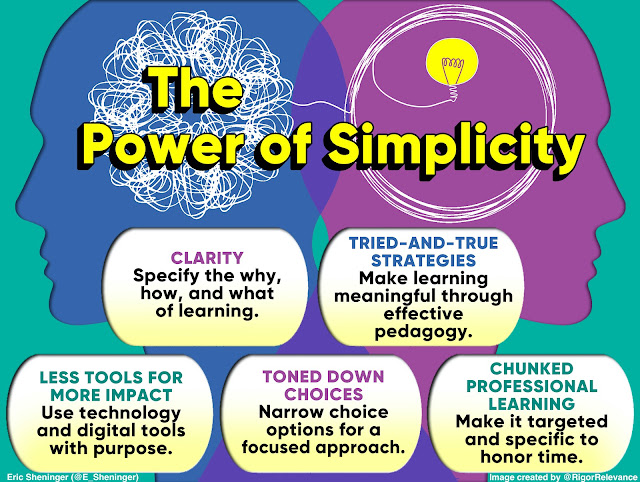
Don’t Use a Lot Where a Little Will Do

The title of this post is a well-known proverb that carries a great deal of weight during times of adversity, struggle, or uncertainty.  I don’t know of a single person who really wants to take on more work, especially during a pandemic.  Pie in the sky strategies, fluffy concepts that are dead on arrival because they ignore critical context or lengthy books with little tangible examples do little to alleviate stress.  There is no better time than the present to pause, reflect, and focus on simplicity as a means to improve practice.

In Disruptive Thinking in Our Classrooms, I honed in on research-based strategies that have withstood the test of time in addition to emerging strategies such as personalized learning.  While I was afforded the opportunity to go into depth in the book, the fact of the matter is less can be genuinely more.  


Clarity

It is critical that students understand not only what they are expected to learn but also why they are learning the concept(s) and how it will be used outside of school.  A straightforward way to set this stage is to unpack the standard(s) into a learning target.  I shared the following in Disruptive Thinking:

These frame the lesson from the students’ point of view and are presented as “I can” or “I will” statements.  They help kids grasp the lesson’s purpose—why it is crucial to learn this concept, on this day, and in this way.  Targets help to create an environment in which students exhibit more ownership over their learning.  Critical questions framed from the lens of the learner include:

  1. Why is this idea, concept, or subject vital for me to learn and understand?
  2. How will I show that I have learned, and how well will I have to do it?
  3. What will I be able to do when I’ve finished this lesson? 

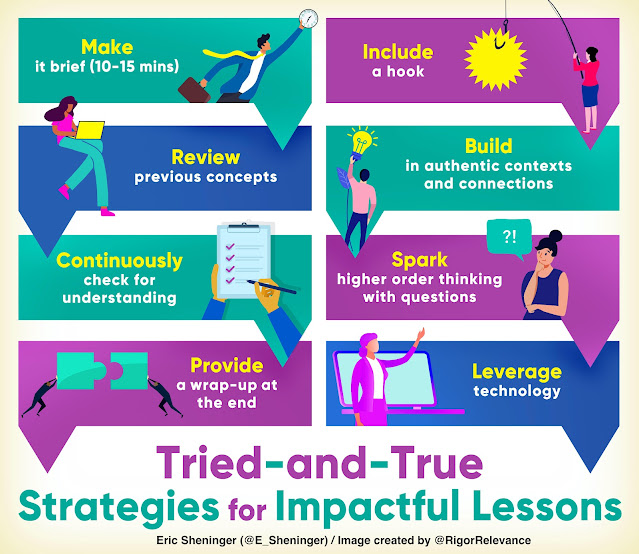
Tried and True Strategies

While a learning target is a significant step to ensure clarity, it is the use of effective pedagogical techniques that lead to meaningful learning.  Reviewing prior learning, checks for understanding, and closure have and always will be valuable components of a lesson.  Be sure to check out this post on the topic that adds context to the image below.  


Fewer Tools for More Impact

It’s not how much technology you use in the classroom that matters, but the degree to which students use it in a purposeful way.  Too much of a good thing tends to have drawbacks, which tend to increase when not aligned with sound pedagogy.  When it comes to technology, less is definitely more.  Consider settling on one or two tools to complement and enhance the instructional strategies you use daily.  For a list of some of the tools I see teachers use the most with a high degree of efficacy by instructional strategy, click HERE. 

Toned Down Choices

I am a huge fan of personalization through blended learning as a way to ensure equitable learning in and out of the classroom.  All of the schools I coach in have found ways to successfully implement these strategies with a high degree of efficacy.  One stumbling block is time.  Educators love choice boards and will spend hours creating them with either six or nine options.  While these can be very effective in empowering learners, the fact is that you don’t need a full-fledged board.  Consider having only two are three options for them to choose from to complete.  You can also consider utilizing must-do/may-do or a playlist with only a few options. 

Chunked Professional Learning

Time is the most precious resource for educators these days.  Lengthy workshops or being pulled out of schools for even a day isn’t always practical or beneficial.  Just like with direct instruction, chunking professional learning allows for needed support that is more targeted and specific.  Single concepts or strategies can be presented, as well as modeled, in twenty-minute blocks.   Creating an asynchronous course in a learning management system (i.e., Canvas, Schoology) or Google Classroom is another excellent way to chunk learning into manageable pieces. 

In the words of Leonardo da Vinci.  “Simplicity is the ultimate sophistication.” It also helps ensure that an idea, strategy, or implementation helps achieve its intended goal. 

Sunday, November 8, 2020

The Professional Learning Sweet Spot

For the better part of my educational career, I always referred to any type of learning to assist me as a teacher or administrator as professional development (PD).  It was always referred to like this, so who was I to argue.  For the most part, this consisted of attending mandatory district “PD” days, professional learning communities (PLC)’s or approved off-site experiences such as conferences, workshops, or webinars.  The experiences where I had some level of choice were the most meaningful to me and resulted in real changes to my educational practice. I think the same can be said when it comes to the learners we serve.

In March of 2009, I began to use Twitter, and it was at this time that I began to create a Personal Learning Network (PLN). Through the use of social media, I realized that I didn’t really need to be “developed.” What I craved were experiences that I valued and could pursue that would help my school and district achieve collective goals. Thus, my thinking changed. Up until this point, professional development was always done to me as opposed to something that I wanted to be an active part of. Intrinsic motivation should always be the focal point of any experience geared at improving professional practice. If we find and see value, the emphasis becomes embracement as opposed to buy-in.

With a PLN, I was able to learn anytime, anywhere, from anyone I wanted for free. I now had access to a human-generated search engine where I gleaned the best resources, ideas, supports, and advice. Questions became a more prized commodity than answers. No longer did I have to continually fret about reinventing the wheel or coming up with the next most fantastic innovative idea.  I was both enlightened and empowered. It was at this time that I began to shift away from PD and instead embrace a culture of professional learning. There is a big difference in my mind.

Learning should be a personal experience, deeply rooted in purpose, meaning, authenticity, practicality, and relevance.  If the goal is to provide this for our students, then the same must be emphasized for teachers, administrators, and support staff. Personalization emphasizes high-agency approaches such as voice, choice, path, pace, and place, perfect for both kids and adults. Even though the individual level is the most important in my mind, we cannot discount our organization, district, or school needs. 

In order for a mission, vision, and goals to become a reality, it takes a collective effort to learn and grow together. The professional learning sweet spot evolves through a balancing act, as depicted by the image below.


In Digital Leadership I emphasized how input from educators is crucial to the success of any professional learning experience, as is time. When you think about the image above, take a critical lens to what you currently engage in and what is provided to you by your organization, school, or district.  On-going and job-embedded experiences lead to sustained changes to practice and improve student outcomes when it comes to results. A dynamic mash-up of workshops and coaching definitely falls into the sweet spot. It is crucial always to align any professional learning with current trends and needs. The COVID19 pandemic has brought a few of these to the forefront, such as social-emotional, remote, personalized, and blended learning. As schools begin to develop plans for student and staff re-entry, pertinent professional learning supports will need to be emphasized.

Below are some pathways to consider that are more personal and focus on the unique needs of educators:

  • Personal Learning Network
  • Asynchronous, self-directed opportunities (i.e., Professional Growth Period, flipped sessions, webinars, open courseware, digital badges/micro-credentials)
  • Edcamps and Teachmeets
  • Professional Learning Communities where educators determine the focus
  • Blended approaches
  • Peer observation
  • School and site visits

Effective and meaningful professional learning is all about striving for the sweet spot. At times there will have to be concessions in terms of time, choice, and available funding. 

That’s just how it goes. The key takeaway that I hope you leave with is developing professional learning opportunities through consensus and ensuring mechanisms in place lead to improved outcomes.  In the event that you are not satisfied with what is provided to you through your organization, district, or school, then there is a myriad of options that you can pursue.

Sunday, October 25, 2020

Give and Take Ideas to Support Teachers

The pandemic has really put a strain on educators, yet they continue to rise to the occasion on behalf of kids. This has come at a cost both mentally, socially, and physically. Something has to give. There has been a great deal of conversation lately about what can be taken off the plates of teachers.  I have to commend those administrators who are working to find ways to put their staff more at ease in these challenging times. While removing specific responsibilities to reduce stress and anxiety is a great start, we must also consider what can be given to them to provide multifaceted support. Giving can be just as, if not more, powerful than taking away, which is typically the more straightforward option. 

Below are some ideas that I have. Some are more doable than others, but all are realistic.


Time

If there is one thing that teachers consistently ask for, it is time to plan, create videos, grade, conference with remote students, update the LMS, etc. I don't want to belabor this point as I recently wrote about the topic. You can view the post HERE. The main takeaway with time though is to develop ways to give it unconditionally to teachers and not schedule or mandate anything else in its place, such as meetings or PLC's. 

Eliminating Meetings

Let's be honest for a minute. No one truly likes meetings, and the value of them is open to interpretation. I, for one, did not find value in them when I was a principal and eliminated most while reducing the time of the ones that were kept. Now I am not saying that all meetings don't have value, but while the pandemic rages on minutes and essential information can be emailed to staff or made part of a collaborative Google Doc. 

Coaching and Feedback

There is a difference between wanting to be left alone and a desire to grow. The majority of educators fall into the latter. Even in the midst of challenging times, growth is necessary to meet the needs of diverse learners. Now is not the time to revert back to traditional observation and evaluation protocols because, quite frankly, they will not result in improved outcomes.  Taking this away and replacing with non-evaluative strategies consisting of coaching and feedback will go a long way towards creating an empathetic environment.  

Prioritize standards

It is unrealistic to try to cover the entire curriculum as educators are implementing hybrid models for the first time, and increasing COVID cases is forcing some schools back to remote learning. An emphasis on priority standards can significantly reduce teachers' burden while streamlining other pedagogy aspects, such as assessment. Other elements to consider are aligning formative tasks and checks for understanding to those prioritized standards so teachers can monitor the learning of students. In the end, more manageable conditions are created for teachers. 

Grading grace periods

There is inequity when it comes to grading, as some subject areas require a great deal more time because of the nature of the content. Additionally, many teachers are still getting used to tasks and assessments in a hybrid environment. Even though deadlines are needed showing a little grace will always be appreciated.

Cover classes

Some districts and schools are hiring substitutes. Others are seeing their administrators offer their time and that of other non-teaching staff members. No matter the route taken, this strategy is sure to build up morale. There should be no catch when a class is covered, and it should be up to the teacher as to how he or she will use this opportunity to either grade, prepare lessons, attend professional learning, observe peers, or just put up their feet and relax. 

Eliminate non-instructional duties 

Many contracts have teachers assume a duty either during the school day or after. These can include cafeteria, hall, in-school suspension, extracurricular, or athletics, where there is no compensation. If possible, try to eliminate all of these. If you can't, consider developing a schedule where administrators and other support staff can fill them in lieu of teachers. 

Choice in professional learning

Forcing educators to engage in one-size-fits-all professional development at this time will tend to be hit or miss depending on the person. Mostly miss as there is a definite need for practical strategies in the areas of remote, hybrid, and blended learning facilitated in practical ways. Growth and improvement are of vital importance, but it needs to be something that educators want to engage in at a time when there are so many challenges. Consider providing different choices such as face-to-face, virtual, blended, or asynchronous options. It is also wise to gather input from staff to determine what they feel is needed. 

Communicate norms to families

One of the most common frustrations I hear from teachers when I am coaching is that they can't keep up with all parent emails that come in after school hours, mostly from remote learners and parents. I have gone as far as to recommend that teachers state they're out of office on their email each evening from 5:00 PM until 7:00 AM. Establishment of, and then clear communication of, norms can go a long way towards taking away some emails and messages, especially late at night and early in the morning. In Digital Leadership, I lay out the importance of using a multifaceted approach to meet stakeholders where they are while reinforcing the vital message at hand. Develop the norms with teachers and then "pound the pavement" with digital communications. 

Mental health days

With a substitute shortage, this could be a bit dicey, but the overall impact far outweighs the short-lived frustration of covering classes in a pinch. Based on the size of a district or school, a determination can be made as to how many of these days can be realistically given to each teacher. 


Empathetic leadership is critical to helping staff get through challenging times. Using a give and take strategy and lessening the burden will create a culture of empowerment.  As people have different needs, it is crucial to consider various options as there is no one right way to help people at any point in time. Work to take things off educators' plates, but also consider what you can personally give. In the end, powerful relationships will be formed, and that benefits everyone.


Sunday, October 18, 2020

Important Lessons Learned During the Pandemic and How They Can Drive Needed Change

There is no shortage of challenges that have been leveled on schools during the COVID-19 pandemic. After some time, we have seen an initial move to all remote learning, depending on where you live, a shift to some sort of hybrid model.  A spike in cases has led to buildings being closed again and a resumption of remote learning in some locations.  Uncertainty and a lack of continuity have had a heavy toll on teachers, administrators, students, and parents. 

As educators continue to grapple with these challenges, lessons have materialized that can pave the way for needed change. Even though it is difficult at the moment to provide the time and energy to focus on these, it is essential to begin to lay the foundation. One day the pandemic will be over. Education can ill afford to revert back to the way things were done in many districts and schools. If the pandemic has taught us one major lesson, it’s that the system has not worked for many learners. The time is now to seize on the opportunity to do something about it while it is fresh on everyone’s minds.  

Below are some topics where vital lessons have been learned. Even though some have been prevalent prior to the pandemic, there should be a renewed sense of urgency to right the ship sooner rather than later.


Equity

The lesson here is that many learners have suffered from inequity because of socioeconomic status, inefficient resources, or insufficient pedagogy. If all kids are doing the same thing, at the same time, the same way, and in the same place, a red flag should be raised. Equity is about providing learners what they need when and where they need it. A move to real personalized learning at scale is the most logical step. At the same time, the digital divide has to be tackled where all learners have equitable access to a device, reliable WIFI, and quality resources.  

Infrastructure

Health and safety are of utmost concern right now. When the dust settles, long term planning should commence to install or upgrade air filtration systems and make hand sanitizer stations permanent. New classroom furniture that is flexible should be considered that can be arranged in ways to support collaboration and blended pedagogies that were implemented remotely.  As many schools decided to purchase devices for students as a means to ensure equity during remote learning, investments will likely need to be made to boost WIFI throughout buildings.  

Humans Crave Social Interaction

Social distancing and remote learning shined a light on the importance of interaction.  It is the foundation of which relationships are built and sustained.  A lesson learned is how critical it is to develop virtual experiences that incorporate discourse and collaboration.  We must also look for opportunities to increase human interaction in face-to-face settings.

Use of time

One of the biggest challenges for educators during the pandemic was time, especially when it came to implementing a hybrid model.  A lesson learned through this ordeal as we advance is to rethink how time is used in the classroom and innovative ways to give educators more of it during the workday. Both pathways require taking a critical lens to current practice and reflect on potential improvements. It is also vital to think about moving from traditional requirements such as the school calendar, seat time, and Carnegie Units (first rolled out in 1906, by the way) to competency models.  

That’s the way we’ve always done it (TTWWADI) inhibits change

Everyone has been presented with a clean slate. In the midst of an unprecedented period in education, the pursuit of innovative practices that break from the mold of what has always been done should be the imperative. Now, this is not to say that some “traditional” methods won’t still have value. It is up to each school system to determine what should be continued, which particular practices need to be shelved, and areas of focus that will benefit all learners. This includes digital pedagogy that consists of purposeful use, a move to personalized learning through blended strategies, use of data to differentiate, innovative assessment, and performance tasks. The big shift overall is to make a move from low to high agency methodologies. 


Importance of a learning management system (LMS)

Before the pandemic, many districts had an LMS (Canvas, Schoology, Google Classroom), but its uses varied greatly.  Many have realized how vital they were to continuity in learning, whether it was remote or hybrid. The key is to continue to ensure systemic use K-12 to support pedagogically-sound blended learning, self-paced activities, and the continuation of quality learning during extended school closures. It can also set the state to the creation of a viable virtual learning option for students who prefer this model.

More relevant professional learning

If there was ever a time to transform professional learning, it is now. The majority of educators will agree that one and done, as well as drive-by days or events, don’t lead to meaningful changes to practice at scale. One important lesson learned is the shift from this to job-embedded and on-going experiences. Another critical change is how professional learning is structured as well as the areas of focus. On the first point, there is a need to create or replicate the conditions that are reflective of the environments teachers and administrators work in currently. This should then be connected to relevant ideas and strategies that can be implemented in a practical way.  

SEL and our own well being

Social and emotional learning was a hot topic prior to the pandemic. It is even more imperative now as learners are grappling with social isolation, parents losing jobs, family members becoming sick, and a great deal of time spent on technology. We might not know for years, or ever, the full impact all of this has had on learners, which is why a proactive approach is needed that focuses on SEL competencies. Professional learning can fill this void. We can’t forget about the adults and what they are currently dealing with, especially teachers and the time being put in to manage and implement hybrid learning.  Although not directly tied to pedagogy, consistent efforts need to be made in the areas of mindfulness and health for all. 

I am confident that many of you reading this post could add numerous more lessons. Please consider adding them in the comments section below. You will also notice there is not much depth above. I only added a few suggestions in each category where vital lessons have been learned. It is up to you in your role to reflect on each and begin to take the required action in relation to your current situation. 


Sunday, July 12, 2020

Purchasing Devices Does Not Equate to Learning

The COVID19 pandemic unearthed many harsh realities for education across the globe. One of the more glaring issues was the vast digital divide that still exists in many places, especially the United States.  Inadequate WIFI and the availability of computers at home for kids to use for learning caught many educators off guard. Remote learning was a monumental challenge for districts and schools that already had made large-scale investments in devices, but it was even more so where inequity was prevalent.  Many kids were automatically at a severe disadvantage as a result, which will most likely result in extreme learning loss and ever-widening achievement gaps.

It is okay to admit that we were ill-prepared before and during the pandemic.  Now is the time to seize on lessons learned as schools prepare to move into uncharted territory whether the COVID19 rages on or begins to subside. Teaching will and must be different. Leadership must and will be different. Most of all, the learning culture will most certainly be different, and it will be a travesty if it is not. We have begun to see some change as more and more school districts are purchasing devices for all of their students.  Every day I see new articles highlighting the millions of dollars; in some cases, spent to either begin to close or eradicate the digital divide. There are also forward-thinking districts who either purchase WIFI hotspots for kids or park WIFI-enabled busses around the community for family access.  All of these efforts are to be commended.

Here is the rub in all of this. Time and time again, even well before the pandemic hit, schools had a thirst for ensuring that there was a device in the hands of every student. William Horton says it best, "Unless you get instructional design right, technology can only increase the speed and certainty of failure." 


Below are some lessons we learned after hitting the reset button on our Bring Your Own Device (BYOD) initiative in order to get it right that I captured in a 2015 post.
We found great success at my school during our digital transformation by focusing on pedagogy first, technology second if appropriate mindset. Not only was there a focus on solid instruction, but we also provided numerous supports for our teachers in the form of ongoing and job-embedded professional learning opportunities. If the expectation was to integrate technology with purpose to support or enhance learning, we made sure everyone was prepared to do just that. 
For technology to live up to the hype, pedagogy must change, whether learning is face-to-face, remote, or based on a hybrid model to ensure student and staff safety. Drive-by professional development did not work in the past. What has and will continue to make a difference are supports that incorporate the following:
  • Ongoing
  • Job-embedded
  • Supported with coaching (face-to-face or virtual)
  • Personalized and differentiated
  • Facilitated by people who have done the work and implemented successful change that resulted in improved student learning outcomes and achievement
  • Directly correlated to professional practice
  • Aligned with research and case studies
  • Addresses real challenges educators face
  • Sustainable over time
Before COVID19, I always cautioned districts and schools to be wary of putting the cart before the horse. I am not sure that I would offer the same advice as we now know there is a great deal of work to be done to ensure digital equity for all kids. However, I am still steadfast in my opinion that just purchasing devices does not equate to learning, nor will it in the future if proper supports are not in place. Teachers need training and job-embedded coaching. Principals need support so that they know what to look for and can give their staff actionable feedback. Superintendents and central office administrators need to be able to determine the efficacy of the investment.  


Just putting a device in kids' hands and expecting learning miracles to materialize is wishful thinking at best. Ongoing support is needed to usher in pedagogical change while building capacity. Teachers and administrators deserve this investment if large sums of money are being spent on devices.  Without this support, the overall goal of the purchase might never be realized.