Showing posts with label feedback. Show all posts

Sunday, June 22, 2025

How to Give Feedback That Actually Works

Feedback is the engine of growth - offering clarity, challenge, and direction. Recently, on Unpacking the Backpack, I shared some thoughts on the topic after revisiting blog posts I wrote in 2018 and 2019.  Listen on Spotify or wherever you access your favorite podcasts. Below are some expanded thoughts on the topic, including additional research.

We’ve all been there: the feedback sandwich that feels more like a criticism wrapped in two stale pieces of praise, or the vague "good job" that leaves you wondering what you actually did well. Facilitating feedback that is heard and acted upon is a critical competency in any professional setting. Fortunately, a wealth of research has illuminated the key ingredients for turning feedback from a dreaded formality into a powerful tool for growth and development.

Effective feedback is about closing the gap between a person's current performance and a desired goal. It’s a process of providing information that helps individuals understand where they are, where they need to be, and how they can get there.

Be Specific and Behavioral

One of the most consistent feedback research findings is the importance of specificity. Vague comments are difficult to act on. Instead of saying, as a teacher, “Your essay needs to be more organized,” try saying, “I noticed that your main points are all in a single paragraph. Try dedicating a separate paragraph to each key idea and use transition sentences to guide the reader from one point to the next.” Now let’s look at an administrator example.  Instead of saying something vague like, "You need to improve student engagement," a principal could provide specific, actionable feedback by saying: "During my observation of your history lesson, I noticed that you shared fantastic information, but some students in the back seemed to lose focus during the lecture portion. To help keep everyone actively involved, you could try incorporating a 'turn-and-talk' after introducing a key event. This would give students a moment to process the information and discuss it with a peer before you continue." This focuses on a specific, observable behavior and provides a clear path for improvement. As research by Goodman and Wood (2004) suggests, highly specific feedback can significantly enhance immediate performance.

Focus on the Task, Not the Person

Feedback is most effective when it hones in on the task or the process, rather than making judgments about the individual's personality. When feedback is perceived as a personal attack, defensiveness is a natural reaction, and the intended message is often lost. A seminal meta-analysis by Kluger and DeNisi (1996) found that feedback directed at the self can even have a negative impact on performance. The key is to address the "what" and "how" of the work, not the "who."

Make It a Two-Way Conversation

Effective feedback isn't a monologue; it's a dialogue. Create an environment where the recipient feels comfortable asking questions, sharing their perspectives, and disagreeing. This approach develops a sense of ownership and collaboration. Research on "feedback literacy" by Carless and Boud (2018) emphasizes the importance of the recipient's ability to not only receive but also process and use feedback, a skill that is best developed through interactive and supportive conversations.

Timeliness is Key

The impact of feedback diminishes with time. For it to be most effective, it should be delivered as close to the event as possible. This allows the recipient to recall the situation clearly and apply the feedback promptly. While immediate feedback is often ideal, the most crucial element is that it is regular and ongoing, rather than a once-a-year event.

Balance is Important, But Honesty is Crucial

While the "feedback sandwich" (praise, criticism, praise) is a popular technique, it can sometimes dilute the core message. It's more important to be honest and clear. That doesn't mean being harsh. According to Shute (2008), effective formative feedback is supportive and non-evaluative. When delivering constructive criticism, ensure it is framed in a forward-looking and developmental way.

In their influential work, Hattie and Timperley (2007) conceptualize effective feedback as answering three key questions for the learner: Where am I going? How am I going? and Where to next? By keeping these principles in mind, you can transform your feedback from a source of anxiety into a catalyst for genuine improvement and professional growth.

Carless, D., & Boud, D. (2018). The development of student feedback literacy: Enabling uptake of feedback. Assessment & Evaluation in Higher Education, 43(8), 1315–1325.

Goodman, J. S., & Wood, R. E. (2004). Feedback specificity, exploration, and learning. Journal of Applied Psychology, 89(2), 248–262.

Hattie, J., & Timperley, H. (2007). The power of feedback. Review of Educational Research, 77(1), 81–112.

Kluger, A. N., & DeNisi, A. (1996). The effects of feedback interventions on performance: A historical review, a meta-analysis, and a preliminary feedback intervention theory. Psychological Bulletin, 119(2), 254–284.

Shute, V. J. (2008). Focus on formative feedback. Review of Educational Research, 78(1), 153–189.


Sunday, October 22, 2023

Using Feedback to Drive Professional Learning

During this school year, I have been working with Stryker Local Schools in Ohio. Like all my implementations where the work is job-embedded and ongoing, learning walks are a core component. In September, the leaders and I conducted walks in every classroom over two days. As a result, I provided them with close to 5000 words of feedback. With the suggestions in hand, the leaders were empowered to review what we had seen and my recommendations to determine the focus for an upcoming professional development day I would be facilitating. I was excited for the opportunity to provide feedback to staff through a pedagogical design process. The three-hour sessions were tailored by grade level and developed based on suggestions for growth based on the learning walks that were conducted. 

Feedback is a critical catalyst for professional learning and growth. It serves as a valuable tool for educators, schools, and districts to refine their skills and improve teaching, learning, and leadership. Whether it comes from administrators, peers, consultants, or self-assessment, feedback offers insights that help educators identify areas for improvement and build upon their strengths. In schools, feedback should not be merely a one-time event; it is an ongoing process that fosters continuous learning and development. I have found this to be a critical success indicator in all the projects I am involved with, both past and present.  

One key aspect of utilizing feedback for professional learning is creating a culture that encourages open and honest communication. When individuals feel safe and supported in sharing their observations and receiving feedback, the environment becomes conducive to growth. In the sessions I facilitated with Stryker educators, there were activities every ten minutes at five to twenty-minute intervals focused on specific areas of potential growth. This psychological safety fosters a culture of mutual respect and trust, allowing professionals to focus on their own development rather than worrying about judgment or criticism.

Moreover, feedback provides specific and actionable information for educators to set goals and make targeted improvements. Vague or generalized praise or criticism can be less effective, as it needs more specificity for meaningful change. Constructive feedback should be specific, identifying what went well or wrong and how it can be improved. This level of detail allows individuals to take concrete steps toward enhancing their practice.

Self-assessment is another valuable tool for professional learning, as it encourages individuals to take responsibility for their own development. Hence, I provided numerous opportunities to reflect before and after giving specific suggestions. By self-reflecting, educators can gain a more well-rounded understanding of their strengths and opportunities for growth. Self-assessment helps individuals identify areas where they need improvement and enables them to set personal goals for growth. It is a proactive approach to learning that empowers them to control their development.

The feedback loop is not limited to just the individual; schools and districts also benefit from using feedback to drive professional learning. When organizations gather and analyze feedback curated during learning walks, they can make informed decisions about training, development programs, and process improvements. This data-driven approach ensures that professional learning initiatives align with the needs and aspirations of their workforce, promoting a culture of continuous learning and growth. Currently and over the years, I have been blessed to partner with district and school administrators committed to this process.

Feedback is a powerful tool for driving professional learning. It promotes a culture of openness and trust, provides specific and actionable insights, encourages self-assessment, and empowers both individuals and organizations to enhance their performance. By recognizing feedback as an ongoing process and a means to facilitate growth, educators can harness its potential to improve and evolve in their craft continuously. 

Reach out if you want to learn more about what this process could look like for your school or district through Aspire Change EDU's comprehensive suite of services. 


Monday, February 13, 2023

#EDvice: Timeliness of Feedback is Vital

Assisting others to be their best is something that we all can do through feedback. Sometimes it is as simple as making an effort to point out commendations that serve as validation and pieces of advice to improve performance. However, sometimes our delivery and words mean otherwise. It is vital to make the distinction between feedback and criticism. Feedback is information about reactions to a product or a person's performance of a task, which serves as a basis for improvement. Criticism, on the other hand, is the expression of disapproval of someone or something based on perceived faults or mistakes. With growth being the end goal, feedback must be facilitated in a way that moves others to reflect on their work and take the necessary steps to get better.  

"The importance of feedback to grow and improve is undeniable. EVERYONE benefits when it becomes a consistent component of culture. However, we must make sure feedback is TIMELY for it to have value to those we are trying to help."


If the main goal is to use feedback as a catalyst for improvement, then why delay it? This is one of the reasons why I don’t really like final exams. Students rarely receive good feedback that informs their learning as they are typically given these exams at the end of the school year and are then graded up until the last minute. Delaying feedback allows minor problems to fester into larger ones potentially. The bottom line is that the more time that goes by the feedback that could have really made an impact will not be valued as much, if at all.


Feedback stings when it is not: 

  1. Delivered with sincerity
  2. Grounded in practicality
  3. Given in a timely manner

As I shared in Disruptive Thinking, timeliness is critical, but keep in mind that it must be practical, specific, consistent, and facilitated positively. It is also crucial to determine the right strategy or medium for facilitation. 

Sunday, February 5, 2023

How to Lead with Little to No "Experience"

I vividly remember how frustrating it was to interview for various school administrator positions only to be told that I didn’t have enough practical experience related to the position(s). Well duh, of course I didn’t, as I was an aspiring leader who was just venturing into this space. I am sure virtually everyone reading this post has been in the same situation at some point, whether in the past or currently. Frustrating is putting it mildly. It should be noted that experience can certainly be beneficial when it comes to leadership, as it can provide a leader with valuable knowledge, skills, and perspective. However, it is not the only factor that determines a person's ability to lead effectively. Some people may have a natural talent for leadership and are able to inspire and guide others, even if they don't have a lot of experience.

That being said, there are certain situations where experience can be essential for a leader. For example, if a leader is facing a complex or unfamiliar challenge, their past experiences may give them a better understanding of how to approach and solve the problem. Most would agree that the COVID-19 pandemic fits the bill here. Experience can also help a leader to build credibility and gain the respect of their team. Overall, experience can be a valuable asset for a leader, but it is not the only factor that determines a person's ability to lead.

Leadership is not necessarily about having a lot of experience but rather having the ability to inspire, motivate, and guide others toward a common goal. Eventually, I began revising my resume and linking to instances where I actively cultivated leadership characteristics or built capacity through coaching sports, writing curriculum, and advising clubs. Think about what you have done that can translate into a school administrator role.

Once you get your first position, the key is to hit the ground running. Here are a few other tips that may help you to lead effectively, even if you don't have a lot of experience:

  • Set clear goals: Clearly define what you and your staff are working towards. This will help to keep everyone focused and motivated.
  • Communicate openly: Make sure to keep the lines of communication open with all stakeholders. Encourage open and honest dialogue while being approachable.
  • Be adaptable: Be open to new ideas and approaches and show a willingness to pivot when necessary.
  • Empower your people: Trust your staff and give them the autonomy to make decisions and take ownership of their work.
  • Lead by example: Show everyone what it means to be a good leader by being a good follower. Set a positive example through your own actions and work ethic.

As I shared in Digital Leadership, it's not about having all the answers but creating a vision and guiding others toward its realization.


So, what if you have never been an administrator? If you are lacking in leadership experience, there are several steps you can take to compensate for this and become a more effective leader:

  • Seek opportunities to develop your leadership competencies: This can include taking on capacity-building roles within your school or district, enrolling in educational leadership programs, creating a Personal Learning Network (PLN), or participating in pertinent workshops or conferences.
  • Learn from more experienced leaders: Seek out mentors or coaches who can provide guidance and support as you develop.
  • Practice self-reflection: Take time to reflect on your strengths and areas for growth. This can help you to identify areas where you need to focus your professional learning efforts.
  • Stay current on trends and best practices in the education field. Make an effort to stay up-to-date on the latest developments and incorporate this knowledge into your leadership style.
  • Be open to feedback: Seek out feedback from others and be open to learning from their experiences and insights.

Remember, leadership is a never-ending journey and everyone starts at a different point. By being proactive in your development and continually learning and improving, you can effectively compensate for a lack of experience and become a strong and effective leader. 

Sunday, October 23, 2022

Better Feedback for Deeper Learning

In order to learn and grow, some type of feedback is needed along the way. While an experience can be a foundation for learning, it is the feedback that often serves as a catalyst for reflection. At this point, learners gain valuable insight into the strategies being used so that adjustments can be made to make better progress. There is also a robust research base to validate its importance. Goodwin & Miller (2012) provided this summary:

In Marzano, Pickering, and Pollock's 2001 meta-analysis, McREL researchers found an effect size for feedback of 0.76, which translates roughly into a 28-percentile point difference in average achievement (Beesley & Apthorp, 2010; Dean, Pitler, Hubbell, & Stone, 2012). John Hattie (2009) found a similar effect size of 0.73 for feedback in his synthesis of 800 meta-analyses of education research studies. It was found that feedback ranked among the highest of hundreds of education practices he studied.

All feedback isn’t created equal. For it to have an impact, it must be timely, practical, specific, facilitated in a positive manner, and consistent. Hattie and Timperley (2017) shared the following.

Hattie and Timperley (2007) say that effective feedback must answer three major questions: Where am I going? (What are the goals?) How am I going? (What progress is being made toward the goal?) Where to next? (What activities need to be undertaken to make better progress?)


Besides the elements listed above, the medium used matters, especially in the classroom, since time is at a premium for teachers. While the desire is there to engage learners in a feedback dialogue, the reality is that it can be a challenge with large class sizes in addition to other demands. Hence, the reason I shared the feedback log concept in Disruptive Thinking in Our Classrooms.  

Think about all the conversations that educators have with learners on a daily basis. The valuable information, in many cases, aligns with what the research has said constitutes good feedback. The problem, though, is the reasonable possibility that learners forget what they have been told regarding progress or improvement and don’t have the ability to later reflect on the feedback given. Having students create a feedback log solves this issue by helping them remember, retain, reflect upon, and chart their progress of improvement. Best of all, it requires no extra time on the part of the teacher.

While I presented the concept in my book, it wasn’t until recently that I saw an exemplary feedback log during a coaching cycle with Quest Academy Junior High School in Utah. I am still in awe of the vision and culture that principal Nicki Slaugh has worked with her staff to create. So many sound strategies were seen consistently, such as exit tickets, learning targets, self-pacing, and learner autonomy for personalization. When visiting Courtney Hutchins’ ELA class, I saw students following their own path in a self-paced format. As they worked, she used data to call up individuals and engage in a feedback dialogue. During the conversation, students were asked to write down the feedback in a log. You can see an example of this below. 


Try This

  • Develop your own feedback log template or adapt the example pictured above. The most important aspect is to unpack the standard(s) into learning targets and ensure that the feedback that is verbalized helps students advance to these goals.
  • Have students keep this log in a binder or online document and have them reflect on what they have done to incorporate the feedback.
  • Let families know you are using this strategy so they can review and support their kids at home. 

Implementing feedback logs saves precious time, can be seamlessly aligned with research-based strategies, will help students monitor their understanding of concepts, and can be used to provide more targeted support to those who really need it to succeed. Best of all, they can serve as an empowerment tool to help kids exert more ownership over their learning. 

Goodwin, B. & Miller, K. (2012). Research says good feedback is targeted, specific, timely. Educational Leadership, 70(1), 82–83

Hattie & Timperley (2007) The Power of Feedback. Review of Educational Research (Vol 77, No1).


Sunday, December 12, 2021

Unlocking the Potential of Students

What are you good at and why?  I am sure a list of things comes to mind. Now think about how this list of items plays out in your daily life. We all have strengths, and a common reaction is to leverage these as much as possible.  I see this a great deal in my work coaching leaders. While there are many approaches that have varying value depending on the situation, there is a natural tendency to stick with what one believes they are particularly strong. There is nothing inherently wrong with this per se, but by doing so, we run the risk of capping our potential when it comes to achieving goals and growing. Feedback and accountability for growth through a coaching cycle help to unlock strengths that we might never know existed. 

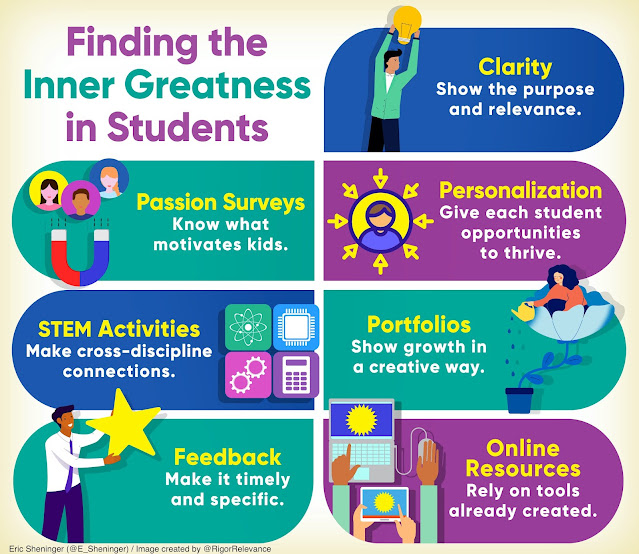
Learners in our classrooms are no different.  They all enter school at various grade levels with a perception of what they are strong at, which can cloud their ability to grow.  The same can be said with perceived weaknesses that act as a limit on their capacity to learn.  All kids have greatness hidden inside them. It is the job of an educator to help them find and unleash it so that they can find success in the classroom and beyond.  There is no one best way to unlock potential. Below are some ideas to try in your classroom, school, or district.


Clarity

Students want and deserve to know why they are learning something, how they will use what has been learned outside of school, and what tells them if they have successfully achieved the specified goal for the lesson, project, or assessment.  If they are unclear about the purpose of the task or how time is being used, it becomes more challenging to empower them. 

Passion surveys

Finding out what really motivates and inspires kids can be one of the best uses of time an educator or school engages in if the act sparks changes to practice.  These passions can be integrated into daily lessons through anticipatory sets and projects or dedicated genius hours at the school level.  They can also be leveraged to make changes to curriculum and course offerings.

Personalization

I have written a great deal on this topic and even included an entire chapter in Disruptive Thinking in Our Classrooms.  These approaches focus on competencies such as time management and self-regulation to develop greater independence. Strategies such as station rotation, choice boards, playlists, and flipped lessons allow students who are already competent in the standard to move ahead and engage in more challenging and relevant activities. They also enable the teacher to work with those students who need more support, which sets the stage for their potential to be unlocked. 

STEAM activities

Kids crave purposeful work grounded in interdisciplinary connections. When content is taught in isolation, a common outcome is students' lack of engagement, becoming either compliant or complacent. This inhibits potential.  When developing lessons, activities, and courses, think about how they will connect science, technology, arts, and math.

Portfolios 

Traditional assessments never tell the whole story and can mask what students actually know or can do. It is also common knowledge that not all kids respond to conventional summative assessments.  Portfolios are a great way to measure the growth of time while also allowing creative freedom by demonstrating what has been learned.  

Feedback

When it comes to unlocking the potential of all kids, feedback is a true gem when it is timely, practical, specific, and addresses progress towards a learning goal.  It can also be used to challenge kids to unleash their creativity or push them outside of their comfort zone.  How students analyze, discuss and act on feedback is as essential as the quality of the feedback itself. 

Pertinent resources

While the strategies above take some planning to integrate effectively, educators can also harness an array of resources to assist with unlocking the potential of learners. Check out this Pinterest board for an array of ideas and strategies. The sky is literally the limit while also saving precious time. 

In the words of Joyce Meyer, "Potential is a priceless treasure, like gold. All of us have gold hidden within, but we have to dig to get it out." It's time to lend kids the tools to unearth theirs. 

Sponsored post

Sunday, October 10, 2021

Seeking Out Feedback

Growth is a never-ending journey. While there is no one best way to get better at what we do, I think we can all agree that feedback is a necessity no matter the path taken. For it to impact practice, it should be practical, specific, timely, and facilitated in a positive fashion.  While we know how important feedback is to our growth, the question becomes how often do we receive it in some form?  I shared the following in a past post:

Feedback can be a catalyst for motivation, engagement, and finding answers to questions or problems. First and foremost, we must be open to it in some form. One way to move the needle is to seek it out from a variety of perspectives. 

If you are not receiving enough feedback to either spark or sustain your growth, how are you seek it out?  I can definitely improve in this area, and I really didn’t think about it much until an experience with Jackson County Schools in Georgia.  One of the site visits took us to East Jackson Comprehensive High School, where I observed one of the best math lessons ever.  In a nutshell, the teacher created a courtroom experience where students dove into the concepts in a relevant way. Various roles were assigned, such as jury members, prosecution, and defense, where the class used evidence to determine whether or not math problems were solved correctly. The teacher was thoroughly immersed in the lesson himself as the judge with a wig and all.  As part of my notes, I wrote that this was an experience students would remember for a very long time.

Even though the lesson was amazing, it was not the best part.  Near the end, the teacher took off his wig and, as a form of closure, asked the students for feedback to improve the activity in the future.  The responses were fantastic and included more challenging problems, finding ways to get the jury more involved during deliberation, and finding ways for all students to report out.  I couldn’t applaud enough the teacher’s willingness to be vulnerable coupled with a sincere desire to improve. To top it all off, this was also a great example of using student voice to personalize the learning experience without technology.

There are so many valuable lessons that each of us can take away from the teacher above related to effective teaching and learning, but also practical ways to seek out feedback and act on it routinely. Here are six ideas to consider:


  1. Seize every opportunity: Don’t wait for someone else to provide you with feedback. If you do, there is a chance you might be waiting for a while. 
  2. Listen intently: After asking for feedback, take in all that is provided to you. Make sure your body language clearly shows that you are paying attention and genuinely care about what is said. It goes without saying that being “present” is vital.
  3. Clarify points: After listening, verbalize what has been suggested to you while using questions to make sure that the points that have been made are clear. Doing so also shows that you were listening.
  4. Be appreciative: If you want honest feedback on a regular basis, people need to know you care. It is also essential to understand that sometimes providing ways to improve to a peer or superior in position isn’t easy for some to provide. By showing appreciation, it sets the stage for others to make efforts to seek you out to engage in feedback conversations instead of the other way around
  5. Write usable points down: You don’t have to agree with everything that is provided to you. Write everything down, process, and then reflect on what has value.
  6. Take action: The value of feedback lies in how it is used to grow and improve.  If it is given and nothing changes, then don’t be surprised if people stop providing it or, worse yet, turn to criticism.

Seeking out feedback is a simple act that anyone can engage in to grow. Always look to seize the moment. The real work begins once you use it to be the best iteration of yourself for those you serve.


Sunday, June 20, 2021

Outlier Practices Make or Break the Learning Experience

We learn, and remember for that matter, from experience.  Thus, it is critical that the culture in your classroom and school positively impacts learners while adequately preparing them for their future, not our past.  I shared the following in Chapter 7 of Disruptive Thinking in Our Classrooms:

Almost all of us have heard the phrase, “Experience is the best teacher.” Growing up, I heard it a great deal. At the time, I didn’t appre¬ciate it or fully understand its meaning, but now I wholeheartedly con¬cur. Of course, there are some experiences I wish I could have avoided that resulted in negative outcomes, but they are still a significant com¬ponent of my story. The driving force behind the decisions we make is the innate beliefs we have about ourselves. Our experiences, positive and negative, shape who we are. They become an integral part of us and create our story.

Think about why you went into the field of education.  For many of us, the answer lies in the relationships that were forged by amazing teachers, administrators, coaches, custodians, bus drivers, or other support staff.  It was the experience that each provided that helped shape us into who we are today.  For me, there were several standout teachers that impacted me in ways that I am forever grateful for. Here is what I shared in Disrutive Thinking:

These teachers—and a handful of others throughout my own K-12 educational journey—engaged in practices that were memorable and perhaps even outside the norm. They did not focus on grades and homework; instead, they focused on learning and creating experiences designed to enhance students’ learning and push our thinking. In many ways, they were “outlier” educators who engaged in “outlier” practices which resulted in outside-the-box thinking and learning on the part of the students with whom they interacted. Pockets of excellence such as these examples are no longer good enough.

Many practices in education can fall into the outlier category. For the intents of this post, I want to focus on those that are either overused, underused, or ineffective, and that can either make or break a student’s experience.  They are as follows:

  • Grades
  • Zeros
  • Homework
  • Feedback
  • Reflection 


Grades

Numbers and letters are synonymous with education. While I am not opposed to grades, I do feel that they often lack true clarity in terms of what a student has learned but are still an overused element in a traditional classroom.  The key is to make them as meaningful as possible through the use of multiple means of assessment, including rubrics and scaffolded tasks aligned to relevant application.  Assigning arbitrary points for participation and behavior as a part of scoring guides or on research papers should be avoided. These do not reflect what has been learned.  

Zeros

The practice of assigning a zero is ineffective as the only role it serves is to punish kids. Once given, it will completely distort a student’s grade, which will no longer represent what has been learned.  It is essential to determine first and foremost why the task is not being completed in the first place. In almost all cases, the assignment should be marked as incomplete until it is done. In my opinion, a zero should only be considered in the cases of cheating or if all other strategies have been exhausted. 

Homework

Rarely does a child come home excited to complete homework, yet it represents another overused outlier strategy. It tends to diminish excitement and appreciation for learning.  Many times, it is assigned because that’s the way it has always been.  In moderation, homework can be an effective strategy if it allows for the authentic application of key concepts learned in a timely manner.  You also can’t go wrong with reading. It should not be graded as there are equity issues or take hours of time to complete. Kids need to be kids. 

Feedback

While a grade might be the final indicator of what has been learned, it’s the feedback that helps students along the way.  This is an underused strategy where there is always room for growth.  Effective feedback is delivered promptly, involves learners in the process, and articulates how to advance towards a goal in relation to standards or concepts. 

Reflection

John Dewey said, “We don’t learn from experience…we learn from reflecting on experience.” Reflective learning allows kids to step back from their learning experience to help them develop disruptive thinking and improve future performance by analyzing their experience. It assists them in moving from surface to deep learning. Writing, video, peer interaction, and closure questions are a great way to incorporate reflection regularly. 

Outlier practices, depending on how they are implemented, can either promote or inhibit disruptive thinking. As you reflect on the outlier practices above where do you see an opportunity to grow or improve? What action steps will you take? The main takeaway is how they are implemented in ways that support or enhance learning while helping to build powerful relationships in the process. 


Sunday, April 18, 2021

Using Feedback to Create a Culture of Excellence

Growth is a huge component of the change process. In order for each of us to pave a path for success, there must be feedback along the way.  When it comes to navigating the process of change, this might be the most essential element to help individuals improve while also validating efforts made to get better.  Cultures of excellence are created and fostered when feedback is used to commend effort while providing considerations for growth regularly.  In a previous post, I highlighted five considerations to help maximize this powerful tool, which you can see below:

  • Positive facilitation
  • Practical and specific
  • Timely
  • Consistent
  • Use the right medium


In my role as a coach, I am constantly providing educators with feedback based on qualitative and quantitative evidence in alignment with the principles listed above.  On a typical day when I visit classrooms with principals in my partner districts across the country, both the building and district leaders receive a 1000-to-5000-word document laden with practical feedback. They get this before I physically leave for the day.  I have always done this because I know that timely information has been critical to my professional growth.  The best outcome of this process has been the feedback I have received from leaders who have stated how valuable this resource has been for them.

During my recent work with the Kentucky Department of Education (KDE), I had the honor of sharing what I have learned from the field while helping them look at and analyze evidence from their change efforts during our time together.  During each virtual coaching session, they were pushed to bring artifacts from their respective cohort.  Recently I shared what Jill Angelucci, an assistant principal from George Rogers Clark High School, created as a result of the project.  My role was to provide then direct feedback on all the evidence shared while also engaging the group to do the same. One of the key points I tried to make was how important it is to do the same with teachers.  It warmed my heart when Amy Rhodes, the principal of Bevins Elementary, shared what she had recently implemented in regard to feedback. The result was “Feedback Fridays.” 

You can see examples of the slips she created HERE and read the summary below:

While our district was on all virtual learning, I began asking my teachers to submit one thing each week they wanted me to give feedback on from Canvas. Teachers could ask for feedback on a module, lesson, or recorded video from Canvas. They could ask me to join a Zoom for the upcoming week or look at a piece of student work. The options are endless. I gave each teacher feedback on what he/she submitted. If the teacher submitted something to me before 2:30 on Friday, I allowed them to leave work 30 minutes early (while we are on all virtual learning and students were not in the building). 

I recently checked back in with Amy Rhodes after reviewing the feedback slips she had shared during the KDE coaching sessions to gain more insight into her views on why and how she moved forward with this strategy.  Below are her thoughts.

Feedback and coaching have been part of my professional growth goal for the last few years.  Being an instructional leader is my top priority, and I know how vital teacher efficacy is to student achievement. When our school closed in March of 2020, we were not prepared for virtual learning. We did the best we could with the resources we had. Going into the new school year in August of 2020, we needed a learning management system and ways to improve virtual learning. Being all virtual, I was unable to observe instruction in the classrooms, and I had to teach myself how to conduct virtual observations through Canvas and by participating in Zooms. 

I noticed that my teachers worked very hard at making their virtual classrooms presentable and designing their Canvas courses so they were easy to navigate. I did not see the sound instruction that I would see in the classrooms if we were not virtual. Some of the things I look for while doing classroom visits, using our district walkthrough document, are learning targets, higher-level questioning and discussion, active engagement, student feedback, technology, and formative assessment. I knew my teachers were already overwhelmed with all the changes, but I also know how vital it is for our students to receive sound instruction rather than be virtual or in person. 

We meet in PLCs every Wednesday and were able to use this time to discuss and have teachers share out their Canvas pages and virtual lessons. When I would see something from the week that I liked, I asked that teacher to share out at PLC. For example, while conducting a virtual observation in Canvas, I noticed a third-grade teacher found a fantastic way to engage students even through virtual learning. I asked her to share her screen I PLC and show her colleagues what she did. This was an excellent way for teachers to learn ideas from others. 

As I already said, my teachers were so overwhelmed, so I chunked the things I look for from our walkthrough document.t I started with learning targets, and I provided coaching and feedback until every teacher had learning targets on their virtual lessons each day. Next, we moved on to formative assessment and then on to questioning and discussion. We chunked the areas and worked on them in small groups. With the coaching and feedback I provided, along with the PLC discussions, it did not take too long until I was observing high-quality teaching and learning virtually!

If there isn’t a concerted effort to improve progress, it is often hard to come by in many cases. Most educators need and want feedback to grow. There is no one right way to do this, in my opinion.  However, once feedback is prioritized and consistently provided, the stage is set for a culture of excellence.

Sunday, December 6, 2020

Feedback is Needed More Than Ever

I think we can all agree that this school year has been unlike any other and not for the best of reasons. The pandemic has upended the entire education system as schools have moved to remote, then hybrid, and back to remote in some cases with no end in sight. Even with the promising news of two potential vaccines, rising COVID-19 cases have resulted in a constant state of flux.  Continuity and consistency have been hard to come by and finding a groove have become an arduous task in many cases. Educators, students, and families have never been in a situation as challenging as what they are experiencing right now. 

The rapid state of uncertainty has caused a great deal of angst, and rightfully so. As a result, there have been increased levels of stress, anxiety, and fear amongst teachers, which has led to decreased motivation in some cases. It’s not that they don’t want to do a good job but more a battle to get through each day. The struggle is real. For students, a lack of engagement on their end has led to significant concerns across the globe. If they aren’t engaged, then the chances that meaningful learning is taking place are slim. Finally, administrators are searching frantically for answers while putting out fires and conducting contact tracing daily. 

With all these challenges, growth becomes an afterthought. However, it is a necessity in order to provide the best learning experience possible for kids, even in times of crisis.  Through adversity, some of the best ideas are developed and implemented with fidelity. The key to setting the stage for this to occur is a concerted effort to make feedback a daily phenomenon. While assessments, observations, and evaluations might have worked well in the past, a more sensitive approach is not only warranted but also a necessity right now. 

Feedback can be a catalyst for motivation, engagement, and finding answers to questions or problems. First and foremost, we must be open to it in some form. One way to move the need is to seek it out from a variety of perspectives. Teachers can engage both students and families in conversations to elicit essential ideas on how to improve remote and hybrid learning experiences. Administrators can do the same with stakeholders and staff in order to gather intel on how to improve school culture immediately. In the classroom, providing regular feedback to learners might be the most critical key to engaging them.  

Everyone benefits if we are diligent and sensitive as to how it is implemented as a means both to inform and empower. Below are some aspects to consider regarding quality feedback:

  1. Facilitate with sincerity
  2. Ground in practicality and specificity
  3. Give in a timely manner
  4. Dialogue over monologue 
  5. Focus on positive delivery
  6. Use the right medium(s)
  7. Be consistent
  8. Align to advancement towards a goal(s)

Most people want to know how they are doing and what can be done to improve, even it is a small shift in practice or learning. Keep in mind the importance of Maslow’s Hierarchy of Needs. Feedback can be as simple as reassuring others that they are doing a great job in these trying times or using it as a way to find out what might be inhibiting motivation or engagement. The bottom line is that it is a great tool that can be used in a variety of ways. When it is all said and done, its best use might be that of relationship builder. After all, relationships are the foundation of learning and growth, no matter if we are in a pandemic or not.  

Sunday, October 25, 2020

Give and Take Ideas to Support Teachers

The pandemic has really put a strain on educators, yet they continue to rise to the occasion on behalf of kids. This has come at a cost both mentally, socially, and physically. Something has to give. There has been a great deal of conversation lately about what can be taken off the plates of teachers.  I have to commend those administrators who are working to find ways to put their staff more at ease in these challenging times. While removing specific responsibilities to reduce stress and anxiety is a great start, we must also consider what can be given to them to provide multifaceted support. Giving can be just as, if not more, powerful than taking away, which is typically the more straightforward option. 

Below are some ideas that I have. Some are more doable than others, but all are realistic.


Time

If there is one thing that teachers consistently ask for, it is time to plan, create videos, grade, conference with remote students, update the LMS, etc. I don't want to belabor this point as I recently wrote about the topic. You can view the post HERE. The main takeaway with time though is to develop ways to give it unconditionally to teachers and not schedule or mandate anything else in its place, such as meetings or PLC's. 

Eliminating Meetings

Let's be honest for a minute. No one truly likes meetings, and the value of them is open to interpretation. I, for one, did not find value in them when I was a principal and eliminated most while reducing the time of the ones that were kept. Now I am not saying that all meetings don't have value, but while the pandemic rages on minutes and essential information can be emailed to staff or made part of a collaborative Google Doc. 

Coaching and Feedback

There is a difference between wanting to be left alone and a desire to grow. The majority of educators fall into the latter. Even in the midst of challenging times, growth is necessary to meet the needs of diverse learners. Now is not the time to revert back to traditional observation and evaluation protocols because, quite frankly, they will not result in improved outcomes.  Taking this away and replacing with non-evaluative strategies consisting of coaching and feedback will go a long way towards creating an empathetic environment.  

Prioritize standards

It is unrealistic to try to cover the entire curriculum as educators are implementing hybrid models for the first time, and increasing COVID cases is forcing some schools back to remote learning. An emphasis on priority standards can significantly reduce teachers' burden while streamlining other pedagogy aspects, such as assessment. Other elements to consider are aligning formative tasks and checks for understanding to those prioritized standards so teachers can monitor the learning of students. In the end, more manageable conditions are created for teachers. 

Grading grace periods

There is inequity when it comes to grading, as some subject areas require a great deal more time because of the nature of the content. Additionally, many teachers are still getting used to tasks and assessments in a hybrid environment. Even though deadlines are needed showing a little grace will always be appreciated.

Cover classes

Some districts and schools are hiring substitutes. Others are seeing their administrators offer their time and that of other non-teaching staff members. No matter the route taken, this strategy is sure to build up morale. There should be no catch when a class is covered, and it should be up to the teacher as to how he or she will use this opportunity to either grade, prepare lessons, attend professional learning, observe peers, or just put up their feet and relax. 

Eliminate non-instructional duties 

Many contracts have teachers assume a duty either during the school day or after. These can include cafeteria, hall, in-school suspension, extracurricular, or athletics, where there is no compensation. If possible, try to eliminate all of these. If you can't, consider developing a schedule where administrators and other support staff can fill them in lieu of teachers. 

Choice in professional learning

Forcing educators to engage in one-size-fits-all professional development at this time will tend to be hit or miss depending on the person. Mostly miss as there is a definite need for practical strategies in the areas of remote, hybrid, and blended learning facilitated in practical ways. Growth and improvement are of vital importance, but it needs to be something that educators want to engage in at a time when there are so many challenges. Consider providing different choices such as face-to-face, virtual, blended, or asynchronous options. It is also wise to gather input from staff to determine what they feel is needed. 

Communicate norms to families

One of the most common frustrations I hear from teachers when I am coaching is that they can't keep up with all parent emails that come in after school hours, mostly from remote learners and parents. I have gone as far as to recommend that teachers state they're out of office on their email each evening from 5:00 PM until 7:00 AM. Establishment of, and then clear communication of, norms can go a long way towards taking away some emails and messages, especially late at night and early in the morning. In Digital Leadership, I lay out the importance of using a multifaceted approach to meet stakeholders where they are while reinforcing the vital message at hand. Develop the norms with teachers and then "pound the pavement" with digital communications. 

Mental health days

With a substitute shortage, this could be a bit dicey, but the overall impact far outweighs the short-lived frustration of covering classes in a pinch. Based on the size of a district or school, a determination can be made as to how many of these days can be realistically given to each teacher. 


Empathetic leadership is critical to helping staff get through challenging times. Using a give and take strategy and lessening the burden will create a culture of empowerment.  As people have different needs, it is crucial to consider various options as there is no one right way to help people at any point in time. Work to take things off educators' plates, but also consider what you can personally give. In the end, powerful relationships will be formed, and that benefits everyone.


Sunday, August 9, 2020

Keeping Kids Engaged in Remote Learning

With the pandemic not letting down in many places, schools are beginning to focus less on re-entry and more on starting the year with remote learning. Even in countries where COVID-19 is under control, there is still a certain level of nervousness and anxiety that a second wave could perpetuate a shift to either a hybrid model or remote instruction. No matter the situation, lessons learned have to be acted upon in order to provide a valuable learning experience to all kids, regardless of demographics. One of the most prominent obstacles encountered was getting and keeping kids engaged.  A recent Chalkbeat article highlighted the results of some surveys that alluded to this issue:

And engagement with schoolwork was relatively low across the board, reflecting the challenges of keeping students engaged in a chaotic time and of teaching from a distance. Teachers in two separate surveys estimated that only about 60% of their students were regularly participating or engaging in distance learning. (Individual district reports of daily "attendance" varied widely, as districts defined the term so differently.) Two-thirds to three-quarters of teachers said their students were less engaged during remote instruction than before the pandemic, and that engagement declined even further over the course of the semester.

Engagement begins with a focus on sound instructional design that leads to pedagogical techniques that foster active learning.  There are many successful remote teaching strategies that can be employed, which I have included in this post. A balance of digital and non-digital activities is preferred, but you might have to lean one way or another depending on the availability of technology and WIFI in your respective community.  No matter the situation, the key to empowering learners is to create valuable and meaningful experiences that they want to engage in every day. Below are six concrete areas to consider when developing any type of remote learning activity for maximum student engagement.

Relevance

Without relevance, learning many concepts doesn't make sense to students, which is supported by research. The why matters more than ever in the context of remote learning. What one must do is step into the shoes of a student. If he or she does not truly understand why they are learning what is being taught, the chances of engagement and improving outcomes diminish significantly. Each lesson should squarely address the why. When it is all said and done, if a lesson or project is relevant, students will be able to tell you:

  • What they learned
  • Why they learned it
  • How they will use what was learned.

Discourse

Social isolation is a real issue impacting many kids, thanks to quarantining and extended school closures. There is a dire need for students to interact with their peers, especially during synchronous lessons facilitated through live video tools.  Discourse can easily be achieved through the purposeful use of technology.  In this previous post, I outline important pedagogical aspects as well as tools that can be seamlessly integrated into remote lessons to foster conversation. If kids are just consuming content and completing activities in isolation, then chances are many won't be engaged.

Collaboration

Another way to counteract social isolation and potential SEL issues is through collaborative experiences. These leverage the power of discourse while empowering kids to work together to solve a problem or complete a performance task.  Using the elements of well-structured cooperative learning (accountability, timeframe, equitable roles, equal opportunity to participate), activities can be designed as part of a remote blended learning experience.  In the end, it is about creating the conditions for positive interdependence, group processing, and interpersonal skills. For specific online activities, click HERE, and for tools, visit this link.

Flexibility

Rigid schedules and expectations didn't work particularly well prior to COVID-19. They sure don't facilitate an engaging learning experience for kids. Having kids meet at the same time for a synchronous Zoom session as they would for a traditional face-to-face class just doesn't make sense and is counterproductive, in my opinion. Any successful remote learning implementation ensures that flexibility is a core component in both attending lessons and completing work. Asynchronous workflows that are set up with some content can lead to higher engagement if there is some flexibility aligned to getting assignments done over a specified timeframe.

Personalization 

Many of the areas I have already discussed are integrated into a personalized experience. It represents a shift in focus from the "what" (content, curriculum, tests, programs, technology) to the "who" to create a more personal learning experience for all kids. At the forefront is developing and sustaining a culture that imparts purpose, meaning, relevance, ownership, and various paths that cater to all students' strengths and weaknesses.

High agency strategies such as voice, choice, path, pace, and place, typically in the form of pedagogically-sound blended learning, lead to high engagement levels. I encourage you to check out this post that provides a deep dive into effective personalized learning.


Feedback

Most kids want to know how they are doing and what can be done to improve.  If there are no mechanisms for timely, meaningful, and specific feedback, then the motivation to complete any type of remote learning activity wanes. Feedback justifies a grade, establishes criteria for improvement, provides motivation for the next assessment, reinforces good work, and serves as a catalyst for reflection. The assessment determines whether learning occurred, what learning occurred, and if the learning relates to stated targets, standards, and objectives. In reality, formative assessment is an advanced form of feedback. Consider developing digital feedback logs as an engagement strategy.

If students aren't engaged, then the chances are that they won't complete remote activities. The result will be widening learning and achievement gaps that will impact disadvantaged kids the hardest. A compelling reason to learn, coupled with meaningful experiences, is the best recipe for sustained engagement to avoid this potential pitfall while developing the motivation to learn. 

Be sure to check out my entire #remotelearning series

Sunday, October 6, 2019

Questions to Guide a Reflective Conversation on Learning

Most educators desire meaningful feedback that can be used as a catalyst for growth. When it comes to improving learning, criticism will rarely, if ever at all, lead to changes to professional practice. Here is the main difference between the two:
Feedback - information about reactions to a product, a person's performance of a task, etc., used as a basis for improvement.

Criticism - the expression of disapproval of someone or something based on perceived faults or mistakes.
As you reflect on the two definitions above, what pathway would you prefer? Successful feedback lies in a variety of factors such as delivery in a timely manner, detailing practical or specific strategies for improvement, ensuring the delivery is positive, consistently providing it, and at times choosing the right medium to convey the message. However, one of the most important considerations is to ensure that a two-way conversation takes place where there is a dialogue, not a monologue. Virtually no educator wants to have suggestions dictated to him or her.

A recent coaching visit with Corinth Elementary School placed me in a position to model all of the above. Over the course of the year, I have been working with the district on building pedagogical capacity both with and without technology. After visiting numerous classrooms, I met with a grade-level team and the administrators to facilitate a dialogue as part of a more meaningful feedback conversation. Instead of just telling them what I saw and thought, I instead had them pair up and discuss their lessons using the following question prompts:

  • How do you think the lesson or activity went?
  • What would you have done differently?

The point here was for them to begin to reflect on both the positive outcomes as well as the challenges that might have been experienced. Lasting improvement comes from our own realizations as to what can be done to grow and improve rather than just being told. After some volunteers shared how they thought the lesson went, I then challenged them with the following questions to facilitate a more in-depth analysis of the effectiveness of the lesson from their lens:

  • How do you know your kids learned?
  • Where was the level of thinking?
  • How did kids apply their thinking in relevant and meaningful ways?
  • How did you push all kids regardless of where they were?
  • What role did technology have in the process?
  • What accountability structures were put in place?
  • What do you think your kids thought of the lesson?


These questions really got both the teachers and administrators in the room to think more critically about whether or not the lesson or activity achieved the desired outcome in relation to the aligned goal. What was powerful from my seat was that most of the feedback I had written down didn't have to be delivered verbally by me as the educators offered it up themselves upon critical analysis of their lessons. This is not to say that I didn't add more detail or provide specific strategies to improve. I most certainly did, but the culture that was created through the use of all the above questions was more empowering and designed to impart a great sense of ownership amongst everyone present.

Whether peer to peer or from a supervisory position, engage in a collaborative dialogue during any feedback conversation. Then provide time to process, further reflect, and develop action steps for improvement. I hope you find the questions in this post as useful as I have.

Sunday, March 31, 2019

Feedback Should Be a Dialogue, Not a Monologue

Feedback can bring people together in the pursuit of a shared goal. Criticism, on the other hand, can drive people apart. In many situations going with the former is the better course of action.  Below is a piece I pulled from an article titled Using Neuroscience to Make Feedback Work and Feel Better that explains why it matters so much:
Feedback isn’t just a ritual of the modern workplace. It’s the means by which organisms, across a variety of life-forms and time periods, have adapted to survive. To University of Sheffield cognitive scientist Tom Stafford, feedback is the essence of intelligence. “Thanks to feedback we can become more than simple programs with simple reflexes, and develop more complex responses to the environment,” he writes. “Feedback allows animals like us to follow a purpose.” It’s no coincidence the words organism and organization share a Latin root. Just as feedback enables the former to flourish, so it does for the latter.
The feedback process matters.


Nobody likes to be just talked at regardless of the age group of the person being spoken to.  Even though there are most certainly cases that necessitate this, context matters.  Lately, I have been thinking about how we give feedback to our learners, colleagues, and those who we supervise.  Maybe give is the wrong word to use here. The prevailing notion is that one person speaks while the other(s) listens intently and reflects on the advice given.  Herein lies one of the greatest misconceptions with an effective feedback loop.  In many cases, feedback is seen as something that is given to another person.  It becomes even more complicated when it is viewed as something that must be delivered. 

When there is a focus on delivery, we run the risk of focusing more on what is said as opposed to a process that fosters reflection and ultimately questions from the receiver.  Often, we settle on what the feedback is in terms of what people have done well, or not, through our own lens.  So much time is then given to mapping out what the feedback is that we want to share with the other person that it becomes more about us than the person or people we are trying to help.  When done this way it can be construed as criticism as opposed to a catalyst for growth. 

If the purpose is to help others grow, then a mentality of delivering the message or advice has to be rethought.  Feedback should be a dialogue, not a monologue. A conversational approach can lead to high value and actual changes to practice. Below are some specific reasons why the conversation is such an integral part of the feedback loop:

  • The receiver sees that it is more about him/her than the giver.
  • Imparts a greater sense of trust on behalf of the receiver resulting in a more powerful relationship with the giver.
  • Creates the space for open reflection based on what was shared.
  • Opens the door for discussion on action steps to be taken.
  • Provides the receiver with an opportunity to present his/her own perspective on the feedback given.  This can result in the sharing of evidence or more context that the giver might not have been aware of when initially providing the feedback.
  • A conversational approach can motivate people to seek out feedback. Research suggests that asking for it can help organizations tilt culture toward continuous improvement.

Delivering feedback in the form of a monologue is an outdated process that can be improved whether you are working with kids or adults.  Instead of preparing how you are going to “deliver” the message think about creating the conditions where the receiver will value the recommendations.  A conversation that incorporates the art of listening will go a long way to creating a culture where feedback is not only acted upon but asked for regularly. 

Sunday, December 30, 2018

Top Posts of 2018

Get up and write!  Well, this isn’t the saying that I abide by, but making the time to reflect and hammer away at the keyboard is something that I still consistently commit to doing.  There are many reasons I continue to blog regularly, but the biggest is trying to add a practical lens to many of the ideas we either see or hear about on social media. During the past year, I attempted to connect more research to either further validate my thoughts or illustrate how educators were implementing proven strategies with an innovative angle into practice.  An increase in the amount of job-embedded coaching work I did in schools over an extended period of time also influenced my thinking.  There is nothing better in my opinion than to see either growth or success in schools where real challenges were overcome. 


In my opinion, you don’t have to be a great writer to blog. Begin with a focus on your work and that of others you spend your days with as a starting point.  Remember, the act of blogging is first and foremost you and the impact that it has on your growth and development. Another outcome is the impact that it has on readers near and far. Never discount how your ideas and experiences might positively influence the work of others.  Back to the whole writing thing. If you ever doubt your ability fall back on a proofreader (thanks mom) on Grammarly as I do. 

Here are my top posts of 2018.

Preparing Learners for the Fourth Industrial Revolution

Change isn’t coming. It’s already on our doorstep.  You can’t run or hide from it. The revolution, or evolution depending on your respective lens, of our world, will transform everything as we know it. We must adapt, but more importantly, prepare our learners for a bold new world that is unpredictable.  Welcome to the Fourth Industrial Revolution.  It is characterized by a fusion of technologies that is blurring the lines between the physical, digital, and biological spheres marked by emerging technology breakthroughs in a number of fields, including robotics, artificial intelligence, nanotechnology, quantum computing, biotechnology, the Internet of Things, 3D printing, and fully autonomous vehicles. Education remains the key to the future. Don’t prepare students for something. Prepare them for anything!

Scaffolding Questions to Develop Deeper Understanding

The key to future-proofing school and learning is to empower all kids to think regardless of label or zip code. By using the Rigor Relevance Framework as a guide, we can begin by asking learners better questions with the goal being that they start to formulate questions on their own. With and without technology, it is crucial to create a thinking culture. Scaffolding questions enhance learning and aids in the mastery of concepts by systematically building on knowledge and relevance. The ultimate goal is to develop competent thinkers and doers who can not only use knowledge in new ways but also construct their own.


The Pivotal Role Movement Plays in Learning

Research has shown that movement in the form of brain breaks, recess, and physical education positively impacts learning. Don’t look at kids moving in class as a break or poor use of instructional time. Schools need to do more to ensure that movement is being integrated into all classes. The brain needs regular stimulation to properly function and this can come in the form of exercise or movement. Based on what is now known about the brain, this has been shown to be an effective cognitive strategy to improve memory and retrieval, strengthen learning, and enhance motivation among all learners. As research has shown, movement is an essential component of learning. If the goal is to help kids be better learners, then we have to be better at getting them up and moving in school. 

Five Components of Good Feedback

Feedback is essential to improvement and growth. There is nothing more vital to our professional roles than a good discussion around evidence-based practice that paints a picture not only of what we are doing well but areas where we can either become much better or outright improve. However, for it to be effective, it must be delivered positively, timely, practical and specific, consistent, and delivered using the right medium.  

To Improve Outcomes, We Need to Take a Critical Lens to Instructional Design

There is no perfection in education; thus there is always room for improvement.  To get to where we want, and our learners need us to be, a routine audit of pedagogical practice is necessary.  In this post, I identify five areas to look at when implementing any digital tool or innovative idea to determine whether or not improvements to pedagogy are changing. These include the level of questioning, authentic and/or interdisciplinary contexts, rigorous performance tasks, innovative assessment, and improved feedback.  A question or two as a means to help self-assess where you are and if improvements can be made follows each of these areas. 

Thanks to everyone who has made the time to visit my blog, read posts, and provide comments.  Here’s to a fantastic 2019!