Showing posts with label remote learning. Show all posts

Sunday, January 23, 2022

Supporting and Rewarding Teachers with Time

If it’s true that life is a test, then the COVID-19 pandemic represents the most challenging one education and everyone in the field has ever faced.  The impacts are far and wide.  Not a single person is unaffected, and everyone needs help in some form or another.  However, one group, in particular, stands out as they are on the front lines every day working with kids – our teachers.  I don’t have to go into specifics as they are well known, but many of the issues include quarantined students, skeleton classes, concurrent teaching, covering classes, abrupt shifts to remote or hybrid learning, increasing demands, and personal exposure to the virus.  As a result, the workload and stress just keep piling up.  If something is not done and soon, I fear, as many others do, that there will be a mass exodus from the profession.  


As someone who is in schools on a weekly basis and working side by side with educators under these conditions, I always ask what could be done to make their professional lives a little bit easier.  The response is always the same no matter where I am in the country, and that is time.  Some might say that this is easier said than done.  Still, districts across the country have made innovative changes to the school calendar and amended contracts to provide uninterrupted time to plan and collaborate.  That means no meetings, phone calls, emails, or mandated professional development.  However, professional learning support is also imperative, and there are other time-sensitive strategies that can be implemented.  Below are some ideas broken up into two categories:


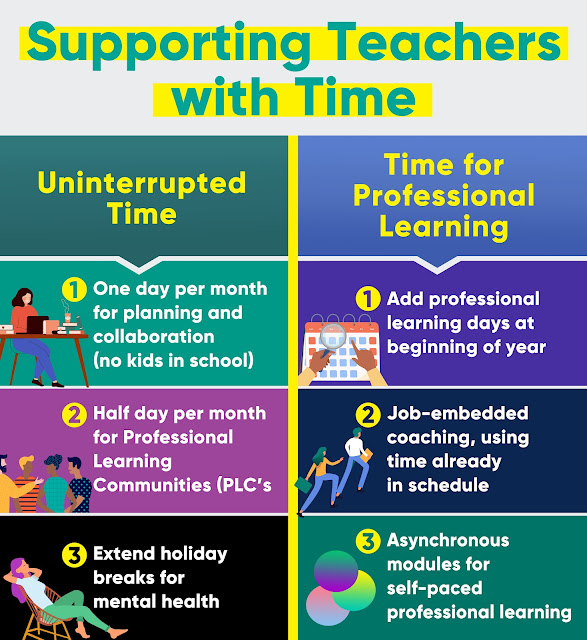
Uninterrupted Time

  1. One day per month for planning and collaboration (no kids in school): I have seen more and more school districts moving to this model, which has been celebrated by teachers, administrators, support staff, and students.
  2. Half-day per month for Professional Learning Communities (PLCs): We took this route in my former district, where I was a principal.  We don’t want PLCs to become “just another thing” teachers have to do.  By providing time, they inherently become more powerful and something that is valued.  On a side note – administrators should be in their own functioning PLC as a way to model. 
  3. Extend holiday breaks for mental health: I have seen a few superintendents across the country take this route resulting in a win-win scenario.

Time for Professional Learning

  1. Add professional learning days: My opinion is that it is best to frontload these at the beginning of the school year to alleviate distraction and pressure.  Another idea is to build in back-to-back professional learning days during the school year so concepts and strategies can be explored in more detail. 
  2. Job-embedded coaching: Teachers want to grow and improve but pulling them from their classes and trying to find subs or coverage creates additional headaches.  Job-embedded and ongoing professional learning support uses the time that is already in the schedule to provide needed growth opportunities.  This model uses staff meetings, team time, and non-instructional duty periods to facilitate targeted sessions on strategies that can be implemented immediately.  Additionally, by observing classes and PLC meetings, valuable feedback can be provided either synchronously or asynchronously.  All of my coaching cycles aligned to longitudinal work with schools worldwide involve this approach. 
  3. Asynchronous modules: There is no better way, in my opinion, to align current context to sound pedagogy than developing personalized options for teachers to engage in at their own pace.  Scaling professional learning is hard.  It is even more challenging during a pandemic.  I recently coached John Orcutt, the principal of Arlington High School in New York, on creating an asynchronous course on personalized learning in Google Classroom.  It came out great!  Now teachers and administrators can work through the activities at their own pace, apply them to their practice, and receive professional learning hours.  Since I am in the district once a month supporting schools, I will be providing targeted coaching and feedback to everyone who has taken the course. 

Please note that these are only suggestions, but each has been successfully implemented in a district or school.  Changes to the school calendar and, in some cases, staff contracts have to be made.  In collective bargaining situations, a compromise must be reached.  Where there is a will, there is a way.  Teachers have earned the attempt to at least try. 

Sunday, January 9, 2022

Tips for an Abrupt Shift to Remote or Hybrid Learning

The other day I was with one of my partner districts as part of ongoing longitudinal work that will last at least two years.  As I was facilitating a model lesson near the end of the school day with a group of teachers and administrators, a staff member came by the room to inform everyone that the district would be going remote the rest of the week.  An email was also sent informing all educators to plan for an asynchronous day of learning on Thursday and synchronous on Friday.  Naturally, I ended the session a little early so they could begin to map out the rest of the week, but I also had planning to do in terms of converting my face-to-face sessions with the leadership team to virtual that was scheduled for the next day.

Unfortunately, what I have described above has become quite common as of late.  COVID-19 has roared back with the highly transmissible Omicron variant resulting in scaled disruption.  Schools are having immense trouble staffing their buildings or even getting kids to school as bus drivers must go out on quarantine.  In this case, the result has been an abrupt shift to remote learning.  The other scenario that has panned out has been many children succumbing to the virus and being quarantined or families keeping their kids home as a safety measure.  In this scenario, a decision to move to hybrid learning has been made.

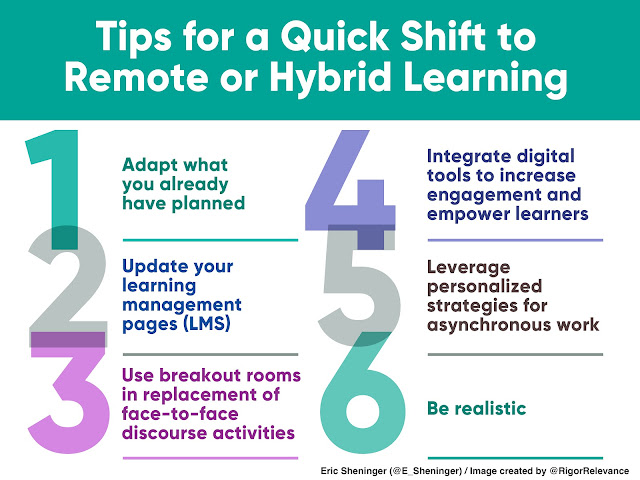
Undoubtedly, this is a very stressful time for educators, but their resilience and flexibility have, and continue to, shine through to make things work.  Remember, we have been here before, and there is no need to reinvent the wheel.  I have been going back through some of my most-read posts ever, and many of them are on the topics of remote and hybrid learning.  You can access all these curated on a Pinterest board HERE.  Below are some straightforward tips that will help you get through this without losing your mind:

  1. Adapt what you already have planned (don't reinvent the wheel)
  2. Update your learning management pages (LMS) such as Canvas, Schoology, or Google Classroom so kids can seamlessly access all assignments and tasks
  3. Use breakout rooms in replacement of face-to-face discourse activities 
  4. Integrate digital tools to increase engagement and empower learners
  5. Leverage personalized strategies for asynchronous work such as choice boards, must-do/may-do, playlists, and flipped lessons.
  6. Be realistic (substance over quantity, prioritize standards)


There is nothing inherently new in the tips provided above.  The key is to remember pivotal lessons learned during the great remote and hybrid experiment of 2020 and parts of 2021 to power through what I hope is only a couple of weeks.  Effective leadership in these unpredictable times is not only needed but greatly appreciated.  Finding additional resources for staff and freeing up time to plan are two quick wins that won’t go unnoticed.  Together, you’ve got this, and if there is anything I can do, please don’t hesitate to reach out (esheninger@gmail.com). 

Sunday, January 2, 2022

Hitting Curveballs

If only everything could be simple.  Life is anything but an easy journey.  While this, for the most part, has been manageable in the past, the pandemic has upended professional and personal lives.  Just when there is a glimmer of light at the end of the tunnel, a new variant materializes.  For now, Omicron is the current curveball.  As I write this post on the first day of 2022, I can't help but reflect on the resilience educators showed the year before.  They stepped up to the plate every time for kids and each other because that is in their DNA.  As the curveballs kept coming, they hit them.  In the midst of immense adversity, they persevered. 

What the future holds, no one can know for sure.  Many schools have or will be making the decision to revert back to some form of remote learning.  While this can be frustrating and challenging, educators have been here before.  The silver lining is that lessons learned in the past can be leveraged to make it a smoother process.  There were many successes when it comes to remote learning that have value now and will for years to come.  I made sure to capture these in chapter 6 of Disruptive Thinking in Our Classrooms.  Good teaching and leadership shine through no matter the circumstance.  If you are in need of remote learning resources I have you covered. Just click HERE. 

For schools that do not go back to remote learning, the curveball will be high rates of absenteeism.  In the case of students being out, we will most likely see hybrid learning come back into the picture.  Just like in the case of remote learning, educators have been there and done that to ensure learning continues.  Throughout the pandemic, I captured successful hybrid learning strategies from the schools where I was coaching on the topic.  You can access those HERE.

Another curveball comes in the form of the emotional and physical impact on educators.  While they valiantly and selflessly continue to serve students, the pandemic has taken its toll on them.  I shared the following in a previous post:

Educators are also in desperate need of social and emotional support.  Many teachers are at their wit's end, and who could blame them.  Morale and mental health are suffering as board meetings spiral out of control, and the pandemic rages on.  Administrators can lessen staff load by offering mental health days, covering classes, getting rid of meetings, providing grading grace periods, and eliminating non-instructional duties.  Grace and empathy can be shown through electronic polling to see what they need.  Bigger lifts include finding ways to add additional time for planning or securing outside counseling services. 

We cannot ignore the other educators who need social and emotional support, including counselors, coaches, instructional aides, administrators, or anyone else who serves students.  While they are typically more behind the scenes, some are suffering as well.  Here is where Central Office, boards of education, families, and community members can step up.  Extending breaks, thank you cards, substituting, or food items can go a long way to help all educators cope a little bit better. 

A systematic approach employ's a Maslow's before everything else lens.  If we don't take care of all of our people – students, teachers, support staff, administrators – our education system could be damaged in ways that will be felt for generations.  

With 2021 in the rear mirror, one can only be more hopeful for the year ahead.  There will be curveballs, but educators will keep hitting them. 

Sunday, December 26, 2021

Top Posts of 2021

With 2020 in the rearview mirror, the consensus was that 2021 would be a much smoother ride.  Most people would agree that this was not the case.  During countless coaching visits, I saw and heard firsthand the myriad of challenges being faced in classrooms, schools, and districts.  Through it all, though, educators found a way to forge ahead in the midst of adversity.  It sure wasn’t an easy path, but the resilience, dedication, and determination of people who have committed their lives to serve children of all ages have and continue to be on display.  I, for one, cannot thank them enough for the sacrifices made and the resulting impact on kids.

Writing this past year has been bittersweet for me.  On the one hand, I continually empathized with educators as the struggle was, and continues to be, very real.  It is difficult to honestly know this feeling if you are just up on a stage and not in classrooms or buildings.  Context matters, especially when doling out advice.  On the flip side, I have witnessed some of the most extraordinary practices that have been implemented with fidelity.  This is no small feat considering the environment that a pandemic had and continues to create.  Through a coaching lens, I was able to generate topics for posts that I thought people would find value in and appreciate.  Writing provides me with an avenue to both reflect on my practice and celebrate that of others.

Speaking of celebrations, I had one on a personal level with the publishing of my latest book in April. Disruptive Thinking in Our Classrooms was one of my major pandemic projects, alongside with becoming a master at cooking charbroiled Gulf of Mexico oysters on the grill.  Since the book became available, I used this blog to create supplemental content while expanding on many of the concepts with additional insight.  All of these posts and accompanying original images have been curated on Pinterest.  In addition to these resources, there is also a comprehensive study guide and an impressive bulk order discount through ConnectEDD Publishing (email info@connecteddpublishing.com).

Without further ado, here are my most popular posts of 2021 in no particular order.  Instead of sharing a summary of each, I have decided to include the unique image that was developed to accompany the content. 

How to Make Learning Stick

Pedagogical Leadership

8 Elements of Effective Coaching

Learning Recovery Through Acceleration

Making Headway with Remote and Hybrid Learning


Thanks for all you do, and wishing everyone the best in 2022!

Sunday, February 28, 2021

Extending Grace to Yourself

The shift to remote and hybrid learning has not been easy, and I don't think anyone would claim that the journey was smooth sailing.  As I continue to work with districts and schools on an on-going basis, I try my best to help them overcome continuous challenges and frustrations. Through it all, educators have risen to the occasion and have innovated their practice at a more frequent pace than any time in history. At least, that is the way I see it, but as the pandemic wears on, educators are still trying to figure things out.  I am here to tell you that you are not alone. Virtually everyone, no matter the profession, has and continues to experience challenges during this unique time.  Just take a look below at what this lawyer went through.


I can't help but laugh every time I watch the video above and never even knew that there were avatar filters available in Zoom. However, there is a fundamental lesson here. We are still in a constant state of flux.  So much of what we are attempting to do is new, or other challenges materialize out of the blue.  Professional learning can most certainly help, but that has been placed on the back burner in many cases.  Thus, it often falls on educators themselves to figure things out.  Then there is the fact that students and colleagues are in desperate need of support so that natural reaction is to put individual needs on the back burner to help others.  While this is admirable and the right thing to do, it is imperative that educators extend some grace to themselves. 

It seems simple, but the reality is that extending grace to yourself isn't easy or something one aspires to do because it just doesn't feel right. Nancy Fulkerson explains why it is essential to do so.

When you feel like your day is unraveling or you've been hard on yourself for whatever reason, "giving yourself grace" is about giving yourself that kindness you often deserve. Sounds awesome. The type of thing you'd want your best friend to do for herself because you don't want to see her breakdown.

The fact of the matter is that what you have done and will continue to do matters. During tough times giving yourself some grace can make all the difference. Here are five ways to do this:

  1. Dedicate an hour doing something you are passionate about.
  2. Give yourself a pat on the back or even look in the mirror while stating that you did well today.
  3. Engage in something that is all about YOU.
  4. Close your eyes and take a deep breath when something doesn't go right.
  5. Begin and conclude your workday with self-affirmations.

Things will not always go as planned, and adversity will always be around the corner.  Continue to always show grace to others while remembering that you need it as well. It is more than ok to give yourself a pick-me-up when needed.  Please know that your dedication and commitment are truly appreciated. 


Sunday, February 21, 2021

Adapting Ideas to Drive Real Change

One of the joys and challenges of blogging regularly is trying to come up with original content that has substance. I can tell you firsthand that this is no easy feat as it seems like virtually everything has been written about in some form or another.  In many cases, content and ideas are remixed into something that is or seems, new. My angle has always been to use coaching experiences in classrooms and schools to illustrate how specific strategies are successfully integrated resulting in changes to practice.  Without these opportunities of working side by side with educators, I would have run out of things to write about years ago.  However, this doesn’t imply that it is still easy to come up with blog ideas. 

With the onset of the pandemic, new ideas began to percolate as remote and hybrid learning quickly became the norm.  These were foreign areas for most of us, especially in relation to PreK-12 education.  Thus, since March 2020, almost all of my posts have been dedicated to this topic because, quite frankly, there weren’t really any applicable content or practical strategies out there.  While I have focused on sound pedagogical techniques that have just as much value now as they did before COVID-19, I explored emerging aspects of personalization to provide a relevant angle that could help educators implement remote and hybrid learning with fidelity. In particular, one post addressed the challenge of managing face-to-face and remote learners at the same time.  As a result of my work with a school, I developed a template for educators to use or adapt as they see fit.  Below is what I created.


It has been fantastic to hear how the above image is being used in classrooms around the world.  The other day I received a message from Kate Tinguely on Twitter, which led to a conversation on how she adapted it for a recent lesson. Here is her take:

This year has been so full of change, adjustment, and anticipation of the unknown due to COVID-19. As a specialist, I have had to completely change the way I approach my lesson planning due to the frequency of times the classes come to me, the arrangement of my space & materials (for social distancing), being new to the school, and keeping in mind how I can foster connections with my students.  Your template and ideas were so helpful and inspired me to act on what I was hoping would be a change for the better. 

I was humbled, to say the least, by what Kate shared, so I asked for a visual as to how she tweaked the template.  You can see what she created below:


Here is how the lesson was structured in her words:

  • Beginning Connection: I always begin class with a question to help connect with my students, give them a chance to share, and learn all of their names. The question was to name one animal they know that hibernates in the winter (first grade). They can answer or say pass.
  • Then I read Bear Snores On (with the Novel Effects app)
  • Station one: Seesaw activity (Animals in the Winter)
  • Station two: Polar Bear Arctic Virtual Field Trip    
  • Wrap up: Think-Pair-Share one fun fact they learned about winter animals or polar bears.
  • The lesson the day before was all about algorithms and coding, so the stations had to do with those concepts involving Kodable and a Seesaw Activity.

It is great to see how educators like Kate are innovating their practice during these difficult times.  Information was used to construct new knowledge and then actively apply it to practice. Since this is what we want from our learners, it is critical that adults model this as well.  On a personal note, her message about why and how the template was used provided validation for why I blog consistently in an attempt to share valuable information.  The lesson learned here is that ideas are great, but it’s what we do with them aligned to effective strategies that truly matters.

Sunday, February 14, 2021

The Lengths Teachers Will Go For Kids

While the challenges schools have faced during the pandemic are often portrayed in the media, some notable changes to practice have occurred. Each day I am in awe as I see innovation in action shared on social media, especially in the areas of blended, remote, and hybrid pedagogy.  It goes without saying that there has also been a significant uptick in the purposeful use of technology. All successes, big and small, should be celebrated.  In my work with school leaders, one of my goals is to push them to unearth these exemplars while also supporting teachers to grow and improve.  

Recently I was facilitating some longitudinal coaching work with administrators from Paterson Public Schools in NJ. Leaders had been broken up into four different cohorts (elementary, middle, high school, and district supervisors).  During a previous session, I assigned each leader some meaningful homework, which consisted of bringing an artifact to share with the group that showed growth in the area. During each conversation, it was empowering to see and hear the progress educators made in their schools.  Therein lies what separates effective vs. ineffective professional learning.  The latter is defined by one-and-done and drive-by touchpoints, while the former is ongoing, job-embedded, laden with feedback, and substantiated with evidence.

While each group shared amazing artifacts, I was blown away by the supervisor cohort. In particular, those who oversee Pre-K teaching and learning shared as a team with concrete examples. Then Stephanie Wright, the Supervisor of Early Education, provided us all with a bird's eye view of what Sofia Kadrmas was doing with her pre-K class.  In a nutshell, she had replicated her real classroom in terms of how it looked and felt before the pandemic into a vibrant virtual environment. As I immersed myself in the experience, it was like I was in the classroom myself. I immediately begged Stephanie to get me permission from Sofia to view and share.  Below you can see her work of art. The interactive classroom can be accessed HERE. 

I was blown away and feel that this is the best example of a remote learning environment that I have seen in the field.  Once I got access to it, I immediately set up a call with Sofia to ask her some questions and commend her on her efforts.  My first question was in regard to how she learned to create this in Google Slides. She explained that she taught herself and always had a knack for technology.  The other, probably obvious, question was how she had the time to create such a masterpiece.  Her response was invigorating and the essence behind why teachers do what they do for kids.  Sofia explained that she is passionate and motivated to help her students in any way that she can.  Her goal was, and is, to create a fantastic experience for kids during this difficult time. She saw an opportunity during the pandemic and ran with it.

Below is Sofia's story in her own words:

When it was announced that our school district would begin the 2020-2021 school year fully remote, I knew it would be a challenge to engage my Pre-K students remotely while still adhering to developmentally appropriate practices and maintaining fidelity to our curriculum. One day I woke up with the idea that I could convert my physical classroom into a virtual format. As you will see in the Slides that have been shared with you, I've created a virtual classroom that accurately resembles Room #204 of Paterson Public School #28, complete with the same area rug, furniture, and interactive whiteboard. It also features a replica of the Tri-Fold Choice Time "Planning Board" I created last year. Clicking on it will redirect the viewer to an enlarged version of the board, including visual representations of the Interest Areas (or "centers"), which contain images of most of the same toys and materials that can be found in my classroom. The realistic aspect of my virtual classroom was intended to provide my students with a sense of familiarity with the physical classroom that they would hopefully someday enter in person.

My goal from the beginning was to create a virtual learning environment that would not only engage my students but also give them a reason to look forward to logging on for class each day. I do feel that I have accomplished this goal, as I have had several parents reach out to me in the last five months to express how much their child loves the resources I post daily. One of my students begs his mother to help him play the "games" that I post on my Daily Google Classroom Agenda almost immediately after the end of our live sessions. These are activities aligned with our curriculum that I have converted into Google Slides to draw my students into the lesson. I use them daily as my primary method of instruction so that both students and parents can efficiently utilize them outside of our live sessions as an extension of learning. I also heavily rely on the Google Translate Chrome extension to make these Slides equally accessible to my bilingual students' families and have posted many of my Google Classroom resources in three different languages. 

It is essential to remind ourselves that these are unprecedented times we are living in currently. It's during times like these, especially when we must open ourselves up to the possibility that continuing to teach in the way "we have always done" may not be what's in the best interests of our students.  Our profession is one that requires us to be lifelong learners. That includes the willingness to adapt to, as well as adopt new teaching practices as the world continues to transform around us. That is precisely what I set forth to accomplish this school year. I adapted. 


My final piece of advice to all teachers in my position is this: Don't resist the change. Face your fears. Ask for help when you need it. It's never too late to learn a new skill, and you will never truly know the extent to which that newly acquired skill could benefit your students until you try it. The last several months have proven to me, beyond any doubt, that my "new way" of teaching is highly effective. My students are learning and growing every day, but most importantly, their smiles and laughter show me that they are having FUN in the process! That's more than enough motivation for me to keep pushing forward. 

During the pandemic, so many teachers like Sofia have gone to great lengths for their kids.  They have persevered in the face of adversity while embracing innovative approaches. Their example is to be celebrated. 

Saturday, January 9, 2021

Making Headway with Remote and Hybrid Learning

With 2020 in the rearview mirror, it is now time to focus on the present with an eye to the future. Many difficult lessons were learned during the pandemic, and a few more are sure to materialize over the next couple of months.  Even though educators have been challenged like never before, they faced adversity and stepped up to the plate admirably for their learners.  While a great deal can be written about the challenges experienced and those still prevalent, I want to focus on some of the good that has come out of the COVID-19 nightmare. Remote and hybrid learning at scale was never meant for K-12 education, but the fact remains that each has been a catalyst for some exciting changes that have long been overdue.

As I recently worked with leaders from Paterson Public Schools in New Jersey, during a coaching session, I asked them to take a few minutes, and each share something positive that came about as a result of the pandemic.  Too often, we tend to dwell on overcoming hardships that we forget to celebrate both small and large wins. With morale at a breaking point now more than ever, teachers and administrators need validation for all they have done recently. These can become critical building blocks for sustainable change. 

As each leader presented their views on positive shifts to practice, you could see their pride swell.  They shared how teachers got better using technology, reached out more for feedback, collaborated more, and improved classroom management. They also shared that the facilitation of professional learning improved, a greater reach was achieved thanks to technology, previously unknown teacher strengths were unearthed, and there was the ability to get into more classrooms. All in all, these are all great examples of progress in difficult times. How has your practice or those in your school/district changed for the better?

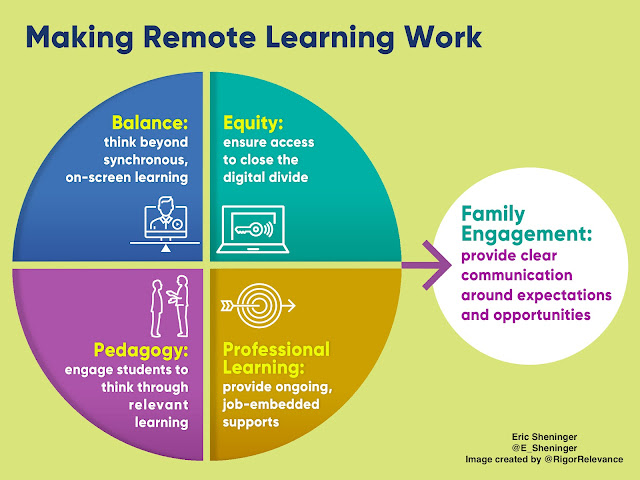
As the new year begins, schools, for the most part, are still where they were in 2020. That is why it is imperative to celebrate success in any form and provide further support for teachers and administrators. Instead of dwelling on all that hasn't worked, energy should be spent on all that has during the pandemic. Consider these questions from your lens. What are your exemplars of effective remote or hybrid teaching and learning, and why? How are you sharing these with colleagues and staff or using them for professional learning and feedback? While these provide ample opportunities to reflect, further headway can be made by focusing on the following:


  1. Continuity and consistency – Keep it as simple as possible. Embrace a learning management system (LMS), settle on a video conference solution that has breakout rooms and integrate one digital tool that aligns with effective instructional strategies. Then be sure to use consistency and ensure there are continuities either across your school or K-12.
  2. Lesson structure – The key here is to ensure there is a balance between synchronous and asynchronous activities both with and without technology.  Other considerations include chunking how content is presented, utilizing routine checks for understanding, providing brain breaks, and incorporating movement activities. Engagement issues arise when it is entirely direct instruction, or learners are expected to be on technology the entire time. HERE are some ideas on how to balance things out.
  3. Relevance – Learners need purpose. Without this, the willingness and desire to learn dwindles. An anticipatory set at the beginning of every lesson is a great start, but they're also should be at least one opportunity to apply thinking in a relevant way.  Kids become intrinsically motivated when they know why they are learning something and how they will use what has been learned outside of school.
  4. Rigor – Any remote or hybrid experience should challenge students to think. Consider how questions are scaffolded and the way in which knowledge will be applied to solve complex problems.  The ability to think, pandemic or not, is the best way to future-proof learning for all students while setting them up for success.  
  5. Purposeful use – Technology has played a considerable role during the pandemic and will continue to well after.  However, just using Zoom to "deliver" instruction should not be the goal and does not constitute effective use. Now is the time to focus on purposeful use aligned to sound instructional strategies (review of prior learning, checks for understanding, closure, assessment).  From here, it is about empowering students to use technology to learn in ways that they couldn't without it.
  6. Blended learning – One of the best ways to incorporate all of the above is through blended pedagogies.  Often, though, there is confusion as to what this really is. Blended instruction is what the teacher does with technology. Blended learning is where students use tech to have control over path, place, and pace while also having voice and choice. Consider practical strategies such as station rotation, choice boards, playlists, and flipped lessons.
  7. Leverage your superstars – There is no better way to make headway with remote and hybrid learning than to put the work of your trailblazers' front and center. Consider sharing what they are doing in email blasts and through social media. Not only can they serve as motivation for teachers who yearn for practical strategies, but their work can also be shared with stakeholders to showcase what is working. Your superstars can also lead professional learning.

What we have and continue to learn during the pandemic will pave the way for sustainable changes to practice that will positively impact kids. Don't sell yourselves short. In the midst of immense challenges and struggles, you have all stepped up in ways that illustrate how amazing educators are. Remote and hybrid learning can work because of your efforts. Continue to keep things manageable while also looking for opportunities to reflect and grow.  You don't have to have all the answers or solutions. It is a sign of strength to admit that you don't know or need help in these cases. If this is your situation, please feel free to reach out as I am more than happy to help in any way that I can.

Sunday, December 27, 2020

Top Posts of 2020

The year began like any other. From a blogging perspective, I kicked it off with a post on what could be as a means to pump up educators as they continued to move towards embracing innovative strategies and ideas.  In my opinion, January always represents an excellent opportunity to try something new. Personalized learning quickly became a focus area based on impressive outcomes from some of the schools I had been working within in an on-going and job-embedded fashion. It is always an honor to share the incredible work of educators in the field. Other pieces included topics that I traditionally cover but with new angles such as pedagogy, change leadership, and school culture.

Everything changed in March, not just for me, but the entire world.  The COVID-19 pandemic began to spread like wildfire across the globe. I vividly remember being on vacation in Cabo San Lucas, Mexico, when everything seemed to go downhill overnight.  Schools closed their physical buildings and shifted to remote learning as lockdowns went into effect worldwide.  My reaction was to take a break from vacation and churn out a blog post focusing on resources that educators could use right away. This happened on March 12, 2020. 

Who would have thought that nine months later, the pandemic would still have its tight grip on society? A powerful reminder and lesson, depending on how you look at things, came out of this mess. Even though educators were (and still are in many cases) flying the plane while building it, we learned that a virus could not stop their commitment to kids. If you get a chance to thank an educator today (or any day for that matter), please do. They are working their tails off and performing miracles in many cases. Their pay does not align with the effort, time, and stress they are dealing with during this pandemic. We are in their debt.

From March on, my blog posts focused on practical strategies in the areas of remote learning, hybrid models, and leadership in uncertain times. They were some of my most read pieces ever! What I learned was that educators were craving useable ideas aligned to the current reality. I used this time to learn and grow myself as I had to both adapt and evolve to improve as a presenter, workshop facilitator, and coach. You need to practice what you preach if it is going to have real value in today’s world, and I worked hard to do just that to better meet the needs of those reading my blog.


Without further ado, here are my most popular posts of 2020 in no particular order. Instead of sharing a summary of each, I have decided to include the unique image that was developed to accompany the content. 

A Pedagogical Framework for Managing Face-to-Face and Remote Learners at the Same Time


Strategies to Foster Discourse and Collaboration in Remote Learning Environments


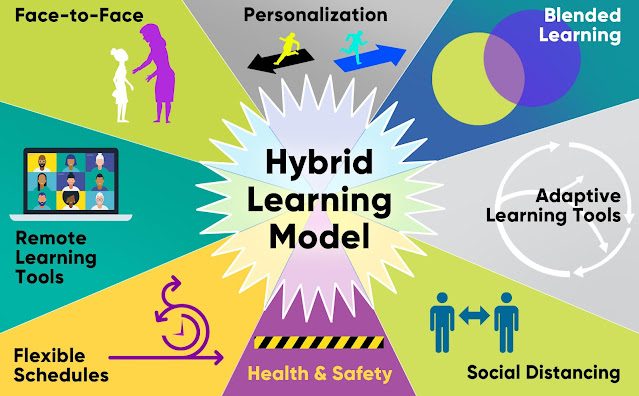
Moving to a Hybrid Learning Model


10 Remote Learning Practices to Avoid


8 Non-Digital Remote Learning Ideas


In the face of adversity, resilient educators stepped up like never before. For this, we owe them our gratitude and heartfelt thanks.  Some valuable lessons were also learned along the way, with the main one being that the future is bright for education. The pandemic taught us all that needed change can happen more quickly than thought. In 2021 we need to use these lessons to drive systemic change.  

Sunday, December 20, 2020

Challenges Create Opportunities

 "Challenges are what make life interesting and overcoming them is what makes life meaningful." - Joshua J. Marine

I love working with educators. Even though I am often the facilitator of learning, I always seek out opportunities to put myself into the shoes of those doing the day-to-day work and then use this as an opportunity to reflect on my practice. The other day I was working with Davis Schools in Utah on a hybrid learning model where educators would be teaching face-to-face and remote learners at the same time. My partner in crime was Belinda Kuck, who is the Director of Teaching and Learning. We have been working closely over the years on personalized learning support for teachers and administrators in the district. I learn so much from her every time we chat.

The premise of the work we kicked off was helping educators and districts manage time and utilize effective pedagogy during these challenging times. It is essential to recognize the fact that a hybrid model was never intended for K-12 education. Thus, providing support in the form of professional learning is something that all districts and schools should be investing in, whether internally or externally. Belinda began each session with an overview of the pilot program where educators would receive both a technology package (digital camera, laptop, microphone, tripod) and on-going professional learning from the International Center for Leadership in Education (ICLE) facilitated by yours truly. The best part of this was how she told the educators that they would be empowered to provide feedback to the district on how to implement the hybrid model best. It's awesome when the voices and ideas of those doing the work are valued.

After the pilot program's premise was shared, there was one more piece that Belinda assigned before I rolled up my sleeves and got to work. She asked each person to share a "peach" and a "pit" from their experiences during the pandemic. At first, I wasn't really sure what she was trying to accomplish with this analogy, but there was some quick clarification. This was a good thing as I had visions of Beverly Hills 90210 in my head. For those of you who never indulged in this 90's classic, there was a restaurant called The Peach Pit that Brandon and the crew frequented. Don't judge me for enjoying the show.

The peach represented something sweet, such as a practice that evolved over the past couple of months. Many of the responses centered around integrating technology, utilizing Canvas more effectively, getting to know students better than in the past, and shifting to more personalized strategies.  The pit referred to hardships and challenges.  It wasn't surprising that there were more pit responses than sweet.  The most common challenges revolved around time, mental health, student engagement, and a learning curve when it came to the purposeful use of technology. 

After reflecting on the sessions, something dawned on me. If it weren't for the pit, we would never have the peach. As much as it can be an annoyance when we are enjoying eating the peach, the giant seed in the middle leads to the tree that will eventually bear the fruit. The point I am trying to make in all of this is that challenges, as much as they cause stress and anxiety, lead to opportunities to change for the better. In the face of adversity, educators have and continue to innovate in ways that will benefit learners for generations. It is vital to view challenges as the pit. When they are overcome, it will be such a sweet feeling and hopefully as satisfying as eating a peach. If you don't like eating peaches, then use this analogy with any fruit that has seeds.  Keep up the excellent work, everyone! 


Sunday, December 13, 2020

Finding Balance in Today's Classroom

Balance has always been a challenge for teachers. I vividly remember this during my early years as a teacher. Each night I came home exhausted. Maybe the 45-minute commute had a little to do with it, but the main culprit was how I used available time in the classroom. Since I was not very open to risks and convinced that the most critical aspect of my job was to get through the curriculum, my sole focus was on direct instruction. Based on the feedback that I received during formal observations, the consensus was that I was pretty good at it. Nights and weekends were spent at the local office store getting transparencies made for the overhead projector, which was the primary technology tool at the time.

I thought I couldn’t live without the overhead projector and appreciated the fact that it limited my time using the chalkboard. No matter how hard I tried, I would always get chalk all over my sleeves. Then something magical happened in the early 2000s. The science department invested in mobile carts outfitted with television sets. Now, these weren’t your run of the mill flat screens as they hadn’t been invented yet. We were given lovely large box sets that were connected to our desktop computers. With the new tech technology in hand, my days of making transparencies were done, and the overhead projector was retired.  Now my time was spent creating PowerPoint presentations for direct instruction.

The short walk down memory lane reminds me of why I was exhausted during my beginning years of teaching. It took some self-reflection and honest feedback from my students to move away from being the sage on the stage and more of a facilitator of learning. Differentiated instruction and cooperative learning strategies became embedded in some form during each lesson. There was also an emphasis on moving to inquiry and project-based pedagogies. After all, I was a science teacher, and the fit was natural.  Direct instruction was still a component of most lessons, but it was now limited to no more than fifteen minutes.  When I shifted more responsibility to learners in class, a better balance was achieved, and I evolved into a more effective teacher.

I share this story because of what I have either seen or been told is happening in classrooms at this very moment. Advances in technology and the pandemic have placed a great deal of stress on teachers and schools, and the reaction has led to an imbalance in many cases. There has either been a reversion to mostly teacher-centered practices or an over-reliance on technology as a result of remote learning and hard to manage hybrid models. No one is at fault here. In these times, educators want to mitigate risk while keeping their sanity. However, I would be remiss if I didn’t broach the topic as I am frequently asked for feedback and ideas during coaching sessions.  

The key is to be reflective in terms of how the lesson is structured and how the time is used. If students are using tech or direct instruction is taking place 100% during the period or block, then there is both a need and opportunity to find some balance with other tasks or strategies.  Below are some ideas to balance out activities to ensure greater engagement and set the stage for empowerment through personalization.

  • Keep direct instruction or the mini-lesson between ten to fifteen minutes.
  • Use varied engagement strategies (click HERE for specific ideas).
  • Utilize digital breakout rooms for discourse and collaboration.
  • Add in movement and brain break activities.
  • Move to pedagogically-sound blended learning and provide a mix of tech and non-tech options.
  • Integrate asynchronous tasks (i.e., self-paced activities) when appropriate and provide individual or small group support to those learners who need the most help.
  • Seek out or ask for professional learning support on remote and hybrid pedagogy.
  • Use the flipped classroom approach and differentiate when you have all your learners live.


Please note that these are just ideas. Finding the right balance is a personal journey that considers available time, supports, and equity.  We can all agree that technology allows kids to learn in ways we could never have imagined. However, in times like this, it should not become a crutch. Its role during the pandemic is the same as prior, and that is as a means to support and enhance learning, not drive it. Always value the magic of teaching, something that technology can never replace.

For more remote and hybrid learning resources click HERE.

Sunday, December 6, 2020

Feedback is Needed More Than Ever

I think we can all agree that this school year has been unlike any other and not for the best of reasons. The pandemic has upended the entire education system as schools have moved to remote, then hybrid, and back to remote in some cases with no end in sight. Even with the promising news of two potential vaccines, rising COVID-19 cases have resulted in a constant state of flux.  Continuity and consistency have been hard to come by and finding a groove have become an arduous task in many cases. Educators, students, and families have never been in a situation as challenging as what they are experiencing right now. 

The rapid state of uncertainty has caused a great deal of angst, and rightfully so. As a result, there have been increased levels of stress, anxiety, and fear amongst teachers, which has led to decreased motivation in some cases. It’s not that they don’t want to do a good job but more a battle to get through each day. The struggle is real. For students, a lack of engagement on their end has led to significant concerns across the globe. If they aren’t engaged, then the chances that meaningful learning is taking place are slim. Finally, administrators are searching frantically for answers while putting out fires and conducting contact tracing daily. 

With all these challenges, growth becomes an afterthought. However, it is a necessity in order to provide the best learning experience possible for kids, even in times of crisis.  Through adversity, some of the best ideas are developed and implemented with fidelity. The key to setting the stage for this to occur is a concerted effort to make feedback a daily phenomenon. While assessments, observations, and evaluations might have worked well in the past, a more sensitive approach is not only warranted but also a necessity right now. 

Feedback can be a catalyst for motivation, engagement, and finding answers to questions or problems. First and foremost, we must be open to it in some form. One way to move the need is to seek it out from a variety of perspectives. Teachers can engage both students and families in conversations to elicit essential ideas on how to improve remote and hybrid learning experiences. Administrators can do the same with stakeholders and staff in order to gather intel on how to improve school culture immediately. In the classroom, providing regular feedback to learners might be the most critical key to engaging them.  

Everyone benefits if we are diligent and sensitive as to how it is implemented as a means both to inform and empower. Below are some aspects to consider regarding quality feedback:

  1. Facilitate with sincerity
  2. Ground in practicality and specificity
  3. Give in a timely manner
  4. Dialogue over monologue 
  5. Focus on positive delivery
  6. Use the right medium(s)
  7. Be consistent
  8. Align to advancement towards a goal(s)

Most people want to know how they are doing and what can be done to improve, even it is a small shift in practice or learning. Keep in mind the importance of Maslow’s Hierarchy of Needs. Feedback can be as simple as reassuring others that they are doing a great job in these trying times or using it as a way to find out what might be inhibiting motivation or engagement. The bottom line is that it is a great tool that can be used in a variety of ways. When it is all said and done, its best use might be that of relationship builder. After all, relationships are the foundation of learning and growth, no matter if we are in a pandemic or not.  

Sunday, November 1, 2020

3 Ways to Streamline Expectations While Making Things Easier for Educators

It seems like every day presents a new challenge or adventure, depending on how you view the current landscape. Educators are stressed, worn-out, and constantly wondering when the pandemic will end. There are no easy answers or solutions that will work for everyone. The fact remains that there was no professional learning to prepare for the reality that everyone is facing nor a plan for something like COVID19. Through it all, though, educators have risen to the occasion like never before. In the midst of adversity, we see daily empathy, selflessness, commitment, and innovation.

I always like to focus on the small wins when I am facilitating professional learning with schools and districts. We can’t discount even the smallest success during these trying times as it is imperative to build people up. Over time these small wins can morph into catalysts for more extensive change efforts. During workshops and coaching sessions, I am always asked what advice I have to help teachers and administrators make things as easy as possible while ensuring quality learning is taking place. In this case, the goal is trying to achieve more systematic change that all educators can embrace. The bottom line is that it has to make sense and not require a great deal of effort to implement.

Below are the three recommendations I have been providing to help districts and schools persevere during the pandemic. You will see they are relatively straightforward, but each in its own right requires a certain level of continuity and consistency. I tend to refer to these as norms that everyone can get behind.  

  1. Embrace a learning management system (LMS) K-12
  2. Settle on a video conference platform with breakout rooms
  3. Use one digital tool for engagement and empowerment


The consistent use of an LMS such as Google Classroom, Schoology, or Canvas works to create a more equitable learning environment for all kids and families provided there is access in school and at home. It can become the hub for all lessons, videos, activities, assessments, and student work. A foundation can then be established for more personalized approaches such as pedagogically-sound blended learning or self-paced activities.  Students and families win as they have on-demand access to resources.  Building capacity now benefits all educators through vertical articulation and provides a foundation to build upon in subsequent years.

Whether remote or hybrid, many schools have relied on a video conference platform for synchronous instruction and learning. Like the LMS, consistent use across a district or school helps develop continuity, especially in upper-grade levels. For discourse and collaboration, selecting a video conference platform that has breakout room capability is a must, in my opinion. Thus, the options are Zoom, Webex, and Google Meets. No matter the platform selected, it is crucial to follow guidelines established by FERPA to protect student identity and information.

There are many digital tools available to educators these days, which often creates an overwhelming feeling. It’s not how many tools you use that matters, but instead the degree to which they are employed to facilitate engaging and empowering experiences. Hence, my advice is to master one tool and use it consistently to review prior learning and check for understanding and closure. The key here is establishing a comfort level amongst both the teacher and student. There are many great tools out there to use. My advice is to pick the one that allows for student responses to be used in different ways. My favorites are Mentimeter and Padlet.

The success of each suggestion above hinges upon providing professional learning support on using the tool or platform, as well as sound pedagogy. This represents a great starting point to help educators manage expectations during the pandemic. The recommendations can set the stage for more structured synchronous and asynchronous experiences that empower learners in different ways. They can also be a springboard for future change.

Sunday, October 25, 2020

Give and Take Ideas to Support Teachers

The pandemic has really put a strain on educators, yet they continue to rise to the occasion on behalf of kids. This has come at a cost both mentally, socially, and physically. Something has to give. There has been a great deal of conversation lately about what can be taken off the plates of teachers.  I have to commend those administrators who are working to find ways to put their staff more at ease in these challenging times. While removing specific responsibilities to reduce stress and anxiety is a great start, we must also consider what can be given to them to provide multifaceted support. Giving can be just as, if not more, powerful than taking away, which is typically the more straightforward option. 

Below are some ideas that I have. Some are more doable than others, but all are realistic.


Time

If there is one thing that teachers consistently ask for, it is time to plan, create videos, grade, conference with remote students, update the LMS, etc. I don't want to belabor this point as I recently wrote about the topic. You can view the post HERE. The main takeaway with time though is to develop ways to give it unconditionally to teachers and not schedule or mandate anything else in its place, such as meetings or PLC's. 

Eliminating Meetings

Let's be honest for a minute. No one truly likes meetings, and the value of them is open to interpretation. I, for one, did not find value in them when I was a principal and eliminated most while reducing the time of the ones that were kept. Now I am not saying that all meetings don't have value, but while the pandemic rages on minutes and essential information can be emailed to staff or made part of a collaborative Google Doc. 

Coaching and Feedback

There is a difference between wanting to be left alone and a desire to grow. The majority of educators fall into the latter. Even in the midst of challenging times, growth is necessary to meet the needs of diverse learners. Now is not the time to revert back to traditional observation and evaluation protocols because, quite frankly, they will not result in improved outcomes.  Taking this away and replacing with non-evaluative strategies consisting of coaching and feedback will go a long way towards creating an empathetic environment.  

Prioritize standards

It is unrealistic to try to cover the entire curriculum as educators are implementing hybrid models for the first time, and increasing COVID cases is forcing some schools back to remote learning. An emphasis on priority standards can significantly reduce teachers' burden while streamlining other pedagogy aspects, such as assessment. Other elements to consider are aligning formative tasks and checks for understanding to those prioritized standards so teachers can monitor the learning of students. In the end, more manageable conditions are created for teachers. 

Grading grace periods

There is inequity when it comes to grading, as some subject areas require a great deal more time because of the nature of the content. Additionally, many teachers are still getting used to tasks and assessments in a hybrid environment. Even though deadlines are needed showing a little grace will always be appreciated.

Cover classes

Some districts and schools are hiring substitutes. Others are seeing their administrators offer their time and that of other non-teaching staff members. No matter the route taken, this strategy is sure to build up morale. There should be no catch when a class is covered, and it should be up to the teacher as to how he or she will use this opportunity to either grade, prepare lessons, attend professional learning, observe peers, or just put up their feet and relax. 

Eliminate non-instructional duties 

Many contracts have teachers assume a duty either during the school day or after. These can include cafeteria, hall, in-school suspension, extracurricular, or athletics, where there is no compensation. If possible, try to eliminate all of these. If you can't, consider developing a schedule where administrators and other support staff can fill them in lieu of teachers. 

Choice in professional learning

Forcing educators to engage in one-size-fits-all professional development at this time will tend to be hit or miss depending on the person. Mostly miss as there is a definite need for practical strategies in the areas of remote, hybrid, and blended learning facilitated in practical ways. Growth and improvement are of vital importance, but it needs to be something that educators want to engage in at a time when there are so many challenges. Consider providing different choices such as face-to-face, virtual, blended, or asynchronous options. It is also wise to gather input from staff to determine what they feel is needed. 

Communicate norms to families

One of the most common frustrations I hear from teachers when I am coaching is that they can't keep up with all parent emails that come in after school hours, mostly from remote learners and parents. I have gone as far as to recommend that teachers state they're out of office on their email each evening from 5:00 PM until 7:00 AM. Establishment of, and then clear communication of, norms can go a long way towards taking away some emails and messages, especially late at night and early in the morning. In Digital Leadership, I lay out the importance of using a multifaceted approach to meet stakeholders where they are while reinforcing the vital message at hand. Develop the norms with teachers and then "pound the pavement" with digital communications. 

Mental health days

With a substitute shortage, this could be a bit dicey, but the overall impact far outweighs the short-lived frustration of covering classes in a pinch. Based on the size of a district or school, a determination can be made as to how many of these days can be realistically given to each teacher. 


Empathetic leadership is critical to helping staff get through challenging times. Using a give and take strategy and lessening the burden will create a culture of empowerment.  As people have different needs, it is crucial to consider various options as there is no one right way to help people at any point in time. Work to take things off educators' plates, but also consider what you can personally give. In the end, powerful relationships will be formed, and that benefits everyone.