Showing posts with label pedagogical leadership. Show all posts

Sunday, July 26, 2026

Supporting the Craft: Aligning Organizational Systems with Pedagogical Goals

Leaders frequently navigate a complex operational matrix. School and district administrators are routinely expected to perform as logistical strategists, compliance managers, instructional coaches, and community anchors. However, through my lens, leadership models in educational environments generally fall into two distinct domains in the System for Educational Transformation (SET): organizational and pedagogical leadership. While often analyzed in isolation or set up in direct opposition to one another, these two domains represent interdependent forces that define the structural integrity and instructional quality of a school environment.


The Operational Engine: Organizational Leadership

Organizational leadership focuses on the systems, logistics, and central office infrastructure necessary to maintain operational, safe, and compliant educational facilities. At the systemic level, this domain encompasses district resource allocation, centralized facility operations, labor agreement compliance, technology deployment across campuses, and district-managed staffing allocation. Historically, school and district leadership was primarily evaluated through this administrative lens, prioritizing smooth operational functioning and regulatory adherence (Bush, 2007).

When central office organizational leadership fails, operational friction directly impairs classroom instruction. Inequitable resource distribution, delayed physical plant maintenance, dysfunctional data management platforms, and fragmented staffing pipelines deplete teachers' cognitive resources. Rather than focusing on lesson design and formative assessment, educators must spend their energy managing systemic barriers and operational friction.

When implemented effectively, organizational leadership functions as a protective shield for teaching and learning. Capable central administrators design operational systems specifically engineered to protect instructional time, deliver necessary physical resources, and promote psychological safety (Grissom et al., 2021). Streamlining administrative reporting demands and ensuring dependable central support allows teachers to direct their focus toward student learning.

The Instructional Heart: Pedagogical Leadership

If organizational leadership constructs the structural framework, pedagogical leadership provides the educational purpose. Pedagogical leadership centers explicitly on the craft of teaching, curriculum alignment, student cognitive engagement, and professional reflection. Leaders operating in this capacity serve as instructional mentors who prioritize classroom dynamics and student development over administrative compliance (Male & Palaiologou, 2012).

Pedagogical leadership shifts administrator evaluation from surface-level checklists toward substantive dialogue about teaching strategies. Traditional managerial observations frequently prioritize rigid compliance metrics, such as evaluating whether learning targets are listed on the board or if classrooms remain silent. Conversely, a pedagogical leader analyzes student learning processes, questioning how teachers differentiate instruction, support varied learning needs through personalization, and deliver real-time feedback.

This instructional approach cultivates learning communities where teachers feel supported in implementing research-backed, student-centered methodologies. When school and district leaders engage deeply with peer-reviewed research, teachers are positioned as clinical professionals rather than technicians implementing scripts.

The Cost of Systemic Imbalance

In many educational settings, organizational and pedagogical leadership operate in tension rather than harmony. This misalignment often manifests in two distinct patterns:

Research indicates that instructional improvement efforts struggle to sustain traction without strong operational support structures (Robinson et al., 2008). Conversely, central organizational efficiency devoid of pedagogical purpose yields compliance-driven environments that do not support student growth.

Harmonizing Operations and Pedagogy

Educational excellence requires aligning central organizational systems directly with pedagogical goals. Operational mechanics must be deliberately designed to serve learning outcomes.

A clear example of this integration is district-level resource allocation and professional learning funding. From an instructional standpoint, collaborative data analysis and peer reflection drive student achievement (Goddard et al., 2007). However, expecting teachers to sustain meaningful collaboration without system-wide support often leads to burnout. An effective district leadership team bridges this gap by aligning budget models, staffing formulas, and centralized calendar structures to guarantee dedicated collaborative time within the regular workday across all school sites.

When central systems and school pedagogy operate in tandem, educational institutions protect instructional time, align professional development with classroom needs, and adapt administrative structures to serve student learning. By establishing central operational foundations that explicitly advance pedagogical design, educational leaders create sustainable environments where both teachers and students thrive.

Bush, T. (2007). Educational leadership and management: Theory, policy, and practice. South African Journal of Education, 27(3), 391-406.

Goddard, Y. L., Goddard, R. D., & Tschannen-Moran, M. (2007). A theoretical and empirical analysis of the teacher collaboration for school improvement and student achievement in public elementary schools. Teachers College Record, 109(4), 877-896.

Grissom, J. A., Egalite, A. J., & Lindsay, C. A. (2021). What great principals really do. Educational Leadership, 78(7), 21-25.

Male, T., & Palaiologou, I. (2012). Pedagogical leadership: Just what is it? Exploring the concept in relation to early years practice. Educational Management Administration & Leadership, 40(2), 214-231.

Robinson, V. M., Lloyd, C. A., & Rowe, K. J. (2008). The impact of leadership on student outcomes: An analysis of the differential effects of leadership types. Educational Administration Quarterly, 44(5), 635-674.


Sunday, January 25, 2026

The Force Multiplier: AI-Assisted Pedagogical Leadership

We are currently standing at a pivotal crossroads in the field of education, as I shared in both Disruptive Thinking and Digital Leadership. On one side, we have the timeless, fundamental principles that make a school function successfully, including leadership, relationships, and sound pedagogy. On the other side, we are witnessing the explosive and rapidly evolving world of artificial intelligence (AI). The question is no longer whether AI will change education because that shift has already occurred. The real question for us as administrators is how we harness this power without losing the human element that defines our profession. We must look at how we use AI to become better pedagogical leaders.

To understand this shift, we need to ground ourselves in the core purpose of our roles. Pedagogical leadership is not about being a manager of a physical building or a processor of paperwork. It is about being a leader of learning. My Framework for Pedagogical Leadership centers on five key domains: developing relationships, providing research and resources, making time for feedback, learning with staff, and analyzing evidence. For years, the biggest barrier to excellence in these areas has been a lack of time. AI changes that math by allowing us to automate the mundane so we can be more present for the profound.

Reclaiming the Human Element

The first pillar of the framework is developing relationships based on trust and mutual respect. Some critics fear that AI is the opposite of human connection, but I argue that it is actually the key to reclaiming the time needed for those connections. When you use AI tools to draft newsletters or summarize meeting notes, you are buying back the minutes required to sit in a classroom and truly support a teacher. Research indicates that when leaders are perceived as supportive and present, teacher self-efficacy and job satisfaction increase significantly. According to Goddard et al. (2015), instructional leadership that fosters a collaborative environment and trust significantly predicts higher levels of collective teacher efficacy. As I noted in my book, digital leadership is about establishing direction, influencing others, and initiating sustainable change through the use of resources and relationships (Sheninger, 2019).

Curating Research and Evidence

The second and fifth pillars involve providing research and resources while analyzing evidence to improve implementation. In the past, being a resource provider meant spending hours scouring journals for strategies. With AI, a pedagogical leader becomes a high-speed curator. You can now use large language models to find research-backed strategies for specific student populations in seconds. One of my favorite tools is Consensus AI. However, the leader must still provide relevance by vetting this output through their professional lens.

AI moves us from being data-rich to being evidence-informed. We can now use technology to look for patterns across massive datasets that would take a human weeks to spot. This allows us to respond to student needs in real time. Research by Liñán and Pérez (2022) highlights how educational data mining and AI can identify students at risk and provide personalized pathways to improve learning outcomes. By using AI to analyze evidence, we ensure that our strategies are actually moving the needle for every learner.

Transforming Feedback and Professional Learning

The third and fourth pillars focus on providing feedback and learning with your team. Feedback must be timely, practical, and specific to be effective. AI-assisted leadership revolutionizes this feedback loop by allowing leaders to organize walkthrough observations into structured formats almost instantaneously. This ensures that the conversation happens while the lesson is still fresh in the teacher's mind. Hattie and Timperley (2007) emphasize that the main purpose of feedback is to reduce discrepancies between current understandings and a goal, and its effectiveness is highly dependent on how it is received and used. AI ensures that facilitation of this feedback is not delayed by administrative friction.

Finally, we must remain the learner-in-chief. Learning with your staff means exploring these new tools together rather than pretending to have all the answers. When we hold Professional Learning Communities (PLC’s), we can use AI to generate prompts that spark deeper pedagogical debates. A study by Chen et al. (2020) suggests that the integration of AI in professional development can help personalize the learning experience for teachers and provide more targeted support for their specific instructional challenges.


AI will not replace leaders, but leaders who use AI will eventually replace leaders who do not. The leaders using AI will have more time for relationships, better access to research, and the ability to provide superior feedback. My framework has not changed because of AI; instead, the technology has made each pillar more attainable. We now have the tools to finally do the work we signed up for which is the work of transforming lives through learning.

For more information on how Aspire Change EDU supports districts, schools, administrators, and educators with AI, click HERE.

Chen, L., Chen, P., & Lin, Z. (2020). Artificial Intelligence in Education: A Review. IEEE Access, 8, 75264-75278.

Goddard, R., Goddard, Y., Kim, E. S., & Miller, R. (2015). A theoretical and empirical analysis of the connections between instructional leadership, teacher collaboration, and collective efficacy scaffolding. Journal of Educational Administration, 53(5), 644-664.

Hattie, J., & Timperley, H. (2007). The Power of Feedback. Review of Educational Research, 77(1), 81-112.

Liñán, L. C., & Pérez, Á. A. J. (2022). Educational Data Mining and Learning Analytics: differences, similarities, and time evolution. International Journal of Educational Technology in Higher Education, 19(1), 1-21.

Sheninger, E. C. (2019). Digital Leadership: Changing Paradigms for Changing Times. Corwin Press.


Sunday, August 18, 2024

Prioritization: The Key to Leadership Success

Do you ever feel virtually everything seems critical or important as a leader? Most, if not all, of us have been in this position repeatedly. What happens, though, is that we place an emphasis on tasks that seem essential but have little to no impact on student learning. Prioritization 

The reasons people often prioritize less essential tasks over crucial ones are multifaceted. Sometimes, urgent tasks masquerade as important, capturing immediate attention and eclipsing long-term objectives. Additionally, fear of failure or the unknown can lead to procrastination on challenging but essential tasks. External pressures, such as meeting deadlines or pleasing others, can also divert focus from higher-priority items. Furthermore, a lack of clarity about goals or values can make it difficult to discern what truly matters. Personal factors, including stress, fatigue, or emotional state, can influence decision-making and prioritization abilities. Ultimately, a combination of these elements can contribute to the common challenge of prioritizing effectively.

The ability to prioritize is paramount for effective leadership. Leaders juggle countless responsibilities, such as strategic planning, professional learning, evaluating staff, engaging with stakeholders, and a slew of management tasks.  Trust me when I tell you that this is just a sample list. Prioritizing incorrectly can lead to wasted resources, missed opportunities, and a demotivated team. By focusing on the right things, leaders can drive the organization toward its goals, inspire confidence, and create a clear path forward. 

Educators develop a sense of direction and purpose when priorities align with the overall mission and vision, something I elaborate on in Digital Leadership. Moreover, effective prioritization allows leaders to make tough decisions, allocate resources efficiently, and manage time effectively. The last outcome is the most critical.  How time is used in support of student and educator growth is worth its weight in gold.  Ultimately, a leader who excels at prioritization demonstrates strong decision-making skills, strategic thinking, and a clear understanding of what truly matters to the organization's success.

A person stands at the center of a large, sandy desert with several paths leading out in different directions. Above each path, there are floating scales. Each scale has different objects balanced on it—some light and insignificant, like feathers, and others heavy and meaningful, like gold bars. The person is carefully weighing the paths, looking at the scales, and deciding which path to take, representing the act of prioritizing important tasks over less significant ones.

Shifting from a focus on management to pedagogical leadership requires a reprioritization of time.  Instruction is what the teacher does, whereas learning is what the student does.  Here is where a sole emphasis on instructional leadership might not lead to efficacy at scale.  Pedagogical leadership focuses on numerous responsibilities and roles that work to ensure a vibrant learning culture that helps to meet the needs of all students. It is a broader view that includes more attention to what the learner is doing and the support needed for success such as:

  • Development of collaborative benchmarks that lead to continuous improvement across the system
  • Deeper understanding of how the brain works and research-based strategies that teachers can readily implement in their classrooms
  • Routine use of data and feedback
  • Ongoing and job-embedded professional learning

As you reflect on how your time is used, is it more on managerial tasks or aspects that actually move the learning needle in your school or district?  Now I get it; everything seems important all at once, so where do you begin?  Enter the Eisenhower Matrix.  The Eisenhower Matrix is an invaluable tool for school administrators seeking to prioritize pedagogical leadership. By categorizing tasks based on urgency and importance, administrators can allocate their time to high-impact activities directly influencing student learning. This framework helps them focus on critical long-term goals like curriculum development and teacher support rather than being consumed by immediate but less significant demands. Additionally, the matrix empowers administrators to delegate or eliminate less important tasks, freeing up valuable time for strategic initiatives that foster a positive learning environment and drive academic achievement.

Below are some questions I developed to help leaders prioritize their time as pedagogical leaders.

Urgent and Important: Critical Instructional Issues

How effectively are we addressing the most pressing teaching and learning challenges, such as low student achievement in core subjects, significant gaps in student learning, and consistently implementing research-based pedagogies? This question focuses on immediate needs that require immediate attention and significantly impact student outcomes.

Important but Not Urgent: Long-Term Instructional Goals

Are we consistently allocating sufficient time and resources to long-term instructional improvement initiatives, such as implementing new curricula and professional learning communities (PLCs) with a focus on data, developing teacher leadership, conducting learning walks, providing timely feedback, /or fostering a growth mindset culture? If not, where do we begin and why? This question helps prioritize proactive steps to enhance overall pedagogical quality.

Urgent but Not Important: Time-Consuming Distractions

How can we delegate or eliminate urgent tasks that do not directly contribute to improved student outcomes, such as administrative paperwork or non-essential meetings? This question encourages focusing on high-impact activities by reducing time spent on less important matters.

Neither Urgent nor Important: Low-Value Activities

Are there any practices or initiatives that consume valuable resources but have little impact on student achievement? How can we eliminate or repurpose these? This question helps to identify and eliminate ineffective practices to optimize resource allocation.

As you reflect on the image above, consider how the Eisenhower Matrix can help you maximize time while delegating or eliminating practices that don’t significantly impact learning.  

Learn more about the pedagogical leadership offering and others from Aspire Change EDU HERE or email aspirechangeedu@gmail.com

Sunday, April 2, 2023

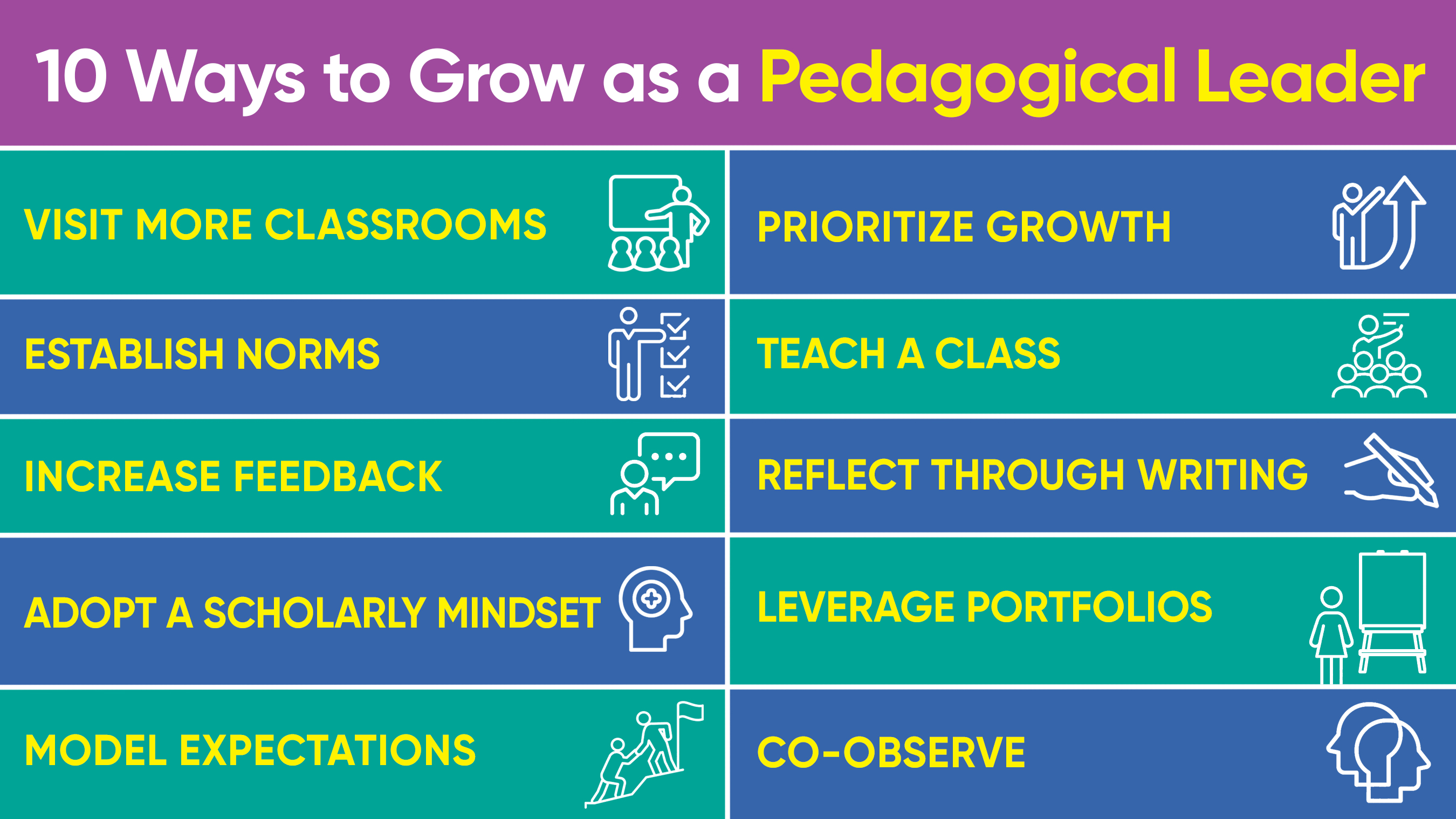
10 Ways to Grow as a Pedagogical Leader

I have vivid memories of my early days as an assistant principal and principal, where overseeing instruction was just one of many duties that came with the job. Managing budgets, developing memos, attending meetings, responding to emails and phone calls, and other tasks also consumed a significant portion of my time. The advent of social media introduced yet another responsibility into my already packed schedule: digital leadership. As a school administrator, one must be proficient in many different areas, but it's essential to maintain sight of the most crucial aspect of the role: pedagogical leadership.

Despite my best efforts, I couldn't visit classrooms as frequently as I would have liked, and the feedback I provided in written reports could have done more to enhance teaching and learning both inside and outside the classroom. If our ultimate goal is to improve, we need to prioritize the aspects of our job that impact student learning most. Pedagogical leaders recognize that management is a necessary part of the job, but it shouldn't come at the expense of cultivating a positive learning culture to boost academic achievement.

It's simple to offer advice on improving in this area or anything else, but putting it into practice can be a constant challenge. To help you get started, I've compiled ten specific strategies that I used during my tenure as a high school principal and now help other leaders with during coaching cycles. 

Visit more classrooms

Firstly, begin by increasing the number of formal observations conducted each year and sticking to a schedule to ensure that all teachers are observed three times annually, regardless of experience. Secondly, develop an informal walk-through schedule with your leadership team, mandating at least five walks per day for each member, and track visits and improvement comments on a color-coded Google Doc.

Establish norms

Establishing a shared vision and expectations for all teachers is crucial. You can do this by utilizing the Relevant Thinking Framework to provide them with consistent, concrete elements to focus on when developing lessons and deciding which high-effect strategies to use. Abolishing the routine of announced observations, having teachers provide artifacts of evidence to show the bigger picture since you can never see all that is done in a single observation, and prioritizing the collection assessments over lesson plans can also be effective.

Increase feedback

When observing lessons, always provide at least one practical suggestion for improvement, no matter how excellent the lesson was. These suggestions should be clear, straightforward, actionable, and timely. For learning, consider curating data weekly and present at an upcoming staff meeting. Feedback is critical to encourage growth and development.

Adopt a scholarly mindset

Improving professional practice as a leader is not the only benefit of being a scholar. It also enables you to have more effective conversations with teachers about their own growth, adding credibility to post-conference feedback. You can align critical feedback to current research by keeping a document of effective pedagogical techniques found in your readings. This approach saved time when writing up observations and improved relationships with staff as the instructional leader. When in doubt, lean on Google Scholar. Another key aspect of a scholarly mindset was brought to my attention by Thomas William Miller and that is to get curious and ask questions. When it comes to leading pedagogical change, questions are often more important than answers. 

Model expectations

As I shared in Digital Leadership, leaders should lead by example and not ask teachers to do anything they wouldn't do themselves, especially regarding technology integration and improving practice. When a teacher struggles with assessments, provide or co-create an example assessment. Developing and implementing professional learning is also an effective way to lead by example and build better relationships with staff.

Prioritize growth

Attending at least one conference or workshop a year that aligns with a significant school or district initiative and reading one education book and one from another field, such as general leadership strategies or self-help, can yield powerful lessons and ideas. Creating or further developing a Personal Learning Network (PLN) is also essential to access 24/7 ideas, strategies, feedback, resources, and support.

Teach a class

One can achieve this regularly throughout the year or by co-teaching with both struggling and exceptional teachers. I personally taught a high school biology class during my first few years as an administrator, which is an excellent example of leading by example. This approach also provides a better understanding of teachers' changing role in the disruption age. When a pedagogical leader sets an example, it strengthens relationships with staff and puts them in a better position to discuss and enhance learning.

Reflect through writing 

As a connected educator, writing has been a valuable tool for me to process my thoughts and critically reflect on my teaching, learning, and leadership work. Our reflections aid in our personal growth and serve as a catalyst for others to reflect on their own practice and develop professionally. Encouraging teachers to write brief reflections before post-conferences can foster a more collaborative conversation on improvement.

Leverage portfolios

Incorporating portfolios into our observation process was a helpful way to provide more detailed insight into pedagogical practices over the course of the school year. Portfolios can showcase personalized learning activities, assessments, unit plans, student work, and other forms of evidence to enhance instructional effectiveness and validate good practice.

Co-observe 

During the first quarter of each year, I collaborated with members of my administrative team to co-observe lessons. This allowed us to benefit from each other's perspectives and expertise and provided opportunities for us to improve our pedagogical leadership skills and reflect on our observations. In my role as a coach, I have K-12 leaders visit classrooms beyond the grade levels they serve when working with districts. For example, elementary will conduct walks in secondary to provide feedback and vice versa. We then share collective insight while processing the feedback. Gaining a perspective of strategies used at various grade levels is invaluable. 

Ultimately, ensuring quality learning takes place in our classrooms is of utmost importance. These ten strategies can be implemented immediately to improve pedagogical leadership, but there may be additional strategies that others find effective. The image below provides further insight.


Sunday, February 27, 2022

The Role of a Leader in Building Capacity

When it comes to leadership, there is no one right way or quick fix.  Just like with learning, it's a process, not an event.  Another given is that no matter where your practice lies, or that of your staff, there are always areas to improve.  Herein is why I stated the following in Disruptive Thinking:

Chase growth, not perfection.

While honesty and vulnerability are necessities to get the ball rolling, action must follow to advance practice.  From a learning standpoint, this requires a focus on pedagogical leadership, something I learned over time when I was a principal, which required taking a critical lens to my practice if I was going to help my staff do the same. 

Even though I tried, the frequency of which I observed teachers rarely extended beyond the minimum expectation.  Not only was I not in classrooms enough, but also the level of feedback provided through the lens of a narrative report did very little to improve teaching and learning both in and out of the classroom.  If improvement is the ultimate goal, we as leaders need to focus on elements of our job that impact student learning.  While it is understood that management is a necessity associated with the position, it should not be something that comes at the expense of improving the learning culture. 

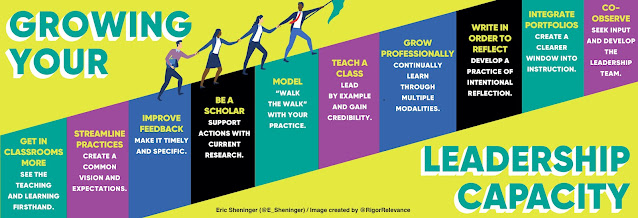
It is easy just to say how one should improve leadership or anything else for that matter.  In Digital Leadership I offered ten specific strategies implemented during my time as principal that you can adopt now, which you can read about below.


Visit Classrooms Routinely

This seems so easy yet is a constant struggle.  Consider increasing the number of formal observations conducted each year and commit to a schedule to get them all done.  We formally observed each of our teachers three times a year, regardless of experience.  Another successful strategy is to develop an informal walk-through schedule with your leadership team.  I mandated five walks a day for each member of my team, and we used a color-coded Google Doc to keep track of where we visited and the specific improvement comments provided to each teacher. 

Streamline Expectations and Eliminate Ineffective Practices

Think about establishing a shared vision, language, and expectations for all teachers.  We did this by using the Relevant Thinking Framework.  This will provide all teachers with consistent, concrete elements to focus on when developing learning activities.  Get rid of the dog and pony show ritual of announced observations.  If lesson plans are still collected, ask for them to demonstrate what will be done two weeks into the future.  Consider less of a focus on lesson plans and more on assessment by collecting these two weeks into the future. 

Improve Feedback

Provide at least one suggestion for improvement, no matter what is seen during an observation or walk-through.  There is no perfect lesson.  Suggestions for improvement should always contain clear, practical examples and strategies that a teacher can implement immediately.  Timely feedback is also essential.

Be a Scholar

Being a scholar helps you as a leader to improve professional practice and puts you in a position to have better conversations with your teachers about their own improvement.  This adds a whole new level of credibility to the post-conference.  I made an effort to align every point of critical feedback to current research.  As you come across research that supports the types of effective pedagogical techniques you wish to see in your classrooms, archive it in a document that you can refer to when writing up observations.  I spent each summer as principal reading, researching, curating, and adapting this for use during the school year.  It saved me time when it came to writing up observations and greatly improved my relationship with my staff as the lead learner. 

Model

Don't ask your teachers to do anything that you are not willing to do yourself.  This is extremely important in terms of technology integration in the classroom and professional learning to improve practice.  If a teacher is struggling with their assessments, don't just say you need to work on building better ones.  Either provide an example that you have created or co-create an assessment together. 

Make Time to Teach a Class 

This can be accomplished regularly during the year or by co-teaching with both struggling and distinguished teachers.  During my first couple of years as an administrator, I taught a section of high school biology.  This is leading by example at its best.  It also provides a better context for the evolving role of the teacher in the digital age.  A leader who walks the walk builds better relationships with staff and will be in a much better position to engage staff in conversations to improve instruction. 

Constantly Seek Out Ways to Grow

Attend at least one conference or workshop a year that is aligned to a significant initiative or focus area in your school/district (the annual Model Schools Conference is a fantastic option).  Try also to read one education book and another related to a different field such as leadership, self-help, or business.  So many powerful lessons and ideas can be gleaned once we venture outside the education silo.  To complement traditional means of professional learning, work to create or further develop a Personal Learning Network (PLN).   

Reflect Through Writing

Writing has enabled me to process my thinking resulting in a more critical reflection of my work in relation to teaching, learning, and leadership.  Our reflections assist us with our growth and can also be catalysts for our staff and others to reflect on their practice or grow professionally.  Having teachers write a brief reflection prior to the post-conference is an excellent strategy to promote a conversation on improvement that isn't one-sided.

Integrate Portfolios

Portfolios were a requirement for my teachers and complimented our observation process nicely.  They provided more clarity and detail on instruction over the entire course of the school year.  Portfolios can include learning activities, assessments, unit plans, examples of student work, and other forms of evidence to improve pedagogical effectiveness.  They can also be used to validate good practice.

Co-Observe 

During the first quarter of each year, I co-observed lessons with members of my administrative team.  This was invaluable for many reasons.  For one, we were able to utilize two sets of eyes during the observation, as some things will always be missed when done solo, no matter how much experience you have.  This also allowed me to work with my team to help them improve their leadership.  It also helped me grow as every conversation helped me further reflect on what I saw.

There is nothing more important than ensuring quality learning is taking place in our classrooms.  The ten strategies presented can be implemented immediately to improve your leadership while enhancing the practice of those you serve. 

Sunday, December 26, 2021

Top Posts of 2021

With 2020 in the rearview mirror, the consensus was that 2021 would be a much smoother ride.  Most people would agree that this was not the case.  During countless coaching visits, I saw and heard firsthand the myriad of challenges being faced in classrooms, schools, and districts.  Through it all, though, educators found a way to forge ahead in the midst of adversity.  It sure wasn’t an easy path, but the resilience, dedication, and determination of people who have committed their lives to serve children of all ages have and continue to be on display.  I, for one, cannot thank them enough for the sacrifices made and the resulting impact on kids.

Writing this past year has been bittersweet for me.  On the one hand, I continually empathized with educators as the struggle was, and continues to be, very real.  It is difficult to honestly know this feeling if you are just up on a stage and not in classrooms or buildings.  Context matters, especially when doling out advice.  On the flip side, I have witnessed some of the most extraordinary practices that have been implemented with fidelity.  This is no small feat considering the environment that a pandemic had and continues to create.  Through a coaching lens, I was able to generate topics for posts that I thought people would find value in and appreciate.  Writing provides me with an avenue to both reflect on my practice and celebrate that of others.

Speaking of celebrations, I had one on a personal level with the publishing of my latest book in April. Disruptive Thinking in Our Classrooms was one of my major pandemic projects, alongside with becoming a master at cooking charbroiled Gulf of Mexico oysters on the grill.  Since the book became available, I used this blog to create supplemental content while expanding on many of the concepts with additional insight.  All of these posts and accompanying original images have been curated on Pinterest.  In addition to these resources, there is also a comprehensive study guide and an impressive bulk order discount through ConnectEDD Publishing (email info@connecteddpublishing.com).

Without further ado, here are my most popular posts of 2021 in no particular order.  Instead of sharing a summary of each, I have decided to include the unique image that was developed to accompany the content. 

How to Make Learning Stick

Pedagogical Leadership

8 Elements of Effective Coaching

Learning Recovery Through Acceleration

Making Headway with Remote and Hybrid Learning


Thanks for all you do, and wishing everyone the best in 2022!

Sunday, July 11, 2021

Pedagogical Leadership

Leadership is leadership. The same essential qualities and characteristics that exemplify what great leaders do have pretty much stayed the same. What has changed are the tools, research, and societal shifts that impact the work. Leadership is both an art and science with the goal of moving the masses towards achieving a common goal. Leading is not easy, and being effective at it is easier said than done. You don’t have to be perfect nor always on your game. You do, however, have to help others achieve a common goal that gets results. There is no more important goal than to improve learning for kids. Hence the need to look at different aspects or styles to improve outcomes.  

Pedagogical leadership encompasses all the many ways to support effective teaching and learning. Instructional design is a significant component as teachers need continuous feedback on how to implement the curriculum in innovative ways that result in improved outcomes. While instruction is important, it is only one of many aspects that need attention.  Instruction is what the teacher does, whereas learning is what the student does.  Here is where a sole emphasis on instructional leadership might not lead to efficacy at scale. Pedagogical leadership focuses on numerous responsibilities and roles that work to ensure a vibrant learning culture that helps to meet the needs of all students.

The main differentiator here is a broader view that includes more attention to what the learner is doing and the supports needed for success. The pedagogical leader works to create collaborative benchmarks that lead to continuous improvement across the system.  It requires a deeper understanding of how the brain works and research-based strategies that teachers can readily implement in their classrooms. Observations, both evaluative and non-evaluative, still have immense value. However, the pedagogical leader doesn’t stop here. The use of data is extremely important. Efforts are made to help teachers analyze and use it effectively while the pedagogical leader is doing the same to find ways to close achievement gaps, scale differentiation, and create an equitable culture.  

The work doesn’t stop with the above. Investments in time and resources are made to establish ongoing and job-embedded professional learning for staff.  One-and-done, drive-by, the flavor of the month, or substanceless sessions are seen, not entertained.  Pedagogical leaders are constantly trying to ensure learner success by employing effective strategies to improve family engagement.  While working directly with teachers is of utmost importance, empowering parents and guardians to assist in the process is vital. 

The pedagogical leader…..

  • Develops relationships based on trust and mutual respect through mentoring and modeling
  • Provides research and resources to support sound pedagogy
  • Makes time to consistently be in classrooms while providing timely, practical, and specific feedback in collaboration with teachers
  • Learns alongside teachers and administrators
  • Collects and analyzes evidence to improve implementation of effective strategies


Talking the talk must be accompanied by walking the walk. It’s relatively easy for people to tell others what they should do. However, true pedagogical leaders go through the challenging work of showing how it can be done. Here is some sage advice that I learned long ago as a new principal – “Don’t ask others to do what you are not willing or have not done yourself.” If you want to improve pedagogy - and outcomes – it all starts with you.