Showing posts with label Innovation. Show all posts

Sunday, July 6, 2025

The Silent Killer of Innovation and Change

Idea voodoo is the paralyzing belief that a brilliant idea is a substitute for the methodical, and often difficult, work of execution required to make it a reality. Recently, on Unpacking the Backpack, I shared some thoughts on the topic after revisiting a blog post I wrote in 2017, which you can read HERE.  Listen on Spotify or wherever you access your favorite podcasts. Below are some expanded thoughts on the topic, including additional research.

We all struggle with a tug-of-war of sorts when it comes to ideas. In many situations, we are asked to either implement or embrace the ideas of others, particularly those to whom we are accountable or so-called experts in the field. This can be problematic at times if the groundwork explaining the what, why, when, and how has not been clearly articulated. Then there are those ideas that we develop on our own. Throughout my career and even up to this point, ideas have constantly flowed through my mind. There tends to be a bias towards the ones that we come up with, a phenomenon where our own labor leads us to disproportionately value our own creations (Norton et al., 2012). This throws another wrench into the process of moving an idea into actionable change.

Being open to new ideas is extremely important in these disruptive times. If we continue to employ the same type of thinking, then the chances are that we will probably have to settle for the same old results, or worse. Great ideas are the seeds of change. Many of them don’t have the opportunity to germinate because of our fixed mindsets. For the most part, nobody likes change. This is just how our brains are wired, unfortunately, for many of us. Research has long shown that a powerful status quo bias often leads individuals to prefer current states over uncertain alternatives, even when the change offers potential benefits (Kahneman et al., 1991). I can tell you that this was the case for me early in my administrative career. It is important not to fall victim to idea voodoo.

“Idea voodoo” is the insidious belief that a powerful, innovative idea is sufficient on its own to manifest change. It’s a form of organizational superstition, treating a concept not as a starting point for hard work, but as a magical incantation that should effortlessly reshape reality. This mindset is one of the most significant yet subtle inhibitors of genuine progress, as it fundamentally misunderstands that change is not a revelation, but a process. It conveniently divorces the glamour of the "eureka!" moment from the grueling, unglamorous labor of execution. An organization captured by idea voodoo will celebrate the brainstorming session but fail to allocate the resources, create the project plans, or assign the accountability necessary to bring the vision to life.

The primary way idea voodoo inhibits change is by fostering passivity. The proponent of the idea, believing in its inherent power, presents it and then waits for it to be adopted, as if the concept itself will persuade dissenters, secure funding, and devise its own implementation strategy. When the idea inevitably falters, its champion doesn’t blame the lack of a plan; they blame the organization’s “resistance to change” or colleagues who “just don’t get it.” This creates a toxic cycle of perceived brilliance followed by disappointing inaction. Over time, this pattern breeds widespread cynicism. Employees learn to see new ideas not as exciting opportunities but as the beginning of another frustrating, dead-end initiative. They become conditioned to ignore the "next big thing," knowing it will likely vanish without a trace.

Ultimately, idea voodoo stalls momentum by treating the catalyst as the entire chemical reaction. It fixates on the noun (the idea) while ignoring the verb (the work). True, sustainable change requires a culture that values execution as much as, if not more than, ideation. It requires acknowledging that the best idea is worthless without a practical, step-by-step plan to navigate obstacles, persuade stakeholders, and integrate the new reality into existing systems. Escaping idea voodoo means trading magical thinking for methodical effort, understanding that successful change depends on a strong implementation climate where the new behavior is expected, supported, and rewarded (Klein & Knight, 2005). Change isn't summoned—it is built, brick by painstaking brick.

Kahneman, D., Knetsch, J. L., & Thaler, R. H. (1991). Anomalies: The endowment effect, loss aversion, and status quo bias. Journal of Economic Perspectives, 5(1), 193–206. 

Klein, K. J., & Knight, A. P. (2005). Innovation implementation: Overcoming the challenge. Current Directions in Psychological Science, 14(5), 243–246. 

Norton, M. I., Mochon, D., & Ariely, D. (2012). The IKEA effect: When labor leads to love. Journal of Consumer Psychology, 22(3), 453–460.

Sunday, May 5, 2024

Quantifying Innovative Practices

Lately, I've been giving a lot of thought to effectiveness, and this has been mirrored in my writing and work as a coach. Reflecting on my time as a principal at my previous school, I recall the successful shift towards digitalization and incorporating innovative practices. Our main goal was to demonstrate tangible improvements rather than just discuss them. We merged quantitative and qualitative measures to validate each innovative idea's reasons, processes, and outcomes in detail. The critical element in this equation was skillfully purposefully employing digital resources while ensuring consistency and continuity in all our old and new practices. 

As a principal, I persistently sought methodologies and procedures to gauge the effects of the changes we were enacting. Regrettably, no such solutions were available. As I engage with districts and schools regularly, they frequently inquire about ways to gauge the outcomes and efficacy of their innovative strategies, such as BYOD, 1:1, blended and personalized learning, classroom and school redesign, branding, makerspaces, and professional development. This got me thinking about what might be missing to ensure efficacy. 

As the CEO of Aspire Change EDU, I'm dedicated to research-driven, data-enhanced, and evidence-based services and resources to aid districts, schools, and organizations in transforming teaching, learning, and leadership. Among these resources stands the Innovative Practices Assessment (IPA), which was created to fill a void in moving from ideas and innovative practices to results that improve the learning culture. 

The IPA establishes the framework for educators and administrators, facilitating an innovative lens to underpin individualized professional growth. It initiates by scrutinizing the tactics instituted within each educational institution, at the school or district level, which bolster student learning through technological integration, encompassing dimensions like rigor, pertinence, interpersonal bonds, involvement, and the broader ethos. Subsequently, the procedure advances to comprehending the extant leadership methodologies that effectively usher in technology and groundbreaking approaches. These methods are harmonized with the 7 Pillars of Digital Leadership & Learning. (Student Learning, Learning Spaces and Environment, Professional Growth, Communication, Public Relations, Branding, and Opportunity). 

Through this proven model, schools and districts can identify opportunities to begin their transformation or take their digital and innovation goals to the next level. The IPA combines a self-reflection questionnaire rubric, on-site observations, and extensive data and evidence collection inventories. Rubrics are then leveraged to observe leadership and instructional practices while collecting artifacts to provide evidence of efficacy-based innovative practices. Once collected and analyzed, a detailed summary report outlining areas of success, focus opportunities, and recommended next steps will guide the professional learning journey, supporting the development of a strategic implementation plan.  


Here is a summary of the IPA process:

Step 1: The IPA questionnaire is completed by the district or school. This 18-question rubric asks school leaders to reflect on their perceptions of where their school falls, from needing to start to well-developed. School leadership teams are expected to collect and document aligned evidence for each item during this reflective process. This information will then be reviewed at the initial meeting for reflection and goal-setting to grow and improve. The baseline evidence shared is in the context of determining the fidelity of innovative practices that currently exist and are implemented on a routine basis (including examples of data, lesson plans, unit plans, student work, PLC minutes, rigorous digital performance tasks, walk-through forms, assessments, sample observations/evaluations, portfolios, PD plans, social media accounts, pictures, videos, press releases, media coverage, partnerships, etc.). 

Step 2: On-site observations and interviews with leaders, staff, and students are conducted to validate perceptions and evidence collected for the questionnaire. Targeted classroom observations of student learning aligned with the mission and vision of the school(s) are also conducted. Additional data is collected for analysis in the final report. The idea is to engage school leaders in dialogue about their culture, student learning, and practices, regardless of their transformation. 

Step 3: The data and evidence are tightly aligned to research-based rubrics to provide a detailed view of where a district or school is with its transformation. The data and artifacts are analyzed, leading to a summary report detailing the current state of practice at each school or district. 

Step 4: The IPA report is shared and discussed with the school or district leadership team. Observations about the evidence collected are shared and discussed. During the strategic planning process, discussions focus on areas of strength and improvements to develop a tailored and personalized implementation plan.

Step 5: On-going professional learning is implemented and progress monitoring through the robust questionnaire is documented to determine the efficacy of the transformation efforts using innovative approaches.

The IPA process has been created to support districts and schools looking for ways to measure and articulate the impact of technology and innovation on practice. While data is valuable, it moves beyond this as the only metric for success by actually taking a lens to an array of strategies and practices that combine to create a thriving learning culture.  

The IPA doesn’t just look at innovation. It also provides insight into all elements of school culture and student learning. In addition to being informed by a broad body of research and driven by evidence, the IPA process is also aligned with the following:

Evaluation of our practice is essential to grasp our current position and the impact of alterations. We aspire that the IPA process will aid you in shaping, honing, gauging, and subsequently disseminating remarkable innovative practices that vividly portray the achievement of effectiveness.

Reach out today to have a conversation on how the IPA process can help transform your school, district, organization, or system (AspireChangeEDU@gmail.com)


Sunday, June 12, 2022

The Significance of Small Wins

Is there such a thing as a “small” win?  I think we can challenge this notion as the overall impact is in the eye of the beholder. Jude King shared the following:

Small wins can be as important or even more important than the big ones.  And there are two main reasons why.  First, without the small wins, the big one likely won’t happen — we give up in disappointment and frustration before we get to the big win.  The small wins hold the key to momentum.  They infuse us with motivation to keep going.  Second, the big magical moments, that we like to savor happens infrequently.  Those big, breakthrough moments that completely takes our breathe away…there are only so much of them in one lifetime.  That’s partly why we enjoy them so much.  But the small wins are more frequent — what they lack in size they make up for in numbers.

It is human nature to have a desire to “go big” or make a dramatic change at scale.  While we tend to think that this is the ultimate measure of success, the fact of the matter is that these situations are few and far between. 

The challenge then becomes what happens to motivation daily during any change process.  Research has shown that the small wins are just as important, if not more, than the big ones everyone aspires to achieve.  Below is a summary by Stephen Meyer of a study by Amabile & Kramer (2011):

Over the course of four months, researchers at Harvard conducted a study of over 200 employees at seven different companies.  The study required participants to do one simple thing each day – respond to a survey at the end of their workday.  The survey asked about the participants’ mood, motivation level and what they did at work that day.  The study resulted in over 12,000 survey responses in total, which were then analyzed by the researchers.

According to the head researcher, the type of progress that results in high motivation, engagement and positive feelings doesn’t need to be earth shattering.  In fact, it often isn’t.  “They don’t have to be big breakthroughs or huge successes… small wins can lead people to feel terrific,” she stated.

The immense value in small wins resides in the immediate impact they can have on an individual and the collective.  They also work to:

  • Increase motivation
  • Improve morale
  • Provide autonomy
  • Leverage available resources
  • Make the most out of time
  • Serve as a catalyst to learn from problems expeditiously
  • Foster collaboration


I shared the following in Disruptive Thinking in Our Classrooms:

We must not discount even the smallest successes during both good and trying times; doing so is a simple and authentic way to build people up and maintain momentum.  Over time these small wins can morph into catalysts for more extensive change efforts.

In actuality, small wins can be huge.  Never discount their impact as they are crucial in setting the stage for bigger ones in the future.

Amabile, T. M., & Kramer, S. J. (2011). The power of small wins. Harvard Business Review, 89(5), 70-80

Sunday, May 15, 2022

Embracing an Evolved Thought Process

It is quite hard to keep up with all the exponential changes we are experiencing.  Take technology for example.  We get used to a device or app and before we know it there has been a huge update that alters the experience or it’s gone and replaced by something else.  I think we can all agree that disruptive change is not the standard in society, but the question becomes how is this impacting education?  Honesty is the first step to grow and improve.  As you take a critical lens to your practice and that of your colleagues or school, what do you see?  Learner success relies on our openness to challenge conventional thought processes in order to evolve. 

I shared the following in Disruptive Thinking in Our Classrooms:

I would wager that many of our assumptions in education stem from how we were taught throughout our own educational journey. Others were likely adopted based on how we were led or the ways in which teaching, learning, and leading was modeled for us. In either case, once beliefs are established, people have a difficult time changing them when challenged. In order to be our best selves—and best serve our students—what we embrace can and should evolve over time. 

While TTWHADI (that’s the way we have always done it) can still lead to positive or even better results, the fact remains that it can also have a stagnating effect.  Traditional does not always mean better, regardless of the fact that it might have worked for you or your stakeholders.  Take a look at the chart below to see where there is an opportunity to think differently and grow. I developed it after re-reading chapter 2 of Disruptive Thinking.


The purpose of the chart above is to be a catalyst for collaborative conversations or individual reflections to spur growth. Elizabeth Thorton provides some good food for thought:

In order to change our lives and ultimately change our world, we must start by examining our own mental models: our beliefs, assumptions, and expectations about the way the world is and the way things ought to be. We think and act through our mental models. What we fundamentally believe about ourselves, what we believe to be true, what we have decided is important to us, what we focus on, is often what our experience will be.

The mind can be either an asset or a detriment to growth.  My hope is that the chart presented in this post can be used to develop questions about where you are, but more importantly where you want and need to go for the betterment of kids.  To prepare them for a disruptive world we must embrace an evolved thought process. 


Sunday, March 27, 2022

Change Begins with You

When we do things a certain way, we often become comfortable, especially if we are satisfied with the result.  While this might seem perfectly fine on the surface, the truth is that progress can become stagnant.  The fact of the matter is that change will always be needed as employing the same old thinking will continue to lead to the same old results.  My hope is that if you are reading this post, you are open to growth and the pursuit of innovative practices.  That, in my opinion, is the easy part.  The heaving lifting lies in moving the masses towards a common goal. 

The hardest challenge you will face is not changing yourself, but convincing or empowering others to embrace change. 

Changing perception and behavior amongst those you work with and for can possibly be the most complex task you ever take on.  Change is hard.  There is no way to sugarcoat this fact.  It is even harder for people who don’t see the value in doing things differently or are burnt out.  The need to push forward is simple yet profound.  Every student in every classroom and school deserves excellence.  While there will always be a myriad of obstacles, the struggle and effort will pay off. 

So, where does one begin?  I shared the following in Digital Leadership:

A true testament to an exceptional leader, regardless of position, is their ability to convince, persuade, or inspire others to change, especially those who do not want to.  It’s not now about trying to get buy-in but moving others to see the value in the change through embracement.

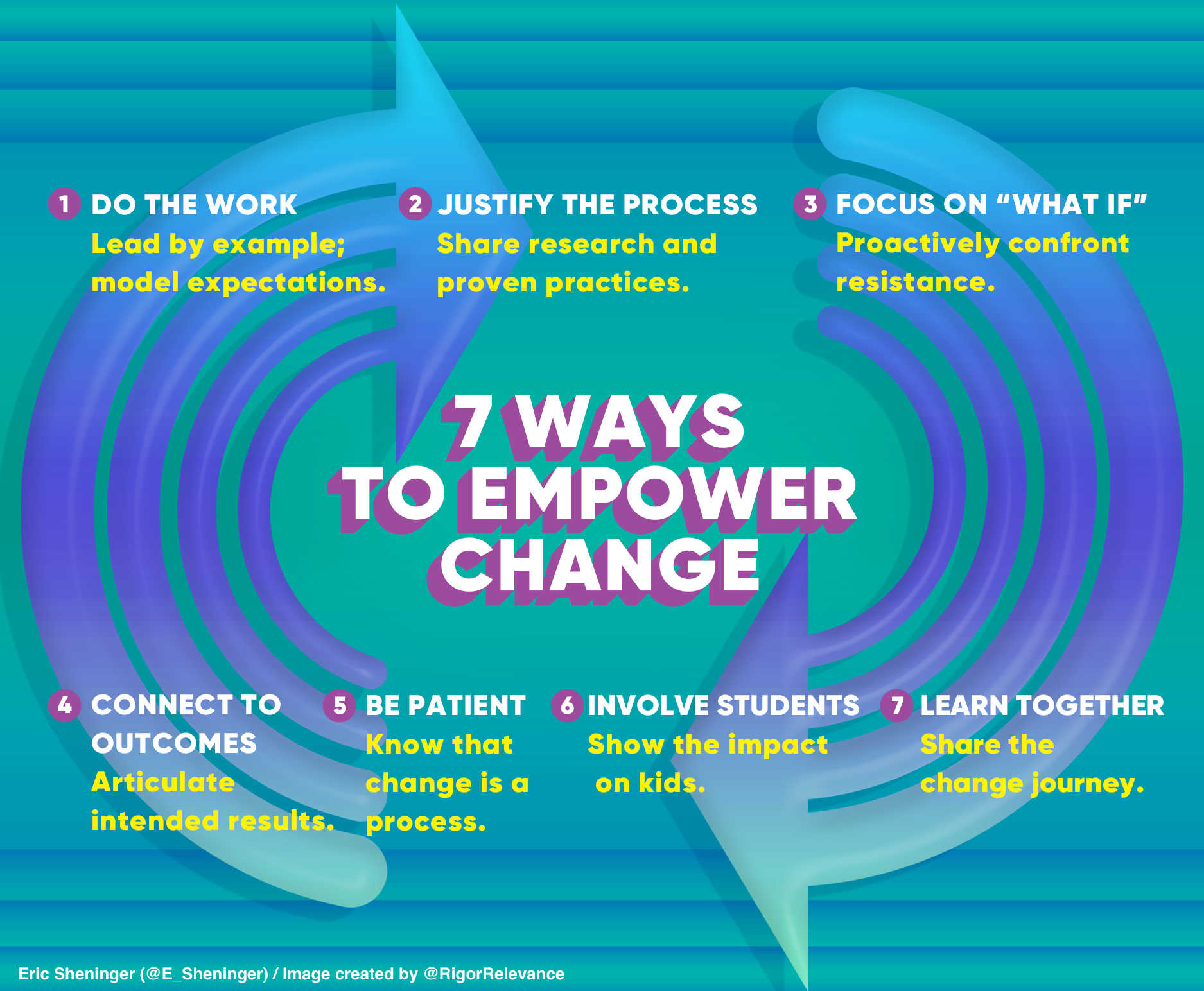
The most challenging yet gratifying work you might ever engage in is empowering your colleagues to change.  Below are some strategies for you to consider when trying to assist your colleagues with changing their professional practice.


  • Do instead of asking.  Impactful change comes from your ability to effectively model expectations for others.  While it might be lonely at first, leading by example is the best way to empower others.
  • Justify with research and proven practices.  Sharing what has been found to work strengthens your call to action.
  • Focus on “what if". Tackle fears and resistance head-on to alleviate concerns by being ready to counter any “yeah but” responses. 
  • Connect to outcomes.  Clearly articulate how the change will improve professional practice resulting in improved student learning and achievement.
  • Be patient (to a point).  Change is a process, not an event.  Treat your colleague like a student and remember how satisfying and rewarding it was when you helped that student succeed.  Help others see the value of the change on their own by taking a step back. 
  • Get students involved.  There is no better way, in my opinion, to convince others to change when educators can see firsthand the impact it has on kids.
  • Learn together.  Encourage colleagues resistant to change to attend professional learning opportunities with you, especially administrators.  If that doesn’t work, make sure you present what you learned at any recent learning experience, either during a faculty meeting or one-on-one.

As with any advice, context matters.  Keep this in mind as you look to implement the strategies presented above.  When it is all said and done, always remember that the most difficult work with the change process involves moving the masses to scale the initiative for the betterment of all learners.  If you are willing to put in the time and work while acknowledging some of the aggravation and stress that naturally comes with dealing with difficult people, a potential positive outcome will be that much sweeter.  

Sunday, May 2, 2021

Student Success Relies on Future-Proofing Learning

Imagine if we all had a crystal ball? It sure would have come in handy prior to the pandemic. What if I told you that we might have actually had one in the form of a retro animated series that aired over fifty years ago that predicted some modern technological innovations? Below is how I opened Disruptive Thinking in Our Classrooms:

One of my favorite shows as a kid was The Jetsons. Even though it only aired for one season in the 1960s, I got my fill thanks to non-stop reruns throughout my childhood. For those who have not seen the show, it focuses on a futuristic family residing in Orbit City, whose architecture looks like it was invented by Google with all the living residences and businesses raised on adjustable col­umns high above the ground. The entire series revolved around the family’s life one hundred years into the future assisted by labor-saving technologies that often broke down in humorous ways. 
The Jetsons provided us with a glimpse into what society could look like one day and inspired people young and old to dream about the future. Some of the show’s bold predictions actually came true, includ­ing video conferencing, robots, smartwatches, drones, jetpacks, holo­grams, and automated homes. Other inventions are within our grasp such as flying cars, driverless vehicles, and computers so powerful they have the operating capacity of the human brain.  Things are moving fast in our world. In the words of the wise Ferris Bueller, “Life moves pretty fast. If you don’t stop and look around once in a while you could miss it.” This is spot-on advice to keep in mind as we enter further into our own Jetsons moment.

Life sure does move fast. Even before the pandemic, it was difficult, if not near impossible, to keep up with all the exponential change as a result of the 4th Industrial Revolution. The “Jetsons moment” has become engrained in our lives no matter where we live or work. In a short period of time, we have seen innovative companies such as Uber, Lyft, Vrbo, DoorDash, and Robinhood disrupt many traditional service areas.  While there might be a consistent focus on disruption now, the fact remains that it is not new and has been impacting the world since the beginning of time.  A ride through Epcot’s Spaceship Earth shows how papyrus paper, the printing press, television, and the first home computer not only disrupted but revolutionized the world.  

Exponential change is the new normal. To adequately prepare students, the key is to future-proof learning, so they are always ready for whatever faces them. While this might seem like a stretch or even impossible, I assure you it’s not. Here is how to begin:

  • Develop higher-order thinking through scaffolded questions and tasks
  • Authentic application of knowledge and concepts in connection with real-world problems.
  • Purposeful use of tech-driven by the learner
  • Equity and cognitive flexibility through personalization
  • Learning environments that reflect current (and future) contexts


Creating a classroom culture that empowers students to replace conventional ideas with innovative solutions to authentic problems can lead to prosperity in a bold new world. Disruption is here to stay, thus the need to future-proof learning. Disruptive thinking is the way to get there. To learn more, get your copy of my new book on Amazon.

Sunday, December 20, 2020

Challenges Create Opportunities

 "Challenges are what make life interesting and overcoming them is what makes life meaningful." - Joshua J. Marine

I love working with educators. Even though I am often the facilitator of learning, I always seek out opportunities to put myself into the shoes of those doing the day-to-day work and then use this as an opportunity to reflect on my practice. The other day I was working with Davis Schools in Utah on a hybrid learning model where educators would be teaching face-to-face and remote learners at the same time. My partner in crime was Belinda Kuck, who is the Director of Teaching and Learning. We have been working closely over the years on personalized learning support for teachers and administrators in the district. I learn so much from her every time we chat.

The premise of the work we kicked off was helping educators and districts manage time and utilize effective pedagogy during these challenging times. It is essential to recognize the fact that a hybrid model was never intended for K-12 education. Thus, providing support in the form of professional learning is something that all districts and schools should be investing in, whether internally or externally. Belinda began each session with an overview of the pilot program where educators would receive both a technology package (digital camera, laptop, microphone, tripod) and on-going professional learning from the International Center for Leadership in Education (ICLE) facilitated by yours truly. The best part of this was how she told the educators that they would be empowered to provide feedback to the district on how to implement the hybrid model best. It's awesome when the voices and ideas of those doing the work are valued.

After the pilot program's premise was shared, there was one more piece that Belinda assigned before I rolled up my sleeves and got to work. She asked each person to share a "peach" and a "pit" from their experiences during the pandemic. At first, I wasn't really sure what she was trying to accomplish with this analogy, but there was some quick clarification. This was a good thing as I had visions of Beverly Hills 90210 in my head. For those of you who never indulged in this 90's classic, there was a restaurant called The Peach Pit that Brandon and the crew frequented. Don't judge me for enjoying the show.

The peach represented something sweet, such as a practice that evolved over the past couple of months. Many of the responses centered around integrating technology, utilizing Canvas more effectively, getting to know students better than in the past, and shifting to more personalized strategies.  The pit referred to hardships and challenges.  It wasn't surprising that there were more pit responses than sweet.  The most common challenges revolved around time, mental health, student engagement, and a learning curve when it came to the purposeful use of technology. 

After reflecting on the sessions, something dawned on me. If it weren't for the pit, we would never have the peach. As much as it can be an annoyance when we are enjoying eating the peach, the giant seed in the middle leads to the tree that will eventually bear the fruit. The point I am trying to make in all of this is that challenges, as much as they cause stress and anxiety, lead to opportunities to change for the better. In the face of adversity, educators have and continue to innovate in ways that will benefit learners for generations. It is vital to view challenges as the pit. When they are overcome, it will be such a sweet feeling and hopefully as satisfying as eating a peach. If you don't like eating peaches, then use this analogy with any fruit that has seeds.  Keep up the excellent work, everyone! 


Sunday, November 24, 2019

The Stages of Innovative Change

Change isn't coming as it is already on our doorstep. Granted, this has been the case for thousands of years thanks to either discoveries such as fire and cultivated crops or inventions that led to the creation of electricity, manufacturing, and expeditious travel. No organization or system in any field is impervious to this fact when one looks at a myriad of disruptive forces at play in society. In the case of education, the choice is to either adapt or evolve in ways that lead to improved outcomes aligned to teaching, learning, and leadership. Just because something worked in the past doesn't necessarily mean it is still an effective strategy now.

The desire or imperative to change depends on a combination of perspective, culture, and achievement. Neither is more important than the other, in my opinion, but all are informed in some way or another by results. Hence the pursuit of innovative practices to usher in needed change. More often than not, there is a will to innovate through the pursuit of new and different practices that aim to improve what our learners and we do inherent in our respective position. Just because we try something different doesn't mean that we or the practice is actually innovative. This is proven or disproven by a tangible result in the form of qualitative or quantitative evidence. To debate this fact takes away from the real power that innovation can have in education.

Now let's focus more on the process of innovative change. It begins with one person and his or her actions to move the needle on a specific practice. As I always say, don't expect others to do what you have not or have been unwilling to do yourself. Now don't get me wrong, this is a fantastic and needed start. However, change in the context of an entire school, district, organization, or system relies on moving the masses so that all learners, staff, or stakeholders benefit. Herein lies both the challenge and the opportunity inherent in the process. In Digital Leadership (2nd Edition), I provided the following image that highlights six common stages that schools work through in order to successfully implement innovative change that impacts the entire culture.


Status Quo

The rationale that leads to both a conversation and a need for change begins here. It is here where the most dangerous phrase in education typically rears its ugly head – That's the way we have always done it (TTWWADI). What results is either a sense of comfort (i.e., high test scores) or fear (what if we try something different and it doesn't work). In both cases, the pursuit of innovative practices either stops or never even begins. Acknowledging that the status quo is holding your system back and that something has to be done differently to improve outcomes gets the ball rolling.

Struggle

News flash – many people don't like change as the status quo presents cover from failure. With any new idea or strategy, there will always be a sense of personal and collaborative struggle. It's the latter that the majority of our energy has to focus on. Moving towards systematic transformation requires an understanding that the journey is rarely easy and seamless. The struggle is also defined by what seems like never-ending challenges such as time, money, support, infrastructure, inadequate professional learning, mindset, and colleagues who fill either the role of antagonist or naysayer. The struggle is real people, and to scale change, you must be prepared upfront.

Dissonance

The stage is characterized by a lack of agreement typically defined by inconsistencies between the beliefs one holds or between one's actions and one's beliefs. Dwight Mihalicz provides this great synopsis on the importance of this stage.
Discord is all around us. And conflict in organizations is nothing new. Why is conflict so pervasive in most organizations, to the extent that some organizations are dysfunctional by any definition? And yet employees tolerate the conditions. This has to do with the concept of dissonance. Dissonance has less to do with conflict and more to do with understanding how and when conflict incites change, and what needs to take place for change to happen seamlessly. 
Dissonance only comes into play when the system breaks down unpredictably and doesn't work. In this state, people are no longer willing to put up with it because there is now unpredictability with results causing discomfort, prompting the desire to change.
The main takeaway here is to embrace dissonance and use it as the fuel for innovative ideas.

Innovative Idea(s)

The foundation is now set for the stage where an innovative idea or strategy can be discussed, implemented, sustained, and evaluated for success based on a tangible result. When developing or presenting an innovative idea, keep these questions in mind:

  • Why will it improve what you or your learners do as well as the culture? 
  • How do you (or will) know it has led to an improvement? 
  • How do others determine if it has led to an improvement? 
  • What is needed to scale the effort(s)? 

Assimilation

In this stage, the innovative idea becomes absorbed into the very fabric of a school or district's cultural DNA. It isn't about one educator, classroom, or isolated practice. The idea takes form and is both embraced and implemented at scale. The key point here is while it is great to experience success at the individual level, real change that impacts the majority is assimilated across all aspects of teaching, learning, and leadership.

New Status Quo

The final stage is what the end goal of any innovative change effort should be, and that is the creation of a new status quo. It is at this point where you can hear and see through multifaceted evidence that new and different has actually led to a better result. What this ultimately looks and feels like will vary from school to school or system to system, but the fact remains that the change effort has been embraced and sustained.   

Innovation is a collective endeavor geared at not only individual but, more importantly, system improvement.  Research can be used to inform and influence the process but does not need to drive it. What is important is to show how innovative practices can, and will, improve our work.  Evidence that illustrates efficacy helps move innovation from an isolated practice focusing on small pockets to scalable change that impacts an entire culture. Start small, but think and plan for big while referring to the stages presented above. 

Innovate with a purpose, but make sure the venture extends well beyond an individual level. In the end, it's not about how much you innovate in education, but the resulting impact of the changes on the collective. 

Sunday, October 13, 2019

Where is Your Learning Culture?

There are many factors that inhibit change. In some cases, comfort is the enemy of growth. We teach the way we were taught or lead the way we were led. Now I am not saying that this is bad per se, but the bottom line is whether or not the practice is effective. The same could be said for the status quo. Doing what we have always done might seem like a sound path forward if the results you are judged on are good or increasing. Herein lies one of the most prominent challenges schools and educators face, and that is perceived success based on traditional metrics and methodologies. 

Achievement is great, but it is one piece of the puzzle. How the structure and function of a learning culture lead to improvements in achievement and outcomes is where change efforts should be focused. This leads to the point of my post. Where is your learning culture? Think about this question in the context of the world where your learners will need to thrive and survive. Will they have not just the skills, but the competencies to succeed in a world that is in constant flux? 


New jobs and fields require learners to be both dynamic thinkers and doers where they have the competence to think in complex ways and to readily apply the knowledge and skills they have acquired. Even when confronted with perplexing unknowns, learners can use extensive experience and expertise to create solutions and take action that further develops their skills and knowledge. As I have written in the past, we are well into the 4th Industrial Revolution characterized by automation, advanced robotics, artificial intelligence, and disruptive innovation. Seismic shifts in the society and the world of work compel us to take a critical lens to our practice, as improvement is a never-ending endeavor.

So how do we begin to transform culture? The journey starts with being honest about where you are in order to chart a path forward to get to the place you want to be. Reflection is a powerful tool for growth. Take a look at the image below and reflect on it for a minute or two.

Image credit: Awaken Group Revolutions

Where does the culture of your school fit into these categories, and why? Think about what needs to happen to make needed shifts to practice that aligns with the 4th Industrial Revolution. Success, in terms of achievement only, can, at times, be a mirage. A learning culture should best prepare kids to meet the demands inherent in the new world of work. The first leg of the process is being honest about where you are.

Sunday, September 1, 2019

It Won't Work...Or Will It?

When we look at various aspects of society, there is always an innate desire to improve through innovation. However, there seems always to be impediments to this process. Perhaps it is the little voice in your head that says any new idea or strategy is a waste of time, as it has no chance to succeed. Maybe it is the collective voices of colleagues pushing you to abide by the status quo and not rock the boat. Throw in fear, complacency, or a myriad of other excuses and the pursuit of innovative practices either wane or never transpires. You will never know what could have been if you don’t take the chance to try something new. Don’t just take my word for it. Check out all of the innovations that people thought wouldn’t work below.


Pretty interesting right? At one point, all of the ideas above were deemed crazy or doomed to fail. Each has been a disruptive force that has changed how people watch movies, book hotels, listen to music, access information, get assistance, store files, or get from one place to another. Many lessons can be learned from past innovations that have reshaped culture and society. For starters, you need to believe in an idea or strategy that might be obscure or shunned upon now. Sure, it might not work, but history has taught us that some of the greatest successes of all time resulted from failure. Always base any decision to try something new on the premise that is it better for your learners and will ultimately improve professional practice.

Another element to consider is moving beyond the misconception that innovation in education has to do with technology. I often look at two ideas that were implemented during my time as a principal that had very little to do with tools or gadgets and everything about improving either school culture or the learning experience for our kids. From a cultural end, we developed learning academies, a school within a school model, to move away from an environment where we continued to do what we had always done. The result was three distinct academies, open to all learners regardless of GPA or label, where they not only pursued a distinct area of study of interest to them but also ultimately graduated with ten to fifteen more credits than the state of New Jersey required.

Grading is another entity that is ingrained in many schools and districts. Some have gone so far as to get rid of grades, which in my opinion, is both innovative and disruptive. Sometimes learning is devalued by a number or letter. We tackled the grading culture when it became apparent that we were failing too many kids. After looking at the research and forming a committee, a new policy was put in place. The result was a 75% decrease in failures over three years, increased achievement gains, and a graduation rate that was one of the tops in the state. Both the academies and grading example are not to say that technology doesn’t play a role. The true innovative nature of tech isn’t to tool or program, but instead how the teacher uses it in a way to improve learning outcomes for all kids.

As I have written in the past, innovation is more than an idea that purports to be new or better. The differentiator is that there is an actual result to substantiate a claim. When looking at the examples in the image, or the ones I provided, there is clear evidence that an idea morphed into something that led to improved results or even a new status quo. There should always be a willingness to innovate that is substantiated with significant changes to learning.

Sunday, June 16, 2019

Education for the 4th Industrial Revolution

“Don’t prepare kids for something. Prepare them for anything!”

I remember a world without the Internet, smart devices, mobile phones, 3D printers, and 4K televisions sets. After all, this was the world that many of us grew up in. There was an abundance of playing outside, reading, walking around the mall, going to the movies, and talking on the phone. Sure, we had our technology at the time, which now seems quite archaic compared to even the most rudimentary devices of today.  However, we were not connected even in the slightest bit when compared to the present. Rotary phones and face-to-face were the main, and really only viable, options available. Little did we know that we were in the midst of the 3rd Industrial Revolution and the dawn of the computer age was upon us. Disruptive change was upon us; we just didn’t know it back then.


Whether you like it or not, we are in the midst of the 4th Industrial Revolution and have been so for many years.  It has and will continue to, fundamentally change the way we engage with each other, work, and go through life. It is exhilarating as it is terrifying.  Take this view from the World Economic Forum:
We stand on the brink of a technological revolution that will fundamentally alter the way we live, work, and relate to one another. In its scale, scope, and complexity, the transformation will be unlike anything humankind has experienced before. We do not yet know just how it will unfold, but one thing is clear: the response to it must be integrated and comprehensive, involving all stakeholders of the global polity, from the public and private sectors to academia and civil society.
Tom Murray and I presented a call to action, highlighting the need to transform teaching, learning, and leadership in Learning Transformed to meet the demands and challenges inherent in the 4th Industrial Revolution.  In the updated edition of Digital Leadership, I took it a step further.  Improving upon and then building pedagogical capacity in ways that align to the competencies that our learners will need in a world that is almost impossible to predict is critical.   Rest assured, it is not as arduous an endeavor as you might think. The key to future-proofing education, and learning, for that matter, is to empower students to think and construct new knowledge while simultaneously having them apply what they have learned in relevant ways. More specifically, education has to prepare kids to be competent in the following areas:
  • Critical thinking and real-world problem solving
  • Relationship building (inter and intra-personal)
  • Digital awareness and use
  • Career and job-specific requirements
So where to begin?  For starters, it is vital to get everyone on the same page. The Rigor Relevance Framework provides the common vision, language, and expectations to help learners develop the competencies to succeed in the 4th Industrial Revolution. For more detailed information, you can view a series of posts on the framework HERE.

Now more than ever, the importance of education cannot be overstated. However, things do need to change at scale.  The status quo cannot be tolerated.  If schools continue down the same path as they have for decades, two things will happen. In one possible scenario, our students could begin to abandon them as they will find more relevant and applicable programs and information online.  The more likely outcome though is that they will not be adequately prepared for the new world of work.  In either case, both of these should be viewed as unacceptable.  Challenging the mantra of TTWWADI (that’s the way we’ve always done it) requires both a bold and fearless educator.  The good news is that we have many of these people in our schools. 


One thing I have learned from hundreds of classroom coaching visits each year is that innovative practices are present. I have been so inspired by teachers and administrators who have begun to embrace different and better pedagogical techniques aligned to the competencies listed above while also improving outcomes in the process.  The challenge is moving practices that prepare kids to succeed in the 4th Industrial Revolution from obscurity to more mainstream.  We must not be satisfied with isolated pockets of excellence. Even though they represent a great starting point and should be celebrated, it is essential to remember that every learner deserves excellence. 

Will the learners in your school be ready?

Sunday, May 19, 2019

The Relationship Between Failure and Success

In life, there are certain truths. One of these is that to succeed, many times, you must first fail. Obviously, this is not always the case, but if you are like me and many others, success doesn’t come easily or on the first try.  Learning to ride a bike is one of many great examples that proves my point.  The process begins with training wheels to build up confidence, get a feel for pedaling, and learning how to brake.  Watching a child zip around on his or her bike at this stage is exhilarating, yet an anxious experience because of what comes next. Then the real challenge and test of resolve begin when the training wheels are removed.  Anxiety on the part of the adult sets in while fear and self-doubt creep into the mind of the child.  I can vividly remember falling numerous times. In the end, though, each failure became a building block for eventual success.


The point of the bike story and countless others is that failure should not weigh us down and in turn, prevent or obscure a pathway to success.  To this day, my personal and professional lives are fraught with varying degrees of failure.  However, I know full well that I would be in a much different place today in both regards if I looked on these experiences as negative and constantly dwelled on them.  This is not to say that I never did both. Sometimes it is hard to get over the hump when we don’t believe in our abilities and ideas. In the end, though, it all comes down to mindset and learning from mistakes.

There is a distinct relationship between failure and success. William Arunda sums it up nicely:
“Failure is not a step backward; it’s an excellent stepping stone to success. We never learn to move out of our comfort zone if we don’t overcome our fear of failure. The most progressive companies deliberately seek employees with track records reflecting both failure and success. That’s because someone who survives failure has gained invaluable knowledge and the unstoppable perseverance born from overcoming hardship.”
To succeed, you must accept that the chances are you are going to fail first. We have seen this lesson time and time again from famous failures throughout history.  The relationship between the two imparts some valuable lessons, which can influence our behavior now and well into the future.  Below are some essential learnings from failure and success:
  1. Determination is the fuel. You will get knocked down. The question is, will you get back up? Try and try again until you achieve the result you and others want.
  2. Use failure as a valuable form of feedback, which can lead to improvement and ultimate success.
  3. An agreement with ourselves to face fear head-on to tackle obstacles and challenges that are always part of the equation. Ignoring or shying away will always result in outcomes that are not favorable or acceptable in the long term.
  4. Mistakes are opportunities to learn. The key is not to make the same mistake twice.
  5. Consistent effort makes all the difference. 
There is a lot more that can be learned from this relationship.  After focusing at the individual level, it is essential to look beyond ourselves and towards the bigger picture.  System-wide success hinges on viewing change as a process, not an event. As the adage goes, there is no “I” in team.  Failure and success then become a shared responsibility where the “downs” are worked through, and the “ups” are collectively celebrated. In the end, we either sink or swim together in schools and organizations.  The choice is yours.  

Sunday, April 28, 2019

Digital Leadership: Leading Change from Where You Are | #DigiLead

A great deal has changed over the past few years not just in society, but also in education. Many of these changes are a result of the exponential advances in technology and the role these tools play in shaping both our personal and professional lives.  As a result, innovative practices emerged in many shapes and sizes. To answer the call of disruption, new thinking had to emerge. Back in 2009, I began calling for an evolved construct of leadership that would better serve schools in meeting the diverse needs of learners and stakeholders alike.  Below is my thinking on the topic that has resulted in the following iteration:
As times change, so must the practice of leaders to establish a culture of learning that is relevant, research-based, and rooted in relationships.  Digital leadership is all about people and how their collective actions aligned with new thinking, ideas, and tools can help to build cultures primed for success.  It represents a strategic mindset and set of behaviors that leverage resources to create a meaningful, transparent, and engaging school culture to prepare learners now and well into the future.
Over time I realized that the digital aspect was a supporting element and amplifier of what leaders in classrooms, schools, organizations, and districts do every day. Sure, there are some unique behaviors and characteristics, but for the most part, it is about identifying intended outcomes, applying an innovative lens, and arriving at them in better, more effective ways. What resulted was the formation of the Pillars of Digital Leadership, a framework for all educators to initiate and sustain innovative change that aligns to the core work that already serves as the foundation for every school or district learning culture. The premise is to do what we already do better by working smarter, not harder. 


Order your copy HERE.

The time has come for a new edition of Digital Leadership.  I can’t begin to explain how excited I am about the finished product as I have woven in what I have learned in the field helping schools apply the concepts to bring about evidence-based results.  Practical and realistic, this version compels all educators to lead from where they are as actions - not title, position, or power – are the key to sustainable changes that lead to actual improvements validated by both qualitative and quantitative measures. Below are some specific highlights embedded in the new edition:
  • A focus on efficacy: In the real-world of education results matter as well as how we arrive at them. Naturally then, this updated edition has research-based, evidence-driven, and learner-focused ideas and strategies that are innovative in nature that lead to observable improvements.  The last chapter of the book weaves all the concepts together while emphasizing the importance of efficacy in any change initiative. 
  • Practical and realistic: Ideas are great, but they have to consider the realities and challenges that schools and educators face across the world.  They also need to align with the core work that educators engage in daily.  The key with this update throughout is for readers to either grasp new ideas and strategies to readily implement or look to improve what they might already be doing. 
  • Evergreen: Many technology books are D.O.A (dead on arrival) once published.  The reason being is that technology changes so fast and tools come and go regularly. To account for this fact, I removed the majority of references to specific tools except for some of the most prolific ones such as Twitter, Facebook, Instagram, etc. The point here is simple. Tools and products will change. However, the means to implement them to transform teaching, learning, and leadership will remain relatively stable.  This edition is written in a way to withstand the test of time. 
  • Re-organized chapters and updated content: You will see not only new chapters but also revised headings and subheadings that are more reflective of the innovative practices that can be scaled in education.  I also re-organized some of the chapters by moving the ones focused on learning to the beginning of the book.  Based on the feedback I received on the first edition, I also beefed up content related to pedagogy. All in all, the new version has approximately 50% new content. 
  • Built-in study guide: Each Chapter ends with 4-5 discussion and reflective questions that are meant to move readers more readily to actions. Be sure to share your reflections, questions, ideas, and successes by engaging on social media using #digilead.
  • Fewer tools, more on leadership dispositions: As mentioned previously, tools will continue to change. That’s why you will see more of a focus on the dispositions of classroom, school, and district leaders that are necessary to initiate and sustain change. 
  • Anyone and everyone can be a digital leader: It is important to understand that everyone has the capacity to lead from where they are. Some of the most impactful leaders I have worked with, or for, have been teachers. The new edition speaks to all educators and empowers them to leverage their specific role to usher in needed change regardless of title. 
  • Updated and expanded research base – It is tough to deny how important this is. Research and evidence in support of ideas and strategies go a long way in building cultures of excellence that are defined by results.  What I hope has resulted is a scholarly piece of work that supports a practical and realistic pursuit of innovative change.
  • Forward by Sugata Mitra: He is a luminary as far as I am concerned, and his research validates many of the ideas presented in chapters 5 and 6, which focus squarely on learning.  His “Hole in the Wall” experiments, begun in 1999, revealed that groups of children could learn almost anything by themselves given Internet access and the ability to work collaboratively. Imagine the possibilities when this learning is facilitated by amazing educators, something the new edition fleshes out.
  • Pick and choose structure: Even though there is a sequential order to the book, it is written in a way that each chapter can serve as a standalone resource.  I wrote it this way so that readers can pick the most pressing, important concepts that they want to focus on to bring about needed change now.  
  • Full color – I will be the first one to admit that this is not that important, but it does add a nice touch.  If you have the first edition, you will see a substantial increase in the number of images throughout the book. My hope is that these add much greater context to the ideas and strategies presented. 
  • Digital resources – To add more substance and stay within a broad wordcount range, I scrapped the appendix from the previous edition.  At the end of the book, you will now see a section that has links to an array of digital resources such as downloadables, sample rubrics, standards alignment, and supporting frameworks. Since I control all of these links each will remain current.
If you enjoyed the first edition, I think you will like the updated version even better. I took to heart feedback I received over the years from readers as well as reflected deeply on my own writing to develop a resource for all, no matter where one is at with their educational career, whether it be in or outside of a school. Thank you for all that you do to support students, teachers, administrators, and other educational stakeholders around the world. My hope is that this new edition can serve as a resource to help you continue to meet and exceed the goals you set. 

Join the movement on social media using #digilead.


Sunday, April 14, 2019

Tap Into Your Full Potential

"Your beliefs become your thoughts. Your thoughts become your words. Your words become your actions. Your actions become your habits. Your habits become your values. Your values become your destiny." - Mahatma Gandhi

There are many elements to change. However, one of the most powerful is that of self-efficacy.  Almost everyone can identify goals they want to accomplish, accomplishments to achieve, or personal and professional aspects they would like to change. Here is where self-efficacy comes in. It plays a significant role in how goals, tasks, and challenges are approached and ultimately achieved.  To improve one's self; we must first determine where our practice currently lies. The next step is deciding where we eventually want to be. Success in this endeavor requires self-efficacy combined with a leap of faith. 


For self-efficacy to play a role in the change process, we must always be open to growth and improvement.  Without these, there is nothing for us to hold ourselves accountable for.  This is why it is so important that we are our own most prominent critic and make reflection a daily part of our routine. No matter who you are and what you do, there is always the opportunity to get better. The question is, will you pursue it?  Enter the Potential Matrix created by Mark Sanborn. It is not about achieving perfection as that is not a reality in the professional world. Sorry to burst anyone’s bubble, but nobody is perfect.  It is about how we can become better to evolve into the best iteration of ourselves. Here is a great description from Thinking Space. 


As we look at the matrix, we probably identify one quadrant which we prefer: perhaps you’re naturally an activist, in which case, ‘performing’ is probably your favored way of operating. If you only ever concentrate on performing, you may not be taking the time to reflect and see how you could operate even more efficiently. If you spend all your time reflecting and planning but never take action to learn new skills and try them out, nothing will change. To see more improvement and to release more potential, we need to step outside of that comfortable quadrant and explore the other areas too. 
You will see that improvement happens not only outwardly as we learn new skills and perform but also inwardly as we think and reflect. It’s about active experiences which we initiate and passive experiences to which we respond.
Our potential is often inhibited by a fixed mindset or an unwillingness to grow.  We often perceive our talents and ideas as not being all that great. I know this is how I viewed these for a long time, which inhibited my growth as both a principal and then as a speaker/author.  However, looking at where we put the most and least amount of time in the quadrants of the Potential Matrix, we can begin to unleash potential that we never thought was possible.  It is ok to not have a clear idea on any given day as to where we want to be.  This is my daily reality.  The key is never to be satisfied where you are. 

If we want to help those we either serve or work with unlock their potential, then we must do so ourselves first. Think about where you are and then where you eventually want to be.  Apply the same lens to your classroom, school, organization, or district. Then take the leap of faith; trusting in your innate abilities to improve in ways you never thought were possible.  Will everything always work out the way you want it to? Heck no! Just remember that each journey, no matter the result, provides an invaluable learning experience. 

There is no better time than now to tap into your full potential. 

Sunday, March 3, 2019

Innovation is More Than an Idea or Tool

What makes something innovative? There is no shortage of debate on this topic in the least bit. From articles to blog posts to books, that subject has been covered in great detail. One can look at numerous companies and develop his or her conclusions.  Take Uber and Airbnb for example. Each in their own right came up with a new and different idea aligned to technology with the goal of creating something that consumers would embrace while making money in the process. Not only did both of these companies disrupt their respective industries, but both have evidence in the form of users and revenue to validate that their solutions were genuinely innovative. The convergence of an idea, tool and strategy have led to ultimate success for both Uber and Airbnb.


In education, there is always an affinity to jump on board the latest tool or idea and automatically stamp the word innovation on it. Now, this isn’t to say that everything in both of these categories is representative of a better means to accomplish a task or to improve professional practice.  The key is the criteria that are used to make such a determination or claim.  Let’s first begin by evaluating the efficacy of both using the following questions:

  • How are kids learning with technology in ways that they couldn’t without it?
  • What observable evidence is there that an idea or strategy represents a fundamental improvement over what has been done traditionally in the past?

I, for one, don’t shy away from the fact that both research and evidence should be part of the conversation.  A mix of qualitative and quantitative measures goes a long way to validating whether or not something is actually innovative.  A push for efficacy benefits everyone who is championing better approaches to improve student learning and professional practice.  Whether to innovate or not should be driven by a challenge or problem that can be overcome in a way that leads to a better outcome.  Achievement can undoubtedly fall into one of these categories, but there is so much more to learning and kids than a score. When it comes to innovation, I see digital leadership and blended learning as two of many ideas, concepts, or strategies where there is research and evidence to support these innovative practices.  

Recently during a coaching visit at Sandshore Elementary School, a part of the Mt. Olive Township School District in NJ, I saw one of the best examples of innovation in practice.  As I was in a second-grade classroom, I saw an odd-looking contraption that I had never seen in a school before, but I also heard a voice coming from it. When I inquired as to what it was, Nicole Musarra, the principal, told me that it was a VGo robotic telepresence for a student who was unable to attend school for health reasons.  Below is a description of the device from the company:
For some students, attending school isn’t possible. 
Injuries, extended illnesses, immune deficiencies, and other physical challenges prevent a student from physically being able to attend school. School districts try to accommodate these special needs by working providing online courses, in-home tutors, special busing, video conferencing and more. But these are expensive and very limiting since students miss out on the classroom experience and social life that comes with attending school.  Now, they can participate in classroom discussions and share in the social aspects of locker-side chats, lunch period and moving from class to class.  VGo gets the student back to the traditional schooling environment by providing a physical device that replicates the student while away from school.  It is operated in real-time by the student (not the teacher or an aid), so they feel empowered with their independence.   VGo enables students to:
  • Receive the same instruction as their peers
  • Move around/between classrooms independently
  • Socialize with friends in the hallways and at lunch
  • Participate in a full school day with their classmates

It was purely amazing to see and hear this student be part of the class even though she wasn’t there physically. As the kids in class rotated from small group to stations so did the student who was at home. In addition to full participation during the lesson, the VGo device was able to move throughout the building so the student could go to gym, lunch, and move about the hallway with her peers. I learned that the kids in school would often dress up the robotic device to add a more humanistic element to it. The only limitation was that the VGo was limited in movement and functionality based on an available WiFi signal. This meant that the homebound student couldn’t go outside to recess. However, I suggested to the principal that hotspots be installed on the outside of the building to solve this challenge in the future. 

The VGo device is a prime example of what innovation really looks like in terms of how it improves what the student is to do.  Without the device, the learning experience, and more importantly the relationships it helps to create, would not be possible. The example above checks all the boxes when it comes to the two questions I posed earlier in the post as well as a fundamental improvement in terms of outcomes. Innovation should not be a buzz word nor something that is thrown around in an attempt to add credence to an idea or strategy.  In addition to the most commonly associated words “new” and “better,” a third term should always follow – RESULT. The key to scaling innovation, in my opinion, is not just to tell how we are, or that we should be, pursuing innovative methods, but actually show the impact in terms of improvements to learning outcomes and professional practice.