Showing posts sorted by relevance for query rigor relevance framework. Sort by date Show all posts

Sunday, March 13, 2016

Rigor, Relevance and Transformation at the Ground Level

The following is a guest post by Jill M. Hackett Ed.D. - Assistant Superintendent, Academic Services/School Accountability, North Kansas City Schools, Kansas City, MO.

Rigor and Relevance can seem like abstract terms until you start to understand how schools and districts apply them in specific ways. Over the past five years, we North Kansas City School District restructured our purpose so that student-centered learning was the ultimate objective. We put Rigor and Relevance in the foreground, along with several other initiatives. By committing to systematic integration of the model, we transformed the culture, the conversation, as well as the results in our district. Making our classrooms truly student-centered and relevant – thereby making real rigor possible – has allowed us to shape common beliefs for student success. 

Here’s a little more about several key elements of our restructuring and their application of the Framework.

“Is this in the best interest of students?”

NKCSD positioned this powerful and grounding guiding mindset as the backdrop for all of our strategies and decisions. This principle helped continually focus our attention on initiatives that would successfully improve our district. We wanted a viable, research-based tool that would allow for collaboration regardless of hierarchy or prior knowledge. We found it in the Rigor/ Relevance Framework. To implement its use, administrators learned how to coach teachers in using it to design learning opportunities as well as how to gauge teacher impact on student achievement. We spent a year training teams of eight teachers from each school to become resident Framework experts who were responsible for replicating professional learning modules on their campuses. Using an early release schedule once a week allowed teachers to meet in teams to further their exposure and understanding of the Framework.

Spotting a Quadrant D Lesson from a Mile Away

As the entire district really became familiar with the Framework, its four quadrants became part of our everyday thinking around instruction and planning. We also developed an awareness of what constituted all of the quadrants and could identify how various lessons were targeted to address learning in each distinct quadrant. Teachers realized that they needed to apply qualities of each quadrant – and know why and when to do so – in order to create relevant and authentic tasks. 

A Hidden Power of the Framework

Every teacher and administrator needs a simple, accessible, and readily-applicable way to talk about how learning can, and needs to, prepare students for life beyond the classroom. With just four quadrants, the Framework is a straightforward tool to consider and discuss student work and achievement. For teachers and administrators in the NKCSD, the Framework began to serve as the common language to describe exactly what it meant to ensure their students were college and career ready. 

A Common Language = A Connected Culture

An additional benefit of deep integration of the Framework into common language was the elevated levels of effectiveness of the PLTs (Professional Learning Teams). Together they shared experiences and observations of the most and least effective instructional approaches and were able to collaboratively determine what kinds of tasks would lead to increased student learning. 

As teachers began speaking the common language of the Framework, true, productive collaboration started to unfold. Numerous teachers grew more confident in their abilities, and mutually supportive relationships blossomed, which had a direct and noticeable impact on the quality of instruction and, hence, the student work emerging from the PLTs.

We also wanted pertinent stakeholders, including students and families, to know that the Framework was the linchpin to instructional decisions and goals. Teachers explained the Framework to students and families, making it known that students were expected to, with time, develop complex, Quadrant D thinking skills and the ability to apply high-level thinking to real-world scenarios. All students and their families were able to see how the district believed in their capability and potential, in specific and identifiable terms. 

Students Truly Owning Their Work

One of the most significant impacts from implementing the Framework came with how teachers provided feedback and built collective ownership of learning. Sharing the Framework with students helped demystify learning goals, giving students powerful ways to self-evaluate, contextualize progress, and articulate goals. 

One representation of the Framework in which a third grader analyzes how he spent his time as part of a writing block demonstrates real ownership of his learning.


The Framework naturally led to conversations in which students and teachers could both analyze and discuss work produced relative to the four quadrants. Instead of the “right or wrong” paradigm, the conversation shifted to the merits of student work and how it could stretch to other quadrants. Students and teachers were able to think about student achievement as a ladder accessible to everyone.

A Story of Improvement and Enrichment

In 2011, North Kansas City Schools had an Annual Performance Report in which the district earned only 78.9% of total points possible, the equivalent of a C in anyone’s grade book. By the 2013-14 school year, and after three years of total district adoption of the Framework, the significant improvements in collegial conversation and student work were reflected in a rating which had jumped to 92.1%. In the 2014-15 school year, we earned a 97.9% rating.

A highlight of the 2016 Model Schools Conference will be welcoming the North Kansas City School District leadership and hearing more about their implementation of the Rigor/Relevance Framework. Be sure to check them out on Twitter.


Sunday, December 27, 2015

Improving Instruction in a Digital World

The Rigor and Relevance Framework—an action ­oriented continuum that describes putting knowledge to use—gives teachers and administrators a way to develop both instruction and assessment while providing students with a way to project learning goals. This framework, based on traditional elements of education yet encouraging movement from the acquisition of knowledge to application of knowledge, charts learning along the two dimensions of higher standards and student achievement.  Capable teacher presence and teacher­ centered instruction always belong in the foreground and always underpin lasting student learning, no matter what digital tools are in use. Grounded in rigor and relevance, instruction and learning with digital tools are limitless. This is the foundation of uncommon learning.

Learning must always be relevant, meaningful, and applicable. Student engagement is a bedrock necessity of attentive and deep learning. Excitement about academic growth, in turn, drives increased student achievement, not only in terms of meeting and exceeding standards but also in terms of learning that extends into all realms of life. With the solid pedagogical foundation that the Rigor and Relevance Framework provides, digital tools and social media afford students the opportunity to take more ownership of their growth and development. Allowing students choice over which tools they will use to create artifacts of their learning that demonstrate conceptual mastery builds a greater appreciation for learning while simultaneously preparing them for the real world.


With advanced digital tools under their belts, students grow to develop their own learning tasks—such as pod­casting, blogging, or digital storytelling—that stretch their creativity, originality, design, or adaptation. These students think and act critically to curate content and apply information to address a range of cross­-disciplinary tasks that are both creative and original. This could include collaborating with others using social media, networking, or reviewing. Their work requires their ability to select, organize, and present content through relevant digital tools, which provide multiple solutions.

Education and digital have become inherently intertwined. Learners and teachers alike are immersed in digital life and need more effective, specific ways to best use digital tools in rigorous and relevant ways to support and/or enhance learning. Educators must be able to develop and enact rigorous, relevant instructional methods and formats while learning about and using effective digital tools to underpin their instruction. As long as educators are clear about the learning objectives, digital tools can be a powerful supporting asset.

As important as teachers are to the purposeful integration of digital tools to support rigorous and relevant learning, ultimate success at scale lies with leadership.  Leaders must begin to transform school culture in ways where there are actually fundamental changes in teaching and learning so that technology is not just a gimmick or tool used to engage students.  The Rigor/Relevance Framework serves as a powerful instructional leadership tool to ensure learning is at the forefront of technology initiatives.  It assists leaders in the following ways:
  • Provides a common language for all
  • Constitutes the lens through which to examine curriculum, instruction, and assessment 
  • Creates a culture around a common vision
Improving instruction in a digital world can only happen with fundamental changes to teaching and leadership. Pedagogy first, technology second when appropriate. With a firm instructional foundation in place, technology can take our students' places never imaginable while meeting diverse learning needs like never before.


Sunday, February 12, 2017

Is Technology Being Integrated Effectively?

In many cases, there seems to be a tendency to water down expectations when it comes to integrating technology.  During a recent presentation on digital pedagogy for deeper learning I asked attendees to discuss then share out on TodaysMeet how they were effectively integrating technology in their classroom, school, or district.  There was an emphasis on describing in detail what effective use of technology meant to them.  As the results poured in there were a few consistent responses that stood out. Most attendees flat out stated that they or their schools/districts were not effectively integrating technology. Others confessed that they weren’t sure what effective use constituted.  Many of the remaining responses centered on just a listing of tools that were being used as a measure of effectiveness. 

The question about effective use provides a great opportunity for all of us to critically reflect upon the current role technology plays in education.  There is a great deal of potential in the numerous tools now available to support or enhance learning, but we must be mindful of how they are being used. Take Kahoot for example. This tool is used in so many classrooms across the world to get students more engaged and add a level of fun and excitement to the learning process. However, most of the time the questions that students are asked to answer in a Kahoot are focused on the lowest cognitive domains and mostly multiple choice.  I have nothing against Kahoot and think it is a great tool that has a great deal of promise. My issue is how this tool, and many others, are utilized in the classroom. 

The burden of responsibility here lies with both teachers and administrators. In many cases, the engagement factor is emphasized over learning outcomes and actual evidence of improvement aligned to standards. I get that this is not the be-all and end-all, but nevertheless, it is important. It goes without saying that effective technology integration should inform instruction and provide feedback as to the level of conceptual mastery students demonstrate. Then there is the unfortunate practice of putting the cart before the horse where acquiring technology and getting it into classrooms takes precedence over improving instructional design.  In either case, for technology to ever live up to the lofty, and at times baseless, expectations that have been established we must take a more critical look at pedagogy. 

For many educators SAMR is the preferred model often associated with technology integration. It’s a catchy model and does have some value mostly in the form of what we shouldn’t be doing (substitution). Take a close look at the tech-centric language used in each category and ask yourself what does the SAMR model really tell you about the level of student learning? This is why I love the Rigor Relevance Framework as a means to ensure that technology is integrated effectively.  It provides a common language, constitutes the lens through which to examine all aspects of a learning culture (curriculum, instruction, assessment), and helps to create a culture around a common vision. 

Technology should be integrated in a way that increases engagement through relevance. As students are utilizing technology are they just applying it in one discipline? I am not saying this is a bad thing, but we must eventually move beyond this typical comfort zone when it comes to tool use. When integrating technology does the task allow students:
  • to make connections across various disciplines and content areas?
  • to solve real-world predictable problems?
  • to solve real-world unpredictable problems?
The other aspect of this framework is the most important.  Are students working, thinking, or both? Successful technology integration is totally dependent on the level of questioning that is asked of our students.  This is why I always say that pedagogy trumps technology.  Think about the formative and summative assessments you either use or see in your respective role. Are students demonstrating high levels of cognitive thought? How do you know whether students have learned or not when integrating technology? What does the feedback loop look like? These are extremely important questions to ask as a teacher or administrator to determine the level of effectiveness. Check out this example to see how all the pieces (rigor, relevance, tech, assessment) come together to create a powerful learning experience).


The overall goal when integrating technology should be to provide opportunities for students to work and think. Another key strategy for successful integration is to use technology when appropriate. Technology will not improve every lesson or project, thus a focus on pedagogy first, technology second if appropriate with help ensure success. Many aspects of the Rigor Relevance Framework can be used to guide you in developing better questions as part of good pedagogy including:
  • anticipatory set/do-now
  • review of prior learning
  • checking for understanding (formative and summative)
  • closure
The most important aspects of pedagogy are assessment and feedback.  If technology (and innovation in general) is going to have a positive impact on learning, let’s ensure these areas are improved first. Then going forward always lend a critical eye to how technology is being used to address standards and inform instruction.

Sunday, October 22, 2017

Efficacy in Digital Learning

As a principal, the buck stopped with me.  I was reminded of this by numerous superintendents during my tenure as a school leader.  However, when we began moving forward with our digital transformation one particular superintendent asked me point blank what evidence I had that actually supported our claims that new equated to better. This not only stopped me in my tracks, but that moment in time provided the grounding that my school and I really needed.  For change to really be embraced by all stakeholders it is critical that we just don’t tell and claim that improvement is occurring, but that we also show. 

Accountability matters and is a reality in our work.  We are accountable first and foremost to our learners. As a supporter of the purposeful use of technology and innovative practices, I had to illustrate how effective these strategies were at improving learning.  Statements and claims didn’t cut it and this was more than fair.  It was at this time where the term efficacy kept finding its way into the conversation and my head. In the real world of education efficacy matters and it is important that this is part of the larger conversation when it comes to digital. It is a word that, in my opinion, has to be a part of our daily vocabulary and practice. Simply put, efficacy is the degree to which desired outcomes and goals are achieved. Applying this concept to digital learning can go a long way to solidifying the use of technology as an established practice, not just a frill or add-on.

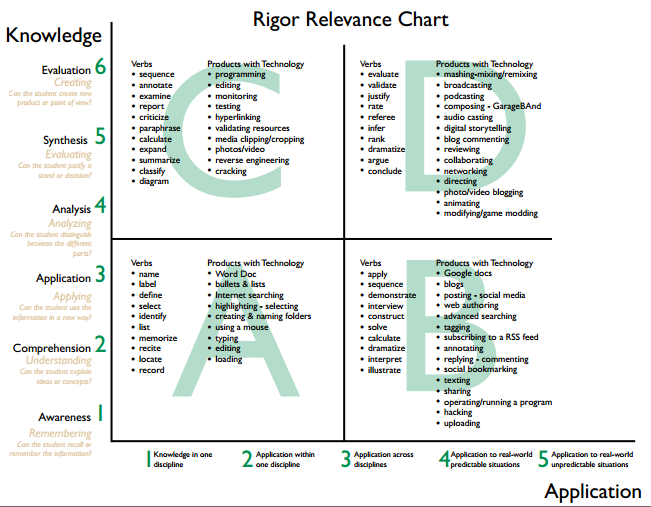
The journey to efficacy begins and ends with the intended goal in mind and a strong pedagogical foundation.  Adding technology or new ideas without this in place will more than likely not result in achieving efficacy.  The Rigor Relevance Framework provides schools and educators with a check and balance system by providing a common language for all, creating a culture around a common vision, and establishing a critical lens through which to examine curriculum, instruction, and assessment. It represents a means to support innovative learning and digital practice as detailed in the description of Quad D learning:
Students have the competence to think in complex ways and to apply their knowledge and skills they have acquired. Even when confronted with perplexing unknowns, students are able to use extensive knowledge and skill to create solutions and take action that further develops their skills and knowledge.
Aligning digital to Quad D not only makes sense but also melds with a great deal of the conversation in digital and non-digital spaces as to why and how learning should change.  A framework like this emphasizes the importance of a strong pedagogical foundation while helping to move practice from isolated pockets of excellence to systemic elements that are scaled throughout the learning culture.  It also provides the means to evaluate and reflect in order to improve. 


Rigor Relevance Framework

Once an overall vision for digital learning is firmly in place you can begin to work on the structures and supports to ensure success.  This brings me back to efficacy.  The why is great, but the how and what have to be fleshed out.  Determining whether technology or innovative practices, in general, are effective matters.  Below I will highlight 5 key areas (essential questions, research, practicality, evidence/accountability, reflection)  that can put your classroom, school, district, or organization on a path to digital efficacy. 

Essential Questions

Questions provide context for where we want to go, how we’ll get there, and whether or not success is achieved.  Having more questions than answers is a natural part of the initial change process. Over time, however, concrete answers can illustrate that efficacy in digital learning has been achieved in some form or another.  Consider how you might respond to the questions below:

  • What evidence do we have to demonstrate the impact of technology on school culture?
  • How are we making learning relevant to our students?
  • How do we implement and support rigorous and relevant learning tasks that help students become Future-Ready?
  • What is required to create spaces that model real-world environments and learning opportunities? 
  • What observable evidence can be used to measure the effect technology is having on student learning and achievement?
  • How can targeted feedback be provided to our teachers and students, so that technology can enhance learning?

Research

Research is prevalent in education for a reason.  It provides us all with a baseline as to what has been found to really work when it comes to student learning.  Now, there is good research and bad.  I get that. It is up to us as educators to sift through and then align the best and most practical studies out there to support the need to transform learning in the digital age. We can look to the past in order to inform current practice.  For example, so many of us are proponents of student ownership, project-based, and collaborative learning. Not only does digital support and enhance all of these, but research from Dewey, Vygotsky, Piaget, Papert, Bloom, and many others provide validation.  See the image below. For more on authorship learning click HERE.


One of the main reasons Tom Murray and I wrote Learning Transformed was to provide a sound research base that supports digital learning and the embracement of innovative practices.  The research of Linda Darling Hammond found that technology can have the most impact on our at-risk learners when it is used to support interactive learning, explore and create rather than to “drill and kill”, and constitutes the right blend of teachers and technology. This is just one of over 100 studies we highlight. Then there is the comprehensive analysis by John Hattie on effect size – a listing of the most effective instructional strategies that improve student learning outcomes all of which can be applied to digital learning. If efficacy is the goal, embracing a scholarly mindset to inform and influence our work, not drive it, is critical.

Practicality

All of what we do should align to the demands, and at times constraints, of the job.  This includes preparing students for success on standardized tests. If it’s not practical, the drive to implement new ideas and practices wanes or never materializes.  The creation of rigorous digital performance tasks that are aligned to standards and the scope and sequence found in the curriculum is just good practice. All good performance tasks include some form of assessment, either formative or summative, that provides the learner and educator with valuable information on standard and outcome attainment.  Again, this is just part of the job. 

The Rigor Relevance Framework assists in creating performance tasks that engage learners in critical thinking and problem solving while applying what they have learned in meaningful ways.  There is also natural alignment to incorporating student agency. This is exactly what so many of us are championing.  My colleague and good friend, Weston Kieschnick, has created a template that combines research and the practical aspect of performance task creation to assist you in creating your own.   Check it out HERE. You can use the template and go through the process of developing a rigorous digital performance task or just use it to inform as you design your own. 

Evidence and Accountability

As many of you know I do not shy away from openly discussing how important this area is. Just go back to my opening paragraph in this post for a refresher. Evidence and accountability are a part of every profession and quite frankly we need more of both in education to not only show efficacy in our work but to also scale needed change. Not everything has to or can be, measured. However, focusing on a Return on Instruction allows everyone to incorporate multiple measures, both qualitative and quantitative, to determine if improvement is in fact occurring. 

Reflection

When it is all said and done the most important thing we can all do is constantly reflect on our practice.  In terms of efficacy in digital learning consider these reflective questions from your particular lens:

  • Did my students learn? 
  • How do I know if my students learned? 
  • How do others know if my students learned? 
  • What can be done to improve? 
  • What point of view have I not considered?

Amazing things are happening in education, whether it be through digital learning or the implementation of innovative ideas.  We must always push ourselves to be better and strive for continuous improvement. The more we all push each other on the topic of efficacy, the collective goals we have for education, learning, and leadership can be achieved. 

Sunday, November 20, 2016

Keys for a Successful Digital Transformation

Nobody likes change, but the fact is that change is at our doorstep.  Changes in technology are quickly beginning to force the hands of schools and districts across the world. This poses some good news for students, as transformation efforts are under way to provide authentic learning experiences that provide relevance, value, and tangible skills in an unpredictable world. Even though changes are occurring, we need to be mindful of what is driving the work while looking past soft claims to ensure technology is actually improving learning and achievement.   It is important not to get sucked into the transformational aspects of the technology itself, but instead focus on the transformation of teaching, learning, and leadership.  

With every inch of progress we must constantly be reflective of where we are at and how to improve. We can ill afford to keep investing in the “stuff” through the played out scenario of putting the cart before the horse. Placing a device in the hands of all students and hoping for learning miracles to happen will always result in a let down.  I know this might rub technology aficionados the wrong way, but the fact remains that edtech has been over-promised and under delivered.  Any leader who has gone through a successful digital transformation realizes this.  The key is to be critical of the process in order to make sure investments pay off in terms of enhanced learner outcomes.  


Image credit: http://core0.staticworld.net/images/article/2015/08/cx-picture-100608993-primary.idge.jpg

Many lessons can be learned from successful digital transformations, including the one that occurred at my former school. Whether going Bring Your Own Device (BYOD), 1:1, blended, or personalized learning take note of some key elements that are essential to success:

Infrastructure

If the plumbing is not in place success will be hard to come by.  By infrastructure I am not talking about devices per say, but WiFi access and space design.  There is noting more frustrating for teachers and students alike when attempts are made to integrate technology with purpose only to have the WiFi not work or operate properly. Hand in hand with WiFi access is the capability to charge devices.  Make the initial investment to get this right the first time.

Framework 

Pedagogy trumps technology. Do you have a framework in place to ensure successful integration?  It is critical to have a common vision, language and expectations for how technology will play a ubiquitous role in supporting and/or enhancing learning.  A growing number of schools and districts rely on the SAMR model.  My question for you to consider is what does SAMR actually tell you or your stakeholders about the level of student learning taking place? We found the answer to be not very much. SAMR does provide good guidance on what to avoid when it comes to technology integration (substitution) and provides an excellent bridge to the Rigor Relevance Framework. Consider the Rigor Relevance Framework, which is learner centric, to assist in effectively aligning technology to instruction, curriculum, and space redesign. Check out this example in relation to Gsuite.

Professional Learning

Investing in people will always be one of the foundation elements of a successful digital transformation. Relevant, job-embedded learning opportunities that move away from traditional drive-by approaches will help to sustain meaningful change.  Equal investments need to be made to support both teachers and administrators. After all, success is dependent on both groups having the knowledge, support, and skills to implement, evaluate, and continuously improve the digital transformation process. There is no substitute for quality face-to-face professional learning opportunities that blend an assessment of where you stand with digital practices, courses, job-embedded coaching, and active discussion.  

Leadership

This element is critical in any type of change process.  It is not only about being open to change, but also being an intimate player in the process.  Thus, digital leadership goes without saying. It is about working smarter, not harder, in order to do what we already do better.  Digital leaders help to establish a collective vision, provide support, model expectations, ensure accountability, and constantly reflect in transparent ways in order to improve.  Technology is a ubiquitous component that supports the work they have always done but in a more effective and efficient manner.

Avoid Assumptions

Let’s begin with an example.  Students know how to use tech (assumption), but they don’t necessarily know how to use it to support their learning (reality). Students will be off task when they are afforded the opportunity to use technology (assumption), yet virtually all of us adults would go off task at times well before the digital age (reality).  So many assumptions are made when it comes to technology that reality plays second fiddle. Progress, and ultimately success, is contingent upon removing a myriad of barriers to change that arise as a result of our mindset. Assumptions and excuses will hold you back. Thanks to the Internet and Personal Learning Networks (PLN’s) we can learn firsthand from the reality inherent in digital transformation success across the globe.  

Evidence

Success breeds success.  There is no greater motivator than the positive results of any change effort. Evidence of success goes a long way towards embracing change resulting in transformation. However, along the same lines of our infatuation with assumptions, a lack of evidence and connection to research tends to be accepted when talking about digital transformations. When integrating technology there needs to be a Return on Instruction (ROI) that results in evidence of improved student learning outcomes. This can come in the form of data, improved observations/evaluations, artifacts, and portfolios. Too much money and time is at stake to just rely on broad claims and a lack of real evidence of success. 

Smart Budgeting 

Having developed a budget for a high school over the course of many years I can tell you that there was a great deal of wasted money year in and year out. Money can be freed up in any budget if we critically analyze how the expenditure will positively impact learning.  Once money is reallocated the next step is to ascertain the role that any technology purchase will play. The question we need to be asking when going through the budget process is how will this technology actually improve learning and achievement at scale?  If there is a challenge in answering this question then obviously you are not making a wise investment.  Do your research and plan accordingly.

Relationships

Relationships are the glue that holds the change process together resulting in transformation.  These need to be built both internally and externally.  From a student perspective it is important to emphasize and follow through in ways to foster greater student agency in the learning culture.  You need to begin to say yes more than no as implemented ideas that come from students are the ultimate relationship builder.  From an adult stakeholder perspective it is critical to develop a positive brand presence that will result from a multi-faceted approach to communications and an evolution into the storyteller-in-chief.  Meet your stakeholders where they are at, engage them in two-way communications, and maintain a level of consistency. Over time powerful relationships will be established with all.

All in all we need to prepare students for their future, not ours.  We can ill afford to prepare them for a world that doesn’t exist.  We need to create schools of the future, today.  Even with progress in many schools and districts it is important to always be open to critical reflection and evaluation on not just where we are at, but more importantly where we want to be.  

Monday, March 7, 2011

Our Quest for More R&R

Many of you probably viewed the title of this post and immediately thought of rest and relaxation.  I will be the first one to admit that we all need more of this, but the focus of my post is increasing rigor and relevancy in schools.  While attending the 2011 NASSP Conference in San Francisco, CA I listened to a keynote by Dr. Bill Daggett.  His message centered on the need for increasing rigor and relevancy in schools.  In an article for SEEN Magazine Dr. Daggett provides some nice working definitions for these two terms:

Rigor - Academic rigor refers to learning in which students demonstrate a thorough in-depth mastery of challenging tasks to develop cognitive skills through reflective thought, analysis, problem solving, evaluation or creativity. It’s the quality of thinking, not the quantity, that defines academic rigor, and rigorous learning can occur at any school grade and in any subject.
 Relevance- Relevance refers to learning in which students apply core knowledge, concepts, or skills, to solve real-world problems. Relevant learning is interdisciplinary and contextual. It is created, for example, through authentic problems or tasks, simulations, service learning, connecting concepts to current issues and teaching others.

Another fantastic resource in addition to the definitions above is the Rigor/Relevance Framework by the International Center for Leadership in Education.  This tool helps educators and schools adjust curriculum, instruction, and assessment to create high standards and increase student achievement.  The research has found that successful high schools provide learning opportunities that are relevant, contain rigorous coursework, and establish meaningful relationships with teachers (See Improving High Schools Through Rigor, Relevance, and Relationships). 

I believe that we are moving the the right direction at NMHS in terms of increasing rigor and relevancy in the quest to improve student achievement.  With the assistance and support of Central Office, we have worked together to make the following changes: 
  • Replaced the antiquated Departmental structure including “Chairs” with an Interdepartmental system that includes “Interdepartmental Liaisons”.  Teachers now meet as part of three overreaching groups that include Humanities, S.T.E.M., and Special Programs (special education, arts, and technology).
  • Overhauled our District mission statement to reflect a new shared vision and philosophy that not only reflects, but puts into practice, many of the core concepts outlined in Dr. Daggett’s definitions above.
  • Created The Academies@New Milford High School.
  • Expanded our Virtual High School Offerings.
  • Added 3 new A.P. courses (European History, Language and Composition, Physics B) and making all such courses available to any student wishing to take them.
  • Total overhaul of our Program of Studies, which included the re-branding, refinement, and creation of innovative courses more relevant to the interests of a student in the 21st Century.
  • Implemented Professional Learning Communities (PLC's) as our means of professional development entirely focused on improving student achievement.
  • Systematic use of research-based Classroom Walkthroughs by the HS Administrative Team.  This week we presented data the the staff on student engagement that we have been acquiring over the past three months.  This was accompanied by a discussion of numerous strategies that our teachers could utilize to increase engagement in an authentic fashion.
I feel that a solid foundation has been set at NMHS to increase rigor, relevancy, and student achievement.  How do you think we are doing based on the changes and initiatives listed above?  Do you have any ideas and/or strategies that have worked in your institutions to increase rigor and relevancy? 

Monday, April 24, 2023

#EDvice: Choosing an Edtech Framework

When it comes to technology in education, there is a natural tendency to see it as just another thing that somebody must do. In other cases, it is viewed as being more work. Let me tackle the second issue first. When we try implementing anything new, there is always a learning curve. It is important to remember, though, that the time and effort put forth will reap the rewards when it comes to improving practice and, in turn, learning outcomes. I have learned from firsthand experience that figuring out how to use a new digital tool is the easy part. The more difficult mental hurdle is that using any digital tool is just another thing added to an already crazy workload.  


While I firmly believe in the merits of digital learning, it comes with a caveat, which I recently shared on social media:

Technology is just a tool and is definitely not a silver bullet. On its own, it WILL NOT lead to learning or improved outcomes. The focus must be on how the LEARNER is using it to LEARN in alignment with sound strategies and pedagogy.

My statement above is meant to reassure all educators that the tenets of good teaching, sound pedagogy, and research on learning are of the utmost importance. Clarity is also essential when it comes to purposeful use. This is why the Rigor Relevance Framework is a sound option compared to SAMR, TPACK, TIMS, and other tools that emphasize tech over learning. I dive a bit deeper into the concept in this piece of #EDvice.


As you look to refine or improve digital learning in your classroom, school, or district, consider keeping the RR Framework handy. I summed up its value in a previous post:

The overall goal, both with and without technology, should be to empower students to work and think. Another critical strategy is to focus on the purposeful use of technology when appropriate. Just because it is available doesn’t mean it can or will improve every lesson or project. Thus a focus on pedagogy first, technology second, if appropriate, will help ensure success, something that I emphasize extensively in Disruptive Thinking in Our Classrooms. While SAMR is a solid starting point, it is not the end-all or be-all. The multi-dimensional aspects of the Rigor Relevance Framework can be used to guide you in developing better questions and tasks as part of good pedagogy.


Sunday, November 11, 2018

3 Shifts to Make Learning Personal

In education, a lesson makes or breaks a learner’s experience in a classroom.  Planning takes time. I remember many nights and weekends when I spent countless hours developing a variety of activities that would keep my students engaged while also following the scope and sequence of the curriculum based on the standards that needed to be addressed.  When it is all said and done, it is more about the experience than the lesson, but the latter is necessary to create the former.  The key to strengthening learning and instruction consists of the right balance of two main components:

  1. Instruction (what the teacher does)
  2. Learning (what the student does)

Balance surely is important. There is a time for direct instruction, but many learners would tell you outright that this component of a lesson is not what they really crave or find meaningful. In Learning Transformed, Tom Murray and I examined research and evidence to conclude that kids want a learning experience that is personal, while educators want alignment with the real expectations placed on schools across the world.  Finding common ground in this area at times poses quite a challenge.  Any personalization necessitates a move from “what” to the “who” to emphasize ownership of learning.  Sounds simple enough, right?  Getting everyone on board becomes the challenge.

Making the shift to personal learning goes right back to finding the right balance between instruction and learning.  Success in this area requires a shared vision, language, and expectations that not only make sense but also jive with curriculum, standards, and assessment.  Enter the Rigor Relevance Framework.  Now, I am not going to rehash the details of this tool as I have been writing about it for years, but I will provide an image of it below. The essence of the framework is quite simple as it allows for a lens for teachers and administrators to determine the level of thinking and relevant application that kids demonstrate while engaged in the process of learning. Instilling a purpose of learning while challenging all kids in the learning process is at the heart of a more personal approach.


Solid instruction should lead to great learning where kids are in the proverbial driver’s seat.  The Rigor Relevance Framework unearths three critical shifts in practice that can lead to personal learning experiences for kids.  As I love using images to articulate ideas and concepts, I will frame each shift with a question that will then be described in more detail using an associated image.

Shift 1: Are learners telling us what they know or showing that they actually understand?


Shift 2: Who is doing the work and thinking?


Shift 3: Who is asking the questions?


There is obviously more to consider when embracing and implementing the shifts listed above.  A personal learning experience doesn’t sacrifice higher-level thinking and application just for the sake of relevance and meaning.  Sound pedagogy lays the foundation with an added emphasis on scaffolding, innovative assessment, and improved feedback.   Student agency and technology both play a huge role throughout by empowering learners through choice, voice, and advocacy.  When these are combined to create effective blended learning activities in flexible spaces, the added elements of path, pace, and place further influence the personalization that will help kids flourish regardless of zip code or label.

However, it is the third shift that tells the tale as to whether a lesson or task supports rigorous and relevant learning to create a more personal experience for kids.  If kids see and understand the purpose while being challenged, then they will be asking the questions.  Better outcomes rely on transforming practice in a way that kids of the present and future can relate.  Making learning personal is a means to this end. 

Sunday, February 17, 2019

The Two Most Important Questions to Ask to Determine if Learning is Taking Place

There are so many thoughts and ideas as to what learning really looks and feels like. From these conversations, educators form their own perspectives and opinions that best align with the vision, mission, and goals of their classroom, school or district.  However, a consensus is critical if the goal is scalable change that results in improved learning outcomes. As I have written extensively in the past, research and evidence should play a significant role in what learning can and should be as well as whether or not it is actually taking place.  Common vision, language, expectations, and look-fors go a long way to creating a vibrant learning culture.

Recently I posted the following tweet. 


It seemed to resonate with many educators.  I decided to post this update when I saw my friend Greg Bagby share an image of the Rigor Relevance Framework where technology is considered. Thus, my tweet referenced a digital angle.  In hindsight though, I should have written the tweet to align with what I genuinely believe in.  Some of the commentary I received reinforced what I always speak and write about as well as coach on; that the two questions I posed are important both with and without technology.  So, when it comes to learning, the two most important questions are:

  1. Are kids thinking at increasing levels of knowledge taxonomy?
  2. How are kids applying their thinking in relevant ways?

The Rigor Relevance Framework provides a practical way to determine the answers to both of these questions by looking at the level of questioning and the tasks that kids are engaged in.  


Consider it a litmus test of sorts. Where do the instruction (what the teacher does) and the learning (what the kid does) fall in terms of the four quads?  Good instruction can, and should, lead to empowered learning, with movement along both the thinking and application continuums. The point here is to not reside in Quad D as that is a place you visit once and a while, but it should be an area that learners are moved to at some point during a unit of study. When technology is added to the mix, it should be utilized purposefully by the learner in ways that address the two questions posed above.


The image above conveys a critical point.  We should never look at technology as a distinct element separate from curriculum, instruction, and assessment.  Each of these in their own right intersects in ways to support and enhance learning. It is essential to understand that the role of any digital tool or experience is to empower learners to think in ways that represent a fundamental improvement over traditional practice. The use of technology leads to yet another critical question – How are kids using technology to learn in ways that they couldn’t without it? 

All in all, learning has to be the focus. It’s up to you to determine if it is, in fact, taking place and if not what can be done to ensure that it is. 

Sunday, February 1, 2015

Getting Digital Tools On Your Side: 4 Steps

This is the second post as part of an adapted article I co-authored, Real-World Ready: Leveraging Digital Tools

A few weeks back I shared ways that digital tools can improve teaching and learning.  It goes without saying that the most important aspect of digital leadership is enhancing student learning while increasing achievement. Technology needs to be integrated with purpose in ways that support learning as opposed to driving instruction.  A good rule to follow is pedagogy first, technology second when appropriate. Using technology just for the sake of it is an ineffective practice.  Effective digital leaders understand this and through the observation and evaluation of instruction ensure that digital tools align to learning outcomes and are having an impact on student learning.


Image credit: http://www.robeson.k12.nc.us/cms/lib6/NC01000307/Centricity/Domain/4057/Blooms_Circle.png

The main driver of successful, effective teaching originates from educators who are scaffolding learning in relevant and strong ways. A grounding in the Rigor/Relevance Framework -- an action-oriented continuum that describes putting knowledge to use -- gives teachers a method for charting learning. This framework is based on traditional elements of education yet encourages movement from acquisition of knowledge to application of knowledge. Although digital tools themselves are no substitute for a clear framework, they can underpin it. No matter what digital tool is considered, introduced, or integrated into the classroom, capable teacher presence and teacher-centered instruction always belongs in the foreground.


How can you, as a school leader, take your understanding of the strengths behind some digital tools and create pathways for rigorous and relevant use of digital tools? Use the following best practices when assessing digital tools and their use in your school:

Prioritize Instructional Excellence: Technology can be an effective tool but it remains just that -- a tool. Educators provide the backbone of the student’s learning experience. A teacher should always have concrete answers to these questions:
  • What capabilities do I want my students to develop? In what specific ways is my instructional design rigorous and relevant? 
  • What are my benchmarks for rigor? relevance? relationships? creativity? inquiry? 
Armed with responses to these questions, a teacher can then go on to consider a specific digital tool, asking:
  • How does this digital tool provide a way towards full development of the capability I want to develop in my students? 
  • Is my teaching, using this tool, still just as structured, rigorous, and relevant as it would be without this tool? 
Identify Student Needs Around Use of Digital Tools: Information should not be confused with knowledge in evaluating digital tools. Knowledge is the recall of information, discovery, observation, or naming. Teachers should be able to define what knowledge (not information) students will need to apply when using a digital tool.

Create a Game Plan for Managing Student Use of Online Tools:  It takes work and careful planning to implement the use of digital tools in defined ways. Before introducing a digital tool into a learning context, teachers should understand:
  • How he/she will be able to support students in using a tool that might be unfamiliar
  • How each student will be able to manage it independently 
  • How he/she will take advantage of students’ diversity and inclination towards building community online 
  • How students and instructor will connect across sometimes great distance
Maximize Opportunities for Diverse Forms of Feedback:  Rather than relying on feedback or evaluation models suited to older models of assignments, have teachers ask:
  • How will this online tool allow me to hone in on each student’s thought process and provide targeted, formative feedback that can be immediately and usefully applied? 
  • How can my feedback help pave the way for next steps in learning and in reaching established, articulated, or modeled goals?
Educational landscape and digital landscape have become inherently intertwined. Learners are teachers alike are enmeshed in digital life and need effective, specific ways to best use digital tools in rigorous and relevant ways. Educators must be able to develop and enact rigorous, relevant instructional methods and formats, while learning about and using effective digital tools to underpin their instruction. As long as educators are clear about the learning objectives, digital tools can be a powerful supporting tool.

Sunday, February 28, 2016

The Meaning of Words

Jargon in education is nothing new. Luckily there are so many resources available to make sense of it as it applies to our professional practice.  Just check the Dictionary of Educational Jargon to get some clarity, then have some fun with the Educational Jargon Generator. Words are always flying around in education circles. Whether it is in person at events and workshops or in social media spaces, I routinely see conversations play out where educators take a certain stance on the meaning of specific words. Now mind you, I am speaking about education buzzwords and am not discounting the negative meaning of words outside this realm. From my lens, I see a great deal of time and energy spent on debating the negative aspects of words that other educators value. 

Certain words jump right out at me such as grit, innovation, branding, mindset, future-ready, deeper learning, and personalization. Each day various people chime in, stating their disapproval of such words when an article focusing on its merits arises. Does the meaning in someone’s opinion really matter or is it more about the outcome as it pertains to the learning culture of our schools? Do our students feel the same way about these words as the adults who spend energy discounting them?  Maybe I am off base with my thinking here, but I try to find the value in many of the words listed above as I can see how they can relate to a positive school culture.

One word that I want to talk about is rigor. It is this word, after all, that motivated me to write this post. I have seen many people I respect get pretty fired up about the term. Taken out of an educational context, the word rigor can imply being rigid, inflexible, strict, unyielding, etc.  With these descriptions, it is no wonder many people dislike the word. I, for one, don't see it this way, especially when using the term throughout my presentations and work. 


I see rigor as a way of framing lessons and learning outcomes at the high end of knowledge taxonomy. Rigorous learning empowers students to develop, have the competence to think in complex ways, and apply their knowledge and skills. Even when confronted with perplexing unknowns, students are able to use extensive knowledge and skills to create solutions and take action that further develops their skills and knowledge. This is my view of rigor. The definition below pretty much sums it up:
Rigor: A concept either describing an assignment that challenges students to use critical thinking skills or a learning environment that is challenging but supportive and engaging.
Rigorous lessons and learning activities ask students to compose, create, design, invent, predict, research, summarize, defend, compare, and justify to demonstrate conceptual mastery and standards attainment. Rigor is quite simply levels of thinking, including 

  • Scaffolding for thinking
  • Planning for thinking
  • Assessing thinking
  • Recognizing the level of thinking students demonstrate
  • Managing the teaching/learning level for the desired thinking level

Rigor is NOT:

  • More or harder worksheets
  • AP or honors courses
  • The higher-level book in reading
  • More work
  • More homework

Rigorous learning is for all students (check out the Rigor Relevance Framework). The perception that rigor only applies to a certain group is near-sighted at best. Herein lies another point of confusion with the word. After all, all students not only deserve but also should be made to feel that they can handle higher expectations.  

Not being flexible with the meaning of educational words and terms seems to be a bit hypocritical. In the case of this post, taking the opposing side of terms that others find value in seems a bit rigid, strict, and unyielding. Words in education are what you make of them. Try to have an open mind and the inherent value might provide more context for your own work and goals, but more importantly, that of your students.