Showing posts with label Rigor. Show all posts

Sunday, August 21, 2022

Addressing SEL and Behavior Challenges with Relationships

One question that is posed to me often by districts and schools is how their staff can be proactive when it comes to student behavior and addressing their social-emotional needs. It comes as no surprise to anyone that the pandemic, in the eyes of many, has led to an uptick in issues that not only disrupts precious learning time but also results in more discipline referrals, tardies, and absences. There is no silver bullet as many behavioral challenges manifest themselves outside the school day. However, practical mitigation steps can be taken by doing what we all know is of utmost importance to learning and that is developing relationships, something a dive into great detail in Disruptive Thinking in Our Classrooms

So, where do we begin? It is essential to realize how vital social-emotional learning (SEL) is when it comes to student behavior and academic success. A meta-analysis of 213 school-based, universal social and emotional learning (SEL) programs involving 270,034 kindergarten through high school students showed promising results. Compared to controls, SEL participants demonstrated significantly improved social and emotional skills, attitudes, behavior, and academic performance that reflected an 11-percentile-point gain in achievement (Durlak et al., 2011). 
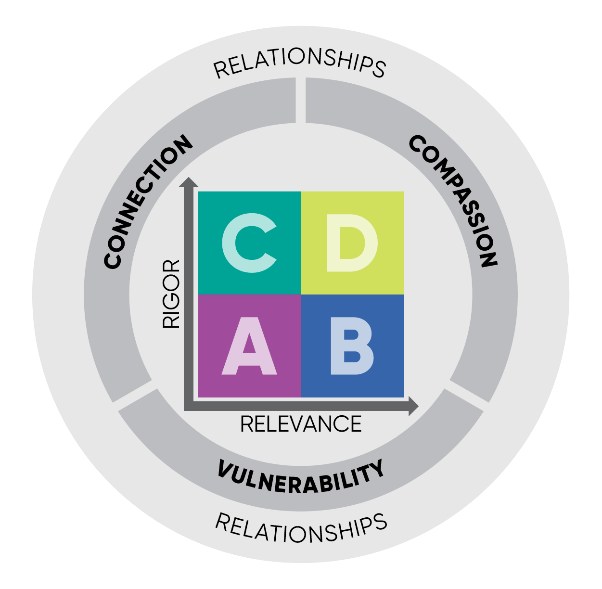

The relationships model above was developed in partnership with Dr. Stephanie Jones at the Harvard EASEL Lab. It can be utilized by administrators and teachers to create vibrant learning cultures. As this model shows, the impact of rigorous and relevant teaching and learning relies on strong student-educator relationships. The way to shape these relationships is through purposeful behaviors tied to three key indicators: Connection, Compassion, and Vulnerability. When you reflect on this above, consider what current practices support the main elements listed. In a past post, I outlined some specific SEL strategies that can be used at any time to aid in the process of addressing SEL needs and behavior, including daily meeting, digital surveys, and family engagement.

While there is a wealth of resources out there, I would be remiss if I didn’t outline some practices that can be employed regularly. For each, I attempt to highlight the clear benefits. 


  • Classroom Management: Co-create rules and consequences with students. Acknowledge positive behaviors regularly. Admin should look to work daily meetings into the schedule as a way to help teachers with management issues. 
  • Relevance: There is a great deal of research out there on the importance of relevance in the classroom and school, which you can read HERE. Students want purpose in their learning. Integrate interdisciplinary connections, authentic contexts, and real-world applications regularly to help convey meaning.
  • Personalized Pedagogy: Moving away from a one-size-fits-all approach to equitable strategies can seamlessly align with RTI/MTSS, which are designed to address behavior proactively. Consider station rotation, choice activities, playlists, and flipped lessons to free up time to work with students who really need in-class support.
  • Empathy: Using an empathetic lens by placing yourself in your students' shoes can help reduce knee-jerk reactions. It is always important to remember that forces beyond our control impact kids.

Adam Drummond shared a comprehensive article on developing relationships by leading through compassion, embracing vulnerability, and making connections. You will find not only applicable relationship-building strategies here but also an array of visuals to focus on areas of growth. Venola Mason explains that supporting students’ social and emotional wellness is a catalyst for building strong teacher-student relationships that can ensure they are better adjusted, have more confidence, and perform better academically. In a recent article, she details five tips to assist with this process:

  1. Be personable with students
  2. Get to know students
  3. Set stretch goals
  4. Make learning fun
  5. Reach out to students in need

Without trust, there is no relationship. Without relationships, no real learning occurs. 

Durlak, J.A., Weissberg, R.P., Dymnicki, A.B., Taylor, R.D. and Schellinger, K.B. (2011), The Impact of Enhancing Students’ Social and Emotional Learning: A Meta-Analysis of School-Based Universal Interventions. Child Development, 82: 405-432.

Sunday, October 3, 2021

Setting the Stage for Current and Future Learner Success

The traditional goal of any education system is to prepare students for either college or careers. Over the years, I would say that while this view still holds value, the context has changed dramatically.  The world has radically evolved as a result of constantly advancing technology and the COVID-19 pandemic.  With knowledge readily available and the means to seamlessly engage in digital spaces now the norm, educators need to keep pace and ensure that the strategies they use will serve learners well into the future. While this might seem like a monumental task, it is not as difficult as one might think. 

While preparation for college and careers might remain a focus, it is important to understand that there is no uniform recipe for success as this varies significantly between different learners.  Herein lies both a challenge and opportunity for educators.  As I shared in Disruptive Thinking in Our Classrooms, our world needs students who have the competencies to replace conventional ideas with innovative solutions to authentic problems. There are many different pathways to accomplish this goal that I discuss in detail in the book. However, a more holistic approach can be taken to set the stage for developing a learner’s ability to accomplish any aim or purpose they set out to achieve.

When designing lessons, projects, or assessments, consider whether or not they empower learners to:

  • Engage in problem-solving
  • Collaborate with peers
  • Think critically and creatively 
  • Communicate clearly and accurately 
  • Develop open-mindedness 
  • Make real-world applications
  • Reflect on learning
  • Analyze, reason, and evaluate

Setting the stage for learner success requires a commitment beyond just the people that have direct contact with students.  It is important to note that administrators play a crucial role in how they support their teachers with feedback on the elements listed above.  Pedagogical leadership can pave the way.

While the elements above are undoubtedly essential, it should be noted that not every lesson, assignment, or assessment will include all of these.  Hence the need to develop a system of norms that can be implemented routinely that will either directly address or set the stage for disruptive thinking.  Below is a checklist of sorts containing questions that can be used to reflect on daily practice and serve as a means for growth:


  • Rigor – How are all learners being challenged to think through scaffolded questions and tasks? Is the work that they engage in thoughtful and providing an opportunity for discourse and collaboration? 
  • Relevance – How are learners applying their thinking in meaningful and purposeful ways? Are they afforded the opportunity to leverage authentic resources and make interdisciplinary connections between various concepts?
  • Empowerment – Do learners own their experience in the classroom or school through personalized strategies that promote voice, choice, path, pace, and place? Are they able to access and use a variety of tools to construct new knowledge and demonstrate what they have learned? How has the learning environment changed to respond to individual strengths and weaknesses? 

Ensuring current and future learner success doesn’t rely on a technology tool or a passing fad.  It is achieved through a dynamic combination of strategies that future-proof learning for all kids so that they can thrive in a disruptive world.  Try not to overthink things. Even though the world will continue to change rapidly, you have the knowledge, tools, and mindset to equip kids and put them all on a path towards success. 

Saturday, January 9, 2021

Making Headway with Remote and Hybrid Learning

With 2020 in the rearview mirror, it is now time to focus on the present with an eye to the future. Many difficult lessons were learned during the pandemic, and a few more are sure to materialize over the next couple of months.  Even though educators have been challenged like never before, they faced adversity and stepped up to the plate admirably for their learners.  While a great deal can be written about the challenges experienced and those still prevalent, I want to focus on some of the good that has come out of the COVID-19 nightmare. Remote and hybrid learning at scale was never meant for K-12 education, but the fact remains that each has been a catalyst for some exciting changes that have long been overdue.

As I recently worked with leaders from Paterson Public Schools in New Jersey, during a coaching session, I asked them to take a few minutes, and each share something positive that came about as a result of the pandemic.  Too often, we tend to dwell on overcoming hardships that we forget to celebrate both small and large wins. With morale at a breaking point now more than ever, teachers and administrators need validation for all they have done recently. These can become critical building blocks for sustainable change. 

As each leader presented their views on positive shifts to practice, you could see their pride swell.  They shared how teachers got better using technology, reached out more for feedback, collaborated more, and improved classroom management. They also shared that the facilitation of professional learning improved, a greater reach was achieved thanks to technology, previously unknown teacher strengths were unearthed, and there was the ability to get into more classrooms. All in all, these are all great examples of progress in difficult times. How has your practice or those in your school/district changed for the better?

As the new year begins, schools, for the most part, are still where they were in 2020. That is why it is imperative to celebrate success in any form and provide further support for teachers and administrators. Instead of dwelling on all that hasn't worked, energy should be spent on all that has during the pandemic. Consider these questions from your lens. What are your exemplars of effective remote or hybrid teaching and learning, and why? How are you sharing these with colleagues and staff or using them for professional learning and feedback? While these provide ample opportunities to reflect, further headway can be made by focusing on the following:


  1. Continuity and consistency – Keep it as simple as possible. Embrace a learning management system (LMS), settle on a video conference solution that has breakout rooms and integrate one digital tool that aligns with effective instructional strategies. Then be sure to use consistency and ensure there are continuities either across your school or K-12.
  2. Lesson structure – The key here is to ensure there is a balance between synchronous and asynchronous activities both with and without technology.  Other considerations include chunking how content is presented, utilizing routine checks for understanding, providing brain breaks, and incorporating movement activities. Engagement issues arise when it is entirely direct instruction, or learners are expected to be on technology the entire time. HERE are some ideas on how to balance things out.
  3. Relevance – Learners need purpose. Without this, the willingness and desire to learn dwindles. An anticipatory set at the beginning of every lesson is a great start, but they're also should be at least one opportunity to apply thinking in a relevant way.  Kids become intrinsically motivated when they know why they are learning something and how they will use what has been learned outside of school.
  4. Rigor – Any remote or hybrid experience should challenge students to think. Consider how questions are scaffolded and the way in which knowledge will be applied to solve complex problems.  The ability to think, pandemic or not, is the best way to future-proof learning for all students while setting them up for success.  
  5. Purposeful use – Technology has played a considerable role during the pandemic and will continue to well after.  However, just using Zoom to "deliver" instruction should not be the goal and does not constitute effective use. Now is the time to focus on purposeful use aligned to sound instructional strategies (review of prior learning, checks for understanding, closure, assessment).  From here, it is about empowering students to use technology to learn in ways that they couldn't without it.
  6. Blended learning – One of the best ways to incorporate all of the above is through blended pedagogies.  Often, though, there is confusion as to what this really is. Blended instruction is what the teacher does with technology. Blended learning is where students use tech to have control over path, place, and pace while also having voice and choice. Consider practical strategies such as station rotation, choice boards, playlists, and flipped lessons.
  7. Leverage your superstars – There is no better way to make headway with remote and hybrid learning than to put the work of your trailblazers' front and center. Consider sharing what they are doing in email blasts and through social media. Not only can they serve as motivation for teachers who yearn for practical strategies, but their work can also be shared with stakeholders to showcase what is working. Your superstars can also lead professional learning.

What we have and continue to learn during the pandemic will pave the way for sustainable changes to practice that will positively impact kids. Don't sell yourselves short. In the midst of immense challenges and struggles, you have all stepped up in ways that illustrate how amazing educators are. Remote and hybrid learning can work because of your efforts. Continue to keep things manageable while also looking for opportunities to reflect and grow.  You don't have to have all the answers or solutions. It is a sign of strength to admit that you don't know or need help in these cases. If this is your situation, please feel free to reach out as I am more than happy to help in any way that I can.

Sunday, November 11, 2018

3 Shifts to Make Learning Personal

In education, a lesson makes or breaks a learner’s experience in a classroom.  Planning takes time. I remember many nights and weekends when I spent countless hours developing a variety of activities that would keep my students engaged while also following the scope and sequence of the curriculum based on the standards that needed to be addressed.  When it is all said and done, it is more about the experience than the lesson, but the latter is necessary to create the former.  The key to strengthening learning and instruction consists of the right balance of two main components:

  1. Instruction (what the teacher does)
  2. Learning (what the student does)

Balance surely is important. There is a time for direct instruction, but many learners would tell you outright that this component of a lesson is not what they really crave or find meaningful. In Learning Transformed, Tom Murray and I examined research and evidence to conclude that kids want a learning experience that is personal, while educators want alignment with the real expectations placed on schools across the world.  Finding common ground in this area at times poses quite a challenge.  Any personalization necessitates a move from “what” to the “who” to emphasize ownership of learning.  Sounds simple enough, right?  Getting everyone on board becomes the challenge.

Making the shift to personal learning goes right back to finding the right balance between instruction and learning.  Success in this area requires a shared vision, language, and expectations that not only make sense but also jive with curriculum, standards, and assessment.  Enter the Rigor Relevance Framework.  Now, I am not going to rehash the details of this tool as I have been writing about it for years, but I will provide an image of it below. The essence of the framework is quite simple as it allows for a lens for teachers and administrators to determine the level of thinking and relevant application that kids demonstrate while engaged in the process of learning. Instilling a purpose of learning while challenging all kids in the learning process is at the heart of a more personal approach.


Solid instruction should lead to great learning where kids are in the proverbial driver’s seat.  The Rigor Relevance Framework unearths three critical shifts in practice that can lead to personal learning experiences for kids.  As I love using images to articulate ideas and concepts, I will frame each shift with a question that will then be described in more detail using an associated image.

Shift 1: Are learners telling us what they know or showing that they actually understand?


Shift 2: Who is doing the work and thinking?


Shift 3: Who is asking the questions?


There is obviously more to consider when embracing and implementing the shifts listed above.  A personal learning experience doesn’t sacrifice higher-level thinking and application just for the sake of relevance and meaning.  Sound pedagogy lays the foundation with an added emphasis on scaffolding, innovative assessment, and improved feedback.   Student agency and technology both play a huge role throughout by empowering learners through choice, voice, and advocacy.  When these are combined to create effective blended learning activities in flexible spaces, the added elements of path, pace, and place further influence the personalization that will help kids flourish regardless of zip code or label.

However, it is the third shift that tells the tale as to whether a lesson or task supports rigorous and relevant learning to create a more personal experience for kids.  If kids see and understand the purpose while being challenged, then they will be asking the questions.  Better outcomes rely on transforming practice in a way that kids of the present and future can relate.  Making learning personal is a means to this end. 

Sunday, February 11, 2018

To Improve Outcomes, We Need to Take a Critical Lens to Instructional Design

No one can deny the fact that we are seeing some pretty exciting changes to teaching, learning, and leadership.  Advances in research, brain science, and technology are opening up new and better pathways to reach learners like never before.  This excitement in some cases is leading to change with supporting evidence of improvement. In other cases, money is being dumped on the latest tool, program, idea, or professional development without ensuring that instructional design is up to par in the first place.  Pedagogy trumps technology.  It also goes without saying that a solid pedagogical foundation should be in place prior to implementing any innovative idea.

Let's start by looking at practice from a general lens.  To transform learning, we must also transform teaching.  When looking at the image below where does your practice or that of your teachers lie? What immediate changes can be made to improve learning for your students tomorrow? 


Now let's turn our focus to some more specific elements of instruction. It is important to take a critical lens to our work to ensure efficacy if the goal is to improve learning.  With that being said it is incumbent upon all of us to make sure shifts to instructional design are occurring that result in better student outcomes. This is why a Return on Instruction (ROI) as described in Learning Transformed is so important both with and without technology.
"When integrating technology and innovative ideas there needs to be a Return on Instruction (ROI) that results in evidence of improved student learning outcomes."
The key to future-proofing education is to get kids to think. If it is easy, then it probably isn't learning. Challenging learners through complex problem solving and activities that involve critical thinking is extremely important, but they also must be afforded opportunities to apply their learning in relevant ways.  This does not have to be an arduous process that takes up a great deal of time.  Below are five areas to look at when implementing any digital tool or innovative idea to determine whether or not improvements to pedagogy are changing. Each area is followed by a question or two as a means to help self-assess where you are and if improvements can be made. 

  • Level of questioning: Are students being asked questions at the higher levels of knowledge taxonomy? Do students have the opportunity to develop and then answer their own higher-order questions?
  • Authentic and/or interdisciplinary context: Is there a connection to help students see why this learning is important and how it can be used outside of school?
  • Rigorous performance tasks: Are students afforded an opportunity to actively apply what they have learned and create a product to demonstrate conceptual mastery aligned to standards?
  • Innovative assessment - Is assessment changing to provide critical information about what students know or don't? Are alternative forms of assessment being implemented such as portfolios to illustrate growth over time?
  • Improved Feedback - Is feedback timely, aligned to standards, specific, and does it provide details on advancement towards a learning goal?

Improving outcomes relies on aligning instruction to solid research, ensuring that pedagogical shifts are occurring, holding ourselves (and others) accountable for growth, and showcasing evidence of improvement.  By taking a critical lens to our practice we can determine where we are, but more importantly where we actually want and need to be for our learners. 

Sunday, February 12, 2017

Is Technology Being Integrated Effectively?

In many cases, there seems to be a tendency to water down expectations when it comes to integrating technology.  During a recent presentation on digital pedagogy for deeper learning I asked attendees to discuss then share out on TodaysMeet how they were effectively integrating technology in their classroom, school, or district.  There was an emphasis on describing in detail what effective use of technology meant to them.  As the results poured in there were a few consistent responses that stood out. Most attendees flat out stated that they or their schools/districts were not effectively integrating technology. Others confessed that they weren’t sure what effective use constituted.  Many of the remaining responses centered on just a listing of tools that were being used as a measure of effectiveness. 

The question about effective use provides a great opportunity for all of us to critically reflect upon the current role technology plays in education.  There is a great deal of potential in the numerous tools now available to support or enhance learning, but we must be mindful of how they are being used. Take Kahoot for example. This tool is used in so many classrooms across the world to get students more engaged and add a level of fun and excitement to the learning process. However, most of the time the questions that students are asked to answer in a Kahoot are focused on the lowest cognitive domains and mostly multiple choice.  I have nothing against Kahoot and think it is a great tool that has a great deal of promise. My issue is how this tool, and many others, are utilized in the classroom. 

The burden of responsibility here lies with both teachers and administrators. In many cases, the engagement factor is emphasized over learning outcomes and actual evidence of improvement aligned to standards. I get that this is not the be-all and end-all, but nevertheless, it is important. It goes without saying that effective technology integration should inform instruction and provide feedback as to the level of conceptual mastery students demonstrate. Then there is the unfortunate practice of putting the cart before the horse where acquiring technology and getting it into classrooms takes precedence over improving instructional design.  In either case, for technology to ever live up to the lofty, and at times baseless, expectations that have been established we must take a more critical look at pedagogy. 

For many educators SAMR is the preferred model often associated with technology integration. It’s a catchy model and does have some value mostly in the form of what we shouldn’t be doing (substitution). Take a close look at the tech-centric language used in each category and ask yourself what does the SAMR model really tell you about the level of student learning? This is why I love the Rigor Relevance Framework as a means to ensure that technology is integrated effectively.  It provides a common language, constitutes the lens through which to examine all aspects of a learning culture (curriculum, instruction, assessment), and helps to create a culture around a common vision. 

Technology should be integrated in a way that increases engagement through relevance. As students are utilizing technology are they just applying it in one discipline? I am not saying this is a bad thing, but we must eventually move beyond this typical comfort zone when it comes to tool use. When integrating technology does the task allow students:
  • to make connections across various disciplines and content areas?
  • to solve real-world predictable problems?
  • to solve real-world unpredictable problems?
The other aspect of this framework is the most important.  Are students working, thinking, or both? Successful technology integration is totally dependent on the level of questioning that is asked of our students.  This is why I always say that pedagogy trumps technology.  Think about the formative and summative assessments you either use or see in your respective role. Are students demonstrating high levels of cognitive thought? How do you know whether students have learned or not when integrating technology? What does the feedback loop look like? These are extremely important questions to ask as a teacher or administrator to determine the level of effectiveness. Check out this example to see how all the pieces (rigor, relevance, tech, assessment) come together to create a powerful learning experience).


The overall goal when integrating technology should be to provide opportunities for students to work and think. Another key strategy for successful integration is to use technology when appropriate. Technology will not improve every lesson or project, thus a focus on pedagogy first, technology second if appropriate with help ensure success. Many aspects of the Rigor Relevance Framework can be used to guide you in developing better questions as part of good pedagogy including:
  • anticipatory set/do-now
  • review of prior learning
  • checking for understanding (formative and summative)
  • closure
The most important aspects of pedagogy are assessment and feedback.  If technology (and innovation in general) is going to have a positive impact on learning, let’s ensure these areas are improved first. Then going forward always lend a critical eye to how technology is being used to address standards and inform instruction.

Sunday, February 28, 2016

The Meaning of Words

Jargon in education is nothing new. Luckily there are so many resources available to make sense of it as it applies to our professional practice.  Just check the Dictionary of Educational Jargon to get some clarity, then have some fun with the Educational Jargon Generator. Words are always flying around in education circles. Whether it is in person at events and workshops or in social media spaces, I routinely see conversations play out where educators take a certain stance on the meaning of specific words. Now mind you, I am speaking about education buzzwords and am not discounting the negative meaning of words outside this realm. From my lens, I see a great deal of time and energy spent on debating the negative aspects of words that other educators value. 

Certain words jump right out at me such as grit, innovation, branding, mindset, future-ready, deeper learning, and personalization. Each day various people chime in, stating their disapproval of such words when an article focusing on its merits arises. Does the meaning in someone’s opinion really matter or is it more about the outcome as it pertains to the learning culture of our schools? Do our students feel the same way about these words as the adults who spend energy discounting them?  Maybe I am off base with my thinking here, but I try to find the value in many of the words listed above as I can see how they can relate to a positive school culture.

One word that I want to talk about is rigor. It is this word, after all, that motivated me to write this post. I have seen many people I respect get pretty fired up about the term. Taken out of an educational context, the word rigor can imply being rigid, inflexible, strict, unyielding, etc.  With these descriptions, it is no wonder many people dislike the word. I, for one, don't see it this way, especially when using the term throughout my presentations and work. 


I see rigor as a way of framing lessons and learning outcomes at the high end of knowledge taxonomy. Rigorous learning empowers students to develop, have the competence to think in complex ways, and apply their knowledge and skills. Even when confronted with perplexing unknowns, students are able to use extensive knowledge and skills to create solutions and take action that further develops their skills and knowledge. This is my view of rigor. The definition below pretty much sums it up:
Rigor: A concept either describing an assignment that challenges students to use critical thinking skills or a learning environment that is challenging but supportive and engaging.
Rigorous lessons and learning activities ask students to compose, create, design, invent, predict, research, summarize, defend, compare, and justify to demonstrate conceptual mastery and standards attainment. Rigor is quite simply levels of thinking, including 

  • Scaffolding for thinking
  • Planning for thinking
  • Assessing thinking
  • Recognizing the level of thinking students demonstrate
  • Managing the teaching/learning level for the desired thinking level

Rigor is NOT:

  • More or harder worksheets
  • AP or honors courses
  • The higher-level book in reading
  • More work
  • More homework

Rigorous learning is for all students (check out the Rigor Relevance Framework). The perception that rigor only applies to a certain group is near-sighted at best. Herein lies another point of confusion with the word. After all, all students not only deserve but also should be made to feel that they can handle higher expectations.  

Not being flexible with the meaning of educational words and terms seems to be a bit hypocritical. In the case of this post, taking the opposing side of terms that others find value in seems a bit rigid, strict, and unyielding. Words in education are what you make of them. Try to have an open mind and the inherent value might provide more context for your own work and goals, but more importantly, that of your students. 

Friday, January 22, 2016

5 Steps Toward Building Successful Digital Communities Infused With Rigor and Relevance

A dynamic combination of mindset, behaviors, and skills is required for schools to become places where social media and digital tools are integral and beneficial parts of a rigorous program and where they work symbiotically with active, engaged, and applicable learning. 
How can we take the greatest advantage of this moment in time and create compelling and challenging learning spaces for students? 


Image credit: https://etsmagazine.files.wordpress.com/

The most important things to do are to give up control and to trust students and their teachers to use real-world tools to unleash creativity and a passion for learning. After putting these tenets in the foundation, the specifics can take several different forms: 


Step 1

Realize that social media is a predominant tool in the world. It fosters personalization, creativity, and collaboration, giving students infinite ways in which to create artifacts of their learning and knowledge. 


Step 2

If 1:1 is not in the cards make use of devices students already have, know, and use. Bring Your Own Device (BYOD) signals to kids that teachers know and understand their basic makeup. 
Employing the energy surrounding personal devices allows them to use the tools that help them do what they do better. BYOD enhances learning, increases productivity, allows students to grow their research skills, and gives teachers the chance to teach appropriate digital responsibility. 

Step 3

Create spaces for making, collaborating, and tinkering. Give students chances to build and create using real-world tools (wood shop, electronics, metal work, and coding stations) and to solve open-ended, real-world problems. Bring play back into the picture. These spaces provide students with challenging problems to solve where there is no one correct solution. Through self- directed learning, students are driven to find solutions to create a product that has value. 

Step 4

Structure schools so that they more accurately reflect the real world. Ubiquitous connectivity, charging stations, and casual zones that promote conversation and play increase students’ sense of belonging and engagement. Digitally astute students engage through such models as blended learning, flipped classrooms, games, makerspaces, and virtual learning

Step 5

Give students access to open courseware and open source technology. Inherent in these approaches is a high level of personalization and choice about what to focus on, which in turn leads to greater ownership over learning and personalized ways to demonstrate understanding. 

Ambitious, successful teaching and learning have become inherently intertwined with the digital world. Educators must be able to develop and enact rigorous, relevant instructional methods and formats while using digital tools effectively to underpin their instruction. Students and teachers can transform learning so that it not only prepares them to excel in academic life, but also endows them with essential digital age skills. 

Monday, March 7, 2011

Our Quest for More R&R

Many of you probably viewed the title of this post and immediately thought of rest and relaxation.  I will be the first one to admit that we all need more of this, but the focus of my post is increasing rigor and relevancy in schools.  While attending the 2011 NASSP Conference in San Francisco, CA I listened to a keynote by Dr. Bill Daggett.  His message centered on the need for increasing rigor and relevancy in schools.  In an article for SEEN Magazine Dr. Daggett provides some nice working definitions for these two terms:

Rigor - Academic rigor refers to learning in which students demonstrate a thorough in-depth mastery of challenging tasks to develop cognitive skills through reflective thought, analysis, problem solving, evaluation or creativity. It’s the quality of thinking, not the quantity, that defines academic rigor, and rigorous learning can occur at any school grade and in any subject.
 Relevance- Relevance refers to learning in which students apply core knowledge, concepts, or skills, to solve real-world problems. Relevant learning is interdisciplinary and contextual. It is created, for example, through authentic problems or tasks, simulations, service learning, connecting concepts to current issues and teaching others.

Another fantastic resource in addition to the definitions above is the Rigor/Relevance Framework by the International Center for Leadership in Education.  This tool helps educators and schools adjust curriculum, instruction, and assessment to create high standards and increase student achievement.  The research has found that successful high schools provide learning opportunities that are relevant, contain rigorous coursework, and establish meaningful relationships with teachers (See Improving High Schools Through Rigor, Relevance, and Relationships). 

I believe that we are moving the the right direction at NMHS in terms of increasing rigor and relevancy in the quest to improve student achievement.  With the assistance and support of Central Office, we have worked together to make the following changes: 
  • Replaced the antiquated Departmental structure including “Chairs” with an Interdepartmental system that includes “Interdepartmental Liaisons”.  Teachers now meet as part of three overreaching groups that include Humanities, S.T.E.M., and Special Programs (special education, arts, and technology).
  • Overhauled our District mission statement to reflect a new shared vision and philosophy that not only reflects, but puts into practice, many of the core concepts outlined in Dr. Daggett’s definitions above.
  • Created The Academies@New Milford High School.
  • Expanded our Virtual High School Offerings.
  • Added 3 new A.P. courses (European History, Language and Composition, Physics B) and making all such courses available to any student wishing to take them.
  • Total overhaul of our Program of Studies, which included the re-branding, refinement, and creation of innovative courses more relevant to the interests of a student in the 21st Century.
  • Implemented Professional Learning Communities (PLC's) as our means of professional development entirely focused on improving student achievement.
  • Systematic use of research-based Classroom Walkthroughs by the HS Administrative Team.  This week we presented data the the staff on student engagement that we have been acquiring over the past three months.  This was accompanied by a discussion of numerous strategies that our teachers could utilize to increase engagement in an authentic fashion.
I feel that a solid foundation has been set at NMHS to increase rigor, relevancy, and student achievement.  How do you think we are doing based on the changes and initiatives listed above?  Do you have any ideas and/or strategies that have worked in your institutions to increase rigor and relevancy?