Showing posts with label blended learning. Show all posts

Monday, January 16, 2023

#EDvice: Closing Learning Gaps with Rotational Models

Education is still reeling from the impacts of COVID-19. The rapid shift to virtual learning was a necessity and, like always, educators rose to the occasion like they always do even though training in this area didn’t really exist at scale.  A few years later, we are beginning to get an idea of the most pressing issue at hand, which is learning recovery. During coaching visits across the country, educators share the difficulty of having classrooms of students where the majority are at different grade levels. So how do we begin to address this issue? 

Knowing where kids are and then developing strategies to meet their respective needs is one of the most effective ways to close learning gaps post-pandemic. While the challenge is real, rotational models can stem the tide. In this piece of #EDvice I unpack this strategy and how it can be easily implemented in K-12 classrooms.

Success using rotational models relies on maximizing available class time, understanding sound pedagogy, and leveraging actionable data.  Below are some resources I created to help educators with effective implementation.  


At the International Center for Leadership in Education (ICLE), we have developed research and evidence-based professional learning solutions to scale personalized strategies that are integral for learner success in a post-pandemic world. If you are interested in learning more, drop your email in the comments section. 


Sunday, December 5, 2021

Time is the Best Resource You Have

These are challenging times, and I cannot express my gratitude enough to dedicated and resilient educators who continue to show up for kids and each other.  As someone who is in schools and classrooms on a weekly basis, I am tasked with validating the excellent practices taking place while also providing practical feedback for growth.  During my coaching work, I almost always recommend to administrators that they poll their staff to see what support they need. Educator voice is critical and even more so now as people are burnt out and emotionally drained. It’s no shock that their number one response is time.  I also hear this when I am facilitating targeted workshops.  While this is undoubtedly important, it is also vital to gather input on professional learning and resources that are needed— more of this down the road.

There is only one thing a teacher can control, and that is how time is used when students are in class. While there is always an innate need for more, it behooves us to think about opportunities that already exist to improve lesson effectiveness while also meeting the unique needs of learners that lead to better outcomes.  Personalized strategies such as station rotation, choice activities, playlists, and the flipped approach maximize the amount of time that is already available.  Data is used to group, regroup, provide targeted instruction, pull individuals for intensive one-on-one support, and differentiate to especially help at-risk learners.  These pedagogical techniques also naturally align with MTSS and RTI models, which you can read about in more detail HERE.

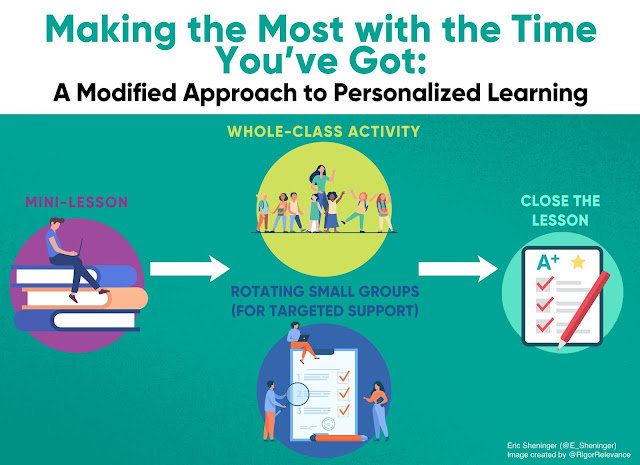
Now I know what some of you might be thinking.  Personalized learning sounds great in theory, but from a practical standpoint, it takes some time to plan when implementing for the first time.  I can’t argue with this point, but it is also a farce to say outright it can’t be done at all grade levels. Hence, the realist in me routinely recommends a modified approach to how time is used no matter the grade level.  Here is the strategy:

  • Facilitate a mini-lesson that chunks the content.
  • Provide the whole class with an activity that you would typically have already planned.
  • While the majority of the class works on the assignment, pull small groups of students or individuals for targeted support.
  • Close the lesson.

That’s it in a nutshell.  No extra time is spent planning, but support within the period is provided to those who need more help, especially at the secondary level, where the physical space might not cater to station rotation. If the goal is to improve learning and close achievement gaps, it is essential to reflect on how time is spent during class, something that I emphasize with a great amount of detail in Disruptive Thinking. From here, specific requests can be made for professional learning support on personalized strategies. 

While easier said than done, administrators can look for ways to provide time to teachers for planning and professional learning aligned to some of the ideas shared in this post.  

Sunday, September 12, 2021

Four Practical Ways to Blend

When it comes to blended learning, it is essential first to have an underlying understanding as to why this pedagogical strategy is valuable in the classroom. Let’s take a step back before diving into the nuts and bolts. Over the years, I have written a great deal about personalization, which is basically a shift from “what” to “who” as a means for students to demonstrate more ownership over their learning.  What is taught or on the test has little value if the diverse needs of learners aren’t addressed. The same could be said if all kids are learning the same thing at the same time in the same way.  

The path to equity begins with a vision where all learners get what they need when and where they need it, regardless of the learning environment.  This is the essence of personalization. While there are many strategies to personalize, blended pedagogies represent the most practical means.  While you don’t need technology to personalize, it is required to blend. Here is my definition shared in Disruptive Thinking in Our Classrooms that makes a distinction between instruction:

Blended instruction is what the teacher does with technology. Blended learning is where students use tech to have control over path, place, and pace.

Over time through my extensive work with schools, I have identified the four most practical ways to personalize through blended learning.  These include station rotation, choice activities, playlists, and the flipped approach. While each has unique benefits, they all help move teaching and learning from a state of equality to equity. The image below is my attempt to capture these significant changes.

I realized that I have separate posts and images on all four of these blended learning strategies and thought it might be a good idea to curate this information that educators have found valuable to create a resource. Below I have briefly summarized each approach and encourage you to click on the link for more detailed information.  

Station Rotation 

Students are grouped based on data and move through a variety of set activities typically consisting of targeted instruction with the teacher, collaborative exercises, independent work, and online tasks that are personalized for individual learners. The teacher establishes a block of time for each station, and students visit each one during a class period followed by some sort of forma¬tive assessment.


Choice Activities 

These allow students to select a set number of activities to complete from numerous options. Typically, they are arranged in a choice board or must-do/may-do format. Often a teacher will differentiate by having different versions. Students do not complete all of the activities.


Playlists 

A series of individualized assignments that students work through at their own pace while following the path of their choice. As students complete a task, they either color in the corre¬sponding box on a digital sheet next to their name or check off each box on a paper worksheet. Unlike choice activities, all tasks are completed. 


Flipped Approach

Students watch a short, direct instruction video or consume other forms of content outside of school at their own pace while communicating with peers and teachers using online tools. While in school, students work to actively apply what they have learned through concept engagement and empowering learning activities with assistance from the teacher.


All the blended learning strategies listed above allow educators to better use their time with students while opening the door to more significant equity through personalization.  It is important to remember that instruction still plays an important role, especially in terms of setting up the blended pathway of choice. It is up to the teacher to determine when and the extent to which each strategy is implemented.

Sunday, July 18, 2021

Blending with the Station Rotation Model

Blended learning is something that is near and dear to my heart. For me, the journey began back in 2011 when we first introduced the flipped approach at New Milford High School, where I was principal, with resounding success. As I transitioned from the principalship to supporting districts and schools, I learned that blended learning was a powerful pedagogical strategy that could unleash students' potential while meeting their diverse needs.  Over the course of many years, my work with Wells Elementary School provided a foundation that I pull from to this very day. It's one thing to talk about blended learning, but another to actually illustrate the many ways it can be implemented effectively and at scale. Wells did the latter exceptionally well.

Technology is a significant component, but not every activity has to incorporate some type of tool. The key is to find strategic ways to use it as a means to improve learning, something that is emphasized in Disruptive Thinking in Our Classrooms. There are many ways to blend, but it is vital to have a firm understanding of the underlying premise of this strategy. Hence, the definition I created a few years back:

Blended instruction is what the teacher does with technology. Blended learning is where students use tech to have control over path, place, and pace. 

In the past, I have penned detailed posts on choice boards, playlists, and the flipped classroom while only touching on the station rotation model. Thus, I thought it might be appropriate to dedicate a post just to this strategy.  With station rotation or centers as it is often referred to at the elementary level, the overreaching goal is to use valuable class time more effectively.  Following a short period of direct instruction with the entire class, the teacher breaks students into groups using data where the class engages in a series of activities during a set period of time.  Each learner will visit all the stations, and a timer is used to let them know how long they have to engage in the activity.  Typical stations include the following:

  • Targeted instruction or support
  • Collaborative experience
  • Personalization through the use of adaptive tools
  • Independent work


There is no set number of activities that a teacher can develop for this model.  However, I most commonly see three or four.  A modified two-station model could be used at the secondary level, where half the class works with the teacher while the other completes independent work using technology.  We need to get past the perception that this is just an "elementary" strategy. To assist in setting up station rotation, I have created a pedagogical framework, which you can view below.  What you will see are traditional elements of effective instruction at the front and back end.  It is essential to use a good data source for groupings so the learners get the most out of the targeted instruction or support rotation.  It is here where achievement gaps are closed, and the kids who are already at or beyond standard attainment can be pushed. 

The image above can be adapted based on the length of the class period. In addition to the use of data for groupings, a timer for pacing is also essential as it aids in self-regulation and time management.  An important aspect is to build in activities that promote collaboration. Here is where an interactive whiteboard (IWB) can be used to unlock its true potential.  Below you will see two examples from Corinth Elementary School that meet all the requirements for an effective station rotation.


Keep in mind that there are many ways to set up this model.  Overall efficacy relies on data being used to continuously group and re-group students, strategic use of adaptive learning tools, independent work that is rigorous and relevant, and the opportunity to collaborate actively. There is only one thing educators can control: the time with students in the classroom.  Station rotation, when used strategically, can be used to differentiate while also building essential competencies such as time management and self-regulation. It's a win-win at any level.  

Sunday, June 6, 2021

A Path to Equity

For a very long time, we have known that an inequitable environment exists for many learners across the world. It’s no one’s fault per se but a reality, nonetheless. Even with this knowledge in hand, change has been hard to come by. Now many might blame a lack of movement in this area on insufficient resources and differences in income levels of families. While these certainly add to the issue, it is important to focus less and the “yeah buts” that morph into excuses and more on the “what ifs” that represent viable solutions to overcome at least part of the problem.

From a school standpoint, the key to equity is the learning experience that is created for students.  Within the walls of a classroom, this is the one thing where there is a certain amount of control. It begins by taking a critical lens to instructional design. If all kids are doing the same thing the same way at the same time, that results in an inequitable experience. While it might seem fair and equal if every student is blanketed with the same direct instruction or have access to a device, it should not be assumed that there is an inherent benefit. There is a great deal of research and evidence out there that tells us people learn differently, and eventually, success relies on a vast spectrum of strategies.  Think about your own learning and what you need.

A move to a more personalized approach can begin to pave the way for a more equitable classroom and school culture.  It relies on the premise that all kids get what they need, when and where they need it, in order to develop into competent learners. Now, this is not to say that direct instruction and devices don’t have a place in the process. They most certainly do, but they only represent some of many interconnected components that a teacher uses to create an experience grounded in relevant application, appropriate challenge, purposeful use of technology, and targeted support. In addition to these, the most significant advantage of personalization in terms of equity is addressing individual strengths and needs during the school day. It’s about controlling what can be controlled.

There is no one right way to personalize. However, high agency elements such as voice, choice, path, pace, and place can be used to create an equitable learning experience. Don’t overthink things. It could simply consist of concerted efforts to get all students involved during a review of prior learning, checks for understanding, or closure.  Another possibility is allowing kids choice when it comes to demonstrating learning or selecting the right tool for completing a task.  When looking at larger-scale efforts, virtual courses, academies, and smaller learning communities (SLC’s) can be established that has the potential to incorporate all five high agency elements,

Blended learning represents the most appropriate way to ensure equity through personalization. In Chapter 5 of Disruptive Thinking in Our Classrooms, I provide numerous strategies and classroom examples in alignment with the following models:

  • Station rotation: After a short period of direct instruction, the teacher has students move through various activities where they are grouped by data. These stations can consist of targeted instruction, independent work, collaborative tasks, and adaptive learning tools. There is frequent re-grouping based on student progress over the year. 
  • Choice boards (and other activities): Following a short mini-lesson, students are given an array of scaffolded options where they select only a certain number to complete.  One of the most common options is modeled after Tic-Tac-Toe. While the class works, the teacher pulls students based on data for 1:1 support. Differentiation can occur by making available different versions based on ability, which is derived from data.
  • Playlists – A short period of instruction sets up a variety of tasks that a teacher curates into a playlist.  Unlike a choice board, students must complete all of them in the order that they wish. Differentiation can occur by making slight alterations and providing kids the best version aligned with where they are currently. 
  • Flipped lessons – With this approach, the teacher provides a short video lesson that addresses the main concepts that are to be learned, which the student completes at his or her pace outside of class.  Content, modeling, checks for understanding, practice (guided and independent), and closure are included.  During class, the teacher differentiates to meet their respective needs. 

In each of the above models (except flipped lessons), a timer is displayed for pacing and transitions. Once the activities have been completed a short formative assessment is given, which should consider of at least three scaffolded questions to ensure efficacy. To achieve greater equity, visuals with embedded tasks should be made available in the learning management system (LMS) for access in class or at home. 

You can only control what happens during the time you have with your students.  While this isn’t optimal, it does present an opportunity to level the playing field. The path to equity begins and ends with how time is used in their presence to create an experience that meets both their diverse needs and interests in alignment with either the curriculum or standards that you are accountable for as an educator. 

Sunday, May 9, 2021

Empowerment Through Choice

Agency in the classroom is about giving students more control over their learning through greater autonomy and purpose. It is driven by many factors, one of which is choice.  The underlying premise is to move learners from a state of engagement to empowerment so that they exert more ownership over their learning.  Consider the following in the context of the professional world of work and employee success.

One of the simplest ways of employee empowerment is to give them the choice to approach their work. The underlying idea in this approach is that choice gives employees a sense of personal control, which can enhance their intrinsic motivation towards their work, resulting in higher morale, creativity and innovation, better performance, more significant organizational commitment, and lower turnover (Chua and Iyengar, 2006).

It is essential to understand just how critical choice can be when thinking about lesson design and pedagogy.  It might be one of the most uncomplicated components to integrate daily, whether you are face-to-face, remote, or hybrid. In Disruptive Thinking in Our Classrooms (chapter 5), I go into detail on strategies such as choice boards, must-do/may-do activities, and playlists while sharing an array of practical examples by grade level.  Each provides students with greater control over their learning while also freeing up the teacher for targeted instruction or support. Best of all, there are unlimited possibilities on how to create these activities.  

Case in point.  Recently I received a text message from Nathan Hall, the principal of Corinth Middle School, where I have been coaching for the past two years.  He shared with me an image during a walk-through of a choice activity that Betty Graham, one of his 8th-grade teachers, implemented with a great deal of success. I loved the image so much that I asked him to send me some more context. Below is what Betty sent as well as the choice activity that she created. 

During intercession, some of my students asked if I could bring back the board they could click on as they enjoyed it so much. They said it was easier to follow. So, after spring break, I worked on making a board for my students. They wanted the links so they would not have to click different places. With this board, they know what they have to do daily, weekly, and what to do when they are finished. One thing I do like about the board, I do not hear, "What do I do now?" They are working. Today I asked my first period what they liked about the board, and they said it was easy to follow, plus they love the links.

It has been incredible watching Betty, and her colleagues at Corinth Middle School grow over the past couple of years.  As I think about what she created, I can't help but reflect on all the many different choice activities I have seen in classrooms or those shared virtually.  Below are some tips to consider as you either develop, refine, or provide feedback on your own options.

  • Use pre-made templates
  • Organize tasks into squares or columns
  • Integrate a timer for pacing
  • Pull learners for targeted support
  • Make available through your learning management system (LMS)
  • Build in rigorous and relevant options
  • Monitor regularly to ensure on-task behavior.
  • Integrate technology
  • Use adaptative learning tools for differentiation 
  • Create a scaffolded formative assessment 

Choice is the great differentiator that helps to meet the needs of ALL learners. Don't think that you need to always utilize the strategies discussed in this post.  It can be as simple as choosing the right tool for a task, topic to write a research paper about, or how to create a product to demonstrate learning.  The key is to always look for opportunities to include choice, as well as voice, during each lesson.  

Chua, Roy Y.J., and S Iyengar. "Empowerment through Choice? A Critical Analysis of the Effects of Choice in Organizations." Research in Organizational Behavior 27 (2006): 41–79.

Sunday, February 7, 2021

Tips for the Socially Distanced Classroom

Schools have either made or are about to make the transition to some sort of hybrid model. The transition is not an easy one. Just ask those who have already been through it. In the midst of adversity and limited training, educators have valiantly risen to the occasion like they always have.  With the proper safety measures in place, students have been welcomed back into classrooms.  For many, this was desperately needed as the distractions and challenges at home impacted their learning.  They wanted and needed their teachers. I would also wager that the adults felt the same about them.

Depending on the hybrid model selected, different challenges arise.  However, no matter the path taken, one consistent element is the need to social distance to keep everyone safe. I have noticed in several schools where I am coaching that a natural reaction has been an emphasis on the whole group. Desks are arranged in rows to take precautions, while the primary strategy is direct instruction. Under the current circumstances, I am not saying this is an ineffective means to facilitate a lesson. However, there is a need to ensure that learners are both engaged and empowered during whole group.  Getting all students involved, both face-to-face (F2F) and remote, is essential.

Below are some strategies that can be implemented right away when using direct instruction:

  • Facilitate checks for understanding or closure through the use of mini-whiteboards or technology. Students would need access to one or the other, but this is a great way to foster student voice as a high-agency strategy. Some excellent digital options are PearDeck, Nearpod, and Mentimeter.  You can even use self-graded Google or Canvas Forms.
  • Randomly call on kids (both F2F and virtual).
  • Integrate movement using tools like Go-Noodle. F2F students can stay by their desks while remote learners can dance away in the comfort of their own homes.  Keeping kids distanced doesn’t mean we can’t find ways to get them up and moving.
  • Utilize conversational strategies such as think-pair-share and turn & talk facilitated through videoconference breakout rooms.  Even in a hybrid model, getting kids to talk to one another through essential questions is critical.  The use of breakout rooms keeps kids socially distanced while also creating an equitable environment where remote kids get the same experience. After the activity, digital tools can be used where all kids can share their responses.

While there is a tendency to rely more heavily on one-size-fits-all methodologies, educators can still use effective pedagogies that were commonplace prior to the pandemic. Once whole group elements are finetuned, educators can begin to integrate more personalized options to empower learners while keeping them safe. While most will be done independently, the digital space provides the environment for cooperative experiences. Here are some ideas to consider.

  • Differentiate tasks to meet the needs of each learner while moving away from a blanket approach.
  • Facilitate collaboration through the use of digital tools.  There are so many options out there, but Padlet, Jamboard, and Google Docs are always good choices.
  • Develop pedagogically-sound blended learning through either choice boards or playlists. These can be used to differentiate but also free up the teacher to provide targeted instruction or one-on-one support. Both strategies allow learners to work in a self-paced format.
  • Leverage any adaptive learning tools that have been purchased. Look at some free options. HERE you can find a list.

Social distancing does place an added stress on teachers. The good news is that many effective practices that were used before the pandemic have just as much value, if not more, in the current environment.  Engaging learners and ensuring they are all actively involved during direct instruction will mitigate off-task behavior while setting the stage for increased motivation.  From here, the stage is set to implement some personalized strategies that support various learning modalities and needs.

Stay safe, everyone, and keep up the great work.  Your efforts are appreciated.

Saturday, January 9, 2021

Making Headway with Remote and Hybrid Learning

With 2020 in the rearview mirror, it is now time to focus on the present with an eye to the future. Many difficult lessons were learned during the pandemic, and a few more are sure to materialize over the next couple of months.  Even though educators have been challenged like never before, they faced adversity and stepped up to the plate admirably for their learners.  While a great deal can be written about the challenges experienced and those still prevalent, I want to focus on some of the good that has come out of the COVID-19 nightmare. Remote and hybrid learning at scale was never meant for K-12 education, but the fact remains that each has been a catalyst for some exciting changes that have long been overdue.

As I recently worked with leaders from Paterson Public Schools in New Jersey, during a coaching session, I asked them to take a few minutes, and each share something positive that came about as a result of the pandemic.  Too often, we tend to dwell on overcoming hardships that we forget to celebrate both small and large wins. With morale at a breaking point now more than ever, teachers and administrators need validation for all they have done recently. These can become critical building blocks for sustainable change. 

As each leader presented their views on positive shifts to practice, you could see their pride swell.  They shared how teachers got better using technology, reached out more for feedback, collaborated more, and improved classroom management. They also shared that the facilitation of professional learning improved, a greater reach was achieved thanks to technology, previously unknown teacher strengths were unearthed, and there was the ability to get into more classrooms. All in all, these are all great examples of progress in difficult times. How has your practice or those in your school/district changed for the better?

As the new year begins, schools, for the most part, are still where they were in 2020. That is why it is imperative to celebrate success in any form and provide further support for teachers and administrators. Instead of dwelling on all that hasn't worked, energy should be spent on all that has during the pandemic. Consider these questions from your lens. What are your exemplars of effective remote or hybrid teaching and learning, and why? How are you sharing these with colleagues and staff or using them for professional learning and feedback? While these provide ample opportunities to reflect, further headway can be made by focusing on the following:


  1. Continuity and consistency – Keep it as simple as possible. Embrace a learning management system (LMS), settle on a video conference solution that has breakout rooms and integrate one digital tool that aligns with effective instructional strategies. Then be sure to use consistency and ensure there are continuities either across your school or K-12.
  2. Lesson structure – The key here is to ensure there is a balance between synchronous and asynchronous activities both with and without technology.  Other considerations include chunking how content is presented, utilizing routine checks for understanding, providing brain breaks, and incorporating movement activities. Engagement issues arise when it is entirely direct instruction, or learners are expected to be on technology the entire time. HERE are some ideas on how to balance things out.
  3. Relevance – Learners need purpose. Without this, the willingness and desire to learn dwindles. An anticipatory set at the beginning of every lesson is a great start, but they're also should be at least one opportunity to apply thinking in a relevant way.  Kids become intrinsically motivated when they know why they are learning something and how they will use what has been learned outside of school.
  4. Rigor – Any remote or hybrid experience should challenge students to think. Consider how questions are scaffolded and the way in which knowledge will be applied to solve complex problems.  The ability to think, pandemic or not, is the best way to future-proof learning for all students while setting them up for success.  
  5. Purposeful use – Technology has played a considerable role during the pandemic and will continue to well after.  However, just using Zoom to "deliver" instruction should not be the goal and does not constitute effective use. Now is the time to focus on purposeful use aligned to sound instructional strategies (review of prior learning, checks for understanding, closure, assessment).  From here, it is about empowering students to use technology to learn in ways that they couldn't without it.
  6. Blended learning – One of the best ways to incorporate all of the above is through blended pedagogies.  Often, though, there is confusion as to what this really is. Blended instruction is what the teacher does with technology. Blended learning is where students use tech to have control over path, place, and pace while also having voice and choice. Consider practical strategies such as station rotation, choice boards, playlists, and flipped lessons.
  7. Leverage your superstars – There is no better way to make headway with remote and hybrid learning than to put the work of your trailblazers' front and center. Consider sharing what they are doing in email blasts and through social media. Not only can they serve as motivation for teachers who yearn for practical strategies, but their work can also be shared with stakeholders to showcase what is working. Your superstars can also lead professional learning.

What we have and continue to learn during the pandemic will pave the way for sustainable changes to practice that will positively impact kids. Don't sell yourselves short. In the midst of immense challenges and struggles, you have all stepped up in ways that illustrate how amazing educators are. Remote and hybrid learning can work because of your efforts. Continue to keep things manageable while also looking for opportunities to reflect and grow.  You don't have to have all the answers or solutions. It is a sign of strength to admit that you don't know or need help in these cases. If this is your situation, please feel free to reach out as I am more than happy to help in any way that I can.

Sunday, October 18, 2020

Important Lessons Learned During the Pandemic and How They Can Drive Needed Change

There is no shortage of challenges that have been leveled on schools during the COVID-19 pandemic. After some time, we have seen an initial move to all remote learning, depending on where you live, a shift to some sort of hybrid model.  A spike in cases has led to buildings being closed again and a resumption of remote learning in some locations.  Uncertainty and a lack of continuity have had a heavy toll on teachers, administrators, students, and parents. 

As educators continue to grapple with these challenges, lessons have materialized that can pave the way for needed change. Even though it is difficult at the moment to provide the time and energy to focus on these, it is essential to begin to lay the foundation. One day the pandemic will be over. Education can ill afford to revert back to the way things were done in many districts and schools. If the pandemic has taught us one major lesson, it’s that the system has not worked for many learners. The time is now to seize on the opportunity to do something about it while it is fresh on everyone’s minds.  

Below are some topics where vital lessons have been learned. Even though some have been prevalent prior to the pandemic, there should be a renewed sense of urgency to right the ship sooner rather than later.


Equity

The lesson here is that many learners have suffered from inequity because of socioeconomic status, inefficient resources, or insufficient pedagogy. If all kids are doing the same thing, at the same time, the same way, and in the same place, a red flag should be raised. Equity is about providing learners what they need when and where they need it. A move to real personalized learning at scale is the most logical step. At the same time, the digital divide has to be tackled where all learners have equitable access to a device, reliable WIFI, and quality resources.  

Infrastructure

Health and safety are of utmost concern right now. When the dust settles, long term planning should commence to install or upgrade air filtration systems and make hand sanitizer stations permanent. New classroom furniture that is flexible should be considered that can be arranged in ways to support collaboration and blended pedagogies that were implemented remotely.  As many schools decided to purchase devices for students as a means to ensure equity during remote learning, investments will likely need to be made to boost WIFI throughout buildings.  

Humans Crave Social Interaction

Social distancing and remote learning shined a light on the importance of interaction.  It is the foundation of which relationships are built and sustained.  A lesson learned is how critical it is to develop virtual experiences that incorporate discourse and collaboration.  We must also look for opportunities to increase human interaction in face-to-face settings.

Use of time

One of the biggest challenges for educators during the pandemic was time, especially when it came to implementing a hybrid model.  A lesson learned through this ordeal as we advance is to rethink how time is used in the classroom and innovative ways to give educators more of it during the workday. Both pathways require taking a critical lens to current practice and reflect on potential improvements. It is also vital to think about moving from traditional requirements such as the school calendar, seat time, and Carnegie Units (first rolled out in 1906, by the way) to competency models.  

That’s the way we’ve always done it (TTWWADI) inhibits change

Everyone has been presented with a clean slate. In the midst of an unprecedented period in education, the pursuit of innovative practices that break from the mold of what has always been done should be the imperative. Now, this is not to say that some “traditional” methods won’t still have value. It is up to each school system to determine what should be continued, which particular practices need to be shelved, and areas of focus that will benefit all learners. This includes digital pedagogy that consists of purposeful use, a move to personalized learning through blended strategies, use of data to differentiate, innovative assessment, and performance tasks. The big shift overall is to make a move from low to high agency methodologies. 


Importance of a learning management system (LMS)

Before the pandemic, many districts had an LMS (Canvas, Schoology, Google Classroom), but its uses varied greatly.  Many have realized how vital they were to continuity in learning, whether it was remote or hybrid. The key is to continue to ensure systemic use K-12 to support pedagogically-sound blended learning, self-paced activities, and the continuation of quality learning during extended school closures. It can also set the state to the creation of a viable virtual learning option for students who prefer this model.

More relevant professional learning

If there was ever a time to transform professional learning, it is now. The majority of educators will agree that one and done, as well as drive-by days or events, don’t lead to meaningful changes to practice at scale. One important lesson learned is the shift from this to job-embedded and on-going experiences. Another critical change is how professional learning is structured as well as the areas of focus. On the first point, there is a need to create or replicate the conditions that are reflective of the environments teachers and administrators work in currently. This should then be connected to relevant ideas and strategies that can be implemented in a practical way.  

SEL and our own well being

Social and emotional learning was a hot topic prior to the pandemic. It is even more imperative now as learners are grappling with social isolation, parents losing jobs, family members becoming sick, and a great deal of time spent on technology. We might not know for years, or ever, the full impact all of this has had on learners, which is why a proactive approach is needed that focuses on SEL competencies. Professional learning can fill this void. We can’t forget about the adults and what they are currently dealing with, especially teachers and the time being put in to manage and implement hybrid learning.  Although not directly tied to pedagogy, consistent efforts need to be made in the areas of mindfulness and health for all. 

I am confident that many of you reading this post could add numerous more lessons. Please consider adding them in the comments section below. You will also notice there is not much depth above. I only added a few suggestions in each category where vital lessons have been learned. It is up to you in your role to reflect on each and begin to take the required action in relation to your current situation. 


Sunday, October 11, 2020

How to Create Effective Learning Playlists

Educators have been working valiantly to make either remote or hybrid learning work. In the midst of this challenging time, we have seen innovative practices embraced more at scale. These represent new methodologies for some, while others are now applying what they had already been doing to the current situation in the form of blended learning. It is essential for me to reiterate what I have been saying for years as there is still some confusion as to what this actually entails:

Blended instruction is what the teacher does with technology. Blended learning is where students use tech to have control over path, place, and pace.

Thus, just using Zoom or Google Meet is not blended learning if content is just being shared. The same could be said if all learners are using Kahoot of Quizizz as part of a synchronous lesson. Another critical aspect of pedagogically-sound blended learning is some form of personalization. If all learners are doing the same thing at the same time the same way, then one can deduce that this is not a personal experience. If equity is the goal, it’s time to flip the script by giving students what they need when and where they need it.

Past posts have explored blended strategies like station rotation and choice boards, which make learning more personal in remote and hybrid environments. Playlists represent another great option, but I have yet to elaborate on how educators can implement these effectively, until now. The premise behind these is quite simple, as learners are presented with a series of tasks that they complete in any order they want. Personalization occurs through path and pace. Unlike choice boards, where only a set number of options have to be completed, learners are accountable for every playlist activity.


The following guidelines outline some best practices for creating effective learning playlists:

  • Provide direct instruction prior to introducing new content either through a mini-lesson or flipped approach.
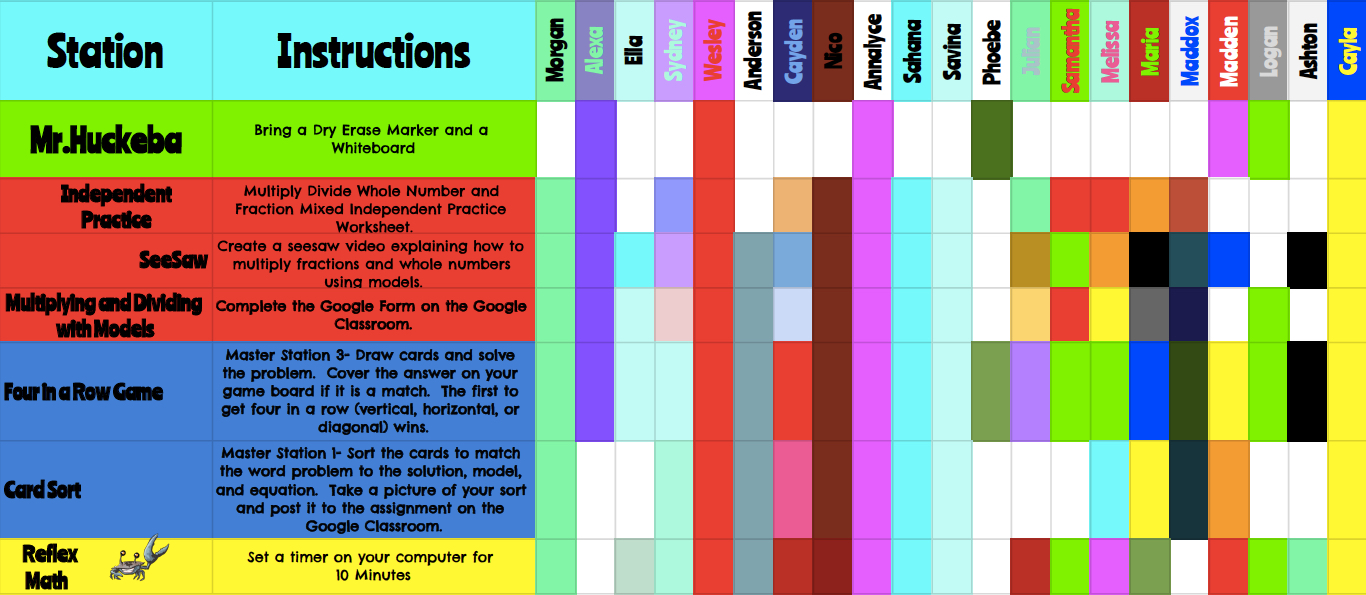
  • List tasks in a learning management system (Canvas, Schoology, Google Classroom) and use a Google Sheet for students to color in once a task has been completed. In cases where digital equity is an issue, these can be listed on paper for distribution, while any activities involving technology would need to be replaced.
  • Scaffold questions and activities to bump up thinking.
  • Build-in relevant problem-solving to instill a greater purpose while providing an appropriate challenge.
  • Use data to provide one-on-one or small group support.
  • Ensure there is a balance between tech and no-tech options.
  • Integrate adaptive tools that respond to strengths and weaknesses while providing data that can be used for groupings and shifts to instruction. 
  • If possible, differentiate by providing multiple versions that address the specific needs of learners while provided different paths.
  • Create a simple formative assessment for learners to complete after they have finished all activities in the playlist. This could consist simply of 3 scaffolded questions. Not only does this provide closure, but it will also provide insight as to whether the kids engaged in all the tasks.


The image above provides an example of what a well-structured playlist looks like, as it includes an array of activities that challenge students to think and play what they have learned in different ways. It also affords the teacher an opportunity to work with kids that need the most support. Once a task is completed, the learner colors in the cell under their name in a Google Sheet.

Playlists are a fantastic blended learning strategy that can be used to personalize learning, differentiate instruction, and free up the teacher during class time. They also represent a viable option for both remote and hybrid learning environments.  The key to remember is that there is no one right way to create them. It is up to the teacher to determine the right number of tasks and the overall length of time that learners will have to complete them. This could range from a single period or block to a few days or even a week. When all is said and done, the goal is to use time more effectively while developing a more equitable learning experience for all kids.


Sunday, October 4, 2020

Time is What Teachers Need Right Now

At first glance, this post's title might be perceived that hybrid learning is not working in many districts and schools.  I can state unequivocally that it is based on firsthand experience coaching in schools the past couple of months. I have seen incredible lessons and activities that have both engaged and empowered learners through the purposeful use of technology, sound pedagogy, and personalized strategies. However, this is not the case at scale, and it is not the fault of teachers.  For virtually everyone, hybrid learning represents a monumental shift from what has been done in schools. No one was thoroughly prepared for this transition. Now we must accept this fact and work to get it right until the pandemic subsides.

Teachers need time, plain and simple, to make this work. There is no way to skirt around the issue. The current course in many districts and schools has created conditions and a workload that is just not sustainable.  I have had heart-wrenching conversations with teachers on this issue. As I have asked them what I can do to support them, the uniform response is to have more time.


Build it into the schedule

If you have not yet moved to a hybrid schedule, now is the time to think about how it can be integrated weekly or daily.  Many schools have implemented some variation of a flex schedule where an entire day is allocated for teachers to plan and catch up, typically on a Wednesday or Friday. During this day, students are all remote and working on asynchronous tasks. For more information on various hybrid models, check out this detailed piece from Education Week.

If you are already in a hybrid model, time can still be added with approval from the Board of Education. Another possibility is to look at other ways to free up time each day. I did this for my teachers as a principal. Since each teacher had a non-instructional duty by contract each day, I cut these in half, freeing them up multiple periods per week to pursue innovative practices. We called this the Professional Growth Period (PGP). If I were still a principal under these current conditions, I would have released them totally from their duties, which would have given them an entire period each day to prepare.

Dedicate specific teachers to remote learners

Another option to help alleviate some pressure is to assign remote learners to specific teachers. Ideally, this is done before a hybrid model is implemented. However, it can be done at any time. In this scenario, teachers are not responsible for both face-to-face and remote learners simultaneously, which turns out to be a huge relief.

Move to blended strategies

Another way to get back some time is to look at how it is being used. Implementing pedagogically-sound blended learning can free some up to manage both groups of learners better or even catch up on tasks. A teacher can work with smaller groups during a targeted instruction component with a modified station rotation model. Remote learners can be placed in the same rotation to eliminate the back and forth that often occurs when trying to teach both groups simultaneously.  Check out this post for more details on how to implement this successfully. More independent strategies such as choice boards and playlists can free up time for the teacher to monitor as needed, but also try to catch up a little bit. Since many teachers were already using these strategies prior to the pandemic, the foundation is already in place, with only a few tweaks being needed. By no means does this solve the issue entirely, but it can lead to less time being spent on the weekends and late at night.

Develop a coverage schedule

If you are an administrator reading this, hero status can be achieved by working with your leadership team to develop a coverage schedule. Thanks to technology, your office can be a classroom, and you won't miss a beat. As part of an alternating process, one leader could be in the main office to attend to any issues. Other administrators and support staff who are not involved in daily hybrid teaching can lend a hand to give teachers the needed time.

It is important to note that no matter the strategy used to free up teachers' time, there should be no strings attached. What I mean here is that this has to be their opportunity to plan, grade, conference with students, create videos for flipped lessons, or engage in professional learning. They should not be mandated to attend meetings, participate in PLC's, meet with parents, or attend professional development. For it to work to alleviate stress and anxiety, they should have full control as to how the time is spent.

For more remote and hybrid learning strategies and resources click HERE.

Sunday, September 6, 2020

A Pedagogical Framework for Managing Face-to-Face and Remote Learners at the Same Time

It's has been great to be back in schools working shoulder to shoulder with teachers and administrators as I kicked off year two with the Corinth School District in Mississippi. Until this point, most of my interactions with educators have been through virtual presentations, workshops, and coaching.  Now don't get me wrong as this has been incredibly fulfilling and a great learning experience for me. However, you just can't replace face-to-face professional learning, in my opinion. Body language, eye contact, verbal discourse, collaboration, and relationship building are much more powerful when people are physically together.

Even though I have been on-site for workshops since the start of the pandemic, last week was my first time working with educators in small groups and visiting classrooms with students. Before I dive into this post topic, I must say how impressed I was with what the teachers and administrators have accomplished.  Their growth has been astounding as they have successfully implemented many of the pedagogical strategies emphasized last year, which has made the transition to a hybrid learning model more manageable. As I visited each school, I felt like a proud parent and can't say enough about their collective efforts to improve professional practice.

There are still challenges, though. Like many districts, Corinth has given parents the option to send their kids to school or learn remotely. In some cases, it hasn't been easy to effectively manage both face-to-face and remote learners during the same class period, which is the case for almost every school district.  It is important to remember that no one was trained for this, and pedagogically-sound models are just starting to appear. Teachers not only in Corinth but across the world, are exhausted. I learned from working with educators virtually and on-site the toll that hybrid learning is enacting on educators.  During a very candid conversation with a small group, I experienced firsthand that the single most impediment was time. The number of hours that some educators are working is just not sustainable.

The key is to either free up time or think about how it is being used. This was overcome by having a dedicated teacher assigned to all the remote learners at the kindergarten through the sixth-grade level. Unfortunately, having a dedicated remote teacher for the upper-grade levels isn't an option in smaller school districts.  After listening to some teacher concerns at the middle school, I began to map out a framework that could help teachers manage their time better while in school.  As I scribbled on a large whiteboard, I simultaneously bounced ideas off the principal Nathan Hall.  The end result was a simple rotational model preceded with direct instruction followed by a summary activity or closure. Since Corinth Middle School has fifty-minute periods, I suggested ten minutes for each rotation as well as the mini-lesson and closure activity.

Content still matters, but there has to be some prioritization of standards and, from there, a mini-lesson.  My advice is to keep it short and sweet. Depending on the block of time, this can be either ten or fifteen minutes. Teachers can record this as it is being streamed live using a video conference tool and then uploaded to a learning management system for all kids to refer to whenever they want. Another option is to use the flipped approach and record the mini-lesson for all kids to watch at home before class.  Within this first small chunk of time, it is critical that relevance is imparted, and the best way to do this is through a quick anticipatory set. The last segment of the class could consist of a formative assessment or a closure activity. 

Now let me discuss conceptually what the rotational model could look like in a school. The teacher has two options here. Either group all the remote students together or use data to regularly group and regroup kids as they work to approach, meet, or exceed standards.


  • Station 1 (Targeted instruction): After a general overview of the lesson during the opening minutes of class the teacher can then dive deeper through more extensive modeling and checks for understanding.  During this time, students can also have their questions answered.
  • Station 2 (Personalized or adaptive learning): In this station, students can work through the curriculum and concepts based on strengths, weaknesses, or personal interests. There are both free (CK-12, Khan Academy, Prodigy, Freckle) and paid (HMH intervention tools, Waggle, IXL) programs. Here is where data can be collected and analyzed for groupings if the right tool is used.
  • Station 3 (Independent or collaborative work): Initially, I would go with independent work as it takes less time to plan for than cooperative learning.  Activities could consist of scaffolded practice problem sets, independent reading, or the use of a self-paced personalized tool if you decide to make the other station purely adaptive.  

The entire premise of the model presented above is to make the best use of available time during a class period where a teacher is managing both face-to-face and remote learners. I suggest only three rotations to begin, but you can definitely add more if you are working with a more extended block of time.  Or you can even tweak it to meet your specific needs as this is what Nathan Hall did for his staff. Below you will see what two Corinth Middle School teachers developed and integrated with Canvas.


Once you are comfortable, consider utilizing choice boards, playlists, or flipped lessons if these won't turn into a time sap. Or you can plan for some sort of cooperative learning using virtual breakout rooms. To ensure success, it is also a good idea to commit to a learning management system such as Google Classroom, Canvas, or Schoology. It becomes more difficult managing remote learners if you are not using one of these solutions.  I loved visiting with Corinth High School science teacher Sally Beth McCullough recently and seeing firsthand what she has implemented successfully. Below you will see how she is effectively using Canvas and choice boards.


I still have 18 more days with the Corinth School District this year and can't wait to see what their teachers and administrators accomplish.

Managing face-to-face and remote learners at the same time can be a challenging task for teachers and schools as a whole.  My hope is that the framework and examples above can serve as a baseline to think about how to best use the time available without succumbing to burnout.  As teachers, always lean on your colleagues near and far. They are your best resource. If you are an administrator, be flexible with your staff and demonstrate empathy. They need your support more than ever. Finally, always be on the lookout for professional learning opportunities that can fill in the gaps and provide needed feedback for continuous improvement. You all will get through this as educators always rise to the challenge.

Be sure to check out my entire #remotelearning series. 

Sunday, August 23, 2020

Developing Asynchronous Remote Learning Tasks

Over the past couple of months, I have written extensively on the topic of remote learning. As I continually work with more and more districts and schools on an ongoing basis, ideas keep percolating in my mind as to the pedagogically-sound strategies that educators can use now.  Modeling on my part and active application on their end, make these learning experiences that much richer.  Many readers have noticed that many of the strategies I have shared are also effective for face-to-face learning.  The significant shifts in adapting to remote learning involve how time is used, providing flexible pathways, ensuring there is regular feedback and the purposeful use of digital tools when appropriate.

In my last post, I focused on engagement in synchronous lessons. If kids aren't engaged during the instructional component, then it is quite difficult to empower them later on, regardless of whether they are offline or online.  Technology plays a huge role, which is why all efforts need to be made to eliminate the digital divide. The key, however, is balance.  To create empowering opportunities for all kids that involve more ownership over their learning requires us to think beyond synchronous learning that is just online.

Asynchronous learning provides much-needed flexibility that better meets the needs of both students and teachers by relinquishing the familiar rigidity of school. It also supports both independent and collaborative work when structured the right way while supporting critical competencies such as self-management, creativity, inquiry, and teamwork. There can also be a mix and match of both digital and non-digital activities that allow students to actively apply what has been learned in relevant and meaningful ways.  It is here where learner empowerment can be emphasized. To get started, consider these tips:

  • Determine how content will be disseminated (synchronous or asynchronous).
  • Map out activities in alignment with priority standards
  • Establish learning targets
  • Determine how much time students will have to complete the tasks
  • Consider developing scaffolded formative assessments for students to complete after a series of asynchronous activities as a form of closure and to check for understanding.
  • Provide a few assessment options and allow students to select which one is graded.
Below are some of the most practical strategies to develop asynchronous tasks. Keep in mind that some rely on technology, while others don't. 
 

Self-Paced Activities

The sky is the limit here, which is why I am addressing this strategy first.  It could include independent reading with reflective questions, scaffolded question sets, inquiry or problem-based performance tasks, or virtual pathways.  In the case of the latter, check out this PreK – 12 curricula from Khan Academy.  Another great resource to incorporate self-paced activities is CK-12.  Be sure to click on the "explore" tab on the top toolbar and check out the adaptive practice, simulations, and interactive games that can all be done in a self-paced format.

Choice Boards

Giving kids a choice as to the activities they engage in is a great way to empower them to learn while providing greater ownership.  Choice boards represent a solid blended learning strategy where tasks can be scaffolded, differentiated, and contain a mix of digital and non-digital options.  To get started, view examples, or take what you have already created to the next level by checking out this post. One of my favorite examples I saw during a coaching visit to Wells Elementary School was a Tic-Tac-Toe board that included formative assessment, purposeful use of technology, and differentiation, which you can read about in detail HERE. Choice might be one of the most uncomplicated components to integrate daily. If creating a board is not your thing, simply start with "must do" and "may do" activities.  

Playlists

Sometimes flexibility can be as simple as letting kids pick the order of the tasks during asynchronous learning.  Unlike choice boards, all of the activities in a playlist or menu are completed by a student at their own pace.  For more details on this blended learning approach, give this post a read. The majority focus on individual work, but there is always an opportunity to include some collaborative tasks using digital tools where kids would be empowered to reach out to peers.  

Adaptive Technologies

Nothing replaces sound instructional design and pedagogy. However, these powerful tools can help close achievement gaps and limit learning loss as part of a teacher's asynchronous arsenal of strategies and supports.  In a nutshell, adaptive technologies use computer algorithms to orchestrate interaction with the learner and deliver customized resources and learning activities to address each learner's unique needs. Some solid options free options can be found using this link while paid solutions can be located HERE.

Flipped Lessons

If there was ever a time to try to develop a flipped lesson, it's now.  This strategy is not new by any means and can easily be adapted to a remote word. Be sure to check out how one of my former teachers implemented this approach. Teachers can record their direct instruction component of the lesson in short clips, typically 10 or 15 minutes. Concepts can be explained using mini whiteboards, slide decks, or digital tools like Educreations. These can then be uploaded to your learning management system (LMS), such as Google Classroom, Schoology, or Canvas.  If you don't use one of these, no worries - the videos can be added to a class Google Site.  After watching the video at a preferred pace, students would then complete a series of asynchronous activities to construct new knowledge and apply what was learned from the content presented.

A major benefit of asynchronous learning activities are their inherent flexibility, which can be a benefit to students, educators, and parents alike. Tasks and assignments can be completed over a specific time period using strategies addressed in this post as well as more traditional options such as research papers or projects. They can also free up the teacher to work with those learners who need targeted instruction or extra help.

Finally, while we’ve now had months to absorb and adjust to this new reality, it’s a natural reaction to feel hampered by the absence of traditional in-person instruction. On the other hand, now is the time to embrace the upside of this moment, let go of some of the old baggage and self-imposed limitations around what we think school really is, and expand our idea of what teaching and learning can be. Creative, asynchronous learning opportunities are a vital way to keep remote learning dynamic, impactful, and even more equitable.

Be sure to check out my entire #remotelearning series.