Showing posts with label ICLE. Show all posts

Sunday, August 7, 2022

Identifying the Best Supports for Personalization

We know for a fact that everyone learns differently. While a one-size-fits-all approach served its purpose for some of us, it doesn’t meet the diverse needs of kids today. It also doesn’t provide teachers and administrators with valuable insight on how to best support learners no matter where they are in relation to standards and critical competencies. Thus, educators need not only a vision for how to personalize learning effectively but also essential supports that will help to ensure success.  


The most crucial aspect when it comes to personalizing learning is the teacher in the classroom. While mindset and relationship building work to form the foundation for a more personal approach, leveraging sound pedagogical practice to assist all students in getting what they need when and where they need it ensures equity in the classroom. In chapter 5 of Disruptive Thinking in Our Classrooms, I dive deeply into these practices while providing numerous examples. You can read a summary of the most used strategies with a high degree of fidelity HERE


Personalized pedagogy sets the stage for the purposeful use of technology to better assist in meeting students' learning needs while providing educators with timely data. While there are many K-8 tools on the market, many have shortcomings such as no research base, difficulty in pulling useable data, no clear alignment to standardized tests, and students finding the tasks to be boring. Naturally, this can be quite frustrating when large sums of money are spent on purchasing these programs. Don’t fret, though, as a fantastic support option is available to districts and schools in the form of Waggle

Waggle is a tool that K-8 educators can use to support the successful implementation of a more personalized approach.  Below are some specific highlights and features that set it apart from tools such as i-Ready and IXL. 
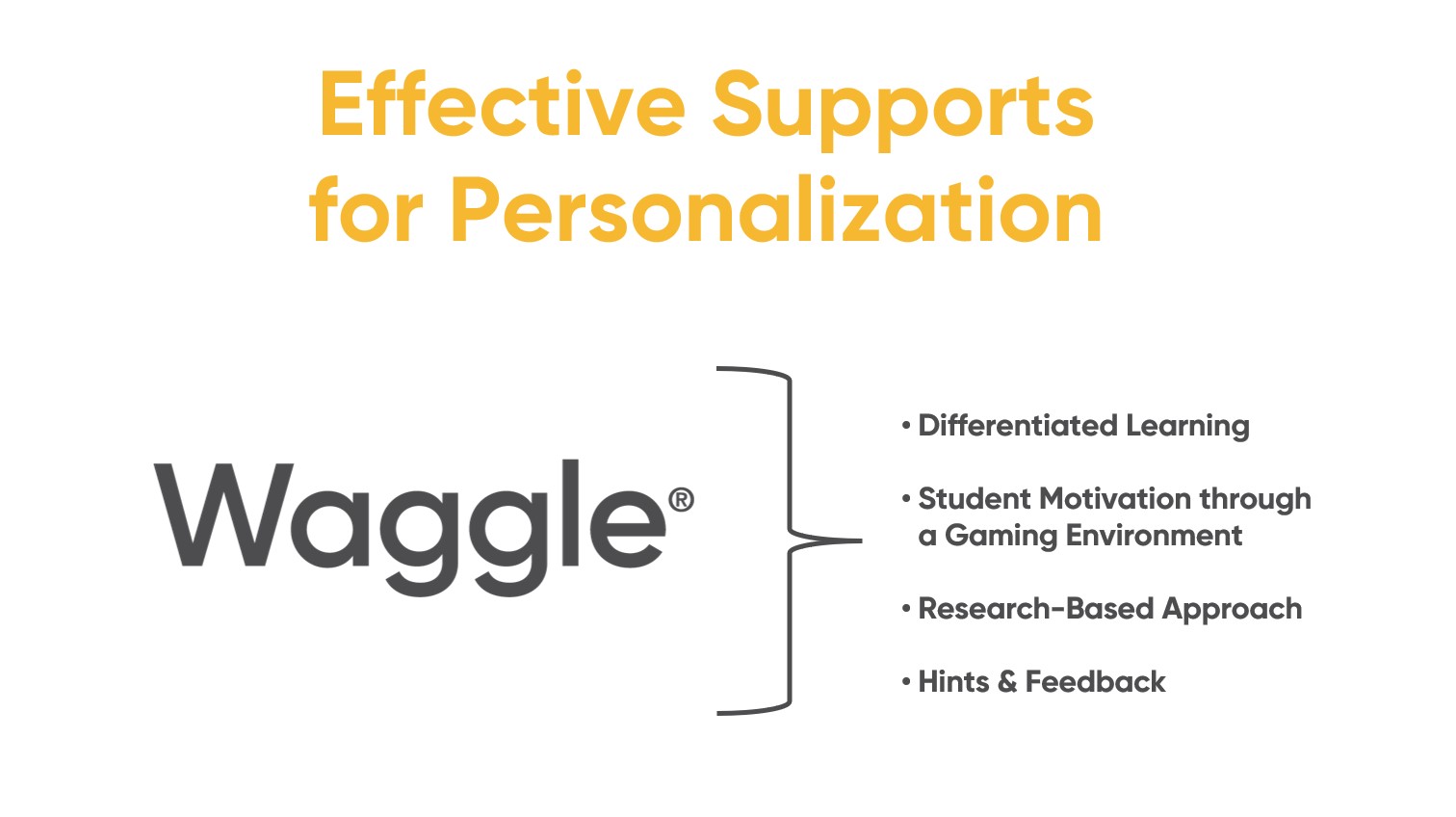

Differentiated Learning

A hallmark of personalization, Waggle provides:

  • Auto-assigned appropriate practice and instruction, or teachers can play an active role and assign additional content that supports their core instruction.
  • Teacher access to K-8 content. 
  • Adaptive functionality that analyzes beyond proficiency. Based on 13 data points, it continuously adjusts to offer true personalization, including behavior and prerequisite knowledge.
  • Instruction and practice on prerequisite skills within the grade level and from earlier grade levels.

Student Motivation through a Gaming Environment

Students can:

  • Learn in an immersive, game-based environment. 
  • Access a dashboard that allows them to track their own progress toward mastery of skills and learning.
  • Choose age-appropriate worlds to visit.
  • Personalize their avatar.

Research-Based

Waggle leverages research-based techniques to enhance students’ knowledge and accelerate learning. Waggle provides Retrieval, Interleaving and Spaced-Out Practice and Feedback, which yield long-term retention and optimal performance.

  • Retrieval is the act of recalling what has been learned and is essential for creating long-lasting memories. Retrieval best enhances retention when practiced early and often in a low-pressure context. 
  • Interleaving involves switching up the types of problems students solve when practicing. Changing the order or type of activity increases the effort and may create more cues for memory. Waggle Practice is comprised of multiple related skills. A student must have mastery of all these skills and be able to apply them simultaneously to be successful. 
  • Spaced Out Retrieval across multiple shorter sessions, days, or weeks is more effective than one long session for long-term retention because it requires more effortful processing. 

Hints & Feedback 

Feedback is information provided to learners about their current level of knowledge and what they can do to progress to the next level. It is an essential step in making formative assessment as meaningful as it does in Waggle. Feedback only works if it is received and acted on by the learner, so both the content and the delivery of feedback matter. Waggle has robust hints embedded in every practice assignment and immediate feedback for every learning activity. Waggle provides a safe, supportive environment through scaffolded hints, support for English learners, explanatory feedback, and optional instructional lessons. Mistakes are embraced as learning opportunities.

The premise of personalization is all learners getting what they need when and where they need it to learn. When utilizing a pedagogy first, technology second lens, Waggle can become your tool of choice to improve student outcomes aligned with job-embedded and ongoing professional learning facilitated by Aspire Change EDU.

Sunday, June 26, 2022

The Everlasting Influence of a Great Teacher

Over the years, I have made the point of highlighting some of the many teachers who not only had a positive impact on me as a student but also have a tremendous amount of influence on me today.  In Disruptive Thinking in Our Classrooms, the stories of Mrs. Williams (kindergarten), Mr. South (middle school science), and Dr. Hynoski (high school science) were shared.  While each in its own right had an incredible impact on me as a learner and person, it wasn’t until recently that I reconnected with Mr. Wynn, my former art teacher, on Facebook.  He, by far, might have had the most significant influence on my development, and I am excited to share his story.

I attended a rural consolidated school in northwestern New Jersey for grades kindergarten through eight.  There were only two teachers per grade level, and the principal was also the superintendent.  My memory is a bit fuzzy, but I believe we only had one art teacher, Mr. Wynn.  This meant my classmates, and I were able to have him as a teacher multiple times over the years.  He was also the soccer, baseball, and softball coach.  I am not sure why we didn’t have baseball at the school even though we did at the recreational level.  Like many of the most influential teachers, Mr. Wynn was involved in as many things as possible that had an impact on kids.

To say that he is a gifted artist is putting it modestly.  All one has to do is see his personal artwork that he shares routinely on Facebook.  Once we connected in this space, it brought back so many powerful memories through the powerful pieces he shares.   Each image has served as a reminder of sorts.  In my mind, I was not a good artist and struggled even to draw a coherent stick figure.  However, Mr. Wynn was never negative and always provided positive feedback on my work while motivating me to make improvements.  I absolutely loved anything to do with ceramics and watercolors.  His class was one that I looked forward to not just every year but also every day.  

There are many attributes that Mr. Wynn possessed that made him a great teacher.  I believe these are shared by all who have an everlasting influence on a student’s past, present, and future.  These teachers:

  • Build relationships
  • Are empathetic
  • Care
  • Provide meaningful feedback
  • Find the good
  • Challenge learners
  • Are enthusiastic
  • Model expectations


While I am always in awe of what Mr. Wynn shares on Facebook, it wasn’t until I began to prepare for my new keynote at the Model Schools Conference that his impact resonated more loudly than ever.  Matt Thouin, an amazing friend who always pushes me to be better with fantastic feedback, suggested that I weave in more personal stories to connect with my audiences.  At this point, I knew I had to incorporate the everlasting influence that Mr. Wynn has had, and continues to have, on me as a person.  As I prepared, I dreamed that I would be able to include some of the artwork that I created in class.   I knew I had at least one ceramic sculpture, but little did I know that there was a treasure trove of artifacts lying in wait in my attic.

Over the holidays, my parents drove to Texas from New Jersey and dropped off a bin of items they had kept and stored for years.  As I searched my attic with a flashlight, I came across this and, when I opened it up, realized that they had saved artwork and projects going all the way back to my kindergarten years.  Tears rushed down my face as I could not explain in words how meaningful these items were as a flood of emotions pummeled me all at once.  Almost all of the artifacts came from Mr. Wynn’s class, including a fully functional ceramic snail that holds pencils and pens.  Below you can see not only this but also many pieces of artwork created in his class.

What I learned after my trip to the attic and writing this post is that I was not as bad at art as I initially thought.  While I never aspired to be an artist, I can confidently say that Mr. Wynn helped me become the educator, father, and husband I am today.  I am also willing to bet that anyone who had him as a teacher agrees.  Thank you, Mr. Wynn, for your commitment and dedication as a teacher and coach.  You, and every other great teacher who embodies those same principles, have and will continue to have an everlasting impact on students.  

Sunday, April 4, 2021

Learning Recovery Through Acceleration

There is an emerging sense of relief amongst educators as more and more schools are welcoming back students or that the most difficult year is finally coming to an end.  With this excitement comes renewed fears of where many of these kids are academically or will be by the beginning of the next school year.  As such, the most common messaging has focused on the impending learning loss epidemic that is about to plague virtually every school.  While we know there are and will be challenges with re-entry and assimilation, my concern is how the use of a deficit thinking approach to stereotype kids who, in many cases, have experienced immense trauma will affect them.  It’s not their fault that a pandemic occurred. 

A more sensitive and pragmatic strategy is to develop systemwide supports for learning recovery through acceleration.  Remediation techniques tend to address foundational skills and lower-level standards and concepts that emphasize perceived weaknesses—employing an asset-based approach instead of a deficit model shifts the focus to strengths and equity. So why learning recovery through acceleration as opposed to remediation?  Suzy Pepper Rollins provides this take:

The primary focus of remediation is mastering concepts of the past. On the other hand, acceleration strategically prepares students for success in the present—this week, on this content. Rather than concentrating on a litany of items that students have failed to master, acceleration readies students for new learning.

With this approach, as opposed to a deficit thinking, focus on learning loss, districts and schools work to develop a comprehensive plan to determine where their learners currently are to help them get back on track and accelerate their learning.  With both a sense of urgency and an array of competing interests trying to advocate for why their way is the best, it is critical not to make the process more complicated than it is.  Don’t overanalyze it or be made to think that just a technology solution will do the trick.  To accelerate student learning, Kyra Donovan suggests the following:

  • Develop teacher clarity by prioritizing standards using consistent and specific criteria.
  • Implement quick differentiation through vertical alignment of priority standards so teachers can dip down a grade level if needed but move quickly back to grade-level standards.
  • Emphasize rigorous and relevant learning through scaffolded questions and tasks that teach priority standards while allowing immersion in key concepts and skills. 
  • Create checks for understanding by creating and aligning formative. assessments to priority standards.
  • Establish continuous high expectations to instill a belief that all students can and will learn. 
  • Be bold by questioning current assessments and their purpose to determine if you need them all.

It is critical to move past remediations that will further exacerbate learning gaps while identifying and implementing strategies that represent a sound investment to help learners get back on track and accelerate their learning. Below are some more thoughts from Kyra. 

At Aspire Change EDU, we have developed comprehensive learning recovery through acceleration solutions.  With the Elementary and Secondary School Emergency Relief (ESSER) Fund, Congress has made money available to school districts to tackle the ongoing impact of the COVID-19 pandemic.  The two rounds of funding are primarily focused on learning recovery but can be used for a variety of professional learning needs. The time is now to develop a longitudinal plan.  Feel free to email me at any time (esheninger@gmail.com) for more information.  

Sunday, July 12, 2020

Purchasing Devices Does Not Equate to Learning

The COVID19 pandemic unearthed many harsh realities for education across the globe. One of the more glaring issues was the vast digital divide that still exists in many places, especially the United States.  Inadequate WIFI and the availability of computers at home for kids to use for learning caught many educators off guard. Remote learning was a monumental challenge for districts and schools that already had made large-scale investments in devices, but it was even more so where inequity was prevalent.  Many kids were automatically at a severe disadvantage as a result, which will most likely result in extreme learning loss and ever-widening achievement gaps.

It is okay to admit that we were ill-prepared before and during the pandemic.  Now is the time to seize on lessons learned as schools prepare to move into uncharted territory whether the COVID19 rages on or begins to subside. Teaching will and must be different. Leadership must and will be different. Most of all, the learning culture will most certainly be different, and it will be a travesty if it is not. We have begun to see some change as more and more school districts are purchasing devices for all of their students.  Every day I see new articles highlighting the millions of dollars; in some cases, spent to either begin to close or eradicate the digital divide. There are also forward-thinking districts who either purchase WIFI hotspots for kids or park WIFI-enabled busses around the community for family access.  All of these efforts are to be commended.

Here is the rub in all of this. Time and time again, even well before the pandemic hit, schools had a thirst for ensuring that there was a device in the hands of every student. William Horton says it best, "Unless you get instructional design right, technology can only increase the speed and certainty of failure." 


Below are some lessons we learned after hitting the reset button on our Bring Your Own Device (BYOD) initiative in order to get it right that I captured in a 2015 post.
We found great success at my school during our digital transformation by focusing on pedagogy first, technology second if appropriate mindset. Not only was there a focus on solid instruction, but we also provided numerous supports for our teachers in the form of ongoing and job-embedded professional learning opportunities. If the expectation was to integrate technology with purpose to support or enhance learning, we made sure everyone was prepared to do just that. 
For technology to live up to the hype, pedagogy must change, whether learning is face-to-face, remote, or based on a hybrid model to ensure student and staff safety. Drive-by professional development did not work in the past. What has and will continue to make a difference are supports that incorporate the following:
  • Ongoing
  • Job-embedded
  • Supported with coaching (face-to-face or virtual)
  • Personalized and differentiated
  • Facilitated by people who have done the work and implemented successful change that resulted in improved student learning outcomes and achievement
  • Directly correlated to professional practice
  • Aligned with research and case studies
  • Addresses real challenges educators face
  • Sustainable over time
Before COVID19, I always cautioned districts and schools to be wary of putting the cart before the horse. I am not sure that I would offer the same advice as we now know there is a great deal of work to be done to ensure digital equity for all kids. However, I am still steadfast in my opinion that just purchasing devices does not equate to learning, nor will it in the future if proper supports are not in place. Teachers need training and job-embedded coaching. Principals need support so that they know what to look for and can give their staff actionable feedback. Superintendents and central office administrators need to be able to determine the efficacy of the investment.  


Just putting a device in kids' hands and expecting learning miracles to materialize is wishful thinking at best. Ongoing support is needed to usher in pedagogical change while building capacity. Teachers and administrators deserve this investment if large sums of money are being spent on devices.  Without this support, the overall goal of the purchase might never be realized.

Sunday, January 28, 2018

To Fail Forward You Need to Believe in Yourself

"Failure is simply the opportunity to begin again, this time more intelligently." - Henry A. Ford

I was never one to embrace the mindset that failing at anything was good for you.  For the most part, my educational experiences kept me in a box where success was determined by the destination, not the journey.  Grades and marks were the main indicators of how well I did and with a few exceptions, the learning process focused on a linear path.  As I have grown as a professional and learner, the one thing I now believe in without a doubt is that success and learning follow a similar path, which is anything but linear and often a convoluted process.  It is important that we as adults understand this if we are to transform learning in an effort to improve education for students at scale.  

Failing forward is the ability to reflect on unintended consequences in pursuit of goals and ultimately achieve success.  It requires a mindset rooted in determination, self-efficacy, patience, resilience, creativity, big-picture thinking, and accountability.  Above all else, you need to believe in yourself and your own unique abilities.  Quite often I speak on the need for the profession of education to redefine success and learning.  When doing so I point to the acronym that many people now use for the word FAIL: First Attempt in Learning. So, what does this really look like in the context of transformative learning, innovation, and success?  Look no further than famous failures throughout the course of history who persevered after many failed attempts to succeed.


Now there are numerous famous people who have failed forward. One of the stories that I like to share most often is that of Henry Ford. Not only is his story inspiring, but the quote at the beginning of this post is one of the most powerful quotes related to learning that I can think of. I read a great summary about Ford on the Intellectual Ventures blog. He was an amazing entrepreneur and as history has shown he optimized transportation forever changing the automobile industry. Even though he succeeded, Ford experienced numerous failures. From the lessons learned he was able to fail forward to eventually develop an automobile manufacturing process that was cost efficient, produced reliable vehicles, and paid workers well all while creating a loyal culture.

The Intellectual Ventures post goes on to summarize the two main failures that Ford experienced:
The capital was difficult to attain and in the late 1800s, no one had established a standard business model for the automobile industry. Ford convinced William H. Murphy, a Detroit businessman, to back his automobile production. The Detroit Automobile Company resulted from this union, but problems arose shortly after its creation. In 1901, a year and a half after the company began operations, Murphy and the shareholders got restless. Ford wanted to create the perfect automobile design, but the board saw little results. Soon after, they dissolved the company. 
Ford recalibrated his efforts after his first failure. He realized that his previous automobile design depended on serving numerous consumer needs. He convinced Murphy to give him a second chance. However, their second venture, the Henry Ford Company, stumbled from the start. Ford felt that Murphy pressured him to prepare the automobile for production and set unrealistic expectations from the beginning. Shortly after Murphy brought in an outside manager to supervise Ford's process, Ford left the company, and everyone wrote him off. 
These two failures could have been career-ending, but Ford continued. Several years after the second parting with Murphy, Ford met Alexander Malcomson, a coal magnate with a risk-taking spirit like Ford. Malcomson gave Ford full control over his production, and the company introduced the Model A in 1904. 
For Henry Ford, failure did not hinder innovation but served as the impetus to hone his vision for a technology that would ultimately transform the world. 
The story of Henry Ford is so empowering, as he did not let failure inhibit his resolve to succeed. Each failed attempt to revolutionize the automobile industry provided the vital learning lessons he needed to create something amazing. The story is the same for virtually every other famous person who did not succeed at first.  You must have a desire to change. Then you have to follow through with the process of change, which will not always go the way you would like. Ultimately, we must believe in our abilities to transform ideas into actions that produce a better, more successful result.  History has taught us that we should never doubt the difference one person can make with the right attitude and commitment to be the change. Those who fail forward change the world. 

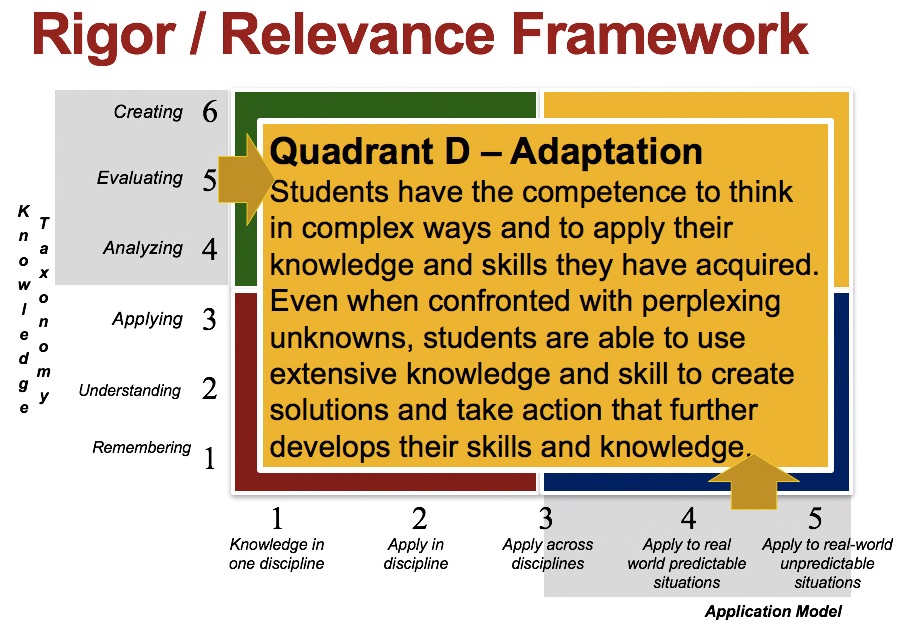
Achieving success in the real world is rarely easy.  It is a convoluted process fraught with obstacles and unforeseen challenges.  That same goes for learning.  If it is easy, then it probably isn't learning. Our learners also need to see the value of failing forward.  The transition from Quad A learning to B, C, and eventually D as outlined in the Rigor Relevance Framework helps to give students a deeper understanding of concepts through authentic application. Quad D learning sees failure as being an iterative component of the learning process. Take a look at the image below that illustrates the power of Quad D learning to push students towards deeper thinking and application.


It is not what students ultimately know that really matters, but what they actually understand. When students are able to solve complex problems, even though they might experience setbacks along the way, critical competencies are developed that will prove invaluable in the future. This is key if we are to groom the next generation of inventors, thinkers, and entrepreneurs poised to succeed in the new world of work. 

Whether it is success in the real world of the classroom, failing forward requires an unwavering belief in our abilities as well as getting students to believe in theirs.  

Sunday, December 17, 2017

Learning Walks

Successful change and consistent improvement rely on many interconnected factors. I mention this, as it is important to note that it isn’t one particular action or person that ultimately moves an idea or initiative into something that positively impacts school culture.  This applies to the success that my staff and I were able to be a part of during our digital transformation a few years back.  The focus might have been on digital, and I was the initial catalyst that got the ball rolling, but it was the collective action of my teachers, students, and other administrators who embraced different and better while showing evidence of improvement that resulted in improved outcomes.  

What many people also don’t realize is that even though all eyes were on the digital aspects of our transformation, it was the continuous focus on improving teaching and learning that ultimately led to results. I have routinely written and spoken about the concept of a Return on Instruction (ROI), which states that when integrating technology or implementing innovative ideas the result should be evidence of improved student learning outcomes. This makes sense on many fronts, as we are accountable first and foremost to our learners as well as our other stakeholders.  To help achieve an ROI we increased the number of formal observations and evaluations, collected learning artifacts (lesson plans, assessments, student work, etc.) and had staff create portfolios to show growth and changes to practice.  Additionally, my admin team and I conducted learning walks every day.

The process of learning walks or walk-throughs as many schools refer to them is to get a glimpse of what is happening in classrooms to then provide non-evaluative feedback for improvement.  They serve an integral role as “soft” accountability mechanisms to spark conversations and reflections on practice.  The more we observe and talk about practice the better equipped we are to make and lead change.  Another positive outcome of learning walks is the building of better relationships since the non-evaluative nature of the process focuses on meaningful growth around targeted look fors. We developed look fors that aligned to both our McREL observation/evaluation tool to prepare teachers for these in the future and the purposeful use of technology to improve student learning. 


It’s been a few years now since I left the principalship to pursue my new career as a Senior Fellow with the International Center for Leadership in Education (ICLE).  In addition to keynote presentations and workshops I typically facilitate, I have also been engaged in job-embedded coaching with districts across the country.  One district, in particular, is the Downingtown Area School District (DASD) in Pennsylvania.  Their leadership team, comprised of building and district administrators as well as instructional coaches, has worked face to face with me on a deep dive into the Pillars of Digital Leadership.  They have also been completing job-embedded tasks after these sessions and completed a reflective questionnaire as part of ICLE’s Digital Practice Assessment (DPA) process.   Our collective goal is to create an immersive experience that moves beyond the typical one and done professional development.

Under the leadership of Matt Friedman and Jonathan Blow from Downingtown, coaching days with me were added so that we could all get into classrooms and conduct learning walks.  The inherent value of this exercise was to observe and collect evidence to determine instructional areas that needed the most focus.  After our first session, which was very successful based on the feedback received, they pushed me to think about targeted look fors that could be integrated into our next set of learning walks to support their digital transformation efforts across the district further.  Challenge accepted! 

Below are the look fors I developed that would later be integrated into a learning walk form:

  • Learning targets (objective/concept what are students expected to learn/do)
  • Standard alignment 
  • What are learners doing?
  • What is the teacher doing? (direct instruction, modeling, monitoring, facilitation, etc.)
  • Authentic context – Do the students know how their learning aligns to or how it can be applied to a real-world context? Do they understand why they are learning what they are and how they will use it?
  • Level of questioning (Rigor Relevance Framework – creating, evaluating, analyzing, applying, understanding, remembering)
  • Means of assessment (formative, summative)
  • Reflection - Is there an opportunity for students to reflect on their learning at some point?
  • Rigor Relevance Quad alignment (Which quad does the lesson or activity align to?)
  • Device Use (passive or active learning) - Passive (note taking, digital worksheet, consuming content) vs. Active (creating, applying, collaborating, synthesizing, etc.)
  • Student agency (voice, choice, advocacy) – Are students empowered to own their learning (blended/personalized/virtual learning options, they select tool to be used, etc.)
  • Use of classroom/school space (arrangement, furniture, choice, flexibility, comfort, lighting, temperature, mobility, acoustics, etc.) – Are desks in rows or arranged in a way to foster collaboration? Are there flexible/comfortable seating options? Does the room offer an appropriate level of stimulation? Would you want to learn in this space?

After sharing the areas of focus above, Jonathan created a Google Form for the Downingtown leaders to use as we all engaged in learning walks across the district.  You can access and download the form HERE if you wish.  The group conversations and reflection that ensued after the walks were conducted was terrific!  My role was to act as a facilitator to engage the group in critical discussions on what they saw. As you see from the form, the primary focus is on learning, not technology.  The two elements should go hand in hand, not treated as separate entities.  It is also important to note that not every lesson should or will incorporate technology. 

With any learning walk form or tool, there has to be a great deal of flexibility regarding how you use it. You would be hard pressed to see all of the look fors listed above as a learning walk is brief and only gives you a snapshot of what is (or isn’t) taking place. This is why I encouraged DASD leaders to take pictures of learning artifacts and ask questions of both the students and learners to develop a more holistic view.  Another way to use it would be to just focus on 3-4 look fors during a walking cycle. However, the most critical aspect of the learning walk process is what is done afterward to improve practice.  Collaborative discussion as a leadership team about what can be improved as well as timely feedback to teachers is both crucial for success.  

If you have any feedback on the look fors or the learning walk form please share in the comments below. 

Sunday, November 19, 2017

School of Dreams

As many people know I am originally from the Northeastern part of the United States.  I was born and raised in New Jersey, where I also became a teacher and eventually a principal.  After meeting my wife in 2002, I moved to Staten Island, NY and resided there for thirteen years. To be honest, I never thought I would leave that area of the country as my wife, and I had such strong roots there. Things change, however.  The successful digital transformation at the school where I was principal attracted a great deal of attention from the mainstream media, schools locally and globally, and organizations, in part because we were able to show efficacy in our work.  It was at this time that I decided to take a calculated risk and attempt to help other schools scale their digital and innovative change efforts.

As I transitioned from principal to Senior Fellow with the International Center for Leadership in Education (ICLE) my work began to take me all over the country and the world.  I vividly remember the day when I was away working in Hawaii, and Staten Island got dumped with over a foot of snow.  Shortly after I returned home, my wife sat me down and gave me an ultimatum.  I either had to go back to being a principal so I could be home to shovel any and all snow in the future or we had to move somewhere else in the county where it was warm and didn’t snow at all.  My wife knew full well how much I love the work that I do so out came a map of the United States and the discussions as to where we would raise our family for the foreseeable future began.

During our discussions, I had to set my non-negotiables.  She wanted warmth and no snow while I needed a huge airport that was centrally located to cut my flight times and connections down.  There were only two realistic choices at this point, Dallas and Houston. Since Houston was a bit further south and we could get the exact home we wanted the decision was made.  One other factor that weighed heavily in our decision-making process was the school district that our children would attend.  The icing on the cake for me was that when it was all said and done taking into account our non-negotiables, we decided to build our home within the Cypress-Fairbanks Independent School District (CFISD). 

CFISD is an amazing school district that is not only one of the highest achieving large districts in the state of Texas, but also firmly committed to scaling innovative practices to improve learning for all 120,000 students. For the past year and a half, my team and I at ICLE have been assisting the district with doing Bring Your Own Technology (BYOT) K-12, incorporating blended learning, and aligning sound pedagogy to the use of flex spaces.  We have also used our Digital Practice Assessment (DPA) process to help them determine where they are at, but more importantly where they want to be for their learners. Now back to my story.

Shortly after arriving in the Houston area I was contacted by Cheryl Fisher, a local CFISD elementary principal.  She had been following me on Twitter and asked if I would be willing to visit her school and see how they were implementing blended learning across all grade levels.  What I saw just warmed my heart, but more on this later.  A little over a year later Cheryl was named the principal of Wells Elementary, a brand-new school right smack in the middle of the community where I lived.  I couldn’t control my excitement, but there was a challenge ahead in the form of my daughter, Isabella.


Bella, who was in 4th grade at the time, had a big decision to make. Stay in the other community school where she had made friends for two years or go to a brand-new school for her last year of elementary school. To be honest, she was leaning on staying put. I discussed this with Cheryl, and she said quite bluntly, “If your daughter decides to come to Wells she will love learning every day.” Well, I was already hooked, but Cheryl also made the time to meet with Bella and explain in detail the vision she had for the learning culture at Wells.  What followed was the waiting in anticipation of what Bella would decide to do. 

Well, my daughter, on her own without much pressure from my wife and I, decided to attend Wells Elementary. Every day I ask her how school was and literally tear up when she responds as the answer is always the same – “It was great Daddy.” My daughter is entirely in love with the school. As an educator and parent, this means so much more to me than her consistently being advanced proficient every year on all standardized tests.  Wells Elementary to me is a school of dreams because my daughter loves learning.  Here are some specifics as to why:
  • School-wide decision to have no homework.
  • Students K-5 are empowered to use their technology to support their education as part of BYOT. In addition to this, technology is used to support and enhance learning while providing authentic opportunities to explore concepts.
  • Strategic use of the station rotation blended learning model to maximize learning time and increase student agency.
  • Incorporation of flexible learning spaces throughout the building.
  • Portfolio-based assessment using Seesaw and Google Classroom to provide better feedback to students.
  • An entire staff that believes in the power of being connected and the importance of having a Personal Learning Network (PLN).
  • Systemic use of a variety of social media tools to communicate with stakeholders and keep them in the know.
I encourage you to check out this video where Cheryl and one of her teachers discuss the digital transformation at Wells Elementary.


It is important to know I am not just making the casual statements about using only my parent lens.  I am honored by the fact that I am the one who is engaged with Wells as part of ICLE’s partnership with CFISD to support the district with our Digital Leadership and Learning solutions.  As the job-embedded coach for the school, I have been working with the teachers and administrators and will continue to do so throughout the school year.  Even though there are some fantastic initiatives in place as mentioned above, the Wells community knows that there is room for improvement.  This is the case in any classroom, school, or district. Together we are working on the pedagogical shifts needed to support their bold vision and plan for innovative learning.  

All in all, this is a school of dreams in my opinion.  The fact that my daughter loves learning and is being prepared for her future means the world to my wife and me.  Thank you to all the educators at Wells and CFISD who are have brought so much joy to my daughter. With the compelling learning opportunities she is experiencing, I hope that she will be further motivated to follow her dreams, no matter what they are. 

Sunday, October 22, 2017

Efficacy in Digital Learning

As a principal, the buck stopped with me.  I was reminded of this by numerous superintendents during my tenure as a school leader.  However, when we began moving forward with our digital transformation one particular superintendent asked me point blank what evidence I had that actually supported our claims that new equated to better. This not only stopped me in my tracks, but that moment in time provided the grounding that my school and I really needed.  For change to really be embraced by all stakeholders it is critical that we just don’t tell and claim that improvement is occurring, but that we also show. 

Accountability matters and is a reality in our work.  We are accountable first and foremost to our learners. As a supporter of the purposeful use of technology and innovative practices, I had to illustrate how effective these strategies were at improving learning.  Statements and claims didn’t cut it and this was more than fair.  It was at this time where the term efficacy kept finding its way into the conversation and my head. In the real world of education efficacy matters and it is important that this is part of the larger conversation when it comes to digital. It is a word that, in my opinion, has to be a part of our daily vocabulary and practice. Simply put, efficacy is the degree to which desired outcomes and goals are achieved. Applying this concept to digital learning can go a long way to solidifying the use of technology as an established practice, not just a frill or add-on.

The journey to efficacy begins and ends with the intended goal in mind and a strong pedagogical foundation.  Adding technology or new ideas without this in place will more than likely not result in achieving efficacy.  The Rigor Relevance Framework provides schools and educators with a check and balance system by providing a common language for all, creating a culture around a common vision, and establishing a critical lens through which to examine curriculum, instruction, and assessment. It represents a means to support innovative learning and digital practice as detailed in the description of Quad D learning:
Students have the competence to think in complex ways and to apply their knowledge and skills they have acquired. Even when confronted with perplexing unknowns, students are able to use extensive knowledge and skill to create solutions and take action that further develops their skills and knowledge.
Aligning digital to Quad D not only makes sense but also melds with a great deal of the conversation in digital and non-digital spaces as to why and how learning should change.  A framework like this emphasizes the importance of a strong pedagogical foundation while helping to move practice from isolated pockets of excellence to systemic elements that are scaled throughout the learning culture.  It also provides the means to evaluate and reflect in order to improve. 


Rigor Relevance Framework

Once an overall vision for digital learning is firmly in place you can begin to work on the structures and supports to ensure success.  This brings me back to efficacy.  The why is great, but the how and what have to be fleshed out.  Determining whether technology or innovative practices, in general, are effective matters.  Below I will highlight 5 key areas (essential questions, research, practicality, evidence/accountability, reflection)  that can put your classroom, school, district, or organization on a path to digital efficacy. 

Essential Questions

Questions provide context for where we want to go, how we’ll get there, and whether or not success is achieved.  Having more questions than answers is a natural part of the initial change process. Over time, however, concrete answers can illustrate that efficacy in digital learning has been achieved in some form or another.  Consider how you might respond to the questions below:

  • What evidence do we have to demonstrate the impact of technology on school culture?
  • How are we making learning relevant to our students?
  • How do we implement and support rigorous and relevant learning tasks that help students become Future-Ready?
  • What is required to create spaces that model real-world environments and learning opportunities? 
  • What observable evidence can be used to measure the effect technology is having on student learning and achievement?
  • How can targeted feedback be provided to our teachers and students, so that technology can enhance learning?

Research

Research is prevalent in education for a reason.  It provides us all with a baseline as to what has been found to really work when it comes to student learning.  Now, there is good research and bad.  I get that. It is up to us as educators to sift through and then align the best and most practical studies out there to support the need to transform learning in the digital age. We can look to the past in order to inform current practice.  For example, so many of us are proponents of student ownership, project-based, and collaborative learning. Not only does digital support and enhance all of these, but research from Dewey, Vygotsky, Piaget, Papert, Bloom, and many others provide validation.  See the image below. For more on authorship learning click HERE.


One of the main reasons Tom Murray and I wrote Learning Transformed was to provide a sound research base that supports digital learning and the embracement of innovative practices.  The research of Linda Darling Hammond found that technology can have the most impact on our at-risk learners when it is used to support interactive learning, explore and create rather than to “drill and kill”, and constitutes the right blend of teachers and technology. This is just one of over 100 studies we highlight. Then there is the comprehensive analysis by John Hattie on effect size – a listing of the most effective instructional strategies that improve student learning outcomes all of which can be applied to digital learning. If efficacy is the goal, embracing a scholarly mindset to inform and influence our work, not drive it, is critical.

Practicality

All of what we do should align to the demands, and at times constraints, of the job.  This includes preparing students for success on standardized tests. If it’s not practical, the drive to implement new ideas and practices wanes or never materializes.  The creation of rigorous digital performance tasks that are aligned to standards and the scope and sequence found in the curriculum is just good practice. All good performance tasks include some form of assessment, either formative or summative, that provides the learner and educator with valuable information on standard and outcome attainment.  Again, this is just part of the job. 

The Rigor Relevance Framework assists in creating performance tasks that engage learners in critical thinking and problem solving while applying what they have learned in meaningful ways.  There is also natural alignment to incorporating student agency. This is exactly what so many of us are championing.  My colleague and good friend, Weston Kieschnick, has created a template that combines research and the practical aspect of performance task creation to assist you in creating your own.   Check it out HERE. You can use the template and go through the process of developing a rigorous digital performance task or just use it to inform as you design your own. 

Evidence and Accountability

As many of you know I do not shy away from openly discussing how important this area is. Just go back to my opening paragraph in this post for a refresher. Evidence and accountability are a part of every profession and quite frankly we need more of both in education to not only show efficacy in our work but to also scale needed change. Not everything has to or can be, measured. However, focusing on a Return on Instruction allows everyone to incorporate multiple measures, both qualitative and quantitative, to determine if improvement is in fact occurring. 

Reflection

When it is all said and done the most important thing we can all do is constantly reflect on our practice.  In terms of efficacy in digital learning consider these reflective questions from your particular lens:

  • Did my students learn? 
  • How do I know if my students learned? 
  • How do others know if my students learned? 
  • What can be done to improve? 
  • What point of view have I not considered?

Amazing things are happening in education, whether it be through digital learning or the implementation of innovative ideas.  We must always push ourselves to be better and strive for continuous improvement. The more we all push each other on the topic of efficacy, the collective goals we have for education, learning, and leadership can be achieved. 

Sunday, October 15, 2017

Achieving a Balance

When it comes to work, I have had to battle some internal conflicts over the years.   Early on in my career as a school administrator, and then again in my work in my current position as an ICLE Senior Fellow, I had to be put in place, thankfully, by those who care a great deal about me.  In the past, the challenge for me had always been putting too much focus on the job and not enough time and effort on my family or personal well-being.  I am going to try to speak about my battles with the work-life balance and attempt to offer up some sound advice for all of us that, at times, can be consumed with professional work.  My perspective always comes back to some sage advice that my mother gave my wife and me when we became parents, “You never get this time back so make the most of it.”


Image credit: http://www.saxonsgroup.com.au/blog/wp-content/uploads/2016/09/work-life-balance.jpg

The work-life balance as I see it can be broken down into three main categories: professional, family, and personal.  The first two types are self-explanatory. Personal takes into account your lifestyle, health, friends, and anything else that contributes to your well-being.  When the demands of our jobs are factored in, finding a balance between these areas can pose quite the challenge.  Add the pressure that we all put on ourselves to perform at a high level and what results are a hole that at times is difficult to get out of. 

When it comes to my professional work, I allocate my time each day to ensure tasks get done.  Yes, I am a list guy.  For the most part, I write out all tasks that have to be completed the night before.  I did this as a principal and still to this day embrace this practice.  Having a schedule and sticking to it helped me be more productive.  It forced me to prioritize specific tasks while delegating others that had no real impact on student learning. However, I am not a slave to my list.  Things beyond my control can and do come up.  That's where flexibility and patience come into play. Both attributes are instrumental in helping us achieve professional success, but also in achieving a positive balance in life.

Let me share an example of what this looked like.  As high school principal, I conducted 2-3 unannounced observations a day.  The week before I would not only schedule these on my calendar, but I would also set time aside to write each up the same day so that I could conduct the post-conference with the teachers the very next day.  I not only committed to this schedule but also made it known to my secretary that I shouldn’t be bothered unless necessary. Some might think this is extreme, but this practice helped me to focus on getting my work done at school so that I could enjoy priceless time with my family at home each evening. The work-life balance starts here. I chose not to bring work home, period. Sometimes I would stay a bit later to get things done, but the weekends were off limits.  That was family time.

Social media posed another challenge to the balance.  Twitter was a considerable time zap early on, and then the use of other tools began to take a negative toll on my time. Once I got that under control my travel began to turn the tables in the wrong direction.  In both cases, my fantastic wife took the initiative to explain how each was negatively impacting our family.  As my father always says, “There is nothing more important in life than family.” Never take for granted what you have right in front of you.  Social media has had such an incredible impact on my professional and personal life as well as many of you that are reading this post.  The key here is not to let it drive a wedge between those who depend on us the most – our family.  

When it comes to social media and writing in general, I put time aside when I am either on the road or when my wife and kids are at school.  This small shift has had a magical effect.  When they are home, I am more present, both physically and emotionally.  We also commit to at least two family trips a year.  As far as travel is concerned, ICLE has been amazing, as they have encouraged me to scale back to achieve this balance.  I can’t explain how awesome it is to work for a company who actively promotes attaining and maintaining a work-life balance.  This has enabled me to be home more during the workweek and work towards eliminating weekend travel. As a cheer dad, this is crucial in the eyes of my daughter as all of her competitions are on weekends. 


So, what about the personal component of the work-life balance?  Here is where all of us need to be a bit selfish.  Our well-being is not only good for us on a personal level, but it has positive impacts on our professional work and family life.  As a high school principal, I had a lengthy commute from Staten Island, NY to New Milford, NJ.  Each morning I had to drive through the gauntlet, which was my term for the journey that took me over the Goethals Bridge and then through a good stretch of the NJ Turnpike. If I didn’t leave early enough, I would be stuck in traffic for hours.  Thus, I left my house each morning at 5:15 AM. 

Why that early you might ask?  This is where I began to add some balance to one of the three categories above.  On a personal level, I had to make the time to work out in the morning or else it just wouldn’t happen.  I would leave at this time to not only get my workout in but to also open the fitness center at 6:00 AM for students that wanted the same opportunity. Having a routine was nice.  With my crazy travel schedule, it is more difficult to be consistent. My rule of thumb now is a minimum of four days working out each week. If I do not achieve this, then I attempt to deprive myself of something I have grown to enjoy as of late – craft beer.  

Equally as important in the personal balance category is trying to eat healthily. As a principal, I had a fairly strict eating regime that was consistent.  Now that has all changed when I am not home.  I am genetically prone to high cholesterol and am currently on a statin to control it.  With this condition life on the road becomes even more of a challenge because it is virtually impossible to eat the way I want.  Just look at the calorie counts of many salads, and you know exactly what I am talking about.  Every change matters, no matter how small.  For me I get my salad dressing on the side, avoid fried foods and desserts, and eat smaller meals throughout the day.  

I really could go on and on about my ideas on achieving a balance, but that is not the reason for this post.  My hope is if you are dealing with some of the struggles that I have encountered this post might help you get a better handle on finding a balance that works for you, work, and your family.  Below is some general advice that applies to the three main categories outlined in this post:

  • Don’t let work get in the way of what’s most important – your family and personal well-being.  Establish a schedule that works for you and be “present” during family time.
  • Take care of yourself!  Try to make some small shifts to your diet and make the time to exercise a couple of times per week. Go to the doctor and get a check-up regularly. 
  • Scale back on the social media time.  I am one of the biggest proponents of PLN’s and engaging in chats is excellent for our professional growth. However, making the time for real, face-to-face conversations with our family over a meal is crucial to the balance.
  • Get outside!  Walks with the dog, family, or just on your own to reflect can be invigorating.
  • Make time for your friends and neighbors in your immediate area.  I have been doing this more and more when I am at home thanks to the push from my wife.  
  • Find or resurrect a hobby.

I hope you all will consider sharing how you go about achieving a balance in your life as well as some of the challenges you face.  Achieving a balance all comes down to the fact that we care for those who we love, depend on, work with, and who depend on us.  When it is all said and done, I want to succeed on a professional level, but achieving success as a dad, husband, and friend in the eyes of those I care about is what truly matters. 

Sunday, September 17, 2017

Get Your SWOT On

Leaders often find and leverage tools, frameworks, and systems to support their own change, as well as that of their school or district.  There are many great options out there.  As a principal, I in particular, found success using the Rigor Relevance Framework as a means to integrate technology with purpose in order to improve student-learning outcomes.  This framework helped us to really focus on improving instruction first before throwing technology into the mix. This then became part of a set of strategies and competencies that guided our overall digital transformation efforts – The Pillars of Digital Leadership. My work now is focused on helping leaders, regardless of position, to leverage these resources to successfully implement and sustain needed change. 

Outside of education there are other tools and frameworks that can assist with various change efforts, many of which come from the business world. Business leaders know that assessing the status of an effort prior to the change process is crucial.  Building awareness is also a key element. As an innovative leader, you are reinventing the school culture through a different lens. As such, it is important to get a sense of the journey ahead by taking stock of where you are in the current moment. Prior to leading any new initiative, you can use an adapted version of a well-known business tool to take a snapshot of where you perceive the current culture to be in its current situation. Using this adapted tool may reveal important data and insight that helps you understand the status of your culture in order to successfully implement sustainable change. 


Image credit: hwww.business-to-you.com/swot-analysis/

In BrandED, Trish Rubin and I introduced the SWOT analysis.  I will elaborate on how this tool can be used to create or enhance a brand effort, but in all honesty, it can be used to tee up any new change initiative.  SWOT Analysis is a useful technique for understanding your strengths and weaknesses, and for identifying both the opportunities open to you and the threats you face. Adapted from BrandED, here is how you can use this tool to implement a positive brand presence.
Every business brand journey includes the use of this tool, an activity known as a SWOT analysis. In conducting a SWOT, the strengths, weaknesses, opportunities, and threats to brand success are stated and examined.  The SWOT activity is done in the very early stages of development of a mission so that the brand strategy can be assured of success (Armstrong & Kotler, 2015).  
Adapted for educators, a SWOT analysis is a chance to understand how you perceive your school community and can help you articulate a brand that addresses the current state of the organization. Especially interesting to leaders will be the opportunities for growth that are identified, which can be used as tangible measures of brand success, and the threats that are challenging the school. Making those threats a target and finding ways to see opportunities in those challenges can strengthen the school’s brand. A SWOT analysis can serve you well in your initial reflections about both your personal brand and your school’s. A SWOT process conducted with frankness yields valuable information about the current state of an organization and directs decision making. Once the analysis is complete, it forms a direction for leaders as they take on their personal brand, as they can more clearly see themselves serving the needs of the community.  
As business managers have found, putting yourself through your own SWOT analysis can even further inform the building of your own brand. Why do a personal SWOT? A SWOT analysis may goad you into real action as you advance your own brand in real time. Honestly assessing your strengths and weaknesses and reflecting on any opportunities or threats that are present in your leadership style can help you assess your capacities before you build a professional brand that you own as the storyteller-in-chief. 
As you think about the changes you want to implement in your classroom, school, district, or organization take the time to conduct a SWOT analysis (see matrix below). This simple, yet effective process can help to identify potential pitfalls while building greater support for the effort. 


Image credit: www.thirstt.com


Cited sources

Armstrong, G., & Kotler, P. (2015). Marketing: An introduction (12th
     ed.). Boston, MA: Pearson.


Monday, June 27, 2016

Inspiring Students: Bringing Awe Back to Learning

 Awe might seem like just another three-letter word, but it is so much more.  A recent New York Times article detailed how humans can get goose bumps when we experience awe, that often-positive feeling of being in the presence of something vast that transcends our understanding of the world. It is a catalyst that can motivate people to do more good. The article also highlighted the research of Paul Piff and Dacher Keltner who found that awe helps bind us to others, motivating us to act in collaborative ways that enable strong groups and cohesive communities.

Think back to the last time you experienced awe and think about how this impacted you.  I would wager that many specific experiences come to mind, which is not very surprising at all.  Descriptors such as awesome, jaw dropping, satisfying, and rapturous probably come to mind. The power of awe cannot be overstated. It is a huge component of life—it’s hardwired in our brains. When we experience the sensation of awe, we are consumed by wonder, relevancy, emotion, engagement, inspiration, and real-world connections. Jason Silva considers awe to be a pivotal ingredient in making ideas resonate. Check out his Shots of Awe YouTube series and you will see exactly what I am talking about. Below is the one video of his that got me hooked. Excuse the pun, but you will be “awed” while watching it. 


The more I read about awe, the more convinced I become about how important it is in our lives. In an article published in The Atlantic titled Making Time for Awe, various research studies support the many benefits of having our minds blown. Researchers from Stanford and the University of Minnesota found the following in a recent study:
"Participants "who felt awe, relative to other emotions, felt they had more time available, were less impatient, were more willing to volunteer their time to help others, and more strongly preferred experiences over material goods."  Awe is an experience of such perceptual expansion that you need new mental maps to deal with its incomprehensibility."
Applying this concept to education is both exciting and depressing.  Awe is a driving force for learning that will not just benefit our students now, but also well into their future. However, traditional views and functions of school deprive many students from experiencing the joy and power of awe as a catalyst for meaningful learning. Current policies in many (not all) schools focus on control, compliance, conformity, and rules that don’t awe our learners. Data from a recent Gallop Poll shared and analyzed by Dr. Scott McLeod shows what many of us know - students are disengaged, bored, and disempowered.  Systemic change is needed even in schools where there are isolated pockets of excellence, as all students should be exposed to the power of awe.
"Don't prepare kids for something. Prepare them for anything."
We have a responsibility to awe and students need us to bring this element into their daily learning experiences, such as those aligned to Quad D of the Rigor Relevance Framework. To do this we must innovate our practice. In my definition innovation is creating, implementing, and sustaining transformative ideas that instill awe to improve learning. Increases in our willingness to innovate can result in disruptive changes to learning. 


Disruption in a way that facilitates improved learning opportunities that engage and empower students through awe should be the goal. In order to drive innovation there has to be a focus on changing learner needs, evolving technologies, changing the learning environment, and bold ideas. 


Schools and educators can advantage of inherent stimuli in these drivers to create better, more meaningful learning experiences for students that leverage the power of awe. Building off a sound pedagogical foundation rooted in rigor, relevance, and relationships, the drivers of innovation can bring awe back into learning. Let’s look quickly at these drivers in a bit more detail:

  • Evolving Technologies – Technology continues to change at a rapid pace, which presents education with some exciting opportunities to awe learners. Some examples include augmented reality, virtual reality, open education resources (OER), adaptive tools, coding, drones/robotics, and gamification. With all the excitement and possibilities it is important to remember that pedagogy trumps technology if the goal is meaningful student learning.
  • Changing Learning Environment – You can have all the best technology and digital pedagogical techniques, but if the learning environment remains unchanged the results that we yearn for might never materialize. Learner designed spaces emphasize comfort, flexibility, choice, and the use of authentic tools. They are reflective of the real world, leverage the outdoors, and capitalize on mobile technology.
  • Changing Learner Needs – Learners crave a greater purpose and sense of relevance in their learning. We must seize on the gift that access to the real-time web provides to foster student learning anytime, anywhere, and with anyone. Awe can be cultivated in both personal and personalized learning opportunities where the main motivation comes from student agency. This all culminates in a shift from consumption to creation and curating as a means for students to awe us in their learning experiences.
  • Bold Ideas – There needs to be a shift from business as usual to business as unusual.  Ideas that are bold work to counteract the status quo and current education reform policies. We must work to elevate the profession, integrate more play in the school day, embrace failure throughout the system, redefine success and learning, and provide meaningful professional learning with accountability.
To inspire students we must make a concerted effort to bring the awe back into learning. This is not an easy journey, but one that is well worth the potential hardship.