Showing posts with label COVID19. Show all posts

Sunday, January 23, 2022

Supporting and Rewarding Teachers with Time

If it’s true that life is a test, then the COVID-19 pandemic represents the most challenging one education and everyone in the field has ever faced.  The impacts are far and wide.  Not a single person is unaffected, and everyone needs help in some form or another.  However, one group, in particular, stands out as they are on the front lines every day working with kids – our teachers.  I don’t have to go into specifics as they are well known, but many of the issues include quarantined students, skeleton classes, concurrent teaching, covering classes, abrupt shifts to remote or hybrid learning, increasing demands, and personal exposure to the virus.  As a result, the workload and stress just keep piling up.  If something is not done and soon, I fear, as many others do, that there will be a mass exodus from the profession.  


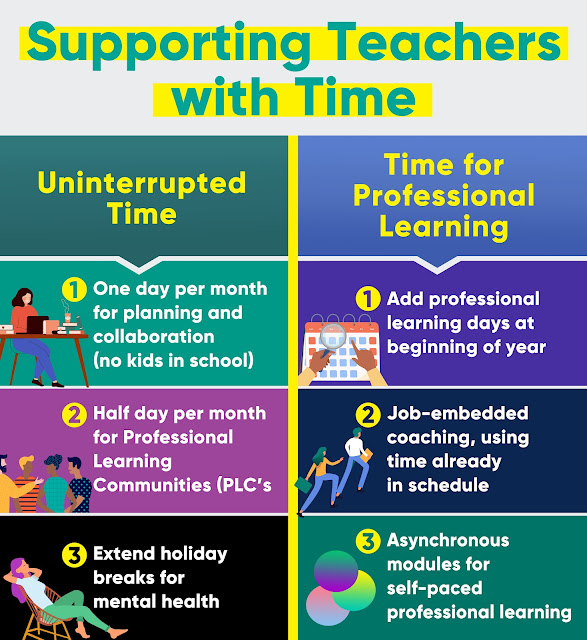
As someone who is in schools on a weekly basis and working side by side with educators under these conditions, I always ask what could be done to make their professional lives a little bit easier.  The response is always the same no matter where I am in the country, and that is time.  Some might say that this is easier said than done.  Still, districts across the country have made innovative changes to the school calendar and amended contracts to provide uninterrupted time to plan and collaborate.  That means no meetings, phone calls, emails, or mandated professional development.  However, professional learning support is also imperative, and there are other time-sensitive strategies that can be implemented.  Below are some ideas broken up into two categories:


Uninterrupted Time

  1. One day per month for planning and collaboration (no kids in school): I have seen more and more school districts moving to this model, which has been celebrated by teachers, administrators, support staff, and students.
  2. Half-day per month for Professional Learning Communities (PLCs): We took this route in my former district, where I was a principal.  We don’t want PLCs to become “just another thing” teachers have to do.  By providing time, they inherently become more powerful and something that is valued.  On a side note – administrators should be in their own functioning PLC as a way to model. 
  3. Extend holiday breaks for mental health: I have seen a few superintendents across the country take this route resulting in a win-win scenario.

Time for Professional Learning

  1. Add professional learning days: My opinion is that it is best to frontload these at the beginning of the school year to alleviate distraction and pressure.  Another idea is to build in back-to-back professional learning days during the school year so concepts and strategies can be explored in more detail. 
  2. Job-embedded coaching: Teachers want to grow and improve but pulling them from their classes and trying to find subs or coverage creates additional headaches.  Job-embedded and ongoing professional learning support uses the time that is already in the schedule to provide needed growth opportunities.  This model uses staff meetings, team time, and non-instructional duty periods to facilitate targeted sessions on strategies that can be implemented immediately.  Additionally, by observing classes and PLC meetings, valuable feedback can be provided either synchronously or asynchronously.  All of my coaching cycles aligned to longitudinal work with schools worldwide involve this approach. 
  3. Asynchronous modules: There is no better way, in my opinion, to align current context to sound pedagogy than developing personalized options for teachers to engage in at their own pace.  Scaling professional learning is hard.  It is even more challenging during a pandemic.  I recently coached John Orcutt, the principal of Arlington High School in New York, on creating an asynchronous course on personalized learning in Google Classroom.  It came out great!  Now teachers and administrators can work through the activities at their own pace, apply them to their practice, and receive professional learning hours.  Since I am in the district once a month supporting schools, I will be providing targeted coaching and feedback to everyone who has taken the course. 

Please note that these are only suggestions, but each has been successfully implemented in a district or school.  Changes to the school calendar and, in some cases, staff contracts have to be made.  In collective bargaining situations, a compromise must be reached.  Where there is a will, there is a way.  Teachers have earned the attempt to at least try. 

Sunday, January 9, 2022

Tips for an Abrupt Shift to Remote or Hybrid Learning

The other day I was with one of my partner districts as part of ongoing longitudinal work that will last at least two years.  As I was facilitating a model lesson near the end of the school day with a group of teachers and administrators, a staff member came by the room to inform everyone that the district would be going remote the rest of the week.  An email was also sent informing all educators to plan for an asynchronous day of learning on Thursday and synchronous on Friday.  Naturally, I ended the session a little early so they could begin to map out the rest of the week, but I also had planning to do in terms of converting my face-to-face sessions with the leadership team to virtual that was scheduled for the next day.

Unfortunately, what I have described above has become quite common as of late.  COVID-19 has roared back with the highly transmissible Omicron variant resulting in scaled disruption.  Schools are having immense trouble staffing their buildings or even getting kids to school as bus drivers must go out on quarantine.  In this case, the result has been an abrupt shift to remote learning.  The other scenario that has panned out has been many children succumbing to the virus and being quarantined or families keeping their kids home as a safety measure.  In this scenario, a decision to move to hybrid learning has been made.

Undoubtedly, this is a very stressful time for educators, but their resilience and flexibility have, and continue to, shine through to make things work.  Remember, we have been here before, and there is no need to reinvent the wheel.  I have been going back through some of my most-read posts ever, and many of them are on the topics of remote and hybrid learning.  You can access all these curated on a Pinterest board HERE.  Below are some straightforward tips that will help you get through this without losing your mind:

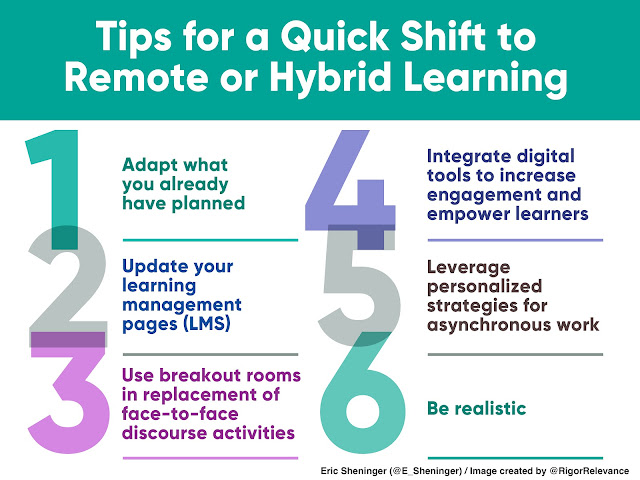
  1. Adapt what you already have planned (don't reinvent the wheel)
  2. Update your learning management pages (LMS) such as Canvas, Schoology, or Google Classroom so kids can seamlessly access all assignments and tasks
  3. Use breakout rooms in replacement of face-to-face discourse activities 
  4. Integrate digital tools to increase engagement and empower learners
  5. Leverage personalized strategies for asynchronous work such as choice boards, must-do/may-do, playlists, and flipped lessons.
  6. Be realistic (substance over quantity, prioritize standards)


There is nothing inherently new in the tips provided above.  The key is to remember pivotal lessons learned during the great remote and hybrid experiment of 2020 and parts of 2021 to power through what I hope is only a couple of weeks.  Effective leadership in these unpredictable times is not only needed but greatly appreciated.  Finding additional resources for staff and freeing up time to plan are two quick wins that won’t go unnoticed.  Together, you’ve got this, and if there is anything I can do, please don’t hesitate to reach out (esheninger@gmail.com). 

Sunday, January 2, 2022

Hitting Curveballs

If only everything could be simple.  Life is anything but an easy journey.  While this, for the most part, has been manageable in the past, the pandemic has upended professional and personal lives.  Just when there is a glimmer of light at the end of the tunnel, a new variant materializes.  For now, Omicron is the current curveball.  As I write this post on the first day of 2022, I can't help but reflect on the resilience educators showed the year before.  They stepped up to the plate every time for kids and each other because that is in their DNA.  As the curveballs kept coming, they hit them.  In the midst of immense adversity, they persevered. 

What the future holds, no one can know for sure.  Many schools have or will be making the decision to revert back to some form of remote learning.  While this can be frustrating and challenging, educators have been here before.  The silver lining is that lessons learned in the past can be leveraged to make it a smoother process.  There were many successes when it comes to remote learning that have value now and will for years to come.  I made sure to capture these in chapter 6 of Disruptive Thinking in Our Classrooms.  Good teaching and leadership shine through no matter the circumstance.  If you are in need of remote learning resources I have you covered. Just click HERE. 

For schools that do not go back to remote learning, the curveball will be high rates of absenteeism.  In the case of students being out, we will most likely see hybrid learning come back into the picture.  Just like in the case of remote learning, educators have been there and done that to ensure learning continues.  Throughout the pandemic, I captured successful hybrid learning strategies from the schools where I was coaching on the topic.  You can access those HERE.

Another curveball comes in the form of the emotional and physical impact on educators.  While they valiantly and selflessly continue to serve students, the pandemic has taken its toll on them.  I shared the following in a previous post:

Educators are also in desperate need of social and emotional support.  Many teachers are at their wit's end, and who could blame them.  Morale and mental health are suffering as board meetings spiral out of control, and the pandemic rages on.  Administrators can lessen staff load by offering mental health days, covering classes, getting rid of meetings, providing grading grace periods, and eliminating non-instructional duties.  Grace and empathy can be shown through electronic polling to see what they need.  Bigger lifts include finding ways to add additional time for planning or securing outside counseling services. 

We cannot ignore the other educators who need social and emotional support, including counselors, coaches, instructional aides, administrators, or anyone else who serves students.  While they are typically more behind the scenes, some are suffering as well.  Here is where Central Office, boards of education, families, and community members can step up.  Extending breaks, thank you cards, substituting, or food items can go a long way to help all educators cope a little bit better. 

A systematic approach employ's a Maslow's before everything else lens.  If we don't take care of all of our people – students, teachers, support staff, administrators – our education system could be damaged in ways that will be felt for generations.  

With 2021 in the rear mirror, one can only be more hopeful for the year ahead.  There will be curveballs, but educators will keep hitting them. 

Sunday, January 31, 2021

A Message to School Leaders

A great deal has been written on the heroic efforts of teachers during the pandemic. I, for one, have penned my fair share of posts that highlight the exceptional work they have and continue to do under extraordinarily challenging conditions.  They continue to overcome daily obstacles as every day feels like a trial by fire ordeal. It’s tough to understand the challenges they are going through unless you walk in their shoes for a day. We owe them all a debt of gratitude that should extend well into the future after the virus has been controlled.

Flying under the radar in many cases are school leaders.  The pandemic has also placed immense stress on them as they balance support for teachers and meeting the demands of stakeholders. As I work with schools on hybrid learning, I see firsthand the immense pressure on leaders to solve what seems like endless challenges that come from every direction.  During a recent coaching visit, the time was spent strategizing ways to support students who are struggling as well as figuring out how to get remote learners to attend classes. These issues are not new by any means but have been amplified as the pandemic has worn on over time.

Many leaders are desperate for ideas that can help their staff and students.  You might not see it, but many are at a breaking point. Here are both a message and recommendations based on what I have witnessed and learned firsthand in schools since the onset of COVID-19:

  • Don’t think you need to do it all yourself.
  • Prioritize time, standards, and SEL needs.
  • Continue to advance learning and equity in your schools with professional development.
  • Know and appreciate the impact you have.


No one has all the answers or even the best ones.  Keep in mind that strong leaders ask for help and admit when they don’t know something. In this day and age, it is critical to rely on our best resource – each other.  Leveraging other leaders, both externally and internally, to assist with overcoming challenges just makes plain sense.  Consider tapping into the expertise of a global network through a Personal Learning Network (PLN). When appropriate, delegate tasks to build capacity on others while lessening the load on yourself. Finally, focus energy on the most vital tasks.

Keeping our sanity while reducing both stress and anxiety are paramount.  Prioritizing what is truly important sends a powerful message to teachers.  In a recent post, I outlined specific give and take strategies that can be used to free up time, focus on the most critical standards students need right now, and address mental health concerns.  The latter is so important for teachers and students.  When looking out for others, please don’t forget to address your own social and emotional needs.  Taking care of yourself allows you to do the same for others, but your own family will greatly thank you for it.

In the midst of adversity, opportunity arises.  We have seen so many educators innovative their practice in such a short period of time, especially regarding the purposeful use of technology.  Many valuable lessons have been learned during the pandemic that has set the stage for scalable change that benefits all learners. One of those is the embracement of more personalized approaches to ensure equity where all learners get what they need, when and where they need it.  While progress has been made in many schools, there is always a desire and a need for job-embedded professional learning that is practical and on-going, something that I emphasize in Digital Leadership.  Learning is the fuel of leadership. Effective leaders engage in it continually while also providing options for their staff to do the same.

Finally, it is difficult at times to realize the impact that a leader has when every decision either doesn’t feel right or is second-guessed.  There are no easy or straightforward solutions.  Focus first and foremost on creating a nurturing environment for all kids.  Ensure you are there for your staff by listening to concerns and addressing them to the best of your ability.  Take needed action on behalf of those who you serve.  Showing up and trying is more important than you know.  Believe in your abilities and the impact that you have. You might not see it, but the rest of us do.  Thanks for your efforts, and keep up the great work.

Sunday, November 15, 2020

Competencies for a Post-COVID World

It seems as of late that we are always in the midst of difficult times. As I am writing this post, the world is seeing a surge in COVID-19 cases. The challenges that this is placing on society goes without saying.  In classrooms, educators continue to grapple with the impacts this is having on both remote and hybrid learning models. It's not easy, and many people are at a breaking point, but who could blame them.  The silver lining here is that we will get the pandemic under control at some point through more stringent social distancing requirements and a vaccine.

When the dust settles, we need to look carefully at critical lessons learned. The world of work has, and continues to, fundamentally change. There is a necessary shift emerging right before our eyes. More and more employers are moving away from physical spaces and embracing remote environments while providing greater levels of trust. What this equates to is less of a focus on the number of hours put into a day and more on getting the work done at a high level.

In my view, the future is bright, and these changes will be welcomed by many. The fact of the matter is that reporting to an office or being required to put in a set number of hours each day doesn't necessarily result in success. So, what does this mean for education? A greater emphasis on productivity in the future of work will require our learners to have a refined set of competencies. It is important not to get caught up in the hoopla about needed "skills." While these are important, they focus on the "what" in terms of the abilities a learner needs to perform a specific task or activity. Competencies outline "how" goals and objectives will be accomplished. They are more detailed and define the requirements for success in broader, more inclusive ways. In a previous post, I shared this:

Competencies, therefore, may incorporate a skill but are much more than the skill. They include a dynamic combination of abilities, attitudes, behaviors, and knowledge that is fundamental to the use of a skill aligned to a learning outcome. 

Now, and in the future, our learners will most likely need to be competent in the following areas to succeed.


  • Self-regulation: Process by which people plan for a task, monitor performance, and reflect on the outcome.
  • Remote collaboration: People work together, regardless of their geographic location, to achieve organizational goals using a variety of digital tools.
  • Critical thinking and problem-solving: The ability to think in complex ways and apply knowledge and skills acquired in relevant ways. Even when confronted with perplexing unknowns, people are able to use extensive knowledge and skill to create solutions and take action that further develops their skills and knowledge.
  • Emotional intelligence (EI) – A person's capacity to be aware of, control, express one's emotions and handle interpersonal relationships judiciously and empathetically. A person who is competent in EI can understand, manage, and use their own emotions to communicate effectively, relieve stress, empathize with others, overcome challenges, and defuse conflict in positive ways.
  • Time management: Process of organizing and planning how to divide the time you have available between specific activities or delegate tasks to others depending on organizational structure. In a nutshell, it's about working smarter, not harder, to achieve goals.
  • Creativity – The ability to develop and successfully implement innovative ideas to develop solutions to complex problems while connecting seemingly unrelated phenomena.

It is essential for educators to develop their own sense of what is critical for learners going forward. The curriculum might dictate what has to be taught, but the art of teaching is all about how we teach in ways that inspire meaningful learning. As the world continues to change in ways that we could never have imagined, it is imperative that learners have what they need to succeed.

Sunday, September 13, 2020

Empathetic Remote and Hybrid Learning

As almost all schools across the globe are back in session in some form or another, many have decided to begin the year remotely with the hopes that COVID-19 cases will subside in the coming months. Others have started the year with some sort of hybrid model.  There is no easy decision when it comes to determining which pathway is the most appropriate at this time. Each, in its own right, presents particular challenges. Regardless of the route taken, all learners and adults' health and safety should be the driving force that determines whether to stay the course or move in another direction.

There is a great deal of stress on students, parents, and administrators, and even more on teachers. The next few weeks, or even months, will be ridden with anxiety, fear, and at times confusion no matter how prepared a district or school is. What we have learned about COVID-19 is that it can spiral out of control at a moment's notice if social distancing and health recommendations aren't followed. However, this is not all doom and gloom. Throughout the pandemic, educators have embraced new opportunities that have materialized and taken advantage of a clean slate. Innovative practices and technology that might have been on the back-burner months ago are now front and center. Rest assured, when this is all over the resilience of teachers and administrators will help usher in a new normal that better meets the needs of all learners.

Now more than ever, empathy is needed to help everyone get through remote or hybrid learning. The reality is that successes are and have been, overshadowed by fear, stress, and anxiety at levels never experienced.  Below I will address six specific areas that can help to create an empathetic teaching and learning culture.  


Time

As I work with more and more teachers across the country, this is the number one issue that consistently comes up.  Teaching both face-to-face and remote learners at the time is not easy, but I recently developed a pedagogical framework using a station rotation model that can help. Many hybrid learning models have either an entire day (typically Wednesday or Friday) for teachers to plan, grade, provide interventions, and conference with students.  Some set aside a half-day.  Administrators can even cut any non-instructional duties to free up teachers. Remote teachers also need time, which is why having them follow a traditional school day schedule doesn't make much sense, especially when asynchronous tasks can be employed, freeing up much needed minutes or even hours.  

Support

Teachers and administrators need professional learning that aligns with the challenges they currently face and the demands of education in a COVID-19 world.  Targeted presentations can now be facilitated virtually, both live and on-demand, in time-sensitive ways.  Job-embedded coaching, which most educators yearn for, can also be facilitated virtually or face-to-face.  Asynchronous models that address the time issue above can also be used to mirror the same conditions that learners will experience either remotely or in a hybrid model.  Support can also come in the form of budget allocations for needed technology, an administrator covering a teacher's class, feedback, granting mental health days, listening to and then acting on general concerns, allocating time each day to check in with remote learners, and providing daily encouragement through inspirational messages. Another suggestion is moving around personnel so that there are dedicated teachers just for the remote learners in a hybrid model. Even though balancing both face-to-face and remote kids can be done successfully, it is still a challenge.

Grace

Depending on your position, leading and teaching with grace is the epitome of an empathetic culture. This can mean many different things to people, but overall it can be characterized by being welcoming, patient, warm, and kind. It's about emphasizing relationships over discipline or correction. For a learner, it might be giving him or her multiple chances on an assessment or to complete a project.  Or it might be a focus on restorative practices that emphasize forgiveness and the building of relationships. Leading with grace is all about service to others with a focus on humility and respect. From an administrator perspective, it means treating teachers with dignity and exhibiting generosity in addition to the characteristics listed earlier in this paragraph. When it is all said and done, continuously ask these questions when someone might be having a difficult day:

  • Are you ok?
  • Is there anything I can do for you or that you need?
  • Is your current workload manageable?
Exemplars

Empathy is about putting yourself in the shoes of others. Modeling through exemplars is a great way to help ease potential concerns, fear, and anxiety on behalf of learners, teachers, and administrators. Showing examples of sound remote and hybrid pedagogy, as well as successful implementation plans, builds confidence in that you don't have to reinvent the wheel.  Recently I shared what some Corinth School District educators in Mississippi were doing and received some very positive feedback. In particular, teachers want to see what this looks like in alignment with their grade level and content focus. 

Flexibility

For remote or hybrid to work, a flexible approach has to be prioritized. Having teachers and students follow a rigid schedule that replicates what traditional schooling has looked like for years could dramatically impact morale, attentiveness, and motivation.  Video conference fatigue is a real issue, and it just doesn't make sense to have remote learners log in from home when they could just watch the recorded highlights and then complete the same tasks that they could in class asynchronously. Teachers also get fatigued if they are on a screen too long.  If the decision has been made for all students to be remote, then at the very least, each teacher should be given a choice as to whether or not they want to teach from their classroom or home. Other areas that can show flexibility include deadlines, attendance, and general with teachers and students.

Compassion

Some might think grace and compassion are the same things. Even though they are similar, there is a difference.  Compassionate teaching and leadership consider any type of suffering and move towards specific actions to relieve it.  The pandemic has resulted in so many misfortunes that are difficult to wrap our heads around.  This is why social-emotional learning (SEL) should be integrated into any learning model, but it also has to be adapted for adults as well.  Henri Nouwen said it best, "Compassion asks us to go where it hurts, to enter into the places of pain, to share in brokenness, fear, confusion, and anguish. Compassion challenges us to cry out with those in misery, to mourn with those who are lonely, to weep with those in tears. Compassion requires us to be weak with the weak, vulnerable with the vulnerable, and powerless with the powerless. Compassion means full immersion in the condition of being human."

There is hope as educators continue to embark into the great unknown. The virus will eventually be subdued. New learning models and innovative pedagogies will take hold. Parents and students will be more comfortable with and open to different ways to learn. Resilient educators who triumphed in the face of adversity will lead education in a better direction. Empathy will not only help us get through to better days but will also help to establish a thriving school culture grounded in relationships.

Be sure to check out my entire #remotelearning series. 

Sunday, August 2, 2020

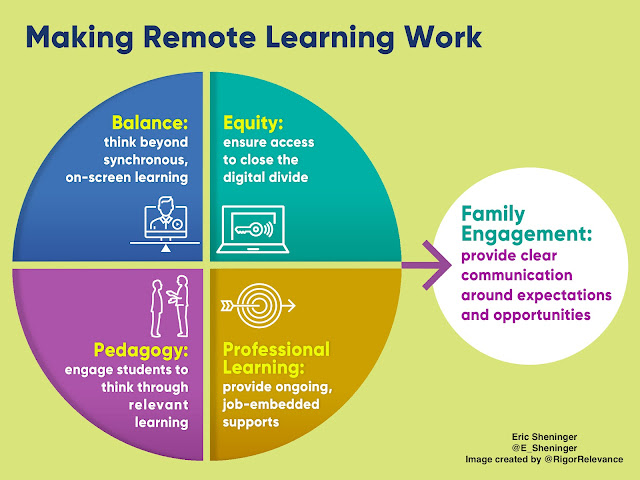
5 Keys for Successful Remote Learning

There is a lot to consider as schools either begin the school year or reassess where they currently are based upon the current COVID19 situation. Here in the United States, many school districts are adopting a hybrid model when they open in the fall, while others have made the decision to start remotely.  With the latter, it is imperative that any challenges and mishaps from the spring are addressed now to ensure better implementation at scale. The fact of the matter is that there were too many examples of how it didn’t work across the country.  Time is of the essence to get it right so that all kids can benefit from a quality learning experience that pushes them to think while limiting learning loss and achievement gaps.


Balance

Remote learning does not mean piling on excessive amounts of work on our learners. It also should not require them to be on a device for all of their learning activities. Non-digital assignments have just as much value and can give kids a much-needed break from screens.  When technology is used, sound planning ensures there is a balance between synchronous and asynchronous learning while building in breaks for movement, mindfulness, and other essential brain breaks.

Equity

There have always been issues with equity when it comes to education. However, the current pandemic and social justice movements across the globe have brought a more unified focus on the work that needs to be done.  In a previous post, I shared these thoughts:
COVID19 has unveiled the harsh reality of the inequities that plague learners in virtually every country. Where you live, in particular, has had a direct correlation to whether or not remote learning has been successful in many schools. The “haves” have tended to prosper while the “have nots” have suffered. We can ill-afford not to address this fact. Additionally, the digital divide is wider than many perceived. Access to devices and reliable WIFI needs to be emphasized.
Kids also need access to equitable resources and learning experiences. 

Pedagogy 

Let’s begin with engagement. If students are not engaged, then they most likely are not learning.  Herein lies why it is crucial to make sure that passive consumption of content and low-level activities are followed with more opportunities for active learning.  Successful remote learning is dependent on the consistent utilization of effective teaching strategies and pedagogy that empowers all kids to think and apply their thinking in relevant ways. The Rigor Relevance Framework is a fantastic tool for teachers to develop pedagogically sound tasks, both with and without technology. It also provides school leaders with a lens to provide valuable feedback to teachers when it comes to addressing priority standards, implementing scaffolding techniques, creating performance tasks, and developing quality assessments. 

From here, schools can begin to focus on a remote blended learning model that can serve as a foundation for all K-12 classrooms to create a more personalized experience.  


Professional Learning

Many schools were not prepared when the pandemic hit. Going forward, this excuse cannot and should not be used.  Over the summer, there has been ample time to support both teachers and administrators to plan and implement remote learning successfully. However, this has also been a time of considerable fluctuation and flip-flopping on opening plans in relation to COVID19 infection rates. If professional learning was not emphasized, it’s definitely not too late.  Think about experiences that reflect the conditions where your students will be expected to learn remotely. Foundations workshops and deep dives that address the areas noted in the pedagogy section above represent a solid start. For success, though, a commitment to job-embedded and on-going support in the form of coaching, mentoring, advising, and consistent evaluation of the remote learning plan is needed, with refinement and improvement being the main goals.

Family Engagement

It goes without saying that parents and guardians have many questions and concerns regarding how schools will effectively implement remote learning in the near term. Begin with meticulous planning using the information provided in the key focus areas previously covered above. Then think about strategies to inform and educate families as to what their kids can expect. Digital leadership compels us to meet them where they are and engage in two-way communications using a hybrid approach. Also, consider providing opportunities for them to experience remote learning actively. I have worked with many schools and districts, facilitating webinars for parents on the topic since the pandemic hit to ease concerns and illustrate validity in the approaches being embraced.

To dive deeper into various remote learning elements, please visit this comprehensive Pinterest board that covers teaching, edtech, and SPED strategies as well as abiding by privacy laws.  It is essential to understand that there is no one-size-fits-all approach to remote learning. Each district is unique in terms of resources and demographics.  Success hinges upon taking and applying the key focus areas listed above and aligning them with your respective classroom, school, or district culture. 

Be sure to check out my entire #remotelearning series. 


Sunday, July 19, 2020

Tracking COVID Cases to Better Safeguard Students and Educators

Safety is at the top of the minds of all educational stakeholders, especially teachers and parents. News outlets are flooding all channels with advice on what schools should and should not do.  The CDC has also released specific guidelines to help guide the reopening of schools and the subsequent re-entry of students.  There are no easy answers or solutions during these unprecedented times, but we can all agree that the health and safety of every child and adult are of paramount importance.  To that end, it is critical that all groups have a seat at the table to add input and suggestions to any plan being developed.  For some suggestions on how to do this in a meaningful way, check out this post.

All any district can do is meticulously plan while trying to foresee as many possible scenarios that could occur once schools are reopened. Many questions and associated challenges will undoubtedly arise. The key is to be ready for them.  A proactive approach entails the establishment of protocols to track and report COVID cases across a school district while abiding by privacy laws.   Doing so provides an additional safeguard for students and staff to complement social distancing, hybrid learning models, hygiene stations, and facemasks.  It is critical that everyone knows who has been infected or has come in close contact with people that have tested positive for COVID.  Access to this vital information will then allow for staff to quarantine as necessary.  


I recently wrote about a fantastic tool called ZippSlip that every district should consider as a means to streamline communications.  It is a cloud-based mobile app that supports all communication sent from the school to parents like student registration, athletic waivers, permission slips, mass notifications in multiple languages, dynamic use of video, and the list goes on and on. You can now add another essential feature to that list as Zippslip now can seamlessly collect data on COVID for tracking purposes that can assist with safety until the virus is eradicated.  Below are some specific highlights from a brief on their website:
ZippSlip offers a solution to electronically collect and track COVID symptoms and risk information from students' parents attending the school. Quickly deployed, ZippSlip allows parents to securely update their students' information from a browser or via the ZippSlip app. School administrators can track COVID risk information on customizable dashboards that include trend charts, heatmaps, and other relevant analytics. In one glance, administrators can monitor district-wide information and then quickly take mitigation steps. With a couple of clicks on ZippSlip's administrator portal, administrators can find students with symptoms, their siblings, and which schools and classes are at risk.


In addition to collecting data from families regarding students, districts, and schools can also report information related to staff infections or recent contact with others who have the virus.  Together, the data in the dashboard can be used to help adjust plans to keep in-person learning going or make the decision to move to remote learning. In the end, it is just one more resource to help ease the many concerns that are out there. For more detailed information check out this downloadable slide deck.

With many schools implementing a hybrid learning model, a solution such as ZippSlip can help ease, but not eradicate, some concerns while keeping stakeholders constantly up to date. 

Sunday, July 12, 2020

Purchasing Devices Does Not Equate to Learning

The COVID19 pandemic unearthed many harsh realities for education across the globe. One of the more glaring issues was the vast digital divide that still exists in many places, especially the United States.  Inadequate WIFI and the availability of computers at home for kids to use for learning caught many educators off guard. Remote learning was a monumental challenge for districts and schools that already had made large-scale investments in devices, but it was even more so where inequity was prevalent.  Many kids were automatically at a severe disadvantage as a result, which will most likely result in extreme learning loss and ever-widening achievement gaps.

It is okay to admit that we were ill-prepared before and during the pandemic.  Now is the time to seize on lessons learned as schools prepare to move into uncharted territory whether the COVID19 rages on or begins to subside. Teaching will and must be different. Leadership must and will be different. Most of all, the learning culture will most certainly be different, and it will be a travesty if it is not. We have begun to see some change as more and more school districts are purchasing devices for all of their students.  Every day I see new articles highlighting the millions of dollars; in some cases, spent to either begin to close or eradicate the digital divide. There are also forward-thinking districts who either purchase WIFI hotspots for kids or park WIFI-enabled busses around the community for family access.  All of these efforts are to be commended.

Here is the rub in all of this. Time and time again, even well before the pandemic hit, schools had a thirst for ensuring that there was a device in the hands of every student. William Horton says it best, "Unless you get instructional design right, technology can only increase the speed and certainty of failure." 


Below are some lessons we learned after hitting the reset button on our Bring Your Own Device (BYOD) initiative in order to get it right that I captured in a 2015 post.
We found great success at my school during our digital transformation by focusing on pedagogy first, technology second if appropriate mindset. Not only was there a focus on solid instruction, but we also provided numerous supports for our teachers in the form of ongoing and job-embedded professional learning opportunities. If the expectation was to integrate technology with purpose to support or enhance learning, we made sure everyone was prepared to do just that. 
For technology to live up to the hype, pedagogy must change, whether learning is face-to-face, remote, or based on a hybrid model to ensure student and staff safety. Drive-by professional development did not work in the past. What has and will continue to make a difference are supports that incorporate the following:
  • Ongoing
  • Job-embedded
  • Supported with coaching (face-to-face or virtual)
  • Personalized and differentiated
  • Facilitated by people who have done the work and implemented successful change that resulted in improved student learning outcomes and achievement
  • Directly correlated to professional practice
  • Aligned with research and case studies
  • Addresses real challenges educators face
  • Sustainable over time
Before COVID19, I always cautioned districts and schools to be wary of putting the cart before the horse. I am not sure that I would offer the same advice as we now know there is a great deal of work to be done to ensure digital equity for all kids. However, I am still steadfast in my opinion that just purchasing devices does not equate to learning, nor will it in the future if proper supports are not in place. Teachers need training and job-embedded coaching. Principals need support so that they know what to look for and can give their staff actionable feedback. Superintendents and central office administrators need to be able to determine the efficacy of the investment.  


Just putting a device in kids' hands and expecting learning miracles to materialize is wishful thinking at best. Ongoing support is needed to usher in pedagogical change while building capacity. Teachers and administrators deserve this investment if large sums of money are being spent on devices.  Without this support, the overall goal of the purchase might never be realized.

Sunday, July 5, 2020

Don’t Forget About Educator Safety When Reopening Schools

We are all in the midst of some very challenging times, regardless of our profession. When it comes to education, schools are grappling with reopening safely here in the United States. There are no easy answers or choices here.  As schools across the country are now virtually all closed for summer break, preparations are being made, and hopefully, comprehensive plans are being developed. However, in the midst of all of this, COVID-19 cases are rising in many states. Those planning to begin reopening in phases have pushed the pause button. On top of it all are conflicting messages about what is the best course of action.

When it comes to students, the American Academy of Pediatrics (AAP) has come out strongly in favor of schools having students return to the classroom in the fall despite the ongoing risks associated with COVID-19, as reported in the Huffington Post. Below is an excerpt.
"The AAP strongly advocates that all policy considerations for the coming school year should start with a goal of having students physically present in school," the group said in an update to its guidance for school re-entry. The guidance asserts that "the importance of in-person learning is well-documented," and that evidence already has emerged of "negative impacts" on children due to school closures in the spring.
It is tough to deny the negative impacts the pandemic has had on kids such as learning loss, widening achievement gaps, social-emotional issues, and in some cases, a lack of physical activity and proper nutrition. Education Week provides a wealth of information and resources for schools in this recent piece focusing on developing the right schedule to meet the student needs. The bottom line is that schools need to reopen for their sake, but at what cost? As much as kids need to be in school learning, there is mounting pressure and concerns, rightfully so I might add, from adults who fear for their health and safety.


A recent story from ABC News highlights the fear and frustration felt by many educators.
Some teachers around the country say they are nervous about returning because of underlying health conditions or concerns about infecting family members. Others say they are frustrated by the lack of clear guidance from officials about what's safe. And for some, it's about child care if their own kids are only back at school for a handful of days during the week. The result is an inevitable clash between leaders pushing aggressive reopening policies in states like Texas and Florida and teachers, some of whom say local officials need to think more about what they are asking teachers to do.
All re-entry plans must emphasize health and safety above all else, something that I highlight in this post. The process should be a collaborative one that enlists the input from teachers, students, administrators, and community members. Any plan that actually succeeds in helping people feel at ease about reopening schools will incorporate many of the ideas that the group decides upon based on consensus.


No matter how great the planning process is, the result won't be perfect or even acceptable for all. As many districts and schools are considering hybrid-learning models for kids that incorporate flexible schedules and choice, the same should be offered to teachers who are experiencing the issues laid out in the ABC News piece.  It is difficult for me even to suggest what this should look like. However, think about the different options and choices your district or school is offering students and adapt accordingly to teachers. A one-size-fits-all approach just won't cut it, and we owe it to them, to our teachers, to do everything possible to support them as they come back to work, whatever that form might be. Strong and compassionate leadership will be critical to ease concerns while developing a successful plan for reopening.


It's not just teachers we need to worry about, but also administrators and every other adult who is asked to work in a building.  Considerations should also be made for these people if the same COVID-19 concerns are prevalent.  The challenge and inherent opportunity are to begin to think about what types of work have to be done in-person and those that can be completed remotely.  

The time is now to put all the cards on the table while considering various options for staff that need them. Forcing anyone into a painful or uncomfortable decision because of COVD-19 risks, both direct and indirect, must be avoided. If not, then we might very well see a mass exodus of educators this school year.

Sunday, June 28, 2020

Leading in Uncertain Times

The concept of leadership hasn’t changed, although the conditions under which leaders work and learn sure have. Prior to COVID-19, the vast amount of uncertainty in education lay in societal changes resulting from the 4th Industrial Revolution. The world of work was being disrupted right before our eyes. A rapid evolution in artificial intelligence, automation, and advanced robotics should have served notice to anyone in the education space that things needed to change. No longer did a “this too shall pass” mantra carry any weight.  In the end, though, scalable change resulting in a transformation of teaching, learning, and leadership was more of an exception as opposed to the rule.

Then the COVID-19 pandemic came crashing down on the world.  Schools were not prepared, as nearly no one could have envisioned the mass closings for extended periods of time.  Triage resulted as educators valiantly put remote learning plans in place while attempting to overcome a myriad of challenges.  Curriculum must be revised, assumptions are taken head-on, and a school culture that focuses as much on equality and equity as it does everything else.

The bottom line is that the world has been turned upside down, and this is not necessarily a bad thing. In times of uncertainty, strong leadership is needed more than ever.  


Embrace vulnerability

It is a misconception that being vulnerable means you are weak.  On the contrary, it is a sign of strength. Brene Brown shares the following in Dare to Lead, “vulnerability is the emotion that we experience during times of uncertainty, risk, and emotional exposure. It is having the courage to show up, fully engage, and be seen when you can’t control the outcome.” Leaders use this as a tool to build strong relationships with the people they work alongside by making known what is going on in their heads. As the saying goes, …sharing is caring.

Demonstrate empathy

Empathy is the ability to understand and share the feelings of another. I shared the following in a previous post, “As leaders, it is important for us to imagine ourselves in the position of our students, staff, and community members. This gives us a better perspective on the challenges and feelings of those we are tasked to serve. Better, more informed decisions can result from “walking in the shoes” of those who will be most impacted by the decisions that we make.” Empathetic leadership builds trust and helps to create a culture where change will be more readily embraced in uncertain times. 

Exhibit courage

Now is the time to challenge assumptions, tackle bias, take risks, and make bold decisions. To move forward with needed change, we need leaders who are able to persevere in the face of uncomfortable situations and not back down when things get difficult. Don’t be afraid to step outside your comfort zone.

Be a great listener

There are many ways to earn respect and build trust, both of which are needed to get change efforts off the ground. Active listening helps to accomplish both while opening up a leader to new ideas, strategies, and feedback. Research has shown many positive outcomes associated with excellent listening skills.

Health & safety first

As we continue to move forward in unprecedented times, the pandemic has made painfully clear that health and safety must supersede everything else.  Closing achievement gaps and addressing learning loss will always be critical, but in challenging and disruptive times, leaders must emphasize Maslow’s over Bloom’s.  

Model the way

Leadership is not about telling people what to do. It’s about taking them where they need to be. Don’t ask others to do what you are not willing to do yourself. Empowerment rests on leading the way through observable actions. Modeling helps to instill belief.

Ask questions

No one has or will ever have all the answers. To assume as much is unrealistic, to say the least. One could even say that there are no definitive answers in uncertain times.  The best leaders ask questions, and the more of them, the better. Developing, asking, and following up on the right questions can lead to answers that will help usher in the changes that are needed now and in the future.

Provide support

Support can come in many forms, such as resources, time, and professional learning opportunities.  It can also manifest itself through many of the points listed above, such as showing empathy, listening, putting safety first, and modeling.  Leaders need to determine what types of support they can readily provide as well as those that need to be acquired, such as needed professional learning on personalized/blended learning, purposeful use of technology, relationships, Tier 1 instruction, and digital leadership, to name a few areas.

Relentlessly communicate

You will not find an effective leader who is not an effective communicator. It’s all about getting people the right information at the right time through the proper means. During uncertain times you can’t communicate too much. Digital leadership is essential, and it compels us to meet our stakeholders where they are while employing a multi-faceted approach.

Learn from the past

A great deal has been learned since the onset of the pandemic and the social justice movement. We can ill afford to continue to do what we have always done and expect a different or better result that aligns with reality. Critical lessons have been learned, which can lead to new opportunities to transform teaching, learning, and leadership.  Leaders need to make sure past mistakes are not repeated.

None of us know what the future holds in the face of these unprecedented times.  What we do know is that schools and educators need leaders to guide them in ways that help to subdue the fear and confusion that naturally arises during uncertain times. Leaders set the tone, and they are needed more than ever to step up and accept this responsibility.

Want to learn more? Check out the presentation I did on the topic below. 

Sunday, June 21, 2020

Moving to a Hybrid Learning Model

We don’t know for sure what education will look like in the future, but one thing is for sure, and that is the need to adapt and evolve.   The pandemic shuttered schools across the globe, and lessons, some of which were very hard, were learned.  As re-entry planning either begins or continues in earnest, the priority must be to transform learning in ways that provide kids with the best experience possible while ensuring the safety of all.  It goes without saying that this is no small feat. In a previous post, I outlined eight specific focus areas, in no particular order, that can help to usher in a new and better normal.  Now decisions must be made as to what this will actually look like in reality.

Business as usual just won’t cut it.  The lessons learned during COVID19 provide opportunities to re-envision what schools can be.  Now efforts have to be made in developing a practical path forward.  So, what might this look like going forward? My thinking as of late has been around a hybrid learning model.  At this point, they are just thoughts, but each can be a powerful catalyst to initiating and sustaining a transformation of education at scale. The premise though is to not only incorporate what has been learned up to this point during one of the most disruptive times in history but also to perceive what might come next. Failing to prepare for the unknown or addressing the slew of challenges that arose when schools were closed means that nothing was learned.  

The premise of a hybrid learning model is to combine traditional and non-traditional methodologies to improve education while ensuring that high-quality learning for all kids is the gold standard.  To start, a workable definition must be established to begin creating a vision for this model.  Take this definition from Learning Technologies:
Hybrid learning combines face-to-face and online teaching into one cohesive experience. Approximately half of the class sessions are on-campus, while the other half have students working online. Although that may sound like a cut-and-dry formula, a lot of planning is needed to ensure that hybrid works well, allowing its two formats to capitalize on each other’s strengths.
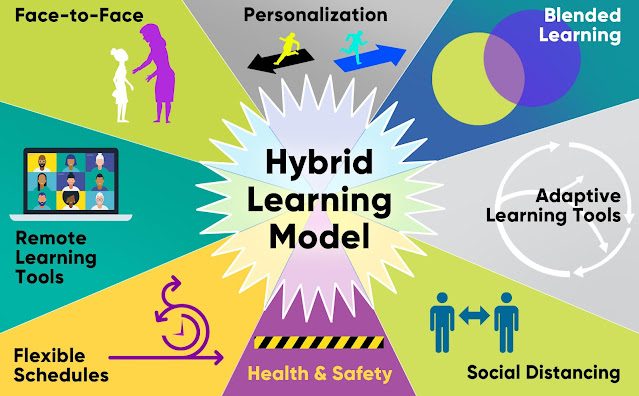
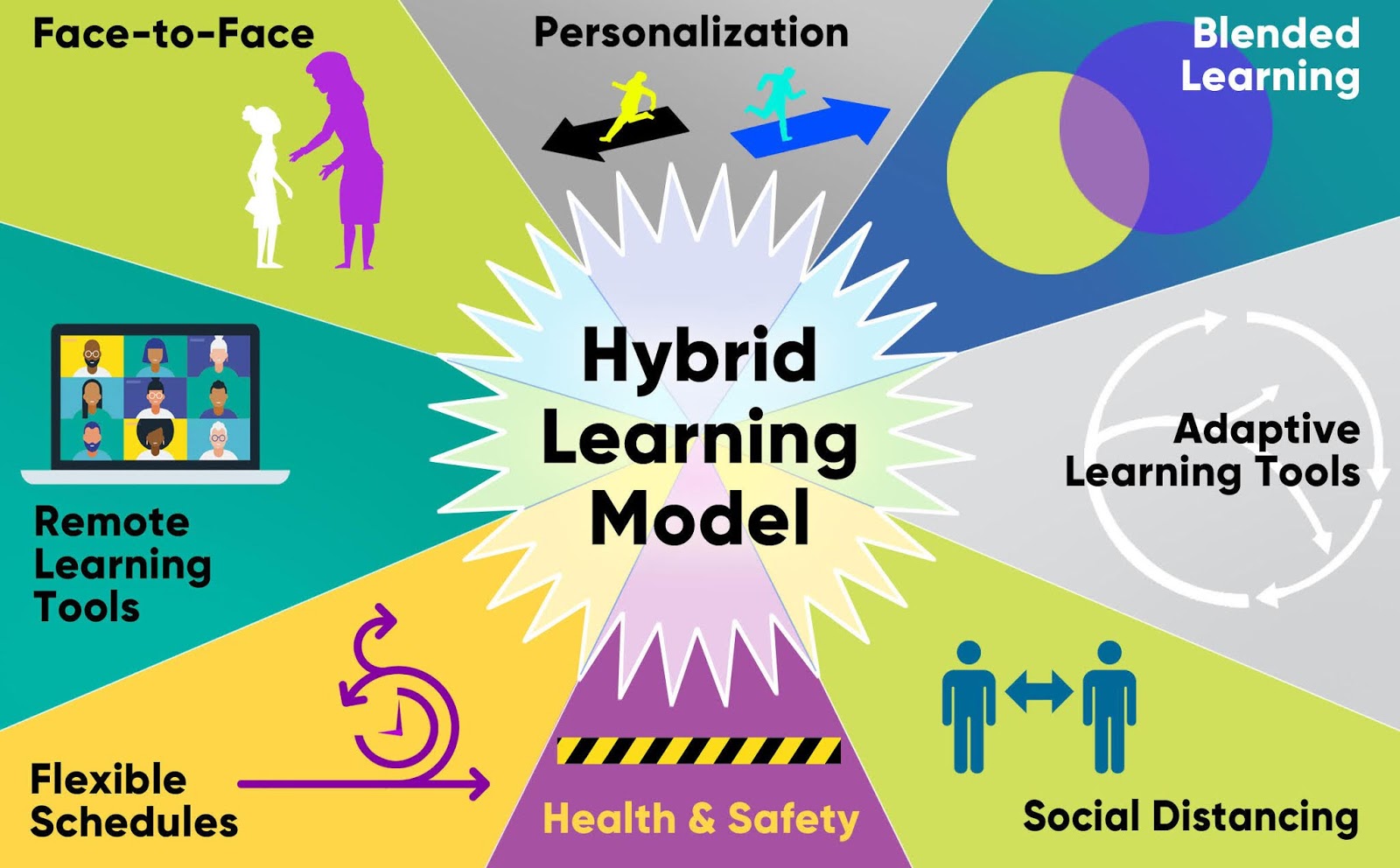
There is a lot more detail in this report that they developed. Hybrid, in the context of this post, represents the combination of two or more different things. Some might argue that education has always embraced this approach. Yes, to some extent, but definitely not scaled in a way that has led to system-wide transformation.  With the inherent challenges ahead, a uniform hybrid model is necessary for success.  The image below begins to visualize what this could look like as schools begin to transform teaching, learning, and leadership.  


Face-to-face

It’s not a matter if, but when kids return to school. The most powerful relationships for students form through interactions with teachers, administrators, and peers. In most cases, the consensus is that high-quality instruction and effective pedagogy are facilitated best when educators are physically with their students. The key is to utilize the time better. 

Personalization

Personalized learning represents a movement from the “what” to the “who” as a means to facilitate student ownership of the learning process. It consists of high-agency strategies that focus on voice, choice, path, pace, and place both with and without technology. Check out this post for more detailed information.


Blended Learning

One of the best strategies to personalize the experience for students is blended learning. Blended instruction is what the teacher does with technology. Blended learning is where students use tech to have control over path, place, and pace.  The key is to focus on sound pedagogical strategies that will help to ensure improving student learning outcomes. 

Adaptive learning tools

The success of a hybrid model does, in part, rely on the purposeful and strategic use of technology. These can be instrumental in providing needed or supplemental support to close achievement gaps, provide independent practice, and help learners move ahead if they have already mastered the content.  Blended pathways are the best options for the seamless integration of adaptive learning tools. 

Social distancing

With new and potential clusters of COVID19 appearing, many schools across the globe will be mandated to implement social distancing measures. A hybrid model accounts for this fact, and its success relies on budgeting, existing space redesign, and professional learning support. 

Flexible schedules

The premise behind any hybrid-learning model is altering the “traditional” school day schedule (and calendar for that matter) to make the best use of time and resources. The literature on this goes way back, and it just makes sense. Flexible scheduling patterns address the concern for more appropriate learning environments for students and respond to the need, not for schools to be more organized, but to be more flexible and creative in their use of time (Spear, 1992). Flexible scheduling allows schools to optimize time, space, staff, and facilities and to add variety to their curriculum offerings and teaching strategies (Canady & Rettig, 1995). Pandemic or not, this is long overdue.

Remote Learning

Distance and virtual are appropriate where all kids have access to a device and the Internet. Remote, on the other hand, focuses on both digital and non-digital pathways to keep realistic learning going. With social distancing and flexible schedules having a considerable role in any hybrid learning model, the need to adequately prepare for and implement remote learning while ensuring equity is paramount. For more information, check out my entire remote learning series. 

Health and safety

I will echo what many others have said, “Maslow’s before Bloom’s.”  Above all else, we need to make sure each and every person in a school system feels safe, and measures are taken to both prevent and address any COVID19 issues.  For more specifics, refer to this post. 

As I stated previously, these are just some ideas that are floating around in my head. What I do know is that learner and educator success going forward will rely on a hybrid-learning model. Business as usual in the face of current challenges and those lurking in the shadows down the road has given us all a golden opportunity to transform education. My hope is that schools take it. 

Canady, R. L. & Rettig, M. D. (1995). Block scheduling: A catalyst for change in high schools. Princeton, NJ: Eye On Education

Spear, R. C. (1992). Middle level team scheduling: Appropriate grouping for adolescents. Schools in the Middle, 2(1), 30–34.