Showing posts with label teachers. Show all posts

Sunday, June 26, 2022

The Everlasting Influence of a Great Teacher

Over the years, I have made the point of highlighting some of the many teachers who not only had a positive impact on me as a student but also have a tremendous amount of influence on me today.  In Disruptive Thinking in Our Classrooms, the stories of Mrs. Williams (kindergarten), Mr. South (middle school science), and Dr. Hynoski (high school science) were shared.  While each in its own right had an incredible impact on me as a learner and person, it wasn’t until recently that I reconnected with Mr. Wynn, my former art teacher, on Facebook.  He, by far, might have had the most significant influence on my development, and I am excited to share his story.

I attended a rural consolidated school in northwestern New Jersey for grades kindergarten through eight.  There were only two teachers per grade level, and the principal was also the superintendent.  My memory is a bit fuzzy, but I believe we only had one art teacher, Mr. Wynn.  This meant my classmates, and I were able to have him as a teacher multiple times over the years.  He was also the soccer, baseball, and softball coach.  I am not sure why we didn’t have baseball at the school even though we did at the recreational level.  Like many of the most influential teachers, Mr. Wynn was involved in as many things as possible that had an impact on kids.

To say that he is a gifted artist is putting it modestly.  All one has to do is see his personal artwork that he shares routinely on Facebook.  Once we connected in this space, it brought back so many powerful memories through the powerful pieces he shares.   Each image has served as a reminder of sorts.  In my mind, I was not a good artist and struggled even to draw a coherent stick figure.  However, Mr. Wynn was never negative and always provided positive feedback on my work while motivating me to make improvements.  I absolutely loved anything to do with ceramics and watercolors.  His class was one that I looked forward to not just every year but also every day.  

There are many attributes that Mr. Wynn possessed that made him a great teacher.  I believe these are shared by all who have an everlasting influence on a student’s past, present, and future.  These teachers:

  • Build relationships
  • Are empathetic
  • Care
  • Provide meaningful feedback
  • Find the good
  • Challenge learners
  • Are enthusiastic
  • Model expectations


While I am always in awe of what Mr. Wynn shares on Facebook, it wasn’t until I began to prepare for my new keynote at the Model Schools Conference that his impact resonated more loudly than ever.  Matt Thouin, an amazing friend who always pushes me to be better with fantastic feedback, suggested that I weave in more personal stories to connect with my audiences.  At this point, I knew I had to incorporate the everlasting influence that Mr. Wynn has had, and continues to have, on me as a person.  As I prepared, I dreamed that I would be able to include some of the artwork that I created in class.   I knew I had at least one ceramic sculpture, but little did I know that there was a treasure trove of artifacts lying in wait in my attic.

Over the holidays, my parents drove to Texas from New Jersey and dropped off a bin of items they had kept and stored for years.  As I searched my attic with a flashlight, I came across this and, when I opened it up, realized that they had saved artwork and projects going all the way back to my kindergarten years.  Tears rushed down my face as I could not explain in words how meaningful these items were as a flood of emotions pummeled me all at once.  Almost all of the artifacts came from Mr. Wynn’s class, including a fully functional ceramic snail that holds pencils and pens.  Below you can see not only this but also many pieces of artwork created in his class.

What I learned after my trip to the attic and writing this post is that I was not as bad at art as I initially thought.  While I never aspired to be an artist, I can confidently say that Mr. Wynn helped me become the educator, father, and husband I am today.  I am also willing to bet that anyone who had him as a teacher agrees.  Thank you, Mr. Wynn, for your commitment and dedication as a teacher and coach.  You, and every other great teacher who embodies those same principles, have and will continue to have an everlasting impact on students.  

Sunday, January 23, 2022

Supporting and Rewarding Teachers with Time

If it’s true that life is a test, then the COVID-19 pandemic represents the most challenging one education and everyone in the field has ever faced.  The impacts are far and wide.  Not a single person is unaffected, and everyone needs help in some form or another.  However, one group, in particular, stands out as they are on the front lines every day working with kids – our teachers.  I don’t have to go into specifics as they are well known, but many of the issues include quarantined students, skeleton classes, concurrent teaching, covering classes, abrupt shifts to remote or hybrid learning, increasing demands, and personal exposure to the virus.  As a result, the workload and stress just keep piling up.  If something is not done and soon, I fear, as many others do, that there will be a mass exodus from the profession.  


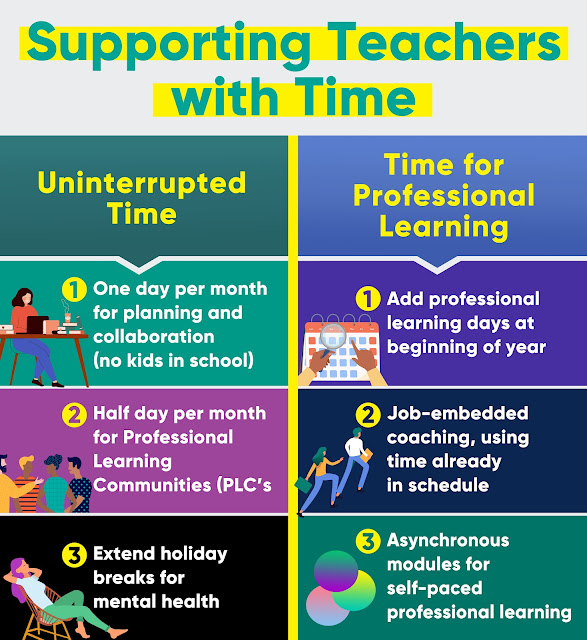
As someone who is in schools on a weekly basis and working side by side with educators under these conditions, I always ask what could be done to make their professional lives a little bit easier.  The response is always the same no matter where I am in the country, and that is time.  Some might say that this is easier said than done.  Still, districts across the country have made innovative changes to the school calendar and amended contracts to provide uninterrupted time to plan and collaborate.  That means no meetings, phone calls, emails, or mandated professional development.  However, professional learning support is also imperative, and there are other time-sensitive strategies that can be implemented.  Below are some ideas broken up into two categories:


Uninterrupted Time

  1. One day per month for planning and collaboration (no kids in school): I have seen more and more school districts moving to this model, which has been celebrated by teachers, administrators, support staff, and students.
  2. Half-day per month for Professional Learning Communities (PLCs): We took this route in my former district, where I was a principal.  We don’t want PLCs to become “just another thing” teachers have to do.  By providing time, they inherently become more powerful and something that is valued.  On a side note – administrators should be in their own functioning PLC as a way to model. 
  3. Extend holiday breaks for mental health: I have seen a few superintendents across the country take this route resulting in a win-win scenario.

Time for Professional Learning

  1. Add professional learning days: My opinion is that it is best to frontload these at the beginning of the school year to alleviate distraction and pressure.  Another idea is to build in back-to-back professional learning days during the school year so concepts and strategies can be explored in more detail. 
  2. Job-embedded coaching: Teachers want to grow and improve but pulling them from their classes and trying to find subs or coverage creates additional headaches.  Job-embedded and ongoing professional learning support uses the time that is already in the schedule to provide needed growth opportunities.  This model uses staff meetings, team time, and non-instructional duty periods to facilitate targeted sessions on strategies that can be implemented immediately.  Additionally, by observing classes and PLC meetings, valuable feedback can be provided either synchronously or asynchronously.  All of my coaching cycles aligned to longitudinal work with schools worldwide involve this approach. 
  3. Asynchronous modules: There is no better way, in my opinion, to align current context to sound pedagogy than developing personalized options for teachers to engage in at their own pace.  Scaling professional learning is hard.  It is even more challenging during a pandemic.  I recently coached John Orcutt, the principal of Arlington High School in New York, on creating an asynchronous course on personalized learning in Google Classroom.  It came out great!  Now teachers and administrators can work through the activities at their own pace, apply them to their practice, and receive professional learning hours.  Since I am in the district once a month supporting schools, I will be providing targeted coaching and feedback to everyone who has taken the course. 

Please note that these are only suggestions, but each has been successfully implemented in a district or school.  Changes to the school calendar and, in some cases, staff contracts have to be made.  In collective bargaining situations, a compromise must be reached.  Where there is a will, there is a way.  Teachers have earned the attempt to at least try. 

Sunday, February 14, 2021

The Lengths Teachers Will Go For Kids

While the challenges schools have faced during the pandemic are often portrayed in the media, some notable changes to practice have occurred. Each day I am in awe as I see innovation in action shared on social media, especially in the areas of blended, remote, and hybrid pedagogy.  It goes without saying that there has also been a significant uptick in the purposeful use of technology. All successes, big and small, should be celebrated.  In my work with school leaders, one of my goals is to push them to unearth these exemplars while also supporting teachers to grow and improve.  

Recently I was facilitating some longitudinal coaching work with administrators from Paterson Public Schools in NJ. Leaders had been broken up into four different cohorts (elementary, middle, high school, and district supervisors).  During a previous session, I assigned each leader some meaningful homework, which consisted of bringing an artifact to share with the group that showed growth in the area. During each conversation, it was empowering to see and hear the progress educators made in their schools.  Therein lies what separates effective vs. ineffective professional learning.  The latter is defined by one-and-done and drive-by touchpoints, while the former is ongoing, job-embedded, laden with feedback, and substantiated with evidence.

While each group shared amazing artifacts, I was blown away by the supervisor cohort. In particular, those who oversee Pre-K teaching and learning shared as a team with concrete examples. Then Stephanie Wright, the Supervisor of Early Education, provided us all with a bird's eye view of what Sofia Kadrmas was doing with her pre-K class.  In a nutshell, she had replicated her real classroom in terms of how it looked and felt before the pandemic into a vibrant virtual environment. As I immersed myself in the experience, it was like I was in the classroom myself. I immediately begged Stephanie to get me permission from Sofia to view and share.  Below you can see her work of art. The interactive classroom can be accessed HERE

I was blown away and feel that this is the best example of a remote learning environment that I have seen in the field.  Once I got access to it, I immediately set up a call with Sofia to ask her some questions and commend her on her efforts.  My first question was in regard to how she learned to create this in Google Slides. She explained that she taught herself and always had a knack for technology.  The other, probably obvious, question was how she had the time to create such a masterpiece.  Her response was invigorating and the essence behind why teachers do what they do for kids.  Sofia explained that she is passionate and motivated to help her students in any way that she can.  Her goal was, and is, to create a fantastic experience for kids during this difficult time. She saw an opportunity during the pandemic and ran with it.

Below is Sofia's story in her own words:

When it was announced that our school district would begin the 2020-2021 school year fully remote, I knew it would be a challenge to engage my Pre-K students remotely while still adhering to developmentally appropriate practices and maintaining fidelity to our curriculum. One day I woke up with the idea that I could convert my physical classroom into a virtual format. As you will see in the Slides that have been shared with you, I've created a virtual classroom that accurately resembles Room #204 of Paterson Public School #28, complete with the same area rug, furniture, and interactive whiteboard. It also features a replica of the Tri-Fold Choice Time "Planning Board" I created last year. Clicking on it will redirect the viewer to an enlarged version of the board, including visual representations of the Interest Areas (or "centers"), which contain images of most of the same toys and materials that can be found in my classroom. The realistic aspect of my virtual classroom was intended to provide my students with a sense of familiarity with the physical classroom that they would hopefully someday enter in person.

My goal from the beginning was to create a virtual learning environment that would not only engage my students but also give them a reason to look forward to logging on for class each day. I do feel that I have accomplished this goal, as I have had several parents reach out to me in the last five months to express how much their child loves the resources I post daily. One of my students begs his mother to help him play the "games" that I post on my Daily Google Classroom Agenda almost immediately after the end of our live sessions. These are activities aligned with our curriculum that I have converted into Google Slides to draw my students into the lesson. I use them daily as my primary method of instruction so that both students and parents can efficiently utilize them outside of our live sessions as an extension of learning. I also heavily rely on the Google Translate Chrome extension to make these Slides equally accessible to my bilingual students' families and have posted many of my Google Classroom resources in three different languages. 

It is essential to remind ourselves that these are unprecedented times we are living in currently. It's during times like these, especially when we must open ourselves up to the possibility that continuing to teach in the way "we have always done" may not be what's in the best interests of our students.  Our profession is one that requires us to be lifelong learners. That includes the willingness to adapt to, as well as adopt new teaching practices as the world continues to transform around us. That is precisely what I set forth to accomplish this school year. I adapted. 


My final piece of advice to all teachers in my position is this: Don't resist the change. Face your fears. Ask for help when you need it. It's never too late to learn a new skill, and you will never truly know the extent to which that newly acquired skill could benefit your students until you try it. The last several months have proven to me, beyond any doubt, that my "new way" of teaching is highly effective. My students are learning and growing every day, but most importantly, their smiles and laughter show me that they are having FUN in the process! That's more than enough motivation for me to keep pushing forward. 

During the pandemic, so many teachers like Sofia have gone to great lengths for their kids.  They have persevered in the face of adversity while embracing innovative approaches. Their example is to be celebrated. 

Sunday, March 18, 2018

Teachers are the Driving Force of Change

During virtually every keynote, presentation, or workshop that I give, the topic of change is very much a part of it.  Leading the effort to uproot the status quo and prepare kids for anything as opposed to something is easier said than done.  As Tom Murray and I state in Learning Transformed, "To prepare students for their world of work tomorrow, we must transform their learning today." Great progress is being made in classrooms and schools across the world.  As technology has continued to evolve at an exponential rate we have seen passionate educators begin to embrace and implement innovative strategies to better meet the needs of learners today. 

As a result, isolated pockets of excellence have emerged in virtually every school.  Don't get me wrong, this is great.  I am all for progress and a move from business as usual to unusual in pursuit of learning that will prepare kids with the critical competencies to excel in a disruptive world.  However, we cannot be satisfied with just a few pockets as every student deserves an amazing learning experience.   Change at scale is a collective effort where we must leverage the unique assets embedded in every position and at all levels.  As the saying goes, there is no "I" in team.

Now granted, building and district leaders play a huge role in supporting change and ensuring success.  Their role is to build on these successes while removing obstacles, establishing a shared vision, developing parameters for accountability around growth, evaluating if efficacy has been achieved, and reflecting on the entire process.  Reflection could very well be the most important aspect of the change process as there will either be validation or the identification of needed elements to ensure success.  Since there is always room for improvement in the education profession these leaders need to take action on the broader issues to improve the culture of learning at scale. 

The most important group, however, rarely gets the credit they rightfully deserve.  The most impactful change doesn't come from people with a title, power, or authoritative position in education. It happens at the ground level with our teachers as it is they who have to implement ideas for the direct betterment of students.  Think about this for a second.  If it weren't for our teachers embracing broader ideas and putting them into practice would any change in schools actually occur?  The simple answer is no.  


When I think back to all of the success that we had at my school it wasn't because of me or the fact that I was the principal.  Sure, I played my part as described previously in this post, but my role in the bigger picture was a small one.  It was because my teachers believed we could be better for our learners and as a result, they embraced innovative ideas.  This brings me to a critical point.  We must celebrate the invaluable leadership of our teachers while also working tirelessly to create the conditions where they are empowered to be the change that is needed.

Never say you are "just a teacher." Let your actions, not a role, define you. The change our schools need at scale can only be ushered in by our teachers. If you are in a typical administrative position to make that happen then become a beacon of support, not a roadblock to progress.  We need bold administrators to enlighten others who are unwilling or scared to embrace innovative ideas that go against the status quo. Only by working together can both groups transform learning for all kids now and well into the future. 

Sunday, August 20, 2017

The Impact of an Educator

I fondly remember when I was first asked to consider what my future career path might be.  Mrs. Williams, my kindergarten teacher, asked the class to draw a picture that articulated what we wanted to be when we grew up. I immediately knew exactly what I was going to draw. That was the easy part. The difficult task, for me at least, was to then utilize what limited artistic abilities I had to create an illustration that depicted my future career. To this day I still remember the image I created of a farmer tending to his crops. This was a natural career choice for me as a six-year-old having grown up in a rural area of northwestern NJ with a farm right across from our house. I had no idea how to farm, but being outside the rest of my life was good enough for me.

As I aged the thought of becoming a farmer faded as I began to focus more on careers in the biological sciences. Growing up surrounded by nature and spending each summer at the Jersey Shore helped to kindle and sustain an interest in this area.  I never gave much thought, nor did either of my brothers, about becoming an educator. Quite honestly, I told myself, and my parents, that I would never become an educator.  My response might have stemmed from the fact that I really didn’t understand what they actually did and the impact they were having on kids. All I knew with a great deal of certainty was that a career in education was not in the cards.

My mom, after taking many years off to take care of us, eventually became an elementary teacher where she had a celebrated career.  I say celebrated because at her retirement dinner I was able to witness firsthand the impact that she had on students and colleagues alike. Their stories of her passion and dedication for helping kids learn made me so proud. My father was a successful school administrator for what seemed like forever.  He held many positions, but what I was most in awe of was the fact that he was an elementary principal at the same school for close to 30 years.  When he retired they gave him a key to the city. I don’t know if you can be more successful than that. I never knew the impact my parents had as educators until after I myself became one. Hearing story after story about their work as their careers ended taught me that sometimes the ultimate reward for an educator comes years after we have had direct impact with kids or adults. 


Image credit: http://www.teamworkandleadership.com/

Herein lies the motivation behind this post.  I recently received a text message from a former student and athlete of mine. It started off like this:

"Coach Sheninger, is this still your number?"

My response was a simple yep.

He then went on to text me the following:


"Well hey, its Spenser Brenn just in case you lost my number. Sorry if it’s super early. As sappy as this is going to sound…."

I really was not prepared for what followed next, but I can tell you that his words below touched my heart and soul.


"I was just working out with my athletes and kids yesterday and it reminded of when I was in high school. You let me workout with you and would push me in the weight room, classroom, and on the football field. I have always been asked why did you want to become a teacher and coach. To be honest, I wasn't sure of that answer until I had this moment yesterday when I realized that those seemingly trivial moments of the two of us working out at lunch or study hall were more impactful than most other moments during high school for me. You were tough on me (a pain in the butt, or at least in the eyes of a stupid high school kid), deservingly so, considering I was a pain right back to you. However, you taking me under your wing and motivating, mentoring, and challenging me (whether you knew it or not) meant and still means more to me than you probably know, or more than I knew until yesterday. So I just wanted to reach out and say this - a small gesture like working out with a pain in the butt kid meant the world to him. It showed that you cared, something he, and all people, needed at that time. Thank you. I now know why I became a teacher, a coach, and a mentor to the youth."

It goes without saying that I was totally humbled by Spencer’s message.  As educators we all chose a profession that would not lead to riches in a financial sense. We chose to become educators so that we could not only help kids learn, but hopefully impact them well beyond just grades and achievement.  Education is a calling. It is a calling to make a difference.  That’s what educators do on a day-to-day basis.  Never forget that your work matters and that each day you get up in front of a class, help lead a building, or collaborate with others to run a district that you have an opportunity to positively impact kids. This also applies to your work with adult learners. 

Below is the response I sent to Spencer.


Well you just made my day, well week actually (maybe the entire summer). Life is so much more than what we are made to think is important. Everything comes down to relationships built on trust, empathy, compassion, understanding, and honesty. I really never knew until later in my education career that one of the most important things we can do is to show kids we care. It's not until much later in life that we learn of the impact we have on our students. You will one day be in the same position as me, a proud person humbled by the feedback that you receive knowing that you positively influenced others. Thank you so much for taking the time to send that text. It meant more than you will ever know.

Why did you become an educator? Who were those people and experiences in your life that led you to your current role?  In my new role, I still see myself (and other amazing speakers and presenters) as an educator. Each day is still a calling to try to make a difference.  Whether or not I make a real difference is in the eye of the beholder. Nonetheless, I am driven by the same passion I had as a teacher and principal to help others see the greatness that is within all of us.  

Thank you to every educator out there for the work that you do.

Sunday, July 24, 2016

The Power of You

Make no mistake about it; the job of any type of educator is tough these days. It is a rewarding profession in that we have the opportunity to make a positive difference each day, but for all our efforts, thanks and appreciation are tough to come by at times.  The fact that many countries don’t value the honorable work that is done in classrooms and schools is a tough pill to swallow. Throw in the endless array of mandates, directives, and time dedicated to the job and many would question whether it is even worth it to go into the field of education these days. 

Psychology does not work in our favor.  It is relatively easy to succumb to the negative. A great deal of research has found that negative perspective is more contagious than positive perspective. Thus, it is natural to get bogged down by pressures of the job that seem to keep mounting. Renee Jain provides a good summation of what we experience:


"The negativity bias is a tendency to have greater sensitivity to negative than to positive events. Some researchers posit that, psychologically speaking, negative events weigh close to three times more than positive events. While this bias may serve us in situations related to survival, it can cause distress in everyday encounters. So the question becomes: How can we topple this negativity bias?"

What makes the job of an educator even more difficult are the hard to reach students who are reluctant to learn. When this situation is thrown into the mix with any of the other challenges previously mentioned, the role of an educator could seem pointless. As Jackie Gerstein states, “All kids have worth. Some, though, want to prove to us that they have none. Our job as caring educators is to prove them wrong.” 


Image credit: Jackie Gerstein

With all the challenges you face each day know that your work and compassion is needed more than ever.  Watch this video below.  Put yourself in the role of the storeowner and the child as one of your students. 


The video above exemplifies how important educators are. Even when times are tough know that your work matters to those who we serve. Whether you realize it or not, the payoff of your dedication and commitment might not bear fruit for many years. Even in trying times take solace in knowing how you impact kids. It is in our nature to focus on the negatives, but you work too hard to allow yourself to fall victim to this psychological trap.

It is all about the power of YOU! You have the opportunity to positively impact the life of a child every day. If you care enough, change can and will happen. You are the difference maker. Reach for the sky and experience your potential. Reach for the stars and discover unlimited potential. You CAN usher in bold ideas for a new future. Believe in yourself and help your colleagues do the same. Never underestimate the profound impact you have on your students. Thank you for all that you do. Our future is bright because of YOU!

Sunday, October 11, 2015

Educators are the True Rockstars

"To recruit the brightest and best, teaching needs to be a high status occupation" - Lord Adonis

It is interesting how our culture works, especially here in the United States. We idolize those who entertain us such as actors, actresses, rockstars, and professional athletes to name a few. These people bring joy, and sometimes heartbreak, into our lives. With all the attention, time, and money that are put into our love for the entertainment sector, society needs to take a deep breath and reflect on our priorities. Should we be elevating these people to sometimes god-like status?

In my opinion and that of many others, there is no more important profession than that of education. It is the noblest of professions that quite frankly provides qualified candidates for virtually every job. Without educators would we have doctors, lawyers, engineers, politicians, electricians, mechanics, or anyone in the entertainment industry?  Yet for all that educators do to mold and inspire young minds to think and make a difference in this world, their profession is constantly dragged through the mud. Our priorities are so out of whack and if things don't change fast it will become even harder to attract the best and brightest to work with our children. Not for nothing, but our kids deserve the best.

So what if we treated educators like professional athletes? Let's take a minute and see how things could look if our priorities changed.


Even though the video above is based on comedy, imagine if we viewed educators in a different light putting them on par with other professions and greatly above that of the entertainment and sports industries?  We have a great deal to learn from other countries that value the role of educators above all else as noted by Peter Dolton:
"In recent years it's become a truism that attracting good quality and well-qualified people into teaching is accepted as the essential prerequisite to raising educational standards. In Finland and Singapore, teachers are recruited from the most-qualified graduates, all with a second degreeOne obvious way these countries have attracted the best and brightest into teaching is by paying them well."
The bottom line is that we won't improve the status of educators unless teaching and education in general is recognized as a worthy profession. It is time for society to shift it's priorities. In the short term let social media be your bullhorn to amplify the essential work you do for kids every day. 


Image credit: https://s-media-cache-ak0.pinimg.com/236x/90/b1/0f/90b10f61a19190504eb78a72b0b4235f.jpg


Thursday, April 2, 2015

A Needed Revolution

I routinely write and speak about the changes leaders need to address in order to create schools that work for kids.  The most important job of a school leader is to remove the barriers that teachers encounter so that they can be the catalysts for change.  After all, it is our teachers that work with, and are the most connected to students, on a day-to-day basis.  This places them in the most important role to usher in and sustain meaningful change in the classroom that will ultimately shape school culture for the better.  With or without leadership support, teachers need to be open and willing to change as schools, for the most part, continue to prepare students for a world that no longer exists. To overcome this unfortunate reality a revolution is needed.


Award-winning teacher Josh Stumpenhorst has created a much-needed resource to guide teachers through this process with the publication of The New Teacher Revolution. Josh articulates how teachers have to be ready and willing to change the way they think about teaching to be able to effectively work with this new generation of learners. Education needs a revolution of ideas, pedagogy, and the very way in which we talk about teaching and learning. The status quo has largely been upheld and the system is rarely challenged or pushed back upon. Josh emphasizes that teachers need to take control of their profession and look for ways in which they can encourage and foster change.  Josh’s book outlines and discusses five key areas that teacher’s should focus their energy on if they want to see change and start this revolution.

  • Classroom Management - Simply put, teachers cannot force a child to do anything they do not want to do. They must find ways to use relationships and empowerment rather than fear and punishments as a way to effectively work with kids.
  • Motivation – Teachers need to move past the notion that kids will do anything for a Jolly Rancher or extra credit points. Rather there is a need to embrace the power of choice and autonomy to motivate and empower students. A renewed family dynamic is needed.  It is no longer acceptable to interact with parents simply on conference and open house nights. Teachers must reach out and engage parents and utilize them as key players in their child’s education.
  • Technology as a Lynchpin – In the age of education technology, teachers have to be savvy in their use but also wary in their adoption. Moving past the notion of shiny and new, it is crucial teachers utilize technology to engage and amplify learning for their students beyond the superficial.
  • Distractions – Many a teacher has played buzzword bingo during a conference or staff meeting. How can we recognize which bandwagons to jump on or which fads will last? There are also inherent issues with education traditions.  As in any industry, traditions and legacies exist largely to continue and perpetuate the status quo. In education we have grades, homework, testing, competition and many other practices that we do because “that is what we have always done.” Rather than sticking to what is easiest for the adults, we need to push back, question, and change to meet the needs of our current students.
  • Evolving Practice – For most teachers there is an outlined path to becoming a “better” teacher. It often involves advanced degrees, certifications and evaluations. Yet, most of these fall short of actually improving teaching practice. Teachers need to be seeking alternative ways in which to continue to evolve as educators to stay relevant for the sake of their students.

To embark on a journey of revolution can be a daunting task. Keep in mind there are always those ahead of you on this journey that can advise and guide you. However, it is critical to keep in mind those behind you on this journey as well. It is your obligation to reach out and help bring them along and mentor them as well. The book by Josh Stumpenhorst will not only inspire teachers to become a part of this revolution, but also provide them with the practical strategies to take action and drive change.

Sunday, February 22, 2015

Looking at Teacher Accountability Through a New Lens

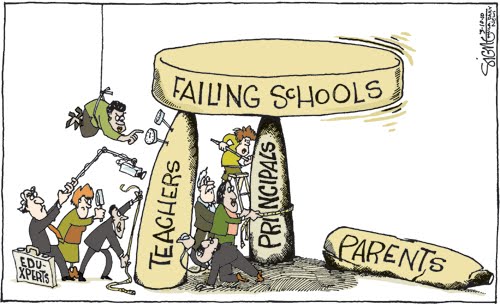
In case you haven’t noticed the education profession has been under attack as of late. The brunt of these attacks has been aimed at the very professionals who are tasked with positively impacting the lives of children each and every day – our teachers.  In my mind education is the noblest of professions.  Without education, at some level virtually all other professions would be non-existent. This places our teachers at the forefront of molding young minds into the next generation of doers, thinkers, creators, leaders, and entrepreneurs.  If there is ever a profession that should be revered as much as that of a doctor who saves lives it is that of a teacher.  


Image credit: https://larrycuban.files.wordpress.com/2011/12/parents.jpg

Unfortunately there is a growing rhetoric and sentiment that the education system in America is broken and our teachers are to blame for this.  New accountability systems have been championed and adopted across the country that reduce teacher effectiveness to a mere number.  The algorithm adopted by many states, which quite frankly makes little sense, crunches data sets in an attempt to measure the quality of a teacher against his or her peers. Each state has different factors that go into their value-added measurement (VAM) of a teacher, but the dominant component is standardized test scores.  Teachers are the true catalysts of change that can create schools that work for kids. Even though countless studies have debunked this means to truly assess teacher effectiveness states have moved full steam ahead ignoring the research.

With such a focus on standardization in schools, many teachers feel compelled to prepare students for a litany of exams, as the data extrapolated from them will be used for high-stakes evaluation. Administrators are also intimately tied to these results as well, so as a knee-jerk reaction an environment that resembles a test-taking factory is created.  The sole focus becomes one that emphasizes performing well on a test as opposed to learning.  What results is the proliferation of an industrialized model of education that reformers claim they want to get away from, but the policies they support only help to sustain it. This gloomy depiction of what is happening to schools across the country by people that have no business enacting education policy is forcing teachers to leave the profession at alarming rates. 

The structure and function of the majority of schools in this country is the exact opposite of the world that our learners are growing up in.  There is an automatic disconnect when students, regardless of their grade level, walk into schools due to the lack of engagement, relevancy, meaning, and authentic learning opportunities.  Our education system has become so efficient in sustaining a century-old model because it is easy and safe.  The resulting conformity has resulted in a learning epidemic among our students as they see so little value in the cookie-cutter learning exercises they are forced to go through each day. The bottom line is that they are bored. It is time that we create schools that work for our students as opposed to ones that have traditionally worked well for the adults.

Creating schools that work for students requires a bold vision for change that not only tackles the status quo inherent in the industrialized model of education but also current education reform efforts. Even though Common Core is not a curriculum, many schools and districts have become so engrossed with alignment and preparing for the new aligned tests that real learning has fallen by the wayside.   We need to realize that this, along with other traditional elements associated with education, no longer prevail.  How we go about doing this will vary from school to school, but the process begins with the simple notion of putting students first to allow them to follow their passions, create, tinker, invent, play, and collaborate.  Schools that work for students focus less on control and more on trust. 

There is a common fallacy that school administrators are the leaders of change. This makes a great sound bite, but the reality is that many individuals in a leadership position are not actually working directly with students. Teachers are the true catalysts of change that can create schools that work for kids. They are the ones, after all, who are tasked with implementing the myriad of directives and mandates that come their way. Leadership is about action, not position. Schools need more teacher leaders who are empowered through autonomy to take calculated risks in order to develop innovative approaches that enable deeper learning and higher order thinking without sacrificing accountability. If the goal, in fact, is to increase these elements in our education system then we have to allow students to demonstrate learning in a variety of ways.  

For change to be successful it must be sustained.   Teacher leaders must not only be willing to see the process through, but they must also create conditions that promote a change mentality. It really is about moving from a fixed to a growth mindset, something that many educators and schools are either unwilling or afraid to do. The essential elements that work as catalysts for the change process include the following:

  • Empowerment
  • Autonomy
  • Ownership
  • Removing the fear of failure
  • Risk-taking
  • Support
  • Modeling
  • Flexibility
  • Collaboration
  • Communication

What I have learned is that if someone understands why change is needed and the elements above become an embedded component of school culture he/she or the system ultimately experience the value for themselves. The change process then gets a boost from an intrinsic motivational force that not only jump-starts the initiative but allows for the embracement of change as opposed to looking for buy-in.  We should never have to "sell" people on better ways to do our noble work nor rely on mandates and directives. These traditional pathways used to drive change typically result in resentment, undermining, and failure.

Even in the face of adversity in the form of education reform mandates, Common Core alignment, impending PARCC exams, new educator evaluation systems, loss of funding, and an aging infrastructure, at my school, we have not only persevered but proven that positive change can happen with the right mindset.  Teachers were put in a position to overcome these challenges and experience success.  Others can as well. Throughout the past couple of years, I have seen improvements in the "traditional" indicators of success by mainly focusing on creating a school that works better for our students as opposed to one that has always worked well for us. Technology was a tool that my teachers harnessed and leveraged to do what they did better while creating a culture of learning that actually meant something to our students. My recent TEDx talk provides insight into how this was accomplished.  

My message is to everyone who has and continues to bash teachers by implementing accountability structures that will do nothing to help our students succeed in life and follow their dreams.  There need to be more creative ways to hold teachers accountable so that a school-wide focus on relevant learning becomes the norm. Teachers should no longer be forced to prepare students for a world that no longer exists and be held accountable through one-dimensional means.  Teacher success should be judged on the products students create with real-world tools to solve real-world problems.  If teachers are allowed to innovate and allow students to create artifacts of learning to demonstrate conceptual mastery, the end goal should be the acquisition of higher-order thinking skills.  

Monday, April 8, 2013

Autonomy Breeds Change


A year and a half ago I decided to implement a job-embedded growth model at the suggestion of some of my teacher leaders.  They desperately sought time during the school day to engage in professional growth opportunities, learn how to integrate Web 2.0 tools, and develop their own Personal Learning Networks (PLN’s).  After some thinking and looking at various options inherent in the current schedule, I decided to cut all non-instructional duties in half to create a Professional Growth Period (PGP).  The inspiration for this idea came from Google’s 80/20 Innovation Model where engineers are encouraged to take 20 percent of their time to work on something company-related that interests them personally.  Duties that we cut are now assumed by me and my administrative team.


Image credit: http://scholasticadministrator.typepad.com/thisweekineducation/2010/02/thompson-autonomy-for-change.html

The PGP was launched in September 2011.   It virtually gave every New Milford High School teacher two to three, forty eight minute periods a week, depending on the semester, to engage in growth opportunities of personal interest.  The only catch was that each staff member had to create and present a learning portfolio at his/ her end of year evaluation conference.   This learning portfolio clearly articulated how they integrated what was learned during this time into professional practice.  They also had to keep a log detailing what was done during each PGP day throughout the year.

A great deal was learned after I reflected on year one of the PGP.  For starters, I read Drive by Daniel Pink this past summer and made a few slight changes.  In order to give each staff member a greater level of autonomy, I removed all top-down mandates such as keeping a log and watching a certain number of PD 360 videos.  This year teachers had true freedom to learn anything and follow their passions as long as the time was spent to improve NMHS’s bottom line – student learning and achievement.  Sample PGP activities include the following:

  • becoming a connected educator by developing and engaging in a Personal Learning Network (PLN)
  • researching best practices
  • developing innovative learning activities
  • creating interdisciplinary lessons
  • engaging in face-to-face professional development
  • learning to use new technologies
  • collaborating on projects with colleagues. 

I also used last year as an opportunity to work with my teachers and better articulate how to compile their learning portfolios. Last week I began conducting end of year evaluation conferences with my teachers.  I was extremely eager to see their respective learning portfolios and discover what they had been working on over the course of the year.  Let me tell you this, I was not disappointed.  As each staff member presented their learning portfolio they all shared how appreciative they were to have this time.  Below is a sample from some of the portfolios:

  • Math teacher Kanchan Chellani has been using her PGP time to create engaging learning activities with Adobe Captivate to flip her classroom.  She has also created her own website filled with resources for students.
  • English teachers Jessica Groff and Nanna Westbook used their PGP time to collaborate.  Throughout the year they met to develop extensive binders to compile resources related to text complexity as outlined by the Common Core Standards.  Jessica also used the time to develop the school’s digital newspaper, The Lance, from scratch.
  • Math teacher Jeff Fiscina learned how to create engaging learning activities using Educreations. He also developed his own blog and started a Twitter account for his classes.
  • English Teacher Sue Michels read numerous books, such as Drive by Daniel Pink and Fair Isn’t Always Equal by Rick Wormeli.  She also re-wrote the entire Honors English 11 curriculum.
  • History teacher Joe Manzo learned how to use iMovie and created a project on the Vietnam War to engage his students in some of the essential concepts.  He is now working on developing a student project where they will use iMovie to create artifacts of learning related to historical concepts later this year.
  • History teacher Rebecca Millan started her own blog and is now having her students blog as well in Sociology.
  • Math teacher April Millian has been exploring the flipped instructional approach and has begun to implement it on a routine basis with the use of Edmodo.
  • English Teacher Jerry Engstrom created several unit plans aligned to the common core and read How to Read Literature Like a Professor by Thomas Foster and Readicide by Kelly Gallagher.  Jerry provided examples of how he has integrated specific concepts and insights learned from each book. He has begun to research how to implement student portfolios using Evernote for next year.

Similar to FedEx days discussed by Dan Pink in Drive, my teachers have been given the opportunity to follow their passions, unleash their creativity, and deliver a learning portfolio that illustrates professional growth to enhance teaching and learning.  Based on the conversations I had with teachers after they presented their learning portfolios, they are already beginning to talk about innovative ideas to pursue next year.  I am excited to see what some of my other teachers have been working on in the coming weeks and am proud that time during the school day is being used productively. 

Sunday, March 17, 2013

Unwrapping the Common Core Standards

Love them or hate them, the Common Core is a reality for the majority of educators and schools across the country.  As a principal I am always on the look out for resources that can aid my teachers with the successful implementation of these standards.  While attending the 2013 ASCD Conference in Chicago I attended a session entitled Unwrapping Standards to Drive the Adoption of the Common Core State Standards.  The presentation was facilitated by the Clark Country School District in Nevada.  As they stated, many teachers are not unwrapping standards themselves.  As a result they are blinding using information and tend to focus on parts of a standard as opposed to the whole thing.  By unwrapping standards educators see the interconnectedness within the Common Core.

Image credit: http://www.livebinders.com/play/play?id=485958

During the presentation Wiki-Teacher was shared.  This is a free resource for any educator to use to assist with unwrapping the Common Core Standards. As the Wiki states the lesson plans, unit plans, centers, textbook supplements, and other resources found on Wiki-Teacher are created and shared by educators. Resources contributed to the site are reviewed by content experts and peer-rated by all of the members of Wiki-Teacher.  Educators can also access demonstration videos once a free account is created. I will most certainly be sharing this resource with my staff upon my return to New Milford High School.

Wednesday, April 25, 2012

Canisters for Classrooms


Back-to-school time can be stressful for teachers who may have limited funds to help stock the classroom with items to help keep kids’ classrooms healthier.[1] That is why the Clorox Company is launching the Canisters for Classrooms program to help teachers get Clorox® Disinfecting Wipes for their classrooms and get parents involved in donating, too!

Now teachers can get the help they need. When they put Clorox Disinfecting Wipes on their back-to-school list, Clorox will automatically donate two canisters to their classroom!  Visit Clorox Classrooms to upload your back-to-school supply list or create your back-to-school supply list online.

Clorox has a long-standing commitment to helping schools and teachers maintain a healthier learning environment throughout the school year. Clorox is dedicated to educating children about the importance of preventive health and recognizes that teachers play an influential role in teaching children about healthier habits.

Below are some helpful tips for fighting germs in the classroom:
  • Sing & Scrub: Make sure kids wash their hands the right way. They should wash frequently with warm water and soap for at least 20 seconds (the time it takes to sing the “Happy Birthday” song twice).
  • Do the Elbow Cough: Teach kids to cough into elbows, not hands, where they are more likely to spread bacteria and viruses through touch.
  • Disinfect Hot Spots: Be sure to disinfect the surfaces kids touch most frequently in the classroom – like desks, computer mice and doorknobs. Use a disinfectant approved to kill cold and flu viruses, like Clorox® Disinfecting Wipes. 

When kids go back to school, we want them to swap summer stories and study tips, but we don’t want them sharing cold and flu germs. Adding Clorox® Disinfecting Wipes to your back-to-school list can help prevent the spread of germs in the classroom when used as directed on hard surfaces.

We know that with budget cuts affecting school programs and the quality of learning environments everywhere, you can use all the help you can get to help make students’ learning experiences the best they can be.[2]   Teachers should check school policy before adding Clorox® Disinfecting Wipes to their classroom list.  Please share this post with other teachers that you know so they can create their back-to-school supply lists online and be eligible for this program.


Please join me in a Twitter chat on Tuesday, May 8th from 8 to 9 p.m. ET to learn more about Clorox’s Canisters for Classrooms program and how teachers can get two free canisters of Clorox Disinfecting Wipes for their classrooms to help keep their classrooms healthier. You can follow the conversation by using the #clxcanisters hashtag.


** I am a member of the Clorox Classrooms teacher panel.


[1] http://articles.boston.com/2011-09-05/news/30116414_1_classroom-supplies-public-school-teachers-middle-schools
[2] http://www.usatoday.com/news/education/2010-06-06-schools-economy_N.htm