Showing posts with label education reform. Show all posts

Sunday, September 11, 2016

Governor Christie’s Guide to Destroying a Great Education System #NJED

It breaks my heart to see what is happening in a state that I hold dear to my heart. I might now live in TX, but I was born and raised in NJ.  Both of my parents were public educators; my father an elementary principal in Hackettstown and my mother an elementary teacher in Flemington.  They both touched lives and impacted kids like countless other NJ educators. It takes a special person to consciously make a decision to earn less money while putting in an obscene amount of time outside the working day to help students reach their potential. Educators are, and have been, the cultivators of virtually every other profession. 

My entire public education career as a teacher (Watchung Hills) and principal (New Milford) was spent in the Garden State working in a system that was, and still is, regarded as one of the best in the nation.  This recognition has been validated by state-by-state data comparisons. Historically NJ is typically number one or two.  Students in the state routinely outperform their peers on the SAT, ACT, and NAEP from across the country.  This past year five of the top 100 public schools in America were from NJ.  

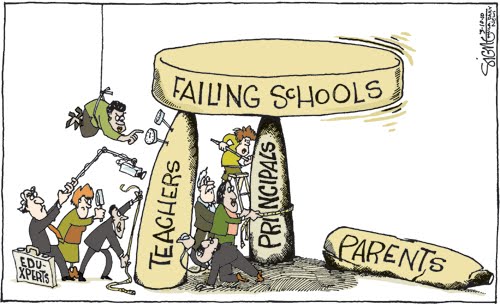
Instead of celebrating and strengthening a great public education system, Governor Christie has taken a dumfounding approach with his agenda. Who in their right mind attacks, berates, chastises, and bullies people in a profession who have made the conscious decision to make less money in order to impact kids? Are there some bad teachers and administrators? Of course, just like there are bad lawyers, doctors, accountants, and politicians (hint, hint). However, just like any other profession the amount of bad educators pales in comparison to those who go above and beyond to help kids learn. 


Image credit: Drew Sheneman

Let’s look at some of the ridiculous decisions Governor Christie has made to derail a great education system:

  • Reduced state funding for schools over the years to pay for tax cuts for his rich friends. His latest wisdom is articulated in this article: Chris Christie’s Education Plan Is Shocking: He Wants to Give to the Rich and Take From the Poor. 
  • Eliminated cost of living adjustments (COLA) for all retired educators who gave their all for kids
  • Vetoed a mandatory school recess bill, even though research had shown how important it is to student learning.
  • Pushed forward a few unfunded mandates (Common Core, PARCC) that have taken away precious funds from improving what really matters. Schools had to front the money for quality professional development, curriculum revision, and technology to support these mandates. Years later many states have backed away from PARCC. The once strong 26-member consortium has now dwindled to 7. For all the hoopla, PARCC has told us nothing we didn't already know from previous assessments. To make matters worse, NJ has been the only state to make this a graduation requirement in the near future.
  • Imposed superintendent caps to drive out some of our best leaders. Many states have welcomed them with open arms and pocket books as good leaders are often worth every penny
  • Followed through with a value-added system for evaluating educators, which by the way has no supporting research. He doubled down on this recently by increasing Student Growth Percentile (SGP) scores to 30% of an educator’s overall evaluation.  This latest change was pushed out on Wednesday, August 31, just days before schools welcomed back students. On Monday, a few days later, Education Commissioner David Hespe resigned. A bit shady, huh? In all, the new regulations completely give up on quality teaching and simply shoot for compliance. This was most likely done because people were overburdened with paperwork, but no consideration was given as to the effect of the regulations. The entire SGP issue is a nightmare as in some cases they rely on arbitrary numbers 
  • Refused to fully fund the public pension system that he committed to in 2012 while pushing all the blame for the state’s economic woes on teachers, policemen, firemen, and other public sectors committed to the well being of all.

Instead of developing rational strategies based on sound research to support districts, schools, and educators who need the help the most, Christie has implemented a one-size-fits-all approach that goes against the tenets of good pedagogy. The NJDOE has done his bidding long enough and need to begin to push back against his destruction of public education in NJ. It would also be wise of the NJ State Board of Education to take a hard look at how their rubber stamp on Christie’s education agenda has not a shred of supporting research or evidence of success.

NJ teachers, administrators, and teachers continue to rise in the face of this adversity because that’s what professionals dedicated to kids do. Even in these challenging times, schools have risen above the negative rhetoric to innovate and focus on learning that truly matters. A few years ago I challenged Commissioner Hespe to come to my school and see what learning can and should look like. My call on social media went unanswered, but that didn't stop NJDOE representatives from calling my superintendent and asking him to get his principal (me) under control. This only strengthened my resolve.

Keep doing what’s best for kids, as you, not Governor Christie, know what it is like to actually work in a public school.  You made the conscious decision to be a difference maker as opposed to making more money in another profession. Your work matters and NJ’s success on the national stage speaks for itself. Thank you for all that you do and keep making those of us fellow Garden State educators proud.


Sunday, July 24, 2016

The Power of You

Make no mistake about it; the job of any type of educator is tough these days. It is a rewarding profession in that we have the opportunity to make a positive difference each day, but for all our efforts, thanks and appreciation are tough to come by at times.  The fact that many countries don’t value the honorable work that is done in classrooms and schools is a tough pill to swallow. Throw in the endless array of mandates, directives, and time dedicated to the job and many would question whether it is even worth it to go into the field of education these days. 

Psychology does not work in our favor.  It is relatively easy to succumb to the negative. A great deal of research has found that negative perspective is more contagious than positive perspective. Thus, it is natural to get bogged down by pressures of the job that seem to keep mounting. Renee Jain provides a good summation of what we experience:


"The negativity bias is a tendency to have greater sensitivity to negative than to positive events. Some researchers posit that, psychologically speaking, negative events weigh close to three times more than positive events. While this bias may serve us in situations related to survival, it can cause distress in everyday encounters. So the question becomes: How can we topple this negativity bias?"

What makes the job of an educator even more difficult are the hard to reach students who are reluctant to learn. When this situation is thrown into the mix with any of the other challenges previously mentioned, the role of an educator could seem pointless. As Jackie Gerstein states, “All kids have worth. Some, though, want to prove to us that they have none. Our job as caring educators is to prove them wrong.” 


Image credit: Jackie Gerstein

With all the challenges you face each day know that your work and compassion is needed more than ever.  Watch this video below.  Put yourself in the role of the storeowner and the child as one of your students. 


The video above exemplifies how important educators are. Even when times are tough know that your work matters to those who we serve. Whether you realize it or not, the payoff of your dedication and commitment might not bear fruit for many years. Even in trying times take solace in knowing how you impact kids. It is in our nature to focus on the negatives, but you work too hard to allow yourself to fall victim to this psychological trap.

It is all about the power of YOU! You have the opportunity to positively impact the life of a child every day. If you care enough, change can and will happen. You are the difference maker. Reach for the sky and experience your potential. Reach for the stars and discover unlimited potential. You CAN usher in bold ideas for a new future. Believe in yourself and help your colleagues do the same. Never underestimate the profound impact you have on your students. Thank you for all that you do. Our future is bright because of YOU!

Sunday, October 11, 2015

Educators are the True Rockstars

"To recruit the brightest and best, teaching needs to be a high status occupation" - Lord Adonis

It is interesting how our culture works, especially here in the United States. We idolize those who entertain us such as actors, actresses, rockstars, and professional athletes to name a few. These people bring joy, and sometimes heartbreak, into our lives. With all the attention, time, and money that are put into our love for the entertainment sector, society needs to take a deep breath and reflect on our priorities. Should we be elevating these people to sometimes god-like status?

In my opinion and that of many others, there is no more important profession than that of education. It is the noblest of professions that quite frankly provides qualified candidates for virtually every job. Without educators would we have doctors, lawyers, engineers, politicians, electricians, mechanics, or anyone in the entertainment industry?  Yet for all that educators do to mold and inspire young minds to think and make a difference in this world, their profession is constantly dragged through the mud. Our priorities are so out of whack and if things don't change fast it will become even harder to attract the best and brightest to work with our children. Not for nothing, but our kids deserve the best.

So what if we treated educators like professional athletes? Let's take a minute and see how things could look if our priorities changed.


Even though the video above is based on comedy, imagine if we viewed educators in a different light putting them on par with other professions and greatly above that of the entertainment and sports industries?  We have a great deal to learn from other countries that value the role of educators above all else as noted by Peter Dolton:
"In recent years it's become a truism that attracting good quality and well-qualified people into teaching is accepted as the essential prerequisite to raising educational standards. In Finland and Singapore, teachers are recruited from the most-qualified graduates, all with a second degreeOne obvious way these countries have attracted the best and brightest into teaching is by paying them well."
The bottom line is that we won't improve the status of educators unless teaching and education in general is recognized as a worthy profession. It is time for society to shift it's priorities. In the short term let social media be your bullhorn to amplify the essential work you do for kids every day. 


Image credit: https://s-media-cache-ak0.pinimg.com/236x/90/b1/0f/90b10f61a19190504eb78a72b0b4235f.jpg


Sunday, February 22, 2015

Looking at Teacher Accountability Through a New Lens

In case you haven’t noticed the education profession has been under attack as of late. The brunt of these attacks has been aimed at the very professionals who are tasked with positively impacting the lives of children each and every day – our teachers.  In my mind education is the noblest of professions.  Without education, at some level virtually all other professions would be non-existent. This places our teachers at the forefront of molding young minds into the next generation of doers, thinkers, creators, leaders, and entrepreneurs.  If there is ever a profession that should be revered as much as that of a doctor who saves lives it is that of a teacher.  


Image credit: https://larrycuban.files.wordpress.com/2011/12/parents.jpg

Unfortunately there is a growing rhetoric and sentiment that the education system in America is broken and our teachers are to blame for this.  New accountability systems have been championed and adopted across the country that reduce teacher effectiveness to a mere number.  The algorithm adopted by many states, which quite frankly makes little sense, crunches data sets in an attempt to measure the quality of a teacher against his or her peers. Each state has different factors that go into their value-added measurement (VAM) of a teacher, but the dominant component is standardized test scores.  Teachers are the true catalysts of change that can create schools that work for kids. Even though countless studies have debunked this means to truly assess teacher effectiveness states have moved full steam ahead ignoring the research.

With such a focus on standardization in schools, many teachers feel compelled to prepare students for a litany of exams, as the data extrapolated from them will be used for high-stakes evaluation. Administrators are also intimately tied to these results as well, so as a knee-jerk reaction an environment that resembles a test-taking factory is created.  The sole focus becomes one that emphasizes performing well on a test as opposed to learning.  What results is the proliferation of an industrialized model of education that reformers claim they want to get away from, but the policies they support only help to sustain it. This gloomy depiction of what is happening to schools across the country by people that have no business enacting education policy is forcing teachers to leave the profession at alarming rates. 

The structure and function of the majority of schools in this country is the exact opposite of the world that our learners are growing up in.  There is an automatic disconnect when students, regardless of their grade level, walk into schools due to the lack of engagement, relevancy, meaning, and authentic learning opportunities.  Our education system has become so efficient in sustaining a century-old model because it is easy and safe.  The resulting conformity has resulted in a learning epidemic among our students as they see so little value in the cookie-cutter learning exercises they are forced to go through each day. The bottom line is that they are bored. It is time that we create schools that work for our students as opposed to ones that have traditionally worked well for the adults.

Creating schools that work for students requires a bold vision for change that not only tackles the status quo inherent in the industrialized model of education but also current education reform efforts. Even though Common Core is not a curriculum, many schools and districts have become so engrossed with alignment and preparing for the new aligned tests that real learning has fallen by the wayside.   We need to realize that this, along with other traditional elements associated with education, no longer prevail.  How we go about doing this will vary from school to school, but the process begins with the simple notion of putting students first to allow them to follow their passions, create, tinker, invent, play, and collaborate.  Schools that work for students focus less on control and more on trust. 

There is a common fallacy that school administrators are the leaders of change. This makes a great sound bite, but the reality is that many individuals in a leadership position are not actually working directly with students. Teachers are the true catalysts of change that can create schools that work for kids. They are the ones, after all, who are tasked with implementing the myriad of directives and mandates that come their way. Leadership is about action, not position. Schools need more teacher leaders who are empowered through autonomy to take calculated risks in order to develop innovative approaches that enable deeper learning and higher order thinking without sacrificing accountability. If the goal, in fact, is to increase these elements in our education system then we have to allow students to demonstrate learning in a variety of ways.  

For change to be successful it must be sustained.   Teacher leaders must not only be willing to see the process through, but they must also create conditions that promote a change mentality. It really is about moving from a fixed to a growth mindset, something that many educators and schools are either unwilling or afraid to do. The essential elements that work as catalysts for the change process include the following:

  • Empowerment
  • Autonomy
  • Ownership
  • Removing the fear of failure
  • Risk-taking
  • Support
  • Modeling
  • Flexibility
  • Collaboration
  • Communication

What I have learned is that if someone understands why change is needed and the elements above become an embedded component of school culture he/she or the system ultimately experience the value for themselves. The change process then gets a boost from an intrinsic motivational force that not only jump-starts the initiative but allows for the embracement of change as opposed to looking for buy-in.  We should never have to "sell" people on better ways to do our noble work nor rely on mandates and directives. These traditional pathways used to drive change typically result in resentment, undermining, and failure.

Even in the face of adversity in the form of education reform mandates, Common Core alignment, impending PARCC exams, new educator evaluation systems, loss of funding, and an aging infrastructure, at my school, we have not only persevered but proven that positive change can happen with the right mindset.  Teachers were put in a position to overcome these challenges and experience success.  Others can as well. Throughout the past couple of years, I have seen improvements in the "traditional" indicators of success by mainly focusing on creating a school that works better for our students as opposed to one that has always worked well for us. Technology was a tool that my teachers harnessed and leveraged to do what they did better while creating a culture of learning that actually meant something to our students. My recent TEDx talk provides insight into how this was accomplished.  

My message is to everyone who has and continues to bash teachers by implementing accountability structures that will do nothing to help our students succeed in life and follow their dreams.  There need to be more creative ways to hold teachers accountable so that a school-wide focus on relevant learning becomes the norm. Teachers should no longer be forced to prepare students for a world that no longer exists and be held accountable through one-dimensional means.  Teacher success should be judged on the products students create with real-world tools to solve real-world problems.  If teachers are allowed to innovate and allow students to create artifacts of learning to demonstrate conceptual mastery, the end goal should be the acquisition of higher-order thinking skills.  

Wednesday, November 12, 2014

The Place to Be

Throughout my life I have either attended, or worked in, a public school, as had my parents.  In terms of my own education, I always felt that I was provided with the knowledge and skills to succeed in life.  By no means was my pubic schooling perfect and when I look back there were many instances that presented opportunities for improvement.  The bottom line, however, was that I had passionate and caring educators who pushed me to be the best student that I could be regardless of the deficiencies inherent in an industrialized model of education.   

As fate would have it my role changed and I began to have a direct impact in the position of either a teacher or administrator. Throughout my ongoing career as an educator in public schools, I have always worked to provide a relevant, meaningful, and applicable learning experience for my students.  I have written extensively about many of the successful initiatives that were implemented over the course of my career at New Milford High School.  Even with these successes, many of which have been widely publicized, we were never perfect when it came to meeting the needs of all learners. This was also the case when I recollect my days as a science teacher and coach at Watchung Hills Regional High School.  Mistakes were constantly made and some persistent issues were never changed no matter how hard we tried.  Through it all there was more positive than negative in each experience and this has only strengthened by resolve for, and support of, public schools. 

When it came time to make a decision about where to send our two young children to school there really was no decision to be made. Even though I was intimidated by the outright size of the New York City School system I was fully committed to sending my children to public school in my home borough of Staten Island.  We were fortunate to move from our first home on the island to an area called Pleasant Plains and were ecstatic to find out that we were zoned for Public School 3. The word on the street was that this was a very good school, but it wasn’t until I met Principal Judy Wilson that I realized how special the school really was. I still remember the day when I sent my son Nick in with a copy of the Scholastic Administrator magazine where I was featured on the cover. Once Judy realized that I was Nick’s father we began to immediately have conversations on how to improve the school culture at PS 3. 


Judy Wilson is such a passionate principal who works tirelessly to create a school that fosters a love for learning.  At times the cards are stacked against her because of the levels of bureaucracy, mandates, and senseless policies that are embedded elements of the NYCDOE.  In the face of these challenges and many others, she has worked collaboratively with passionate staff members to provide authentic learning experiences for the students there.  For example, a dance studio was created in an unused space and dance has now become integrated across the curriculum.  The dancing classroom program was brought to PS 3 five years ago for every 5th grade student.  The program builds social awareness, confidence and self-esteem in students through the practice of social dance. They cultivate a new competition team every year composed of 12 students who compete citywide. Every year the team has brought home gold medals.

Last year Judy brought VR Quest to the school where students, including my son, were able to create their own 3D virtual reality games from scratch after school.  Thanks to the incredible guidance of Media Specialist James Laieta, my son was part of his S.W.A.T. Team where students worked collaboratively after school to work on their games.  James volunteered to do this, as he is a true educator who believes in allowing students to follow their creative passions. Another highlight at PS 3 includes an annual field trip on board a floating lab. Then there are more personal situations that mean more than words can describe. When Judy Wilson found out that my son was becoming disinterested in school she went out of her way to have him do the morning announcements with older students.  This not only made him a bit more eager to go to school, but also has had a positive impact on his communication skills.  These are just a few examples of how the school is working to better meet the diverse needs of my children.

All in all I am happy with my children’s school, but just like in my experiences, there have been a few issues that have clouded my judgment as of late.  These issues relate to homework and Common Core implementation.  Without going into much detail these isolated issues have morphed into a message that my kids hate school.  I even went as far to state this emphatically in my recent TEDx talk.  The honest truth is that my kids are, well, kids and as such they typically don’t like some aspects of their formal education.  I know I didn’t.  

In retrospect, going forward I need to focus more on collaborating with the staff at PS 3 to improve some of the elements that my children don’t like instead of rattling off sound bites.  Today I sat down with my kids and had a detailed conversation with them about all the many elements of PS 3 that they love. Let me tell you, there were many!  Judy possesses an undeniable focus to move the school forward and actually implement ideas and suggestions I put forth.  I should not use my influence to paint an inaccurate picture of a school version of David going up against Goliath, which is the NYCDOE.  As the motto states, PS 3 is “The Place to Be.” I am a firm believer in this and now have to act like it. Instead of focusing on the negatives, which are inherent in any school system, I will work to promote what makes PS3 special while providing constructive feedback and hands-on support as needed. 

Sunday, September 21, 2014

Learning That Matters

The other day I posted the following statement on social media, "When was the last time any of us had to take a standardized test in our careers? Answer = never. So why is this done to kids incessantly?" I should have clarified my comment a bit more by explaining that I was referring to repetitive standardized tests being taken while in the same job with the same school, company, or corporation.  My point was that there seems to be a disconnect in terms of how many times K-12 students are now subjected to standardized tests compared to the majority of professions. Yes, many career paths require entry-level exams and those that identify essential skills sets needed to do the job. Some jobs even require routine re-certifications. Many, however, do not require another test once a passing score has been achieved.


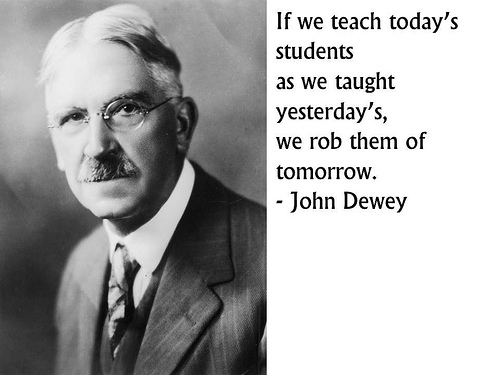
Image credit: http://technologyembedded.files.wordpress.com/2012/05/john-dewey.jpg

The problem I have is that most jobs in both the public and private sectors utilize differentiated means to evaluate job performance. Goals are established collaboratively while keeping or losing a job isn't determined by how well you can bubble in or electronically respond to answers on a test. Now let’s make a connection to learning.  Ask yourselves this, can you clearly make a connection to the results of a standardized test you took and its impact on your current job? I sure can't because most of the tests I took lacked any relevancy and meaning in terms of what I really wanted to do with my life. Sure the SATs and GREs were important benchmarks that I had to score a certain level in order to move through higher education, but I was not one bit passionate about taking them. I can also emphatically state that both exams did absolutely nothing for me in terms of my career in education. There are so many problems with standardized tests that I can go on and on writing about them.

So why did I take them? The answer to this lies in society's overreliance on attempts to quickly and efficiently quantify learning. This is not learning but forced conformity into a system that focuses more on numbers than actual skills that can help one succeed in life. This comment from Lain Lancaster on the Google+ thread sums things up nicely:
"I'm baffled by your country's rush to standardization all across education systems (tests, common core etc.) when research has pretty much proven it's the opposite of what education should be.  (I'm in Canada) Not only that, but thanks to modern technologies, society in general is moving away from mass production/consumption to individualized production/consumption. Yes standardization is easier, and produces lots of pretty data, but there's scant evidence that it’s effective anywhere in realm of education."
So we continue to press forward in a direction that virtually everyone knows is wrong and misguided.  Why do companies like Google go out of their way to provide their employees with spaces where they can play and relax? Play has been stripped away from students so there can be more time to prepare for the tests. The best learning experiences I ever had were experiential in nature. They involved play, creativity, failure now and again, tinkering, collaboration, and meaningful feedback.  If life is all about preparing for and then excelling on standardized tests will that allow society to push forward and solve the plethora of pressing issues that our world faces today? The bottom line is that life is not a standardized test and results on these will rarely determine how successful our students will be in life. We all would be better served if school focused more on preparing students adequately to excel in the real-word instead of wasting time forcing them to take test after test that they see know value in. If true learning is what matters than we should model that in education.

So what are you thoughts?

Wednesday, May 28, 2014

What Drives You?

In education, I think the driving force that compels us to join the profession is the innate desire to instill a love for learning among students and to help place them on a path to success.  There is nothing more exhilarating than seeing, or knowing, firsthand that you played a small part in a student’s evolution over the years.  Foremost is the desire to work with kids. Putting in countless hours developing lessons, grading, providing feedback, observing teachers, providing professional growth activities, constructing a master schedule, formulating a budget, attending events, and writing letters of recommendation are just a few of the myriad of tasks that educators across an array of positions engage in every day.  All of this is done with a single purpose in mind – student learning, achievement, and success.  What other professional position allows for the opportunity each and every day to positively impact the life of a child?

Image credit: http://onmyfrontporch.files.wordpress.com/2012/11/quote-191012.jpg

The above paragraph describes what I feel is the main reason each of us has chosen to pursue a career in education.  It is not about the big payday, accolades, glitz, or glamour.  If that was the case I think we can all agree that we would have chosen any other field except education.  There are, however, a select group of individuals and organizations comprising the majority of the education reform movement that do, in fact, feel that we are overpaid, underworked, and pampered with lavish packages after retirement.  To pour salt on an open wound, ideas are concocted in regards to how we should be evaluated with not a shred of research to back up these initiatives.  The fact of the matter remains that we are the ones who decided to pursue a career working with students while many others either shunned or made fun of our decision.  Now it is these people, the same ones that wanted nothing to do with the education profession, that are trying to dictate every facet of what we do.

The recent education reform movement provides an endless barrage of insults to the noble work we do everyday.  It has perpetuated schools as testing factories, something many of us have always dreaded.  While our driving force is to ignite students’ passion for learning, the relentless focus on standardized testing data is doing little to prepare our students for success in the real word.  Sorry, but that is fact, at least in my eyes.  This then leads to my final point and that is how schools are structured.  In an age where we have what seems like an endless array of tools to engage, enhance learning, and assess in a variety of ways, the majority of schools seem either content or fearful of breaking free from the industrialized model of education that has entrenched our system for over a hundred years.  Schools need to work for students as opposed to the status quo or us.  In a world now dominated with all forms of technology, our mission should be to find natural pedagogical fits.  There is no longer an excuse for creating a system that is the exact opposite of the real world.  This in itself is just as bad as the education reform efforts described previously.  

So what really drives me as an educator today?  My goal is to collaboratively create a culture of teaching and learning that resonates with my students.  Where I once feared giving up control and trusting students, I now relish the opportunity to do this each and every day.  Through the many successful initiatives where change has been sustained, our students have ultimately benefited.  With each passing day, seeing and observing the fruits of our labor in the form of students exhibiting a growing appreciation for the culture that we are creating together brings a smile to my face.  This is what drives me: making learning more about them than everyone else.

So what drives you? 

Thursday, May 1, 2014

Childhood is Expendable to Some Education Reformers

The following piece is cross-posted at the Huffington Post.

When I reflect on my childhood nothing but fond memories come to mind. Growing up in a rural part of western New Jersey sure had its benefits in the 1980's. Upon returning home from White Township Consolidated School (K-8) my brothers and I would complete our assigned homework in well less than an hour, which was reasonable in my opinion. More often than not as soon as we finished we whisked out the door of our house to get outside regardless of the weather. The next couple of hours before and after dinner were then spent playing with friends outdoors, exploring, riding bikes, fishing, shooting hoops, or hiking. If by some chance the weather were really bad we would then play with toys, tinker with Legos, or challenge each other to the coolest games of our young generation on the Atari and later Nintendo. For good measure some time was also spent on the Commodore 64 and Apple IIe computers.


Image credit: http://www.laurieacouture.com/wp-content/uploads/2011/06/End-School-School-Destroys.jpg

The childhood years were some of the best of my life as they should have been. Three was enough time dedicated to learning during my elementary years, but also ample time for play, exploration, competition, and leisure. These experiences definitely helped mold me into the adult I have become today. School complimented my activities at home as education was structured in a way that focused on experiential learning, play, performance, and building self-esteem. I learned and acquired array of skills that prepared me not only for college and careers, but also life. I can't even begin to imagine what my life would have been then or become today if these experiences had been ripped from me. Unfortunately this has now become reality for our youngest students in 2014 and the near future in the name of education reform.

Education reform is destroying childhood as we know it at both home and school. As a parent of two elementary students (first and third grade) in Staten Island, NY, I witness daily the negative impacts that Common Core and standardized testing, under the guise of education reform, are having on them. They come home each day and spend hours on homework that makes little sense to them and absolutely no sense in some cases to us, especially in math. Their love for learning is squashed as more of an emphasis has been placed on instructional scripts aligned to the Common Core, test prep, and homework designed to make them relive the torture they just went through in school. I do not fault the school, principal, or teachers for the wretched environment that my kids are exposed to each day, but rather the reformers who are making them hate school with a passion. Shouldn't we be instilling a passion for learning in each and every child? 

Education reform will be the demise of our once great educational system if politicians and other stakeholders do not get a grip soon. A recent story from an elementary school in Long Island, NY should make the dire predicament we are in very clear. Just the title of the article alone painfully illustrates the monumental mistakes that are being made for the sake of "improving" education - Kindergarten show cancelled so kids can study to be 'college ready'. Here is an excerpt that should make every parent and educator's blood boil:
A Long Island school has canceled its traditional end-of-year kindergarten show -- saying the children can't afford to take time off from getting themselves "college and career'' ready. "The reason for eliminating the Kindergarten show is simple," reads a letter sent by the principal at Harley Avenue Primary School in Elwood, Suffolk County, to parents last week. "We are responsible for preparing children for college and career with valuable lifelong skills and know that we can best do that by having them become strong readers, writers, coworkers and problem solvers."
Are you kidding me? How can anyone with a good conscious do this to little kids? It is these experiences that make learning relevant, meaningful, and fun. The fact that schools feel they even need to prepare elementary students to be college and career ready is appalling in my opinion. This is not even the worst of it though. Other priceless elementary experiences that define the childhood years are being dramatically cut such as the arts and language programs, recess, and extracurricular activities. Developmentally young students need these experiences, but they become quite expendable as only Common Core aligned math and language arts associated activities will create a college and career ready student down the line. What is being done to them in essence is robbing them of some of the most important, life-defining moments of their long lives that will provide the foundation for future successes.

This post provides me with a stark reminder that current education reform has absolutely nothing to do with authentic learning, success, and student achievement. It has become a financial pipeline to line the coffers of anyone associated with Common Core, standardized testing conglomerates, and test prep. The pressure put on teachers to prepare young students for college and careers is utterly ridiculous and should be replaced with inspiring them to explore and discover their learning passions. After all, this is what our system was based on for years and success followed. As a society we cannot stand idly by while crucial foundational elements for learning such as play, creativity (driven by students), discovering one's identity, and the showcasing of non-tested skills are eradicated from elementary schools. If we do I fear that our education system will hit rock bottom in a few mere years and we will have no one to blame but ourselves for not acting.

Wednesday, March 19, 2014

An Open Letter to NJDOE Commissioner David Hespe #NJED

Over the years, and in my latest book, I have written about how social media has presented me and my school with numerous opportunities that I never could have imagined would be possible.  I stress the fact that we now have a plethora of free tools that compel leaders, or all educators for that matter, to become the storyteller-in-chief.  Regardless of whether the stories are being penned by myself, my staff, or the students of New Milford High School, we have done just that at NMHS. We have taken control of our public relations for our school and now actively promote all of the great work we are doing to prepare students for success in a global, digital world. Not only has the local media taken notice of the impactful work we are doing, but others around the world have as well.  I’m not going to lie, one of the best parts of my job as a Principal is being able to put my school in a position to be a model for the types of changes education needs and deserves.


Image credit: http://www.strongchurch.org/wp-content/uploads/2013/07/open-letter.jpeg

Well, I have digressed a bit from the purpose of why I am writing this post. Not only has social media allowed us to flip the script and drown out the negative rhetoric that surrounds education all across the country, but it has also helped me find my voice. This still fascinates me, as I never thought that my opinions and ideas would have much traction outside Bergen County, NJ.  After my dear friend Ken Royal gave me a nudge, over four years ago I began to share my thoughts through blogging.   I have not shied away from sharing my opinions on educational technology, leadership, politics, policy, and reform.  The opinions of all educators matter and it is through platforms such as blogs and Twitter that I, and colleagues across the state, hope to engage all stakeholders in a meaningful conversation on how we can improve education.

Time to get back to my point.  Earlier this week I saw an article from NJ Spotlight titled THE LIST: NEW JERSEY'S 'EDUBLOGGERS' TALK POLICY, POLITICS -- AND TECHNOLOGY.  To my surprise I was identified as a blogger in NJ with some influence. Whether or not I do is besides the point. I immediately saw an opportunity to leverage this so-called influence to engage David Hespe, the new NJDOE Commissioner, in a conversation about the state of education in NJ. The previous Commissioner did not seem very concerned about what those of us in the trenches thought about the current state of education in our great state. To my knowledge there was little to no discourse with students who have and will continue to be impacted by the flurry of changes enacted in a short period of time. We can change this now Commissioner Hespe.

It is my hope that my network can assist me with getting him a message that we welcome an open dialogue so that together we can create teaching and learning cultures that work for our students. My goal is to have David Hespe visit New Milford HS in the near future to see firsthand the innovative work we are doing here.  Then I would like to set up a forum with other state educators so we can share our thoughts on some of the reforms that have been implemented as of late.  This would not be a gripe session, but instead an open conversation about how we can find a common group to accomplish the same goal we all possess – the success of our students.

I compel Commissioner Hespe to answer my call to action. Visit with us here at New Milford HS, engage in a dialogue with an array of educators and students, and listen to some of the ideas, as well as concerns, we have.  Let’s talk about the roll-out of Achieve NJ, Common Core, PARCC, SGO’s as well as some amazing innovative initiatives that inspire a passion for learning among our students.  The previous We can work out the details through email and then the phone, but let’s get this conversation started.  There is no better time than now for us to unite and move NJ to educational greatness as nothing less is expected. Please email me at esheninger@newmilfordschools.org.

Sunday, February 2, 2014

Control or Ownership

For over a century, the industrial model of education did a fantastic job of preparing students for careers.  Those careers are no longer relevant in today's rapidly changing world.  With obvious remnants of this system still in place, new changes are being pushed through under the guise of education reform. Instead of preparing students for an industrialized world the education system is now being tasked with preparing all learners to be college and career ready in order to compete globally with their peers.


Image credit: http://neatoday.org/2011/05/19/beware-pro-charter-parent-groups/

The education system is still not changing at all and is totally based on control and compliance.  The failed legacy of NCLB should provide a stark reminder that pummeling students with standardized tests will not achieve the desired outcome.  So again our education system is in a pickle consisting of an outdated model and the pressure to prepare students for an absurd amount of testing days throughout the school year.  The world does not rest on standardized tests.  Success now lies in one's ability to create solutions to problems, collaborate with peers to meet a goal, communicate effectively, and develop unique ideas that can change things for the better.

Unfortunately the powers that be are ultimately stripping the autonomy away from educators and schools, something that has defined our country for decades.  Even with an outdated model, we have still found ways to provide innovative pathways to unleash a passion for learning among our students. Control, as bad as it is in our system, has been a challenge that some have chosen to overcome.  In the face of adversity, educators have strived to overcome it to benefit our most precious resource - students. However, the current rhetoric and testing blitz that is upon us seeks to not only undermine what makes education special, but to control us to a point that will break the morale of many if it hasn't already.  This control will be the demise of our education system.

Up to this point I have ranted about control at the federal and state level and the dramatic impact it has, and will continue to have, on education if we don't change course.  There is another type of control that we need to acknowledge that is prevalent in virtually every school in the world.  This is the control fostered by administration and teachers as to how learning should, and will, be structured.  This hits home for me on many fronts, as I was guilty of this years ago.  We are often our own worst enemies as we work hard to control what students can do in school or classrooms.  This stems from the fact that we don't want to give up control. Compliancy has worked for so long, and quite frankly we don't trust students or even our own teachers.  What we don't know and understand we fear.  So we react by trying to control every facet of school structure, function, and learning. This was me for many years, but thankfully I changed and I think my school bas benefited.


Image credit: http://whatedsaid.wordpress.com/2011/08/25/10-questions-learners-shouldnt-ask/

The motivation from this post came from a recent presentation I did on digital learning.  The whole premise behind this concept it to provide relevancy, meaning, and authenticity in the teaching and learning process.  It hinges upon our ability to provide an environment and activities that unleash our students' passion for learning and allows them to create artifacts of learning with the tools of their choice to demonstrate conceptual mastery.  Additionally, it relies on a bold vision to grant students and educators the autonomy to take risks, learn from failure, and then adapt as needed.  This is where we have seen a significant shift from a control to ownership of learning.  Students are now able to demonstrate learning transparently for an authentic audience, allowing them to have a choice as to the device and/or tool to demonstrate and apply what they have learned.  Teachers are being empowered and embracing digital learning methodologies to improve professional practice. Meaningful change will only happen if we begin to give up control and establish a culture built on trust and respect.

In the end students have taken ownership of their learning.  As we continue to see the positive impacts of the changes we have willingly made, I wonder if those who are not in schools will take a second and truly reflect upon what their reform decisions are doing to schools, educators, and kids.  I also hope that those who block social media, ban students’ devices, and mandate Common Core scripts understand that these decisions are destroying a love for learning.  Digital learning in its many forms could be one such catalyst to put education on a better path.  If we truly want to prepare the next generation of thinkers, doers, inventors, and change agents we must give up control, trust students and educators, and work to develop a better system that will produce desired outcomes.


Wednesday, December 18, 2013

Be Present

There is no better way to get the pulse of a school as a leader than to be in classrooms.  I have never considered myself one to be tied to a desk and/or office, but the managerial aspects of the position and ridiculous amounts of paperwork catch up to you at some point.  This year educators in NJ, like many other states across the nation, are still adjusting to new mandates related to teacher evaluation and tenure changes.  Here we call it Achieve NJ.  The toll that all of these new directives - from SGO’s, to SGP’s to PDP’s - has taken on administrators and teachers has been quite dramatic.  In my case, none more than the never-ending time sap dedicated to paperwork and meetings.  This is our new reality.

Image credit: http://algetler.com/executive-presence-is-a-leadership-skill/

One of the mandates in particular has resulted in an increase in observations of tenured staff members. This is probably the one area of directed and mandated change that I have come to appreciate.  Why might you ask? It has resulted in my administrative team and I being in classrooms more often and regularly. Now, the beginning of the year was extremely rough as over six of the seven hours that my students were in school were spent conducting pre-conferences, observations, write-ups, and post-conferences.  After only a few months, the four of us that comprise the NMHS Administrative team have conducted co-observations, developed a common language and look fors, and have mastered the McREL tool that we use to observe staff.  Working together we are not only getting into more classrooms, but we have also developed a streamlined process using shared documents in Google Drive.  

The journey thus far has not been easy, but there now is a silver lining.  Once we became comfortable with the new mandates and how each impacted our professional practice we were able to lay out a vision for a renewed focus on the work we do that truly matters.  The only way to accomplish this was to become even more present by developing protocols to ensure we are in classrooms each day.  Even with the seemingly endless burden imposed by state mandates, we developed a walk-through procedure in order to not only know what is going on in our building, but to also better engage teachers and students in learning conversations.  

Our walks over the past two weeks have reaffirmed our belief in the innovative work taking place here at New Milford High School.  More importantly, they have been a catalyst for positive dialogue on what we can do as a school community to improve and celebrate our collective accomplishments. These rich conversations were just not taking place due to the pressure-filled environment that has been created as a result of education reform in this state.  Post-conferences have focused on how one can “prove” that he/she is meeting the criteria contained in a standards-based rubric, especially with uploaded artifacts.  On the other hand, our walks have reinvigorated our belief in public education and the amazing authentic and meaningful work teachers and students do each day.  Here is just a snippet of what I have seen or experienced in the past week:

  • An English teacher having every student in her Film Studies class share their presentation with me on Google Drive minutes after I attended a class.
  • Engineering students showing off the bridge they had just collaboratively created.
  • A pedagogically sound BYOD lesson in English where an equitable environment was created using both student and school-owned technology.
  • A History teacher having students use Socrative on Chromebooks.
  • Document Based Questions (DBQ’s) being administered in a history class.
  • Digital photography students working on editing the photos they just took on a recent trip to Rockefeller Center, Times Square, and Bryant Park in NYC.
  • A Math teacher using Poll Everywhere in AP Statistics to check for understanding.
  • A math teacher diligently working with students as they participated in a cooperative learning activity.
  • Students in our new Makerspace constantly tinkering, hacking, inventing, and creating.
  • Numerous teachers assessing learning in both summative and formative formats.
Picture from recent walk: BYOD and equity (student + school owned tech)


I think you get the point. Being present in our classrooms and other learning areas of our buildings cannot be overstated.  Even in the face of relentless pressures and mandates that don’t make much sense, it is our duty to be instructional leaders, cheerleaders, guides, mentors, and change agents.  This can only happen if we know what is going on in our schools, connect with both teachers and students alike, and provide positive as well as constructive feedback on what we see. Most importantly however is the mere fact that our presence will reaffirm what we do in the most important profession.  The work that I am seeing from my staff and students serves as an inspiration.  When I go into classrooms I am eagerly anticipating what I will see next.  Don’t succumb to the myriad of excuses that education reform provides each of us today not to be in classrooms.  Be present! 

Monday, August 5, 2013

Testing For What?

Cross-posted at the Huffington Post.

NJ Spotlight is a fantastic resource for me.  They are unbiased in their approach to educate citizens on numerous topics, with education being one of them.  I recently came across an opinion piece titled Putting New Jersey's High School Diplomas to the Test.  The article focused on NJ's relentless push to increase standardized testing and institute end of course exams that students would have to pass in order to graduate.  It really got me thinking about the direction we are headed in and the negative consequences that it will ultimately have on our learners.

Image credit: http://dhayeseng100fall2011.files.wordpress.com/2011/12/standardized-testing-comic3.jpg

It is safe to say that the situation in NJ is no different than many states across the country.  For many misguided and misinformed reasons, politicians think that the education system in the United States is not up to par.  As a result, marching orders have been sent down to each state’s DOE to hold teachers and schools more accountable.  New laws have been passed and mandates implemented with little or no input from educators.  To make matters worse, schools and educators are being asked to quickly adhere to these mandates with inadequate training, preparation, and field testing.  I am a firm believer in accountability measures that are backed by research, but less so in those that line the pockets of special interest groups.

So when and how did all of this school failure rhetoric begin?  The NJ Spotlight piece points this out with a little history lesson in NCLB:

"NCLB was a dismal failure in raising academic performance or narrowing gaps in opportunity and outcomes. But its over-reliance on mandated testing did succeed in creating a narrative of school failure that undermined support for public education and led to a decade of bad policy in the name of reform."

The ultimate goal should be to develop a love for learning amongst our students and prepare them to be successful in any college and/or career they choose.  Achievement is great and what we should strive for, but actual learning and growth is much more important.  The centerpiece of the majority of education reform efforts is standardized testing.  Students will NEVER come to school excited to take one of these tests.  They yearn for true authentic, relevant, meaningful learning experiences that inspire inquiry and the desire to learn more.  This is the key to college and career readiness in my mind.

Are we really testing students to determine if they are college and career ready? Like many others I am a bit skeptical of this.  Here is an excerpt from the NJ Spotlight piece:

"In fact there is little evidence that an exit testing policy leads to better prepared graduates, improved college participation or completion rates, or benefits to a state’s economy. Less than half the states have high stakes graduation exams, and several that did recently ended them. A recent study from the National Bureau of Economic Research found that “challenging standards-based exams reduce graduation and increase incarceration rates.” The study found no corresponding positive effects on employment or earnings."

If that wasn't eye-opening enough here is another piece from the article that I found as a compelling argument against graduation tests, or any standardized exam for that matter, that will be linked to a student graduating:

"Current graduation tests don’t reliably measure what they pretend to measure (“intelligence,” “academic ability,” “college readiness”), and they don’t measure at all qualities all high school graduates should have (responsibility, resilience, critical thinking ability, empathy). The new tests are not likely to be much better. They must be given over computer networks many schools don’t have and will still mainly consist of multiple choice questions that assess a narrow range of skills and curricula." 

Please take a look at the entire NJ Spotlight article for more insightful information about the road ahead. So what are we really testing students for?  I have my opinions please share yours.  Maybe this dialogue will resonate with policy and decision makers so that they can right the ship before it crashes.

Thursday, April 11, 2013

The Runaway Train


As the end of the school year draws near, the education reform rhetoric is heating up.  This means states like New Jersey and New York are closer to implementing new teacher evaluation systems as a result of Race to the Top, NCLB waivers, and other mandates adopted through recent legislation.  It seems like we are now at a crossroads between what the reformers think is best for elevating education in our country and the opinions of actual educators who work with students day in and day out.   One thing is for certain, it is going to be extremely difficult to initiate meaningful change as the divide between these stakeholder groups continues to widen.

Image credit: http://theragblog.blogspot.com/2009/11/barack-obama-stop-runaway-train.html

I am all for meaningful change that will benefit our students, but I continue to scratch my head as I watch what is happening in the state I live in (NY) and the one where I work (NJ).  The last time I checked both states have consistently been at the top in terms of student achievement and graduation rates.  In both cases, the respective Department of Education is moving at a feverish pace to implement the Common Core State Standards, new teacher evaluation systems, and adopt standardized tests produced by PARCC.  Can we do better?  Of course we can, but the solution is not testing the living daylights out of children thereby destroying their love for learning, demoralizing teachers, or evaluating principals on how well they implement new teacher evaluation systems instead of actual leadership.  

I live and work by one simple rule, do one thing exceptionally well as opposed the many things average.  Unfortunately common sense has not, at the moment, prevailed in this case.  What I see is a mad rush to the finish line and for what?  To appease politicians and others so disconnected from classrooms and learning that reform deadlines are met no matter how ridiculous they appear to be?   We are moving much too fast with all these initiatives and it has nothing to do with providing the best education for students.  Instead, it seems like it has everything to do with money and lining the pockets of companies in the areas of testing, teacher evaluation, and Common Core alignment.  If this runaway train is not stopped, I fear that the consequences will have a devastating impact on our education system for years to come.

The key to reform is not directives, mandates, and threats.  It is consensually figuring out the best course of action to improve education by making what we do better.   What I have learned during my tenure in education is that forcing people to do something builds resentment and animosity, especially if a body of research and valid field-testing does not back it.  I often ask myself how we have gotten to this point in time.  Education as a profession used to be revered; now no one in his or her right mind wants to pursue this career.  This is what happens when success is reduced to a hollow standardized test score or rating that is influenced by so many factors beyond the control of teachers and administrators.  Only people who have worked, or are working, in schools get this.

It is apparent that we have lost our way, but I would like to think that there is still hope.  To begin, we must slow down this runaway train before it is too late and make sure that what is being implemented is actually better that what is to be replaced.  If so, then we might be on to something.  Instead of pumping money into testing and evaluation systems why not use those funds to elevate the profession by attracting the best and brightest?  Another common sense approach in my book is that we must remove all of the red tape that prevents schools from easily removing ineffective teachers and administrators, not some algorithm that makes no sense or can’t be explained.  Finally, we must look to the past in order to plan for the future. Our country’s education system has led the world in producing some of the greatest creative minds ever known yet we are still made to think and feel like we are failures.  My hope is that we can slow down this train before it is too late.

Thursday, July 26, 2012

Standardization Will Destroy Our Education System, If It Hasn't Already

Cross-posted at the Huffington Post.


This summer I have made a commitment to reading more and have chosen books that I think will help me become a better leader.  A few weeks ago I finished Drive by Daniel Pink and am now halfway through with Linchpin bySeth Godin.  I highly recommend both of these book at any educators who is interested about the science behind motivation or overcoming resistance to become and indispensable component of an educational organization. 

Through my reading of both books it has become painfully clear that many of our current politicians and so-called educational reformers have it completely wrong when it comes to standardization.  Now I have always thought this was the case, but these two books have not only reaffirmed my views, but also given me a great deal of concern as we inch closer to an educational system that focuses on test scores as the number one determinant of achievement. 


Image credit: http://www.noodle.org/noodlings/k-12/decoding-standardized-test-scores

Dan Pink reveals that the keys unlocking and sustaining intrinsic motivation are autonomy, mastery, and purpose.  As a leader this is the type of teaching and learning culture that I want to foster and cultivate, one where creativity flourishes, students find relevancy and meaning in their learning, and teachers are given the support to be innovative.  A teaching and learning culture powered by intrinsic motivation will achieve this.

Unfortunately we are being forced in the opposite directions.  The current education movement is laden with "if-then" rewards and a carrots & sticks approach to motivation. If students score well on standardized tests they move on to the next grade level or graduate while their teachers receive favorable marks on evaluations.  These are forms of extrinsic motivation and will work in short term, but performance will not be sustainable as those motivated intrinsically.  The same can be said for merit pay.  Pink has provided a compelling case as to why this will never work and this is supported by the research. 

Students are not motivated by standardized tests, as they find no true meaning and value in them.  Teachers are motivated for all the wrong reasons, of which includes job security or a financial incentive.  A focus on standardization narrows the curriculum and creates a teaching culture where creativity, exploration, critical thinking are scarce or non-existent.  It creates a culture that students do not want to be a part of and one that can only be sustained with the use of "if-then" rewards or carrots and sticks.  Is this the direction we want to go in?  Do we want schools to squash creativity and reinforce a model that worked will in the 20th Century that will not prepare our students for their future?

Seth Godin describes linchpins as indispensable components of an organization that are artists in there own right.  These individuals don’t follow a manual, but instead are guided by an urge to do what is right.  In my opinion we want to create schools that allow teachers to become linchpins because in the end students benefit from their creativity, passion, and innovative mindset. However, standardization follows in the footsteps of a century-old education model focused on industrialization, which influences teachers and administrators in a way where the artist in each of them never evolves.  This entrenched system produces students that lack creativity, are fearful of failure, work extremely hard to follow directions (homework, study for tests, not question authority), and are leaving schools with undesirable skills in a post-industrial society. Schools focus more on filling the minds of students with useless facts and knowledge as opposed to learning essential skills that can't be measured with a #2 pencil.

Godin continues to provide example after example of how education has it all wrong.  Take the resume for example.  Virtually every school has students craft one to go along with their college application materials.  Students don't need resumes, they need to create artifacts of learning that provides detail as to what they can really do or know.  Godin provides a compelling alternative to a traditional resume and hiring process.  I have tweaked the business example he provided into an educational one. Instead of standardization, have students make a presentation of their resume and skills learned while in school.  Have them defend, answer questions, and lead a discussion with a variety of stakeholders.  Does this seem more meaningful and relevant? When analyzing the science of motivation presented to Drive I would certainly say so. 

My only hope, and this is wishful thinking, is that research and common sense will ultimately prevail to save our education system from future demise if those with influence and power keep steering us in a failed direction.  Let us learn from the past and create an educational system that instills a sense of intrinsic motivation and creates learners that are indispensable.