Showing posts with label education. Show all posts

Sunday, April 12, 2020

For the Love of Kids

There is no better time than now to observe and then reflect. The actions of teachers, administrators, coaches, technology integrationists, and other support staff have provided us all with a lens to look more deeply at the profession of education and its vital role in the world. Questions are more important than answers if one wants to construct a new perspective on an issue.  Here are some for everyone to ponder.

Why do educators do what they do?

Why did they decide to go into a profession with low pay and a perceived stigma that pales in comparison to other career paths?

Why do they work countless hours after the school day and on weekends planning, grading, reflecting, and improving?

Why do they shun criticism from those who have never taught in a classroom or worked in a school?

For the love of kids, that’s why. These are just a few questions that have been answered in recent weeks.  Educators show up and do what it takes because of their love and passion for working with kids.  The calling is as simple as it is profound. It centers on the innate desire to make a difference in the lives of children by preparing them with the competencies to succeed in life.  They are showing us what real innovation looks like while simultaneously tackling relentless challenges that pop up continuously. It’s like they are living in a game of “Whack a Mole” every day.

To try to sum up what they are doing through this pandemic, I posted this on Twitter recently.


Commitment is a gross understatement. What we are seeing is dedication at unprecedented levels. In light of the fact that there is no one right way and a lack of any training in remote learning pedagogy, teachers and administrators are figuring it out the best they can. It’s not about perfection, as that is a fallacy in anything related to education.  What it is about is perseverance and empathy as families need learning in some form to continue so that their kids don’t fall behind. A powerful message has been sent. The eyes of the world are now open and finally seeing what those of us have known all along. Educators will always do what it takes for their students…period.

When it comes to education, business as usual is not the best course of action in a remote learning world. Here is my advice to educators in the trenches. Take a deep breath, gather resources, see what others are doing, don’t put too much pressure on yourself, and above all else do what’s best for kids. Continue to let your commitment, dedication, and, most importantly, your love for those who you serve, be a driving force to not only facilitate remote learning but also to overcome challenges as they arise. In closing, this quote attributed to numerous individuals sums up the point I am trying to make, “A good educator is like a candle that consumes itself while lighting the way for others.” A lot of candles are being consumed as of late, and that’s a good thing — all for the love of kids.

Be sure to check out all the posts in my #remotelearning series.

Sunday, May 26, 2019

The Challenges Educators Face

We live in amazing times.  Technology, most specifically social media, has flattened the world. Remember when we had to get all of our professional literature and information from journals, books, conferences, over the phone, or people that we came in direct contact with? Educators now have access anytime from anywhere to people, ideas, resources, strategies, and feedback.  As much as this has been a game-changer for so many, we now have better access to research and evidence of improved student outcomes to really hone in on the types of changes that are needed in classrooms, schools, and districts across the world. 

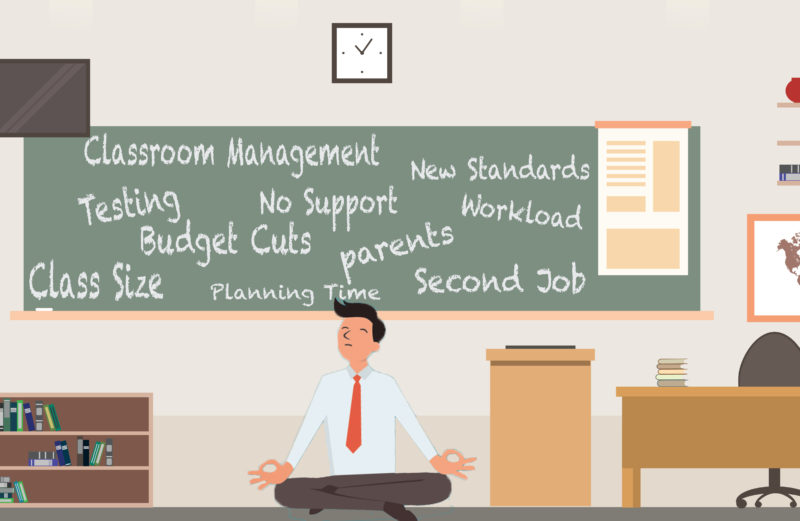
Even with all the positives associated with what I listed above, the truth of the matter is that much of it doesn’t matter when the realities educators face are not given the attention that they deserve.  Just because something sounds good on Twitter and during a keynote or looks good on Pinterest and Instagram does not mean whatever is being promoted will work. Context matters. Finances matter. Facilities matter. Staffing and community support matter.  I have been blessed to not only deliver keynotes and workshops but also to facilitate job-embedded coaching on a long-term basis. It is the latter component of my work where I see firsthand the challenges educators are facing regardless of zip code.  This work has provided me with a more empathetic lens and has allowed me to tailor and personalize the coaching process as well as the feedback that is delivered.  


Image credit: NEA Today

How I see things is still limited and can be influenced by bias. Now don’t get me wrong. I see some significant obstacles and challenges thanks to the long-term work I am engaged in. However, I wanted to move beyond me and focus on the people who are in the trenches on a day to day basis.  This led me to pose a question on Twitter, asking educators to share their particular challenges.  You can see the tweet below. 


Here is a summary of the majority of the responses:
  • Fear of failure and willingness to fail forward
  • Helping educators understand and integrate maker-centered learning
  • Helping teachers and leaders break down silos and understand it is not a competition but a concerted push to provide students with learning experiences they need.
  • Effective strategies to remind adults we are preparing kids for the future not the adults for the future
  • The mental health of students. We don’t have the support needed for emotionally or mentally challenged students that are in the regular education class.
  • Dedicating time to fortify universal instruction and systematic procedures while continuing to attend to the intensive needs of the high volume of kids in crisis & experiencing trauma.
  • Inspiring high school students to choose teaching as a profession.
  • Attracting the best and brightest to the field
  • Boys’ achievement and engagement. There is a considerable disparity at present in our school across all years.
  • Finding the balance between "meet students where they are" and "getting them where they need to go." Many educators are clear on the former, then handhold & scaffold low expectations. Others are better at the latter then lose a good % of their class by not differentiating enough.
  • Lack of alignment of educational institutes knowledge with the practical world. Educational institutions are preparing the future leaders, and due to lack of such coordination they fail to groom themselves as per new emerging trends and increase their absorption level in industry.
  • Work-life balance 
  • Implementing Innovative student-centered learning that improves outcomes 
  • Matching sustainable grading practices that reflect learning
  • Empowering teachers and maintaining alignment to mission, vision, curriculum, etc.
  • Feeling genuinely supported in taking risks and being innovative in the classroom.
  • Students not taking responsibility. Even taking responsibility for picking trash up that they dropped.
  • Inclusion and REAL collaborative teaching... integration of universally designed practices to help all students (which covers social justice, restorative practices, SEL) and somehow helping more teachers embrace that accommodations are not cheating.
  • Screen time for students
  • Making technology purposeful, not just tech for the sake of it
  • Students don’t hold the information anymore as they can get it anywhere. There is a need to teach them not only to access safely and critically but also to apply and construct new knowledge.
  • Motivating digital immigrant teachers and administrators to have a growth mindset to try new strategies and tools.
  • Using interactive whiteboards like projectors
  • Teacher-student ratio
  • Principals seem to be regretting their decision to go into leadership as they have too much on their plate and not enough time. More supports are needed.
  • There is always a new program being purchased. It's used for a few years and then discarded, leading to a high level of initiative fatigue.
  • Real evaluation and accountability
  • School overcrowding, support of libraries by districts, and limited access to libraries
  • Principals with control issues
  • Antiquated buildings, facilities, and resources
  • Ideas that don’t align to consider the realities educators have to deal with
  • Drive-by, one and done professional development that is not on-going, job-embedded, aligned to research, have evidence to back up the investment and lacks accountability for growth.
There are a lot of challenges listed.  What would you add to the list above? 

By putting these and others front and center, efforts can be made to develop practical solutions. Before any new change or mandate, considerations have to be made as to the feasibility (and sustainability) of the idea, strategy, or investment.  Case in point. If you are asking teachers to differentiate instruction on a daily basis, class size and resources matter. Or if you are committed to blended learning, then a combination of pedagogical change as well as updated spaces is needed. It behooves all of us to consider reality when ideas are presented, whether through social media, workshops, professional development days, in books, or during keynotes and presentations.  The struggle for many is real, and they need our support.

Sunday, March 31, 2019

Feedback Should Be a Dialogue, Not a Monologue

Feedback can bring people together in the pursuit of a shared goal. Criticism, on the other hand, can drive people apart. In many situations going with the former is the better course of action.  Below is a piece I pulled from an article titled Using Neuroscience to Make Feedback Work and Feel Better that explains why it matters so much:
Feedback isn’t just a ritual of the modern workplace. It’s the means by which organisms, across a variety of life-forms and time periods, have adapted to survive. To University of Sheffield cognitive scientist Tom Stafford, feedback is the essence of intelligence. “Thanks to feedback we can become more than simple programs with simple reflexes, and develop more complex responses to the environment,” he writes. “Feedback allows animals like us to follow a purpose.” It’s no coincidence the words organism and organization share a Latin root. Just as feedback enables the former to flourish, so it does for the latter.
The feedback process matters.


Nobody likes to be just talked at regardless of the age group of the person being spoken to.  Even though there are most certainly cases that necessitate this, context matters.  Lately, I have been thinking about how we give feedback to our learners, colleagues, and those who we supervise.  Maybe give is the wrong word to use here. The prevailing notion is that one person speaks while the other(s) listens intently and reflects on the advice given.  Herein lies one of the greatest misconceptions with an effective feedback loop.  In many cases, feedback is seen as something that is given to another person.  It becomes even more complicated when it is viewed as something that must be delivered. 

When there is a focus on delivery, we run the risk of focusing more on what is said as opposed to a process that fosters reflection and ultimately questions from the receiver.  Often, we settle on what the feedback is in terms of what people have done well, or not, through our own lens.  So much time is then given to mapping out what the feedback is that we want to share with the other person that it becomes more about us than the person or people we are trying to help.  When done this way it can be construed as criticism as opposed to a catalyst for growth. 

If the purpose is to help others grow, then a mentality of delivering the message or advice has to be rethought.  Feedback should be a dialogue, not a monologue. A conversational approach can lead to high value and actual changes to practice. Below are some specific reasons why the conversation is such an integral part of the feedback loop:

  • The receiver sees that it is more about him/her than the giver.
  • Imparts a greater sense of trust on behalf of the receiver resulting in a more powerful relationship with the giver.
  • Creates the space for open reflection based on what was shared.
  • Opens the door for discussion on action steps to be taken.
  • Provides the receiver with an opportunity to present his/her own perspective on the feedback given.  This can result in the sharing of evidence or more context that the giver might not have been aware of when initially providing the feedback.
  • A conversational approach can motivate people to seek out feedback. Research suggests that asking for it can help organizations tilt culture toward continuous improvement.

Delivering feedback in the form of a monologue is an outdated process that can be improved whether you are working with kids or adults.  Instead of preparing how you are going to “deliver” the message think about creating the conditions where the receiver will value the recommendations.  A conversation that incorporates the art of listening will go a long way to creating a culture where feedback is not only acted upon but asked for regularly. 

Sunday, July 24, 2016

The Power of You

Make no mistake about it; the job of any type of educator is tough these days. It is a rewarding profession in that we have the opportunity to make a positive difference each day, but for all our efforts, thanks and appreciation are tough to come by at times.  The fact that many countries don’t value the honorable work that is done in classrooms and schools is a tough pill to swallow. Throw in the endless array of mandates, directives, and time dedicated to the job and many would question whether it is even worth it to go into the field of education these days. 

Psychology does not work in our favor.  It is relatively easy to succumb to the negative. A great deal of research has found that negative perspective is more contagious than positive perspective. Thus, it is natural to get bogged down by pressures of the job that seem to keep mounting. Renee Jain provides a good summation of what we experience:


"The negativity bias is a tendency to have greater sensitivity to negative than to positive events. Some researchers posit that, psychologically speaking, negative events weigh close to three times more than positive events. While this bias may serve us in situations related to survival, it can cause distress in everyday encounters. So the question becomes: How can we topple this negativity bias?"

What makes the job of an educator even more difficult are the hard to reach students who are reluctant to learn. When this situation is thrown into the mix with any of the other challenges previously mentioned, the role of an educator could seem pointless. As Jackie Gerstein states, “All kids have worth. Some, though, want to prove to us that they have none. Our job as caring educators is to prove them wrong.” 


Image credit: Jackie Gerstein

With all the challenges you face each day know that your work and compassion is needed more than ever.  Watch this video below.  Put yourself in the role of the storeowner and the child as one of your students. 


The video above exemplifies how important educators are. Even when times are tough know that your work matters to those who we serve. Whether you realize it or not, the payoff of your dedication and commitment might not bear fruit for many years. Even in trying times take solace in knowing how you impact kids. It is in our nature to focus on the negatives, but you work too hard to allow yourself to fall victim to this psychological trap.

It is all about the power of YOU! You have the opportunity to positively impact the life of a child every day. If you care enough, change can and will happen. You are the difference maker. Reach for the sky and experience your potential. Reach for the stars and discover unlimited potential. You CAN usher in bold ideas for a new future. Believe in yourself and help your colleagues do the same. Never underestimate the profound impact you have on your students. Thank you for all that you do. Our future is bright because of YOU!

Sunday, October 11, 2015

Educators are the True Rockstars

"To recruit the brightest and best, teaching needs to be a high status occupation" - Lord Adonis

It is interesting how our culture works, especially here in the United States. We idolize those who entertain us such as actors, actresses, rockstars, and professional athletes to name a few. These people bring joy, and sometimes heartbreak, into our lives. With all the attention, time, and money that are put into our love for the entertainment sector, society needs to take a deep breath and reflect on our priorities. Should we be elevating these people to sometimes god-like status?

In my opinion and that of many others, there is no more important profession than that of education. It is the noblest of professions that quite frankly provides qualified candidates for virtually every job. Without educators would we have doctors, lawyers, engineers, politicians, electricians, mechanics, or anyone in the entertainment industry?  Yet for all that educators do to mold and inspire young minds to think and make a difference in this world, their profession is constantly dragged through the mud. Our priorities are so out of whack and if things don't change fast it will become even harder to attract the best and brightest to work with our children. Not for nothing, but our kids deserve the best.

So what if we treated educators like professional athletes? Let's take a minute and see how things could look if our priorities changed.


Even though the video above is based on comedy, imagine if we viewed educators in a different light putting them on par with other professions and greatly above that of the entertainment and sports industries?  We have a great deal to learn from other countries that value the role of educators above all else as noted by Peter Dolton:
"In recent years it's become a truism that attracting good quality and well-qualified people into teaching is accepted as the essential prerequisite to raising educational standards. In Finland and Singapore, teachers are recruited from the most-qualified graduates, all with a second degreeOne obvious way these countries have attracted the best and brightest into teaching is by paying them well."
The bottom line is that we won't improve the status of educators unless teaching and education in general is recognized as a worthy profession. It is time for society to shift it's priorities. In the short term let social media be your bullhorn to amplify the essential work you do for kids every day. 


Image credit: https://s-media-cache-ak0.pinimg.com/236x/90/b1/0f/90b10f61a19190504eb78a72b0b4235f.jpg


Sunday, November 30, 2014

Stop Ignoring Google+

In case you didn't know there are thousands of educators and an array of learning communities over at Google+.  The bottom line is that many people are missing out on some great content, resources, and conversation.  From my point of view educators become quickly attached to one specific social media tool as their go to source for his/her Personal Learning Network (PLN).  Take Twitter for example.  Now anyone who knows me knows that I absolutely love Twitter as a professional learning and networking tool. It has been and will continue to be my number one choice when it comes to learning in the foreseeable future. Twitter has many positive attributes, but also a growing number of negative aspects.  Some examples in my opinion, include an increasing amount of negativity and disrespect, rise in social media cliques, difficulty in following chats, noise, and overbearing opinions.  Even as Twitter still works great for me and others it is not the only player out there.  Nor should it be considered the best learning option for all. At times I just need to get away from the echo chamber to focus more on my learning.


Image Credit: http://blog.markerly.com/wp-content/uploads/2014/01/art-img-google-plus-20131102.jpg

Lately I have been spending more and more time over at Google+.  It amazes me that some people think that it is a dead community. This is obviously not that case or I would not be dedicating as much time as I have recently.  There are some similarities between the two social networks.  One great characteristic shared by both Twitter and Google+ are hash tags (#). The only difference being that popular hash tags in the Twitter world do not carry the same weight over in Google+.  Instead of favoriting a tweet you give it a G+.  The practice of retweeting is mirrored by a simple arrow at the bottom of the post that will allow you to share it across your network and beyond.  As a social network you can also share text, images, videos, and links, but in a much more dynamic way. This is one of the many ways that a Google+ experience differentiates itself from Twitter. Here are some other key differences that provide an enhanced learning and experience:
  • Circles - Unlike Twitter you can place all of the members of your PLN in different circles. With Twitter you send out a tweet and everyone who follows you, pulls up your page, or accesses the hash tag (if you use one) has an opportunity to see it. You can do the same thing on Google+, but you also have the ability to send your message to a specific circle, all of your circles, extended circles, or the entire Google+ world. With circles you can organize your PLN sort of the same way you would your websites using a social bookmarking tool.
  • No Character Limits - Twitter is a bit prohibitive with it's 140 character limit. This is the one feature I love the most about Twitter as it allows me and others to be brief. What if you want more? With Google+ there are no character limits so you can be as detailed as you want. This really adds to your ability to make a point, explain a strategy, discuss an issue, etc. It also keeps all those random rants from entering into your stream that Twitter is becoming notorious for.
  • Threaded Conversations - Twitter chats work for some, but they definitely do not work for all. Just the shear pace of a chat makes them difficult for many educators to follow. Personally I have found that when I try to engage and ask questions directed to specific people those questions go unanswered.  With Google+ each update becomes a threaded conversation that you can engage in at your own pace.  Comments also live in the update so you can go back and reference them at anytime. You can even share the thread across other social networks while accessing all of the resources, ideas, and knowledge that was discussed. I see this characteristic as bringing order to chaos.
  • Dynamic Updates - In addition to sharing text, links, videos, and photos with Google+ you can also create and share events and polls right from your status update box. 
  • A More Comprehensive ProfileYour Google+ account seamlessly links your YouTube account. If you use Picasa all of the pictures you upload will also go to your Google+ page. Another cool picture feature is that all pictures include in my Google Blogger posts are archived in the photo section of Google+.  The about section allows you to include much more detail than Twitter without character limits and and array of additional categories.
  • Hangouts - Many educators are aware of Google Hangouts (GHO's) that allow users to engage in free group video chat.  Hangouts on Air are even more dynamic video chats where you can schedule live broadcasts, host interactive conversations by taking audience questions in real time or in advance, use live apps to enhance the viewing experience, and immediately archive to YouTube when finished.
  • Communities - This is one of my favorite features of Google+. Anyone can join an existing community or create a new one. The difference between Twitter is that you can have rich conversations and share blog posts, resources, ideas/strategies, plan/publicize events, and have discussions aligned to specific categories. Evan Scherr and I have created a Digital Leadership Community. With the evolution of #digilead on Twitter our goal was to develop a space that brings together all the people, ideas, resources, and conversation related to digital leadership and learning. Evan and I hope that you will consider joining this community and sharing everything that you already do on Twitter. Not only is it free, but it gives you a chance to amplify your work and voice while engaging with like-minded educators at a deeper level. 
Google+ is a powerful and dynamic social media tool that many educators and leaders are not taking advantage of.  To begin simply start by setting up your circles, connect with other educators, share your content (i.e. blog posts) and lurk for a little bit. Search for and join a few communities as well. If you need any help please feel free to connect and engage with me on Google+.

So what is stopping you from using Google+? If you are using it consistently what added benefits would you highlight?

Thursday, September 4, 2014

The Ultimate Gift For an Educator

Contrary to the belief of some, educators work extremely hard for little financial incentive when you look at the amount of hours that are put into the job. Whether you are a teacher or administrator, your work has always been about the students first and foremost.  To a lesser extent, but important nonetheless, has been the desire to collaborate with colleagues to enhance learning environments and experiences for education's number one stakeholder - our students.  It all comes down to learning, no matter how you slice and dice it, both on the part of the students and educators themselves as professionals. This innate desire to improve methodologies, pedagogical techniques, environments, and professional practice are the defining characteristics of educators across the world who are making a difference in the lives of students. In our profession it is rare that we receive meaningful impact on our work until a moment in time pulls us in another direction, yet educators continue day in and day out to help all learners discover success.


Image credit: http://onlinebusiness.volusion.com/assets/guide-to-ecommerce-marketing.jpg

This is how I felt for basically all of my fourteen years as a public school educator.  As an administrator I always tried to help my students and staff experience success.  Did I always succeed? No way, but all my decisions were based on doing what was best for students and creating a school that worked better for them than for us as the adults.  I pushed my staff and myself to become better with mixed results at time. The motivation that kept me going was that I thought it was having a positive impact, but like I said earlier, meaningful feedback is tough to come by.  

This summer has been exceptionally difficult after I made my decision in July to leave New Milford HS. I had no idea how tough my last two days this week were going to be.  My professional family opened up like never before and humbled me with positive feedback. It made me feel very awkward, as my success has only come to fruition as a result of their willingness to embrace change and transform our school culture.  Bottom line is that my staff have and always will be the true catalysts for change at NMHS.  The end result has been a learning experience that our students not only deserved, but also expected. Then, just after I thought I had shed my last tear, I received the ultimate gift. I do not say this lightly.  This was the BEST gift a student has or could ever give me as an educator and it came, fittingly enough, through social media.  In the past I have blogged about how amazing Sarah Almeda is, but what she did touched my heart like nothing before. Her video is below.


What Sarah did literally brought me to my knees as I cried hysterically on the first day of my new job. I would never have known the impact that I had on her if it wasn't for her selfless act to create a meaningful tribute using her exceptional talents. There have also been tweets and emails from staff that reaffirmed my confidence in American education and my belief that we as educators have so much power to make a difference in the life of a child.  To educators across the globe, keep up the noble work you do for the sake of helping every child discover his/her passions.  You might not always get the feedback that you deserve, but I can assure you that your students will appreciate you in ways that you never thought were possible. That my friends is why we chose to become educators. Not for money, perks, or fame, but to positively impact kids because it is what we were meant to do.

ALL OF YOU ARE HAVING AN IMPACT!

Thursday, May 1, 2014

Childhood is Expendable to Some Education Reformers

The following piece is cross-posted at the Huffington Post.

When I reflect on my childhood nothing but fond memories come to mind. Growing up in a rural part of western New Jersey sure had its benefits in the 1980's. Upon returning home from White Township Consolidated School (K-8) my brothers and I would complete our assigned homework in well less than an hour, which was reasonable in my opinion. More often than not as soon as we finished we whisked out the door of our house to get outside regardless of the weather. The next couple of hours before and after dinner were then spent playing with friends outdoors, exploring, riding bikes, fishing, shooting hoops, or hiking. If by some chance the weather were really bad we would then play with toys, tinker with Legos, or challenge each other to the coolest games of our young generation on the Atari and later Nintendo. For good measure some time was also spent on the Commodore 64 and Apple IIe computers.


Image credit: http://www.laurieacouture.com/wp-content/uploads/2011/06/End-School-School-Destroys.jpg

The childhood years were some of the best of my life as they should have been. Three was enough time dedicated to learning during my elementary years, but also ample time for play, exploration, competition, and leisure. These experiences definitely helped mold me into the adult I have become today. School complimented my activities at home as education was structured in a way that focused on experiential learning, play, performance, and building self-esteem. I learned and acquired array of skills that prepared me not only for college and careers, but also life. I can't even begin to imagine what my life would have been then or become today if these experiences had been ripped from me. Unfortunately this has now become reality for our youngest students in 2014 and the near future in the name of education reform.

Education reform is destroying childhood as we know it at both home and school. As a parent of two elementary students (first and third grade) in Staten Island, NY, I witness daily the negative impacts that Common Core and standardized testing, under the guise of education reform, are having on them. They come home each day and spend hours on homework that makes little sense to them and absolutely no sense in some cases to us, especially in math. Their love for learning is squashed as more of an emphasis has been placed on instructional scripts aligned to the Common Core, test prep, and homework designed to make them relive the torture they just went through in school. I do not fault the school, principal, or teachers for the wretched environment that my kids are exposed to each day, but rather the reformers who are making them hate school with a passion. Shouldn't we be instilling a passion for learning in each and every child? 

Education reform will be the demise of our once great educational system if politicians and other stakeholders do not get a grip soon. A recent story from an elementary school in Long Island, NY should make the dire predicament we are in very clear. Just the title of the article alone painfully illustrates the monumental mistakes that are being made for the sake of "improving" education - Kindergarten show cancelled so kids can study to be 'college ready'. Here is an excerpt that should make every parent and educator's blood boil:
A Long Island school has canceled its traditional end-of-year kindergarten show -- saying the children can't afford to take time off from getting themselves "college and career'' ready. "The reason for eliminating the Kindergarten show is simple," reads a letter sent by the principal at Harley Avenue Primary School in Elwood, Suffolk County, to parents last week. "We are responsible for preparing children for college and career with valuable lifelong skills and know that we can best do that by having them become strong readers, writers, coworkers and problem solvers."
Are you kidding me? How can anyone with a good conscious do this to little kids? It is these experiences that make learning relevant, meaningful, and fun. The fact that schools feel they even need to prepare elementary students to be college and career ready is appalling in my opinion. This is not even the worst of it though. Other priceless elementary experiences that define the childhood years are being dramatically cut such as the arts and language programs, recess, and extracurricular activities. Developmentally young students need these experiences, but they become quite expendable as only Common Core aligned math and language arts associated activities will create a college and career ready student down the line. What is being done to them in essence is robbing them of some of the most important, life-defining moments of their long lives that will provide the foundation for future successes.

This post provides me with a stark reminder that current education reform has absolutely nothing to do with authentic learning, success, and student achievement. It has become a financial pipeline to line the coffers of anyone associated with Common Core, standardized testing conglomerates, and test prep. The pressure put on teachers to prepare young students for college and careers is utterly ridiculous and should be replaced with inspiring them to explore and discover their learning passions. After all, this is what our system was based on for years and success followed. As a society we cannot stand idly by while crucial foundational elements for learning such as play, creativity (driven by students), discovering one's identity, and the showcasing of non-tested skills are eradicated from elementary schools. If we do I fear that our education system will hit rock bottom in a few mere years and we will have no one to blame but ourselves for not acting.