Showing posts with label Ideas. Show all posts

Sunday, April 14, 2019

Tap Into Your Full Potential

"Your beliefs become your thoughts. Your thoughts become your words. Your words become your actions. Your actions become your habits. Your habits become your values. Your values become your destiny." - Mahatma Gandhi

There are many elements to change. However, one of the most powerful is that of self-efficacy.  Almost everyone can identify goals they want to accomplish, accomplishments to achieve, or personal and professional aspects they would like to change. Here is where self-efficacy comes in. It plays a significant role in how goals, tasks, and challenges are approached and ultimately achieved.  To improve one's self; we must first determine where our practice currently lies. The next step is deciding where we eventually want to be. Success in this endeavor requires self-efficacy combined with a leap of faith. 


For self-efficacy to play a role in the change process, we must always be open to growth and improvement.  Without these, there is nothing for us to hold ourselves accountable for.  This is why it is so important that we are our own most prominent critic and make reflection a daily part of our routine. No matter who you are and what you do, there is always the opportunity to get better. The question is, will you pursue it?  Enter the Potential Matrix created by Mark Sanborn. It is not about achieving perfection as that is not a reality in the professional world. Sorry to burst anyone’s bubble, but nobody is perfect.  It is about how we can become better to evolve into the best iteration of ourselves. Here is a great description from Thinking Space. 


As we look at the matrix, we probably identify one quadrant which we prefer: perhaps you’re naturally an activist, in which case, ‘performing’ is probably your favored way of operating. If you only ever concentrate on performing, you may not be taking the time to reflect and see how you could operate even more efficiently. If you spend all your time reflecting and planning but never take action to learn new skills and try them out, nothing will change. To see more improvement and to release more potential, we need to step outside of that comfortable quadrant and explore the other areas too. 
You will see that improvement happens not only outwardly as we learn new skills and perform but also inwardly as we think and reflect. It’s about active experiences which we initiate and passive experiences to which we respond.
Our potential is often inhibited by a fixed mindset or an unwillingness to grow.  We often perceive our talents and ideas as not being all that great. I know this is how I viewed these for a long time, which inhibited my growth as both a principal and then as a speaker/author.  However, looking at where we put the most and least amount of time in the quadrants of the Potential Matrix, we can begin to unleash potential that we never thought was possible.  It is ok to not have a clear idea on any given day as to where we want to be.  This is my daily reality.  The key is never to be satisfied where you are. 

If we want to help those we either serve or work with unlock their potential, then we must do so ourselves first. Think about where you are and then where you eventually want to be.  Apply the same lens to your classroom, school, organization, or district. Then take the leap of faith; trusting in your innate abilities to improve in ways you never thought were possible.  Will everything always work out the way you want it to? Heck no! Just remember that each journey, no matter the result, provides an invaluable learning experience. 

There is no better time than now to tap into your full potential. 

Sunday, May 21, 2017

Rise of the Edupreneur

Entrepreneurs love what they do. They do what they love, are dreamers, but they also are doers and go-getters. Entrepreneurship may be missing from your resume, but shifting your perspective will change this as you experience the rush and benefits of an entrepreneurial mindset.  This exciting new trend is taking root through disruptive innovation in the workplace. The characteristics of entrepreneurial thinking go well beyond just that of innovation. Individuals and organizations that embrace this mindset shift develop dynamic behaviors that impact their organizational culture while leading to school improvement. Below are some key elements commonly associated with an entrepreneurial mindset:

  • Initiative
  • Risk-taking
  • Creativity
  • Flexibility
  • Critical thinking
  • Problem Solving
  • Resilience
  • Innovation

The elements above can be directly applied to your role as an educator.  In BrandED, Trish Rubin and I discuss the rise of the edupreneur and how this thinking can be a catalyst for transformative change. It’s time to not just think, but also act as an edupreneur to usher in needed change. This edupreneurial persona, one based on openness, can creatively cultivate new relational value and garner trust among members of your community. See what’s worked for successful entrepreneurs who’ve met their own goals, and find a fit for your continuing professional development. While embracing the listed elements above, think about the following strategies that Trish and I believe lead to edupreneurial leadership.


Image credit: www.psdgraphics.com/

Surround yourself with inspiring people

Relationships matter to edupreneurs. Do this in real time through face-to-face associations and with your closest validators. Use the wealth of TED Talks, webinars, and YouTube content online to get inspired. Follow the hot topics in leadership, communication, and relationship building. Start to follow them online. Connect to Mention and Google Alerts to get tailored feeds and information about those key areas you need in order to increase your own edupreneurship.

Get feedback every day

Talk to people about branding and the innovative climate for school reform. Share how applying a few powerful select business strategies is empowering your school leadership. Test the waters on social media with thoughts, quotes, and content that match the topics you are advancing. See the results from your peers near and far.

Ask questions 

Don’t be afraid to ask questions about the new direction you are setting as a leader. Get feedback. Be curious and search for answers. Leverage social media or go with face-to face conversations. Just ask!

Find happiness

Entrepreneurs work out of a passion. So do edupreneurs. There is joy in innovating, challenging the status quo, marching to the beat of a different drummer, and experiencing success through non-traditional means.

Embrace brandED

Work to present yourself with a unique brand value (UBV), which is a key to edupreneurship. Celebrate every benchmark for your school. Talking about big and small tangible accomplishments is part of communicating value. It’s the small moments that create big accomplishments, the proven results and gains with the community that can complement test score reports and expand the idea of value. Join the brandED conversation to unleash the edupreneurial drive to transform education. 

Be a continuous and curious learner 

This is a no-brainer for educators. Continue your study in the manner of a trend spotter. Look out—online, in apps, or through print resources—for the latest trends and research in leadership, pedagogy, initiating school change, technology integration, and whatever other topics inspire you. Search outside your own educational backyard to learn from other disciplines. The digital world allows us to see thousands of bits of information that can be woven into new creative thinking for growing our edupreneurial thinking and leadership.

Work to expand your network

Grow your relationships upward for your community with “reach targets,” the great people you aspire to meet with whom you can share the school brand and engage for support. Grow relationships downward with those good people that complement your network. Build relationships with service providers who help students. Talk to bus drivers, crossing guards, security staff—anyone who provides support to the community—about your vision, goals, and outcomes. Finally, network horizontally with your peers and other leaders in real-time associations, and online through hangouts and chats. Invite them to share their thinking and content about education brand. Promote relationships so that deeper connections can form, leading to cobranding exchange between yourself and other leaders.

Become a writer 

Take the time to write about your efforts in becoming an edupreneurial thinker and doer. Making visible the thoughts and reflections that are part of the journey can be the first-draft thinking that starts you on the way to sharing your personal professional brand.

Be persistent 

Entrepreneurs have the will to carry on; with that same spirit, edupreneurs don’t give up. We demonstrate our persistence on a community-wide stage. Belief is an essential part of brand development. Be the chief believer in your school brand by becoming the storyteller-in-chief.

Exhibit patience 

Entrepreneurs who are successful have a tendency to wait. Some entrepreneurs are actually procrastinators of the highest degree. Edupreneurs move at a pace that can ensure their success. Don’t rush the process. Focus on the work of your students, staff, and district. In time, the results of your improvement strategy will come to fruition.

The time has come to not only embrace new ideas and ways of thinking, but also the way in which we employ these assets to usher in meaningful change. 

Content from the following post was adapted from BrandED: Tell Your Story, Build Relationships, and Empower Learning.  Get your copy today!

Sunday, February 5, 2017

Ideas That Power Lasting Change

Ideas are a dime a dozen. Everyone has them. Some are good and extremely creative while others are not realistic or applicable to a certain situation.  As social media continues to evolve, there now seems to be an endless sea of ideas as to how education should change and what educators should do to improve professional practice. I will go as far to say that just having an idea is not good enough. It doesn’t take much effort to develop a sound bite that sounds great in theory, but if it is challenging to implement in practice, especially at scale, then we need to reconsider the relevancy of that idea.  

We all struggle with a tug-of-war of sorts when it comes to ideas.  In many situations we are asked to either implement or embrace the ideas of others, particularly those who we are accountable to or so-called experts in the field. This can be problematic at times if the groundwork explaining the what, why, when, and how has not been clearly articulated.  Then there are those that we develop on our own.  Throughout my career and even up to this point, ideas are constantly flowing through my mind.  There tends to be a bias towards the ones that we come up with, which throws another wrench into the process of moving an idea into actionable change.  

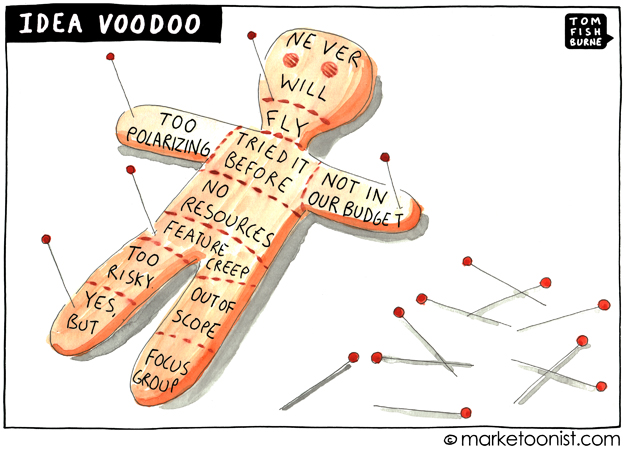
Being open to new ideas is extremely important in these disruptive times.  If we continue to employ the same type of thinking, then the chances are we will probably have to settle for the same old results…. or worse.  Great ideas are the seeds of change. Many of them don’t have the opportunity to germinate because of our fixed mindsets. For the most part nobody likes change. This is just how our brains are wired, unfortunately for many of us. I can tell you that this was the case for me early in my administrative career.  It is important not to fall victim to idea voodoo.


Don’t let idea voodoo cloud your vision as to what is possible.  Embracing a growth mindset can put you in a better position to lead change in your classroom, school, district, or organization.  This is only half the battle though. Don’t assume that just because you are open to new ideas that everyone else is.  This is where the hard, and at times frustrating, work comes in. The real challenge of change is getting the resistance to embrace and implement your idea(s). So what makes a great idea that others will embrace and take some calculated risk to implement? Great ideas are:

Innovative
Doable
Energizing
Aligned
Sustainable

Innovative: here are so many words associated with innovation.  Some popular ones include new, change, transformation, improvement, better, and success. Innovation to me, in an educational context, is creating, implementing, and sustaining transformative ideas that instill awe to improve learning. Fresh Ideas are needed that take into account dramatic changes in society, technology, and learner needs.  New is not necessarily better. That is why innovative ideas must focus on improving existing culture.

Doable: This goes without saying.  Great ideas consider financial resources, time, and mandates. Doable ideas can be associated with lofty goals, but a meticulous effort on articulating the what, why, when, and how must occur to overcome fixed mindsets and an entrenched status quo. 

Energizing: If an idea doesn’t inspire or motivate someone to embrace different and better then it might just be a crumby idea. Great ideas should be energizing and create a buzz. When people believe that a change will lead to improved outcomes embracement is more likely. Initially this might not be the case. Coming up with great ideas is a start, but the differentiator is how the idea is rolled out. Energizing ideas bring an increased joy to learning and professional practice. They are also presented in ways that motivate and inspire.

Aligned: Great ideas should complement and then enhance what is already in place. This includes curriculum, standards, mandated assessments, and other elements associated with school/district culture.  They should also be aligned to research, evidence, and professional development. Take a critical lens to all ideas to ensure efficacy. 

Sustainable: If an idea fizzles out then it probably didn’t meet any or all criteria listed above. Great ideas lead to changes that become embedded into school culture and professional practice. They withstand the test of time and thus become the new normal way of doing business. 

Just because an idea sounds good doesn’t mean that it will lead to an improvement. It is time to weed out the bad and so-so ideas while striving to make good ideas great. 

Sunday, July 24, 2016

The Power of You

Make no mistake about it; the job of any type of educator is tough these days. It is a rewarding profession in that we have the opportunity to make a positive difference each day, but for all our efforts, thanks and appreciation are tough to come by at times.  The fact that many countries don’t value the honorable work that is done in classrooms and schools is a tough pill to swallow. Throw in the endless array of mandates, directives, and time dedicated to the job and many would question whether it is even worth it to go into the field of education these days. 

Psychology does not work in our favor.  It is relatively easy to succumb to the negative. A great deal of research has found that negative perspective is more contagious than positive perspective. Thus, it is natural to get bogged down by pressures of the job that seem to keep mounting. Renee Jain provides a good summation of what we experience:


"The negativity bias is a tendency to have greater sensitivity to negative than to positive events. Some researchers posit that, psychologically speaking, negative events weigh close to three times more than positive events. While this bias may serve us in situations related to survival, it can cause distress in everyday encounters. So the question becomes: How can we topple this negativity bias?"

What makes the job of an educator even more difficult are the hard to reach students who are reluctant to learn. When this situation is thrown into the mix with any of the other challenges previously mentioned, the role of an educator could seem pointless. As Jackie Gerstein states, “All kids have worth. Some, though, want to prove to us that they have none. Our job as caring educators is to prove them wrong.” 


Image credit: Jackie Gerstein

With all the challenges you face each day know that your work and compassion is needed more than ever.  Watch this video below.  Put yourself in the role of the storeowner and the child as one of your students. 


The video above exemplifies how important educators are. Even when times are tough know that your work matters to those who we serve. Whether you realize it or not, the payoff of your dedication and commitment might not bear fruit for many years. Even in trying times take solace in knowing how you impact kids. It is in our nature to focus on the negatives, but you work too hard to allow yourself to fall victim to this psychological trap.

It is all about the power of YOU! You have the opportunity to positively impact the life of a child every day. If you care enough, change can and will happen. You are the difference maker. Reach for the sky and experience your potential. Reach for the stars and discover unlimited potential. You CAN usher in bold ideas for a new future. Believe in yourself and help your colleagues do the same. Never underestimate the profound impact you have on your students. Thank you for all that you do. Our future is bright because of YOU!

Thursday, June 10, 2010

Tips For Establishing Meaningful Partnerships

This past Tuesday I attended our Annual Senior Academic Awards dinner.  It was a great event where New Milford High School students received over $65,000 in local scholarships.  For three hours student after student came up to the podium to receive various scholarships that they had worked so hard for over the course of four years.  One particular presentation provided the motivation for this post.  It was at a point in the evening where the Raymond "Hap" Harrison scholarship was presented.  In short, this scholarship is endowed by Adam Leitman Bailey, an NMHS alumnus (Class of 1988), who was the school's second Distinguished Alumni Award winner in 2008.  The recipient of this annual scholarship receives $10,000 the first year of college, which is then renewable for the remaining years with a G.P.A. of 3.5 or higher. 
Obviously, this is a prestigious scholarship, but there is much more behind this.  Ever since Adam won the distinguished alumni award he and I have formed a partnership to benefit the students of NMHS in many ways besides financially.  We quickly realized that we share a determination and commitment to enhancing and improving educational experiences for NMHS students.  Through extensive communications and face to face meetings we have developed an ever-evolving vision that has led to some significant opportunities that include:

1. Field trips: History students have participated in walking tours of lower Manhattan the last two years where Adam has shared his extensive knowledge on the history of the financial district.  The trip always culminates with a working lunch for all of the students (his treat).
2. Summer internships at his prestigious firm.
3. Mock trials on the campus of NMHS.
4. Participation in our Career Day Program.
5. Facilitation of all Ray "Hap" Harrision scholarship winners into high profile internships at institutions such as Columbia University Medical Center.

This is just one example of a successful partnership that has greatly benefited my students.  Some other successful partnerships that have been established at NMHS include the following (it should be noted that there is no cost to the school, staff, or students):

* Madison Institute: Professional Development
* CBS News: Public relations/Press (5 news stories this year)
* Stevens Institute of Technology: NSF GK-12 Program (S.T.E.M.)
* AverAcademy Showcase School (AverMedia): Technology (document cameras, digital pens) and
   professional development
* Wine & Roses: Worked with our Business Practice Firm class and assisted them with their virtual
   floral business (Wizard of Vase Florists)
* My PLN!!!!!

There are no set guidelines for educators on how to establish successful, sustaining partnerships.  In my opinion schools must place more of an emphasis on this endeavor.  Administrators in particular must be willing to excerpt a great deal of time to seek out and foster these relationships that are mutually beneficial to all parties.  I have found that the successful establishment of the various partnerships is also dependent on the following:

- Flexibility and an open mind
- Effective communication
- Establishment and consensus on a shared vision
- Commitment and follow-through on both ends
- Sharing of student benefits with all stakeholders
- Patience
- Empower and support teachers in establishing their own partnerships
- Reach out to alumni and local businesses
- Leverage social media to connect with potential partners

The formation of partnerships is yet another way to provide meaningful learning experiences to students where the benefits can extend well beyond the instructional day.  I would love to hear about specific partnerships that you have established and the impact they have had or are having on your students.  Any additions to my list of tips would be greatly appreciated as well.

Sunday, May 23, 2010

Google Sites Rock!

The development and maintenance of a website used to be an expensive and complicated task that was not really embraced by many teachers.  The financial constraints alone posed a huge discouraging factor.  Creating a class website or page is now easier than ever.  Teachers now have the ability or organize and routinely update content, assignments, videos, and presentations for students in an easily accessible format for free using Google Sites.

Mr. Keith Devereaux, a science teacher, at New Milford High School, has been using Google sites over the course of the year to establish an information portal to the classes he teaches and as a way to develop engaging learning activities on particular topics.  You can view his main site here and one on electricity/magnetism here.  His AP Biology students are currently creating a Google site on the systems of the human body.    Certain coaches have also begun to create Google sites for their teams.  Mr. Greg Kelly, NMHS Physical Education teacher and track coach, created a Google site for the track and field program.  Here are some quick reasons why I feel teachers, coaches, and club advisors should have a Google site:

1.  Information hub (core curriculum standards, access to digital textbooks, notes, syllabus, proficiencies, etc.)
2.  Access to content 24/7.  Students that are absent can quickly and easily acquire missed assignments without having to ask the teacher upon their return.   This is also great for students that might have missed something during class, want to work on reinforcing the material at home or when away, and to prepare for tests/quizzes.
3.  Calendar of events (assignment due dates, meetings, practice/game schedules).
4.  Links to printable forms, assignments, etc.  Google forms can be embedded onto the sites as a self-grading quiz.  Polls and questionnaires can also be included to collect useful information.   View a quiz that Mr. Devereaux created using Google forms to go along with the Electricity and Magnetism Google site mentioned above here.
5.  Links to supplemental resources.
6.  Promote student achievements and accomplishments.

Google sites are also a great resource to use when delivering professional development.  Keith and I used a Google site during a March presentation on authentic-based learning environments and web 2.0.  Multiple Google tools and activities were inserted into the site, which was accessible to the participants before, during, and after the presentation.  The recent Google Teachers Academy for Administrators also used a Google site for the one day training. 

I think I have done a pretty good job outlining reasons why I think Google sites rock!  Please share any additional ideas you have in the comments section. For more Google app resources visit my Delicious page.

Monday, May 17, 2010

Students Are the Best Tech Advocates

Scholastic recently visited New Milford High School in order to see how we were using and integrating educational technology.  I could not be more proud of how my students represented NMHS and clearly articulated numerous examples of technologies that they have used over the course of the year.

Monday, April 19, 2010

Google Docs & Apps: Putting the Pedagogical Pieces Together

As part of my action plan associated with becoming a Google Certified Teacher, I decided to focus on training other educators about integrating these powerful web 2.0 applications into their instruction. Outside of my role as Principal of New Milford High School, I am the Director of Program Development for Project ABLE International. This is an organization committed to assisting teachers develop authentic-based learning environments in order to provide students with essential 21st Century problem-solving and critical thinking skills. Currently teachers from four different school districts in northern NJ are part of the Project ABLE consortium and have been receiving intense, hands-on training during the course of the 2009-2010 school year. This training has focused on the philosophy, development, and implementation of authentic-based learning activities that are meaningful and relevant to the learner.

As a culminating activity after months of training we decided to illustrate how easily Google Docs and Apps could be integrated into ABLE's in order to foster collaboration and interactivity between the participants. I worked on and develivered the presentation with Keith Devereaux, a science teacher at NMHS who has embraced the use of Google Docs and Apps in my school. We also included Dr. Brian Chinni, Founder and CEO of the Madison Institute that developed Project ABLE. In our development of the presentation we worked collaboratively over the course of a few weeks using the very tools that we would be providing training on. While Keith and I had some face to face contact time, all of Brian's pieces were submitted using Google Docs and Sites. The final result was the creation of a Google Site that included a simple agenda, presentation, and an authentic jigsaw activity where the participants have to create a informative presentation to their home districts using Google Doc and Apps.

Overall we were very satisfied by our presentation and feel that we met all of the objectives that we set. After reflecting we discovered many ways in which to improve the delivery of the conent and have already begun to make adjustments that will make the presentation even more powerful. One thing is certain, all of the educators present experienced the limitless potential that comes with these tools once they investigated each piece and then put them all together. Please take time to visit the Google Site (Project ABLE and Docs) we created and provide us with some feedback!