Showing posts with label Technology Integration. Show all posts

Sunday, February 12, 2017

Is Technology Being Integrated Effectively?

In many cases, there seems to be a tendency to water down expectations when it comes to integrating technology.  During a recent presentation on digital pedagogy for deeper learning I asked attendees to discuss then share out on TodaysMeet how they were effectively integrating technology in their classroom, school, or district.  There was an emphasis on describing in detail what effective use of technology meant to them.  As the results poured in there were a few consistent responses that stood out. Most attendees flat out stated that they or their schools/districts were not effectively integrating technology. Others confessed that they weren’t sure what effective use constituted.  Many of the remaining responses centered on just a listing of tools that were being used as a measure of effectiveness. 

The question about effective use provides a great opportunity for all of us to critically reflect upon the current role technology plays in education.  There is a great deal of potential in the numerous tools now available to support or enhance learning, but we must be mindful of how they are being used. Take Kahoot for example. This tool is used in so many classrooms across the world to get students more engaged and add a level of fun and excitement to the learning process. However, most of the time the questions that students are asked to answer in a Kahoot are focused on the lowest cognitive domains and mostly multiple choice.  I have nothing against Kahoot and think it is a great tool that has a great deal of promise. My issue is how this tool, and many others, are utilized in the classroom. 

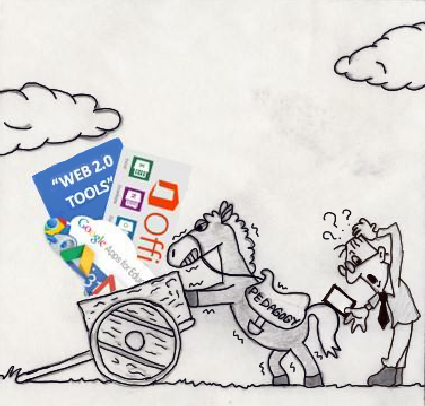
The burden of responsibility here lies with both teachers and administrators. In many cases, the engagement factor is emphasized over learning outcomes and actual evidence of improvement aligned to standards. I get that this is not the be-all and end-all, but nevertheless, it is important. It goes without saying that effective technology integration should inform instruction and provide feedback as to the level of conceptual mastery students demonstrate. Then there is the unfortunate practice of putting the cart before the horse where acquiring technology and getting it into classrooms takes precedence over improving instructional design.  In either case, for technology to ever live up to the lofty, and at times baseless, expectations that have been established we must take a more critical look at pedagogy. 

For many educators SAMR is the preferred model often associated with technology integration. It’s a catchy model and does have some value mostly in the form of what we shouldn’t be doing (substitution). Take a close look at the tech-centric language used in each category and ask yourself what does the SAMR model really tell you about the level of student learning? This is why I love the Rigor Relevance Framework as a means to ensure that technology is integrated effectively.  It provides a common language, constitutes the lens through which to examine all aspects of a learning culture (curriculum, instruction, assessment), and helps to create a culture around a common vision. 

Technology should be integrated in a way that increases engagement through relevance. As students are utilizing technology are they just applying it in one discipline? I am not saying this is a bad thing, but we must eventually move beyond this typical comfort zone when it comes to tool use. When integrating technology does the task allow students:
  • to make connections across various disciplines and content areas?
  • to solve real-world predictable problems?
  • to solve real-world unpredictable problems?
The other aspect of this framework is the most important.  Are students working, thinking, or both? Successful technology integration is totally dependent on the level of questioning that is asked of our students.  This is why I always say that pedagogy trumps technology.  Think about the formative and summative assessments you either use or see in your respective role. Are students demonstrating high levels of cognitive thought? How do you know whether students have learned or not when integrating technology? What does the feedback loop look like? These are extremely important questions to ask as a teacher or administrator to determine the level of effectiveness. Check out this example to see how all the pieces (rigor, relevance, tech, assessment) come together to create a powerful learning experience).


The overall goal when integrating technology should be to provide opportunities for students to work and think. Another key strategy for successful integration is to use technology when appropriate. Technology will not improve every lesson or project, thus a focus on pedagogy first, technology second if appropriate with help ensure success. Many aspects of the Rigor Relevance Framework can be used to guide you in developing better questions as part of good pedagogy including:
  • anticipatory set/do-now
  • review of prior learning
  • checking for understanding (formative and summative)
  • closure
The most important aspects of pedagogy are assessment and feedback.  If technology (and innovation in general) is going to have a positive impact on learning, let’s ensure these areas are improved first. Then going forward always lend a critical eye to how technology is being used to address standards and inform instruction.

Sunday, June 19, 2016

Finding the Right Tools

For technology to have an effective impact on student learning a solid pedagogical foundation needs to be in place. In my mind, pedagogy trumps technology and the importance of instructional design cannot be overstated. With this foundation in place the possibilities to empower students to take ownership over their learning and demonstrate conceptual mastery are limitless. Even if you are not a fan of technology it is hard to ignore the many benefits. As Donald Norman stated, “I'm not a fan of technology. I'm a fan of pedagogy, of understanding how people learn and the most effective learning methods. But technology enables some exciting changes.”  


Image credit: https://elearningindustry.com

Whether you are a technology fan or not, the key to success lies in our ability to integrate technology to support or enhance learning while providing students with skills that will prepare them for their future.  This can be a seamless process like reviewing prior learning, checking for understanding, closure, or formative assessment.  It can also be more elaborate where students select the right tool for the right task to construct new knowledge or authentically apply what they have learned. Either way technology provides an improved method to do both.

Once there is a clear vision and plan for integrating technology in the classroom, the next challenge for many educators and students alike is finding appropriate tools the align to the content, age group of the students, platform, standards, and budget. The good news here is that there are many go-to resources right at your fingertips to either help you in your classroom or to make recommendations to teachers if you are an administrator. Here are my three favorites:
  1. Edshelf – The motto here is simple, yet powerful. Find the right educational tools for your needs. Edshelf represents a socially curated discovery engine of websites, mobile apps, desktop programs, and electronic products for teaching and learning. Click on search for the perfect tool and begin to narrow down your search by price, platform, subject, age, and category.
  2. Graphite by Common Sense Media – A free platform that saves you time by making it easy to discover the best apps, games, and websites for the classroom. It contains thousands of edtech tool reviews and also allows you to browse by subject and standard. There is also an option to search teacher-created lesson plans.
  3. Tech Tools by Subject and Skills – A fantastic resource created by EdTechTeacher that has curated resources by academic subject, topics, and learning activity. It is pretty straight forward and to the point, which is something that I think all can appreciate. 
Just knowing about all the latest tools and apps doesn't cut it. Technology will not transform education. Educators and students who utilize technology effectively will.  Focus on the why and then the how with the right tool for the right task. 

Sunday, July 19, 2015

Be Wary of Putting the Cart Before the Horse

"Unless you get instructional design right, technology can only increase the speed and certainty of failure" - William Horton

As budgets expand or money becomes available at the end of a school year, the knee jerk reaction of many schools is to go all in and spend it as quickly as possible.  With advances in affordable technology, such as the ultra-cheap Chromebook, it has been tough for schools to resist spending these funds on devices.  Now don't get me wrong, I am all for schools increasing student and staff access to quality technology. However, the cart before the horse scenario has played out in so many schools across the globe. The end result has been a massive influx in tools, but a clear lack of vision and planning as to how these powerful tools can, and will, actually impact learning. In some cases, the technology resides unused in classrooms and schools due to the cart before the horse approach. There is nothing transformational about this.


Image credit: Eric Patnoudes

There are many technology frameworks out there for schools to refer to such as SAMR, TPACK, and the TIM. The SAMR Model has provided us with a good lens to observe firsthand the need for proper planning prior to investing large amounts of money on technology.  This by no means is a perfect framework to guide the effective implementation of technology initiatives, but it does give us a good idea of what should not be taking place.  I have visited one too many schools where I have seen time and time again devices being used in ways that serve as a direct substitute for the same ineffective practices that we are trying to move away from. Technology in itself will never transform teaching and learning. Students, teachers, and leaders who effectively integrate technology with purpose aligned to learning and leadership outcomes will.

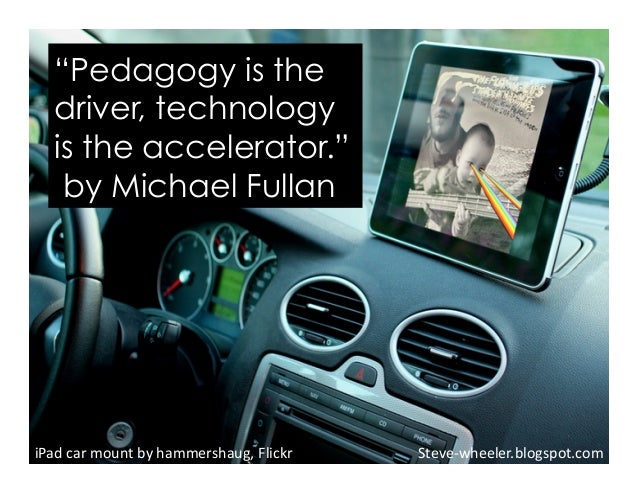
The quote at the beginning of this post from William Horton provides an important reminder of the critical need for teachers to be supported in proper instructional design prior to any massive technology roll out. We found great success at my school during our digital conversion by focusing on a pedagogy first, technology second if appropriate mindset.  Not only was there a focus on solid instruction, but we also provided numerous supports for our teachers in the form of ongoing and job-embedded professional learning opportunities. If the expectation was to integrate technology with purpose to support and/or enhance learning we made sure everyone was prepared to do just that. As Michael Fullan has stated, pedagogy is the driver and technology the accelerator. 


Image credit: Shelly Terrell

It is not just teachers that need work on instructional design when it comes to effectively integrating technology. The same goes for school leaders who also deserve support in the form of professional learning so that they can properly observe and provide valuable feedback to teachers when technology is being integrated into lessons. Ultimately it is a leader’s overall responsibility to make sure technology purposes are having an impact on learning. Thus it is wise to put them in a better position to do just that.

The critical need for learning doesn't stop with teachers and leaders. It also extends to students and parents. As learning changes with successful technology integration and students begin to have more access to technology, a golden opportunity arises to not only address critical digital literacies, but also responsibility. When rolling out either Bring Your Own Device (BYOD) or 1:1 initiative create programs to prepare students for the purposeful use of technology to support their learning. In the end, this will mitigate many issues before they arise. At my school, I met with all the students in large-scale assemblies to educate and reinforce the role of mobile learning devices at the beginning of the school year. Having parent programs in place is also vital to the success of any major technology initiative. With large scale purchases, they will want to know the impact on learning and others will need guidance on the how teaching and learning are now changing.

The importance of getting instructional design right cannot be stressed enough. Don't fall victim to the cart before the horse scenario. If you or your school has the ability and funds to purchase technology, don't rush to get it into the hands of staff and students. Take the time to develop a shared vision and plan for integration that aligns with sound pedagogy, using a tool such as the Rigor Relevance Framework, which is much more robust than the other options mentioned earlier in this post. Reflect on instructional design within the context of student agency and higher-order thinking skills first. Provide professional learning opportunities before, during, and consistently after the roll out.  After a focus on instructional design, work with students and parents to build broader support. In the end, this will help to not only make the implementation process easier but also to have your technology initiatives primed to get results.


Wednesday, July 27, 2011

Turning the Tide

Over the past two years I have seen some dramatic shifts in an effort to transform New Milford High School into a 21st Century institution of teaching and learning.  With a change in mindset and a great deal of support, I have been able to successfully empower my staff to integrate a variety of digital tools, including social media, to engage learners.  The other day USA Today writer Greg Toppo highlighted some of the advances we have made in his article entitled "Social Media Find Place in Classroom."  I'm not going to lie, I was a very proud principal reading this article as it clearly showed me how far we have come in terms of creating a vision for learning and communicating that is more in line with societal shifts.  This vision has now become our reality.
 Photo credit: blogs.oxfam.org
The problem though is that a large majority of stakeholders throughout the world think that the integration of technology is not essential in the classroom.  Furthermore, the perception out there is that educators and schools who are utilizing 21st Century tools for teaching and learning are doing a disservice to learners.  Here are some of the specific comments from the USA Today article:
  • It is a shame they don't worry more about the kids not knowing how to read or write. Most of the high school grads don't even know their time table.
  • Stupid educators teaching stupid kids, sad.
  • More evidence of the "dumbing-down" of society. Stupid media like USA To-shmay buying into it, of course. Put the cell phones and calculators aways, stay off the waste-o-time websites and GET TO LEARNIN'!
  • Okay, now I have heard it all. Digitally literate is not the same as having literacy skills that are useful for employment or in our greater society. This just encourages illiteracy in the skills that are most important to make these kids productive members of society.
  • Lowering the bar yet again. I would say that they'll pay for it in the long run, however, I'm finding that the employers are dumbing things for the dumber workforce they are getting. And the sad thing is, they'll never know or care what they are ignorant of.
  • Nothing like a digital kid showing up for a hands-on job.  Makes for great humor.

Unfortunately the comments above represent the never-ending battle that passionate educators face across the world who understand the pedagogical significance of effective technology integration.  I know I am preaching to the choir, but it really angers me that people who have no background in education, have never stepped foot in a school on a regular basis, and are so disconnected from the real world, can make assumptions that ultimately inhibit change.  In terms of the context of the USA Today article, social media is NOT replacing anything.  At NMHS we place an emphasis on sound pedagogy, and only after this is ensured technology is integrated.  All one has to do is read THIS POST to see all that NMHS is doing with and without technology in order to provide our students with a quality education.

It is time to turn the tide!  Technology is a tool, just like a blackboard, pencil, paper, or transparency, utilized during the teaching and learning process.  The difference though is that it is a dynamic tool that allows students to communicate, connect, collaborate, and create like never before. It allows teachers to measure and schools to promote.  Schools will become irrelevant unless they evolve and stay in line with societal shifts.  To do so, we must open our eyes and better understand today’s learners.  I am proud to say that my school, and many others, are up to this challenge and will continue to ignore the naysayers.  If you need even more rationale for effective technology integration in schools read this post by Scott McLeod.  George Couros does and exceptional job highlighting some concrete examples of successful technology integration in his post entitled "Tell More Stories."

I hope to expand this post and submit a piece to the Huffington Post.  Please consider providing a counter-argument to the statements above in the comment section.  Let’s collectively send a powerful message about the important role technology and social media play in preparing all students with a blueprint for success.

Sunday, April 3, 2011

Spicing Up Spanish

This past week as I was collecting information for my monthly Principal's Report I was happy to learn about how technology was being integrated into some Spanish classes.  For example, students in Ms. Schwarz’s Spanish 1 class had to write a dialogue based on the following situation.  “This is your first day of school and you are introducing yourself to a bunch of classmates.  You are in a Chemistry class and your teacher gives you ten minutes to get to know the person that sits next to you.” The students had to compose a dialogue using an outline that was provided after which they followed directions to create an avatar using Voki.  Voki is a service that allows students to create personalized speaking avatars.  Students created their avatar by customizing each of the options below:
  • Create a character from one of the different styles.
  • Customize the avatar by changing the look, clothing, and accessories.
  • Add your own voice via phone, microphone, text to speech, or upload a file.
  • Choose a background from website library.
  • Click on publish and e-mail it to me.

Ms. Schwarz’s Spanish 3 students created a comic strip that illustrated their daily routine. Students used Make Beliefs Comix, which is a website that enables students to create unique comic strips.  Students can use this tool to make their own characters and customize their looks and mood. They also have the capability to write words and thoughts for their characters. Students were truly engaged and enjoyed incorporating technology in the learning process.
I am extremely proud of the work Ms. Schwarz is doing to spice up her Spanish classes.  Even more exciting is the fact that she discovered these web-based tools on her own and took the initiative to develop authentic-based lessons that engaged her students.  

Monday, May 17, 2010

Students Are the Best Tech Advocates

Scholastic recently visited New Milford High School in order to see how we were using and integrating educational technology.  I could not be more proud of how my students represented NMHS and clearly articulated numerous examples of technologies that they have used over the course of the year.