Showing posts with label New Milford High School. Show all posts

Sunday, April 7, 2019

5 Ways to Create Relevant Cultures of Learning

Education can seem like a balancing act between what we as adults feel is essential and what interests our learners.  The struggle is real as the former is sometimes emphasized as a result of a school or district’s focus.  Make no mistake about it – capturing the attention of students has become harder and harder because of the access that many of them have to knowledge, games, and each other through technology.  As difficult as it might be, schools must rise to the occasion. To authentically engage kids today, a central purpose has to be instilled through a combination of a relevant context and application. Without it, learning many concepts as well as the bigger picture doesn’t make sense to students.  The benefits speak for themselves, which compels all of us to ensure that this becomes a mainstay in pedagogy as well as learning environments. 

Success lies in a shared ownership approach to design relevant cultures of learning.  It is important to note that this task does not just fall squarely on the shoulders of teachers. However, their role in the process is critical. Below are three questions that kids should be able to answer if learning is relevant:
  • What they learned
  • Why they learned it
  • How they will use what they learned outside of school

Image credit: Erik Francis

To dig a little deeper Robin Roberson discusses two fundamental ways to provide relevance to students aligned to research. These include utility value and relatedness. 
Utility value answers the question “Yeah, but what am I gonna use this for?” Utility value is purely academic and emphasizes the importance that content has for the students’ future goals — both short-term and long-term goals (Ormrod, 2006). 
Relatedness, on the other hand, answers the question “What’s this have to do with me?” Relatedness is an inherent need students have to feel close to the significant people in their lives, including teachers (Ryan & Deci, 2000). Relatedness is seen by many as having nonacademic and academic sides. The nonacademic side of relatedness emphasizes the relationship the instructor has with students. Integral to this side of relatedness is the understanding that students need to feel close to their teachers and are more likely to listen to, learn from, and perhaps identify with the ones they like (Ryan & Deci, 2000).
What happens in the classroom through the relationship-building expertise of teachers needs to be supported and enhanced across the entire school or district.  Herein lies the vital role leaders play in designing relevant cultures of learning.  A systemwide focus on meaning and purpose across all grade levels and content areas goes a long way to supporting a consistent interest in learning.  There is no right way to accomplish this as you will see from the examples below.  

Theme-Based Schools

Schools that have embraced this ideal have a central purpose that is embedded across grade levels and throughout the entire curriculum.  The theme serves as a conduit to connect various content areas and concepts to impart a greater sense of relevance whether it be in the classroom, hallways, or cafeteria.  Recently I observed a great example of this during a coaching visit with Kay’s Creek Elementary School in Farmington, UT.  Their theme focused on global goals for sustainable development.  As you will see below, not only were the goals clearly visible, but each wing of the building highlighted the main components of the environment. Video displays and interactive activities were also found in each of the main entrances to further engage learners in the theme.


Academies

Academy programs represent a bold new direction for education, one that considers student interests, national need, and global demand for highly qualified graduates capable of competing at the most challenging levels. They provide a defined framework for studies in well-defined, career-focused areas directly connected to university majors and workforce need. These programs cultivate emerging professionals who exhibit the knowledge, skill, character, and work ethic necessary for success in the global marketplace. To provide more learning opportunities for our students, the Academies @ New Milford High School were launched during my tenure as principal. Think of it as a school within a school. 

The entire program was designed using existing high school courses as well as adding new ones to complement the three Academies—STEM (Science, Technology, Engineering, and Math), Arts & Letters, and Global Leadership—without costing the district precious financial resources. Any learner, regardless of GPA or learning disability, could be a part of these. Students graduated with a mini-major specific to their interests.  To help build the program, junior academies were created at the middle school to spark interest and function as a feeder pipeline. To learn more about our specific academies click HERE. 

A Unifying Focus 

I was torn as to whether or not I should include this in the theme-based or a standalone category. Obviously, I chose the latter.  A unifying focus bridges curriculum, instruction, and assessment to a school’s vision and mission. While every school has a mascot and logo, it is rare to see how these are connected to the elements outlined in the previous sentence.  Wells Elementary School in Texas is a great example of how a unifying focus becomes a reality.  When the school opened the kids and staff selected the “Explorers” as their mascot and from there on out the goal has been to create an innovative culture where kids actively explore learning through blended pedagogical pathways, outdoors, and in flexible spaces.  The focus is strengthened by the school’s commitment to social media to consistently share and reinforce how everything they are doing centers on the whole child and high levels of student agency. To see what I am talking about check out #ExploreWells.

Specialized Programs

Many districts and schools are providing supplements or enhancements to the curriculum to impart more relevance amongst learners.  These can range from traditional electives or more innovative options that align to student interests and current trends in the workforce. Some schools are taking it a step further to upgrade to learning environments while providing even more opportunities to engage students authentically. Be sure to check out what Mt. OIive High School in New Jersey has done in this area. 

Makerspaces

There isn’t much I have to say here as I have written on the topic extensively over the years. Makerspaces function as an oasis for learners who will never do well on a standardized test or succeed in a traditional classroom environment as that is not how they learn.  These spaces foster open-ended exploration, tinkering, making, and creating to learn. Many at-risk kids thrive here as they can learn with their hands while coming up with innovative solutions to problems that align with the real world.  Below are some pictures of makerspaces at New Milford High School and Mt. Olive Middle School in New Jersey.


I am sure there are many other great ideas out there that have positively impacted kids across the world. Creating relevant cultures of learning is the responsibility of all who serve kids, not just teachers in the classroom. This includes administrators, boards of education, parents, legislators, and other pertinent stakeholders. If the goal is to improve an array of outcomes and genuinely prepare kids for the workforce now and in the future, a relevant culture is a necessity. 

Ormrod, J.E. (2006). Educational psychology: Developing learners (5th ed.). Upper Saddle River, N.J.: Pearson Education, Inc.


Ryan, R.M., & Deci, E.L. (2000). Self-determination theory and the facilitation of intrinsic motivation, social development, and well-being. American Psychologist, 55, 68-78.

Sunday, January 10, 2016

Every School's Obligation

Just because today’s students have grown up in a technology-rich world does not mean that they know how to effectively and responsibly utilize technology. It is a common misconception that today’s learners can seamlessly transition from the routine use of devices for personal reasons to using them for learning, research, and enhanced productivity. We routinely hear how students use digital tools inappropriately for sexting, cyberbullying, cheating, video recording teachers, and fights with peers, and plagiarizing. Unfortunately, these behaviors materialize as schools are not doing their part to educate students on digital responsibility, citizenship, and creating a positive footprint online. 

When I was principal at New Milford High School, we have made it our responsibility to integrate digital responsibility across the curriculum. Our program began early in the school year with assemblies for every grade level. During this time, we presented the root causes of cyberbullying as well as strategies and advice to prevent it. We then transitioned into online conduct in social media spaces and how that can impact college acceptances and employment. During this part of the presentation, I pointed out to students the fact that once they post something online (i.e., comments, pictures, videos, etc.), that information can be accessed, adapted, archived, and shared by anyone who has access to their accounts. Near the end of the presentation, I asked each student to Google themselves and share any content they discovered during the search that they were not aware of. It is at this point that reality really sets in. 

In addition to a presentation early in the year, we consistently integrated digital tools (social media, Web 2.0, mobile devices) throughout the school year to enhance learning, improve productivity,  develop critical digital literacies, and to conduct sound research. As students actively used these tools to connect, collaborate, contribute, and create, they were not only developing media literacy skills but also learning in a safe, transparent fashion. Teachers also worked with students to properly cite resources pulled from the Web, giving proper credit when they saw it was governed by a Creative Commons license. 

As they published their own work in the form of learning artifacts, they begin to create a positive digital footprint that they could be proud of. The systematic integration of technology, modeling of effective use by school staff, education programs for both student and parents, and an immersive culture (1:1 or BYOD) all aided in educating students on digital citizenship. Common Sense Media offers a free digital literacy and citizenship curriculum that leaders can easily begin to implement in their schools. 

In an ever-increasing digital world, our students need us more than ever to not only help them make sense of a tsunami of information but also more importantly how to be safe and responsible. Don't assume that these vital lessons are happening at home. It is the responsibility of schools to educate all learners regardless of age on these important topics. What are you and your school/district doing to address this? Are your current programs and initiatives up to par? Schools that work for kids make it their obligation.

Sunday, December 28, 2014

2014 Was One Wild Ride

The holidays present a wonderful opportunity for many of us, including me for once, to relax from the rigors of work while spending time with family and friends. However, there is always some quiet time to write so I am seizing that golden opportunity this morning. With 2014 coming to a close in a few days there is no better time than now to reflect on this past year.  The year began like so many others had in the past with me as Principal of New Milford High School.  There was never any thought in my head that I wouldn't finish my career in this position, let alone the year.  I can honestly say that I could not have predicted many of the dramatic changes to my professional life that would transpire late in the year.  


Image credit: http://www.patrasevents.gr/imgsrv/f/full/1080049.jpg

The one thing I have learned though since I began my social media journey almost six years ago is that we no longer follow a predetermined path. What was once unfathomable in my professional role has become a reality. What is even more crazy has been the successful implementation of initiatives, taking control of my own learning, and professional accomplishments that I never believed were possible.  Social media really did open up a door to a whole new world that I never knew existed.  The best part of this new world were the endless possibilities to improving professional practice and school culture.  This year was no different in strengthening my resolve to lead without fear, learn collaboratively with a global network of passionate educators, and be the change I wished to see in education (with the help of many of you). Here are some professional highlights from 2014:
  • Digital Leadership was published by Corwin on January 14, 2014.  This was my first solo effort at authoring a book.  In a little less than three months it became a Corwin best-seller.  Being an author is still a shock to me as I never, ever thought I could write even a blog post, let alone three books.
  • NMHS teachers began to earn digital badges in earnest as a way to gain acknowledgment for their informal learning. 
  • On February 27, 2014, CBS Channel 2 NYC visited NMHS and did a nice feature on our makerspace, which aired during the five o'clock news. Media specialist/teacher librarian Laura Fleming spearheaded this initiative in the fall of 2013 and the makerspace really hit it's stride around this time.
  • In late March NMHS student Sarah Almeda created the best student projects I had ever seen during my tenure as principal. Not only did she articulate the importance of creativity in learning, but she also challenged the entire education system from a student's perspective.  You can read about the project and view the video HERE.
  • During the late spring we had hosted our 30th school visit to NMHS. These unsolicited visits were a result of our continuous efforts to share what was truly possible in education and how we created a school that worked better for students than adults. Most of the visits were from schools and educators across the Northeast, but there was one other significant guest who would forever alter my career path. More on this later.
  • CBS Channel 2 NYC visited NMHS again on May 16, 2014. This time they did a feature on the 3D virtual learning initiative we were working on.
  • Near the end of the school year in June I published one of my most popular blog posts to date that provided insight on the successful implementation of 13 specific change initiatives at NMHS.
  • On July 9, 2014, I officially announced my decision to step down as Principal of New Milford High School.  This was the hardest professional decision I ever had to make. After Scholastic visited in the spring, conversations began about a potential position with the International Center for Leadership in Education (ICLE).  It was at this point that I chose to go down a new path and assist more educators to experience what is possible in education. My last day as Principal was September 3, 2014. The next day I received the best gift an educator could ever wish for from NMHS student Sarah Almeda.
  • On September 20, 2014, I delivered my first TEDx talk titled Schools That Work For Kids. This is another professional accomplishment that I never thought was possible considering I had a fear of public speaking prior to 2009. Social media let me find my voice in multiple ways and also built up my confidence to overcome fears and self-doubt in my abilities as a leader, writer, and speaker.
  • Thanks to the visionary leadership of Dr. Scott Rocco I was officially appointed as the K-12 Director of Technology and Innovation in the Spotswood School District. This move has allowed me to stay as a true practitioner, something I feel is vital to my work in the field of education. Currently I am assisting the district with their move to Google Apps for Education (GAFE) as well as a more systemic use of technology to enhance and support learning. 
  • In early October the Center for Digital Education notified me that I was a CDE Top 30 Award recipient. This was extremely gratifying as it was a testament to the collaborative work done over the years at NMHS.
  • After months of work the ICLE team and I debuted our new Digital Leadership practice area late this fall to assist leaders, schools, and districts implement sustainable changes resulting in transformation. 
As 2014 comes to a close take a few minutes to reflect on your specific journey including accomplishments, the challenges you overcame, and new connections. You might very well see a link to social media as I have. 


Thursday, September 4, 2014

The Ultimate Gift For an Educator

Contrary to the belief of some, educators work extremely hard for little financial incentive when you look at the amount of hours that are put into the job. Whether you are a teacher or administrator, your work has always been about the students first and foremost.  To a lesser extent, but important nonetheless, has been the desire to collaborate with colleagues to enhance learning environments and experiences for education's number one stakeholder - our students.  It all comes down to learning, no matter how you slice and dice it, both on the part of the students and educators themselves as professionals. This innate desire to improve methodologies, pedagogical techniques, environments, and professional practice are the defining characteristics of educators across the world who are making a difference in the lives of students. In our profession it is rare that we receive meaningful impact on our work until a moment in time pulls us in another direction, yet educators continue day in and day out to help all learners discover success.


Image credit: http://onlinebusiness.volusion.com/assets/guide-to-ecommerce-marketing.jpg

This is how I felt for basically all of my fourteen years as a public school educator.  As an administrator I always tried to help my students and staff experience success.  Did I always succeed? No way, but all my decisions were based on doing what was best for students and creating a school that worked better for them than for us as the adults.  I pushed my staff and myself to become better with mixed results at time. The motivation that kept me going was that I thought it was having a positive impact, but like I said earlier, meaningful feedback is tough to come by.  

This summer has been exceptionally difficult after I made my decision in July to leave New Milford HS. I had no idea how tough my last two days this week were going to be.  My professional family opened up like never before and humbled me with positive feedback. It made me feel very awkward, as my success has only come to fruition as a result of their willingness to embrace change and transform our school culture.  Bottom line is that my staff have and always will be the true catalysts for change at NMHS.  The end result has been a learning experience that our students not only deserved, but also expected. Then, just after I thought I had shed my last tear, I received the ultimate gift. I do not say this lightly.  This was the BEST gift a student has or could ever give me as an educator and it came, fittingly enough, through social media.  In the past I have blogged about how amazing Sarah Almeda is, but what she did touched my heart like nothing before. Her video is below.


What Sarah did literally brought me to my knees as I cried hysterically on the first day of my new job. I would never have known the impact that I had on her if it wasn't for her selfless act to create a meaningful tribute using her exceptional talents. There have also been tweets and emails from staff that reaffirmed my confidence in American education and my belief that we as educators have so much power to make a difference in the life of a child.  To educators across the globe, keep up the noble work you do for the sake of helping every child discover his/her passions.  You might not always get the feedback that you deserve, but I can assure you that your students will appreciate you in ways that you never thought were possible. That my friends is why we chose to become educators. Not for money, perks, or fame, but to positively impact kids because it is what we were meant to do.

ALL OF YOU ARE HAVING AN IMPACT!

Sunday, August 10, 2014

Amazing Students Do Amazing Things

Earlier this year I shared the amazing work of New Milford High School student Sarah Almeda in a post titled Students Yearn For Creativity, Not Tests. Wherever I now speak across the country and soon the world I share the incredible project Sarah created.  Her passion for the arts and creativity serve as an catalyst for her learning. She has capitalized on the concept of student voice, taken ownership of her learning, and become an inspiration for me and countless other educators and students across the world.  I am always in awe of the art that she creates using a variety of mediums to demonstrate conceptual mastery.  It is these artifacts after all that truly measure the construction of new knowledge as well as both skill attainment and application.


So what does an amazing student like Sarah do over the summer?  She creates amazing art as a means to continually demonstrate her passions while learning new skills and techniques in the process.  Above is a picture of her entry into the 2014 Cover Contest held by Creative Outlook, a free magazine distributed to high school teachers and students immersed in art and music. She used her self-taught knowledge of Photoshop, bitmap generation, image distortion, photo-manipulation, digital painting, graphics tablet, and an iPhone to make it. I’m trying to share her entry with as many people as possible as only the top 10 entries that get the most votes will enter the final stage of judging. 

As Sarah took the time over the summer to share her work with me I have made the decision to reach out to my network to see if you can lend her a hand to get to the judging stage. I hope you’ll vote HERE for Sarah and consider sharing her amazing work! Regardless of how the contest turns out Sarah's desire to follow her passions and push her learning boundaries make her a winner in my book.  Her true reward has been the construction of new knowledge and the acquisition of new schools that will aid her as she pursues a future career in game design. She consciously makes the decision to learn over the summer, which is why she is an amazing student. I can't wait to see what work she shares with me once the school year starts.  

Monday, July 21, 2014

Roadmap to a Job-Embedded Growth Model

I remember a few years back, during a meeting with teacher leaders, a tipping point that would ultimately change the direction of professional growth at my school. During this conversation, I was passionately sharing my experiences as a connected learner.  As social media embracement was not even a blip on the radar at this time, these teacher leaders were quite skeptical about the alleged benefits I described.  Undeterred, I continued to talk about the concept of a Personal Learning Network (PLN) and what it had done for my professional growth. I shared how its simplistic nature, built on conversations with educators all over the world, led to new knowledge development, resource acquisition, exposure to innovative ideas and strategies, support, feedback, friendships, and spirited discussion.  Best of all, at least in my mind, was the newfound ability to learn anytime, from anywhere, with anyone in the world for free.  Little did I know that this conversation set the stage for one of the most significant learning shifts we ever experienced at my school.


Once I got off my soapbox to catch a breath, one of my teachers said that this concept was great but questioned the amount of time that teachers had, in general, to engage in meaningful learning.  With all the many state mandates and district-directed professional development, as well as time after school devoted to grading and lesson planning, in her mind and many others, time was not readily available. Who was I to disagree, as her words were stark fact.  In concert, my teacher leaders said it would be great if we could have a job-embedded growth model as many organizations have in the real world.  Well, this is just fine and dandy in theory but much more difficult in practice.  

I wanted to try really hard to at least attempt to find a way to implement a consistent pathway to learning during the school day, as my teachers had requested.  Then it came to me, much to the chagrin of my Assistant Principal.  My inspiration came in the form of the Google 80/20 Innovation Model. The premise of this for a long time was that Google employees had to spend 80% of their time on their actual job duties, while the other 20% could be spent working on anything they were passionate about as long as it improved Google’s bottom line. When reflecting on this, the light bulb went on and I seized on an area of opportunity embedded in the eight-period day schedule.  In the end, we created our own Google 80/20 model at my school even though Google axed the program last year.

By contract, all teachers had to teach five periods. In addition, they each had a lunch, prep, and duty period, all 48 minutes in length.  It was at this time that I saw an area of opportunity in the form of non-instructional duties (cafeteria, hall, in-school suspension). Every teacher had one non-instructional duty period a day in their schedule.  By cutting the non-instructional duties in half, I was able to free up each of my teachers two to three periods a week, allowing them to engage in activities related to professional growth.  This was the birth of the Professional Growth Period (PGP).  In order to free up our teachers, my Administrative team and I assumed the duties that were cut to pick up the slack.  Now you see why my Assistant Principal was not happy with me at first.  Once we got rolling, though, we realized that our improving school culture did not warrant so much attention and supervision of duties, which eventually made it much easier for all of us.

PGP time for the past two years has been dedicated to my staff to become better educators and learners.  Depending on the semester, all teachers now have 2-3 duty periods off per week to engage in professional learning opportunities.  They have been encouraged to find their passion and work to define their purpose.  This time is spent learning, innovating, and pursuing ways to become a master educator.  Think of it as a differentiated learning opportunity that caters to each of my staff member’s specific needs and interests.  Sample activities include:

  • becoming a connected educator by developing and engaging in a Personal Learning Network (PLN)
  • researching best practices
  • developing innovative learning activities
  • creating interdisciplinary lessons
  • engaging in face-to-face professional development
  • learning to use new technologies
  • earning a digital badge
  • collaborating on projects with colleagues. 

This is the time that they desperately wanted and needed to improve their craft, build on innovative thoughts and ideas they always wanted to pursue and acquire new knowledge. It was stressed that this time was not to be used to make copies, leave the building to get coffee/food or socialize in the faculty room.  It becomes all about learning.  The expectation was and has been, that each staff member submits a learning portfolio at the end-of-year evaluation conference that demonstrates how PGP time was used to improve his/her professional practice.  The portfolio can be created in any way that fits the creative nature of the staff member, but should clearly identify what was done to:

  • improve instruction
  • effectively integrate technology
  • engage students
  • address the Common Core Standards
  • increase student achievement  

The PGP Learning portfolio has been presented at the end-of-year evaluation conference for the past two years and is one of the major artifacts used in the McREL observation/evaluation tool.  It can be created in any way that my teachers see fit, but it must clearly articulate what they learned and how this knowledge and/or skills were integrated into professional practice to improve student learning.  Adding more depth to the PGP process and portfolio has been the digital badge platform created by media specialist Laura Fleming to acknowledge the informal learning of our teachers.  The end result has been a proliferation of innovative practices as teachers have been empowered to take ownership of their learning through autonomy.  Removing the time excuse didn't hurt either.  

Wednesday, July 9, 2014

The End is Only the Beginning

This is one of those difficult posts where I honestly am having trouble articulating my thoughts. It is bittersweet, as the time has come for me to make a decision on my future.  Today is the day that I formally announce my decision to step down as New Milford High School Principal, a decision that has been most difficult to make. My last day will be September 3.  The decision making process has been excruciatingly painful as the entire New Milford Community means more to me than many will ever know.  


Image credit: http://thefashionatefotobug.com/wp-content/uploads/2013/06/Anewbeginning.jpg

Almost ten years ago, I was presented with an opportunity to begin my educational leadership career at NMHS. (Thank goodness my wife made me apply for this job.) At age 29, I was hungry and eager to begin down a path of becoming an administrator and following in the footsteps of my father.  Little did I know that these ten years would profoundly shape me as a leader, educator, and person.  After weathering a storm of central office instability, I moved up the ranks from athletic director, vice principal, and finally high school principal, a position I have held for the past seven years.  These past ten years have been an amazing inspirational journey where I have seen firsthand what is possible in education.

New Milford High School has been my second home, which on some days could even be considered my primary place of residence.  From the minute I saw the massive pillars and entered into the hallowed halls, I knew this was a special place.  Once becoming principal, I honestly thought I would retire at a nice age of 60 or more. The community welcomed me with open arms and I inherited a staff eager to grow and learn.  I can’t say enough great things about my staff, past and present.  Each and every one of them has played a huge role in transforming the learning culture at NMHS.  They make me look good every day and push me constantly to be a better leader and learner.  Watching some of the teachers I have hired grow and mature into exceptional educators has been extremely gratifying.  My staff, along with the students, are the true catalysts of change at NMHS. For it is they who made the choice to go down the road less traveled five years ago when we began transforming our learning culture. 

Then there is my administrative team at the high school.  Jerry, Joe, and Mary have been with me in some sort of capacity since the beginning in 2004.  I could not do what I do, nor have experienced success, without the three of them. Their support, honesty, feedback, and willingness to take constructive feedback allowed us to gel into a cohesive unit.  We haven’t had a formal, scripted meeting in years as we are always communicating and collaborating throughout the day.  The level of trust and confidence we have had in one another allowed each of us to focus on our respective duties. By valuing each other’s time and working as a team in the purest sense we were able to move a growth oriented agenda forward on all fronts.  

Last, but definitely not least are the students.  I always brag at home and on the road how amazing the students at NMHS are.  They continuously inspire me with their creative thought, honesty, and desire to make the most out of their high school experience.  Over the years they have been given more ownership over all aspects of their education experience and have taken advantage of it by helping us to redefine teaching and learning for a new age.  After all, it was my students who ultimately shed light on my early failures as a leader and gave me the kick in the butt that I needed to give up certain amounts of control and learn to trust them.  We all go into education to positively impact the life of a child. All I can say is that the students of NMHS have positively impacted me each and every day during my tenure. They have pushed me to become a leader that tried his best to create a school that worked for them as opposed to one that always worked well for the adults. Without my students I would not be where I am today.

Based on the incredible environment I have described above many people are probably confused as to why I would leave.  The work we have done at NMHS has been embraced in ways that I could never have imagined.  My passion now is to assist more schools and educators in initiating and sustaining the types of changes leading to cultural transformation that we have implemented at NMHS.  This is why I will be joining Scholastic at the International Center for Leadership in Education (ICLE) and with Scholastic Achievement Partners (SAP) as a Senior Fellow and Thought Leader on Digital Leadership.  You can check out the official ICLE press release by clicking HERE.  Our main goal will be to create and provide a practitioner-driven professional learning solution that encapsulates the innovative learning pathways that many connected educators embrace.  There is a dire need to support educators in the areas of digital leadership and learning while exposing them to non-traditional learning pathways.  I don’t see any better way than building a solution with a foundation of practitioners who are leading and teaching this way in schools. 

In order to stay relevant myself, part of my new responsibilities will be maintaining a residency in schools, mostly in the Northeast (as of October 2014 I am now also the K-12 Director of Technology and Innovation for the Spotswood School District in NJ). While leaving New Milford is extremely painful I cannot wait to get into other local schools to help them improve their communications, bring attention to their innovative programs through enhanced public relations, promote connected learning/leadership, and work to initiate sustainable change. Other major responsibilities with my new position will be a continued focus on writing books, blogging, connecting with educators, conducting workshops/presentations, and delivering keynotes.

The bottom line with my decision comes down to impact. I want all districts, schools, and educators across the globe to experience what we have created and sustained at New Milford HS. I also want to be able to share the stories of the amazing practitioners who are doing the real, impactful work to authentically improve education.  It is my hope that this new beginning can help more leaders, educators, and schools transform education in a way that provides all students with the skills to succeed in a digital world.

Sunday, July 6, 2014

Raising the Bar on Learning

In my opinion inquiry-based learning is one of the best pedagogical techniques available to teachers.  When activities are developed appropriately students are afforded the opportunity to construct new knowledge through exploration, problem solving, developing then answering their own questions, application, and trial & error. This technique typically makes students uncomfortable at first as they have become so conditioned by our traditional culture of education where they would rather be spoon-fed information instead of having to think. Not only do students fight this technique at first, but so do parents.  This stems from the fact that many parents want their children taught the same way they were.  I have engaged in numerous conversations over the past two years with parents explaining how the inquiry-based process for learning will much better prepare their children for success in the future. It is a conversation that I relish as the students themselves ultimately discover the value of this type of learning over traditional pedagogical techniques that are mostly passive in nature and do not require critical thought. 


Image credit: http://www.inquirylearn.com/inquirydiagram.jpg

New Milford High School teacher Mrs. Chowdury has evolved into a master teacher in this approach and here is why. Physics is often thought to be a fun subject where students get to perform exciting experiments. Mrs. Chowdhury has a teaching philosophy that her students cannot engage in fun activities simply for the sake of having fun, but the activities have to trail or follow difficult calculations. When Mrs. Chowdhury’s students found out that she had some Nerf guns in the classroom, they wanted to play with them. So she created an assignment that involved Nerf guns where students had to apply their understanding of energy concepts to figure out the velocity of the bullet as it was leaving the gun. 

She gave the students a meter stick, a protractor with a string attached from the center, and a Nerf gun with one bullet. The students’ task was to design how they wanted to set up and use the materials to be able to calculate the starting velocity of the bullet. The students chose to use the protractor to figure out how high the bullet went and from there use energy concepts to calculate the velocity. When it comes to learning there should never be an easy way out. Making the process fun and engaging while invoking problem solving and critical thinking skills epitomizes the type of learning our students need and deserve. 

Sunday, June 15, 2014

Twitter as a Tool For Academic Discourse

New Milford High School teachers Jessica Groff and Joanna Westbrook created a Common Core aligned English Language Arts (ELA) task that incorporated Twitter into their unit on Julius Caesar and built on content  authentic to the Shakespeare's history play – i.e. social media re-purposed with and for academic discourse. To accomplish their goal, these teachers began with an informational text on the history of the Roman Forum to ground their use of social media in historical discourse and academic content. This step gave students a context and purpose for using Twitter with this particular play and in this particular way.  In addition, the teachers worked with students to reverse engineer the rhetoric of Twitter and generate a list of the type of tweets students see currently in their daily lives. As a result,  students had more than one reference point and more than one access point to literacy content, something of primary importance to the in-class support (ICS) teacher collaborating with this team, Lorraine Montecuollo. 


Image credit: http://edtechreview.in/images/Daily/E-Learning/twitter_learning_tool.jpg

Next, the team worked with the Digital Media Specialist, Laura Fleming, to find a way to help students use memes to improve the content of their tweets. They used Mozilla Webmaker tool called Mozilla Thimble to create memes that allowed both the tech-savvy and non-tech savvy to present their visuals in a more professional manner, while bringing visual clarity, some humor, and some creativity to their responses. Finally, the results of this project illustrate that the social aspect of this project is important. Students not only interacted with one another in class, but also with students in other classes, as Twitter opened up their ideas to a wider audience.

Sunday, June 8, 2014

Change is a Mindset

For many years New Milford High School was just like virtually every other public school in this country defined solely by traditional indicators of success such as standardized test scores, graduation rates, and acceptances to four year colleges. These indicators have become so embedded in the minds of those judging our schools and work that we, like everyone else, worked hard to focus only on initiatives that would hopefully produce favorable outcomes in those areas. If we were doing well we continued down the same path allowing the status quo to reign supreme.  The mentality of if it isn't broke than why fix it resonated so profoundly with us that we would not have even considered changing our ways.  If results were not what our stakeholders wanted this would then trigger meetings leading to the development of action plans to get us back on course. 


Image credit: http://be-virtual-assistant-wise.co.za/to-stay-in-business-it%E2%80%99s-vital-to-change-your-mindset/

For so long schools have resembled a hamster running on a wheel doing the same things over and over to improve sets of numbers.  We were no different and had succumbed to a fixed mindset. Every excuse in the book was at our disposal not to change and continue down the same path year after year. Heck, our education system has become so good at maintaining the status quo and enforcing compliance throughout that we and many others have been brainwashed into thinking any other course of action would be foolish.  If education is good for one thing it is making excuses not to move forward. There is still an innate desire to sustain a school structure and function that has remained relatively unchanged for well over a hundred years. This is a problem. It was a huge problem for us. We were in a rut and didn't even know it. Luckily change came in the form of a little blue bird that gave me the kick in the butt that I desperately needed back in 2009.  Being blessed with an amazing staff, student body, administrative team, and community provided the necessary support needed to move us forward.

As another school year comes to a close I can't but help reflect on the many successful initiatives that have been implemented this past year.  It is even more gratifying to see numerous other initiatives that were implemented over the past couple of years flourish.  Moving from a fixed to a growth mindset and feeding of the daily inspiration that connected learning provides gave me with the fuel to create a shared vision that eventually became a reality as a result of action. For change to be successful it must be sustained. As leaders we must not only be willing to see the process through, but we must also create conditions that promote a change mentality. It really is about moving from a fixed to a growth mindset, something that many educators and schools are either unwilling or afraid to do. The essential elements that work as catalysts for the change process include the following:

  • Empowerment
  • Autonomy
  • Ownership
  • Removing the fear of failure
  • Risk-taking
  • Support
  • Modeling
  • Flexibility
  • Collaboration
  • Communication

What I have learned is that if someone understands why change is needed and the elements above become an embedded component of school culture he/she or the system ultimately experience the value for themselves.  The change process then gets a boost from an intrinsic motivational force that not only jump starts the initiative, but allows for the embracement of change as opposed to looking for buy-in.  We should never have to "sell" people on better ways to do our noble work nor rely on mandates and directives. These traditional pathways used to drive change typically result in resentment, undermining, and failure.

This gets me back to the main point of my post and that is reflecting on the many changes that have been implemented and sustained at NMHS.  Even in the face of adversity in the form of education reform mandates, Common Core alignment, impending PARCC exams, new educator evaluation systems, loss of funding, and an aging infrastructure we have not only persevered, but proven that positive change can happen with the right mindset.  If we can overcome these challenges and experience success others can as well. Throughout the past couple of years we have also seen improvements in the "traditional" indicators of success by mainly focusing on creating a school that works better for our students as opposed to one that has always worked well for us.  Here is a short list of some of the changes that have been implemented and sustained:

  • Social media use as a communications, public relations, branding, professional growth, and student learning tool implemented in 2009. So many of my teachers are making the choice to integrate social media as a learning tool that I just can't list all of the examples.
  • Online courses through the Virtual High School implemented in 2010. Students now have access to over 250 unique courses that cater to their interests. 
  • Bring Your Own Device (BYOD) implemented in 2011.  The success of this initiative has hinged on our ability to ensure equity, give up control, trust our students, and provide educator support in the form of professional growth opportunities. Charging stations for the students were purchased this year and placed in all common areas.  The three guiding tenets of our BYOD initiative are to enhance learning, increase productivity, and conduct better research. See what CBS New York had to say.
  • The Academies @ NMHS implemented in 2011 as part of my superintendent's vision. These are a means to allow students to follow their passions in a cohort model of learning based on constructivist theory. The Academies are open to any and all students regardless of GPA who what to pursue more rigorous and authentic coursework and learning opportunities. This initiative compelled us to add over 20 new courses to our offerings to better meet the learning needs and interests of our students.
  • Independent OpenCourseware Study (IOCS) implemented in 2012. Students elect to take OpenCourseware and receive honors credit once they demonstrate what they have learned through a non-traditional presentation.
  • Google Apps For Education (GAFE) implemented in 2012 empowering students and staff to learn collaboratively in the cloud.
  • Flipped classroom and instructional model implemented in 2012. A variety of teachers have moved to this model consistently to take advantage of instructional time. The best part is that NMHS teachers themselves are creating the interactive content as opposed to relying on Khan Academy. See what CBS New York had to say.
  • Grading reform implemented in 2012.  A committee was formed to improve our grading practices that resulted in a failure floor and seven steps that had to be met before student can receive a failing grade. All student failures are now reviewed by me to ensure that the seven steps have been met. This was probably the most difficult change initiative I have ever been a part of. If you want a copy of this just add your email in the comments section at the bottom of this post. 
  • The Professional Growth Period (PGP) implemented in 2013.  By cutting all non-instructional duties teachers now have two or three 48 minute periods during the week to follow their learning passions based on the Google 80/20 model.  The rise in many innovative practices have resulted by creating this job embedded model for growth.  I love reviewing the learning portfolios my teachers develop each year to showcase how this time was used to improve professional practice.
  • Makerspace added to the library in 2013. I have written extensively about this space, which has transformed learning thanks to the leadership of Laura Fleming. See what CBS New York had to say.
  • Creation of a digital badge platform to acknowledge the informal learning of teachers implemented in 2013 by Laura Fleming.
  • 3D virtual learning implemented in 2013 using Protosphere. See what CBS New York had to say.
  • McREL Teacher Evaluation Tool implemented in 2013.  This required a huge shift from how we have observed and evaluated teachers for a very long time.  Google Forms were utilized to solicit anonymous feedback from staff members about the roll out, process, and value of the new tool.  This feedback was then used by the administrative team to improve the use of the tool.  
I need to stop here, but I think you get the point.  We have transformed the teaching and learning culture at NMHS that begins and ends with a growth mindset.  The time for excuses, talk, opinions, and fear needs to end if our goal is really about improving teaching, learning, and leadership outcomes. Leadership is about action, not position or ideas that just get pushed around. We continue to push ourselves to create a better school.

So what's stopping you?

Tuesday, May 20, 2014

3D Virtual Learning a New Reality

It has been yet another exciting year at New Milford High School.  We have continued to sustain numerous innovative initiatives while looking for other opportunities to improve the learning experience for the school community.  This year alone Laura Fleming, our stellar media specialist, has successfully created a Makerspace for our students as well as a digital badge platform to acknowledge the informal learning of teachers.  Both of these initiatives have exceeded our expectations and have been met by rave reviews from staff and students alike.  However, a lesser known undertaking might possibly redefine learning in ways that we could never have imagined a few years ago.

At NMHS we focus on empowering students to take ownership of their learning. To that end each staff member is also given the autonomy to be catalysts for change.  When I hired Laura last September, I explained the type of autonomy she would have, including complete control over her budget.  I then gave her one task, which was to leverage her expertise to create unparalleled learning experiences for our students that would inspire a love for learning and prepare them for success after graduation.  Using her connections, she formed a partnership with a company called Proton Media that provides essentially an enterprise solution called Protosphere intended for corporations to explore the possibilities of 3D virtual learning and collaboration in the cloud. The goal of this partnership is to create a 3D virtual learning environment for our school. Check out our progress below.


Using the Protosphere platform we are exploring the unique pedagogy in a virtual environment and technology as the learning environment.  Laura’s inspiration for this idea came from Sugata Mitra’s TED talks on how students can teach themselves and building a school in the cloud.  The cloud allows for both synchronous and asynchronous learning, attributes that we hope to utilize.   In this environment the role of the teacher shifts to facilitator of knowledge acquisition. For our virtual NMHS campus we are exploring the possibilities of 3D virtual learning, collaboration, and technology as the learning environment.  Through a pilot group of teachers and students we are exploring how communicating and collaborating is different in a virtual environment through the integration of avatars. Virtual space is much more participatory than the regular classroom.  For example, one best practice is to design experiences for the avatars to get up and move as much as possible.  Collaborative learning spaces are becoming a virtual reality for us and the potential opportunities are exciting.

It is our hope to also broaden the concept of a ‘building’ as physical attributes and physical space to include a virtual space that contributes to learning success.  For example, Laura as the library media specialist, limited by a dated library, turned to online resources and a digital space as 21st century libraries should comprise fluid, flexible learning spaces.

ProtoSphere brings NMHS students and data together in an engaging and stimulating virtual world, in which users are represented by avatars. The partnership will allow us to utilize Protosphere as a tool for face-to-face interaction in the virtual space in order to raise student achievement and to improve student performance overall while enabling our teachers to deliver classes more efficiently and effectively.  Our learners will be able to talk, view, and interact with presentation and media content, record notes and access the Web, all at the same time, from anywhere.  We will be able to embed learning into collaborative processes to improve performance and extend the learning culture while using technology as the learning environment, as well as prepare students for a 21st century workforce in which many of them will have to communicate and collaborate virtually.  Other potential outcomes will be an ability to use this 3D virtual learning environment to offer home instruction, keep school open virtually during snow days, flip the classroom, tutoring, and enrichment activities.

Monday, May 12, 2014

Inquiry vs. Memorization

Memorization often gets in the way of learning and yet the practice continues unobstructed in schools.  Fortunately the sciences provide schools and educators with many natural opportunities to move away from the boring, meaningless task of memorizing facts and information to a more constructivist approach associated with inquiry-based learning. Recently Ms Chowdhury’s Consumer Chemistry classes conducted testing on various consumer products as related to chemistry topics. While the students were learning about acids and bases, they had played with a simulation where their task was to create solutions of different pH. They also worked with another simulation that demonstrated acids and bases at a molecular level. 


Image credit: http://adaptedinnovation.blogspot.com/2013/04/inquiry-and-project-based-learning-in.html

Based on their learning from the two simulations, with the facilitation of Ms Chowdhury, the students discussed about a design for testing different brands of antacids. They knew they needed a sample acid and a pH indicator. The students were given lemon juice as acid, grape juice as base and they had three brands of antacid (Equate regular strength, Equate maximum strength, and Rolaids). The students used the idea that the grape juice (pH indicator) will change color when enough of the antacid has been added to neutralize the acid. They recorded the number of drops used from each brand of antacid, and decided on Rolaids being the best among the three based on their results. 

Ms Chowdhury believes that experiments such as this helps students contextualize their learning at a more practical level rather than mere memorization of what acids and bases are. The students also thoroughly enjoy any hands on activities. Regardless of the level of the course high school students today need to think. Memorization of facts does now allow for students to truly grasp concepts, let alone apply and then demonstrate mastery. Science is primed for inquiry-based learning, but schools need to do more by promoting this pedagogical technique across all content areas. 

Monday, May 5, 2014

Students Explore Space in the Palm of Their Hands

Towards the end of March and throughout April, Mrs. Moutafis' Science & Society class at New Milford High School studied Space Exploration.  Students created a timeline of the key events that helped shape space exploration, answered questions using the Padlet website, and created travel brochures of a planet of their choosing within our solar system - using the NASA website and additional resources to obtain information from. They compared their chosen planet in the solar system to Earth, and described what it would be like to vacation there. The students listed components necessary for comfortable living, tourist attractions, and possible excursions based on the terrain of their planet or neighboring satellite.  

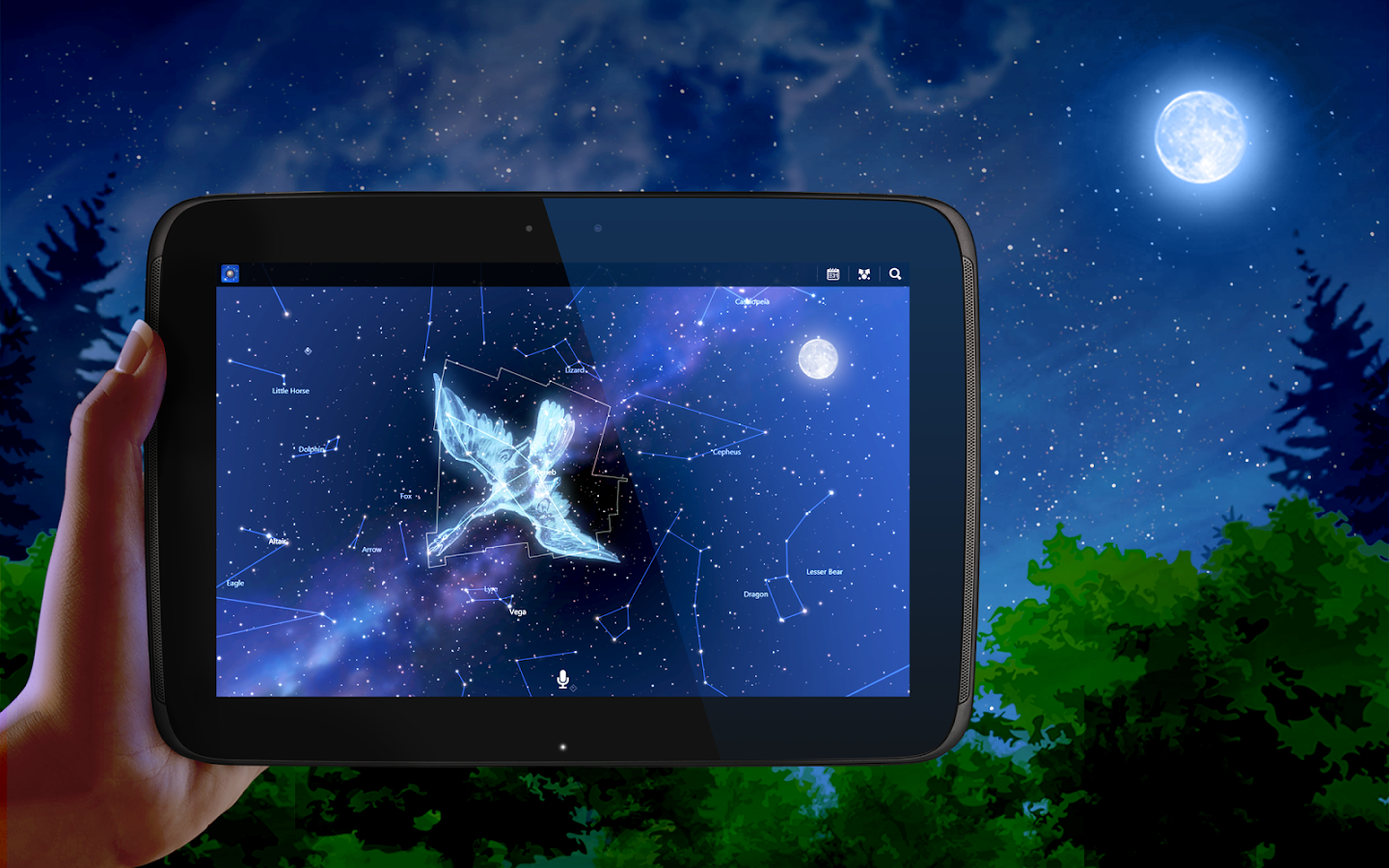
Image credit: https://play.google.com/store/apps/details?id=com.escapistgames.starchart

Using star manipulatives, the class created their own zodiac sign and the Big Dipper. They also downloaded SkyMap (or similar programs specific to their app market) and roamed the classroom to find where their zodiac sign was during the day. They also commented on other interesting features they discovered using the app, such as the location of satellites and other planets.  The class was also introduced to the Stellarium program. To begin, the class researched the longitude and latitude of New Milford, NJ. They took this information and set the default location of the program to their local sky. Students were able to navigate through the program to identify famous constellations in the night sky, their own zodiac signs, and planets visible to us at specific times. After locating them using the program guidelines, they removed them to be able to locate them without any help. Once they located them in the New Milford sky, they selected their own location in the southern hemisphere to compare it to our night sky, and also find specific constellations. 

They also researched the history of their zodiac sign, and the story unique to their specific sign. As an added component to the lesson, the class created their own astrolabe and used them to navigate in the building, just as explorers did as they navigated the seas to discover new worlds. They used it in a modified way, where they instead looked to the time and location of a constellation to determine the direction to turn in the hallway. After they found the location, they scanned a QR code located there to find a famous explorer that used the astrolabe. 

Thursday, April 24, 2014

Simple Yet Effective

Social media provides educators with a wealth of tools that can be used to engage students and enhance learning. Unfortunately many schools are either too focused on sustaining their testing factories, implementing an array of top-down mandates, or are influenced by the perception and stigma that accompanies social media tools.  Since this is an educational technology post I will only focus on the latter.  Many districts, schools, and administrators are convinced that social media has absolutely no place in education, even though the whole entire world using it for some reason or another.  

Image credit: http://www.elephantcreative.co.uk/2013/04/04/social-media-in-schools-tips-for-getting-it-right/#sthash.fPsy9EQk.dpbs

Even if they might see some value they are still convinced that it cannot be used safely in schools as it is a violation of the Child Internet Protection Act (CIPA), goes against the Family Educational Rights and Privacy Act (FERPA), promote cheating, and are a catalyst for cyberbullying.  Thankfully many schools have realized that social media can be used safely and effectively in schools.  In my latest book (Digital Leadership: Changing Paradigms For Changing Times) I debunk the many myths that surround social media use in schools while providing numerous examples of educators who consistently integrate it to authentically engage learners of all ages.  The are also many resources that can be utilized immediately to usher in changes leading to a transformation of school culture that embraces the value of these free tools.  At New Milford High School we have been integrating just about every social media tool under the sun for the past five years and the sky has not come falling down.

Case in point.  In Mrs. Luzuriaga’s Sociology class, students were working on understanding the roles and functions of groups as well as how to read facial expressions, gestures and body language. Using a popular social networking tool, Instagram, students worked in group of six to eight people to create and develop a series of eight photographs that represented the group’s personalities as well as significant issues and themes occurring in both society and the life of a teenager today. Once each group was completed, the rest of the class had to analyze the images and come to a conclusion as to what message or theme was trying to be conveyed. The experiment proved an interesting experience for all.

Simple, yet effective.  When will others get on board?

Friday, April 18, 2014

Instilling an Early Passion for History

At New Milford High School we are always encouraging collaborations resulting in interdisciplinary projects.  Recently students from Mr. Manzo’s 9th Grade Honors World History classes were assigned to create children’s books about the rise and fall of Napoleon Bonaparte in France during the late 18th and early 19th centuries. Students were to incorporate all of the associated subject matter, vocabulary, and major concepts whilst creating a narrative that a small child could not only understand but also be entertained by. Mr. Manzo’s students went above and beyond all expectations of the assignment by creating themes that were not only appealing to children but also an accurate reflection on the rise and fall of Napoleon. Some of the titles include “The Fall of the French Freezer”, “The Lessons Learned by Tadpoleon” “Nappy’s Adventures”, “Napolarbear: A Cold Tale”, “Eat or Be Eaten” (Cat and Mouse Theme) and several more. 

Photograph: Archivo Iconografico

A major component of the assignment was for the students to present these stories to the children involved in the Early Childhood Development program at NMHS. Mrs. Beiner, who is in charge of the ECD program agreed to allow the children in her program to be read to by Mr. Manzo’s students. This took place in the high school cafeteria where stations were set up for the students to read the books to the children. The excitement of the children was contagious not only to Mr. Manzo and Mrs. Beiner, but also to me. All in all, the presentations were a success for all those who participated and/or were involved. Moving forward, they may be attempting to put some of these rise and fall of Napoleon Bonaparte children’s books into a digital format in order to reach more children in New Jersey, the U.S. and maybe even the world. His ultimate goal is to get students excited about history at an early age.