Showing posts with label digital literacy. Show all posts

Sunday, March 6, 2022

A Literate Learner

A great deal has changed since I was in school.  I vividly remember getting a TANDY laptop from my parents when I graduated high school.  It was a considerable upgrade from the Apple IIe that we all shared in the guest room.  I was mesmerized by the black screen with orange text, the fact that I didn’t have to toil over an electric typewriter anymore.  Simplistic games were also available that I could now play without being tied to a desktop monitor or television set.  Even though it didn’t connect to the Internet, as I believe it either had not been invented or was readily available yet, this was my first foray in becoming literate in a bold new world.  

As disruptive forces continually reshape and influence the world we all live in, being literate is of utmost importance.  For a long time, the term has referred to the ability to read and write.  While without question this is still accurate, we must expand our view and recognize that literacy also corresponds to competence or knowledge in a specified area.  UNESCO provides a relevant description below:

Beyond its conventional concept as a set of reading, writing, and counting skills, literacy is now understood as a means of identification, understanding, interpretation, creation, and communication in an increasingly digital, text-mediated, information-rich, and fast-changing world.

Future-proofing learning is contingent upon a focus on developing competencies as opposed to just skills.  I shared the following in Disruptive Thinking:

Skills focus on the “what” in terms of the abilities a student needs to perform a specific task or activity.  Competencies take this to the next level by translating skills into behaviors that demonstrate what has been learned and mastered in a competent fashion.  In short, skills identify what the goal is to accomplish.  Competencies outline "how" the goals and objectives will be accomplished.  They are more detailed and define the requirements for success in broader, more inclusive terms than skills do.  To succeed in the new world of work, students will need to demonstrate the right mix of skills, knowledge, mindsets, and on-the-job ability.  A skill is a practical or cognitive demonstration of what a student can do.  Competency is the proven use of skills, knowledge, and abilities to illustrate mastery of learning by solving problems. 

Learners of today, and tomorrow for that matter, need to be able to replace conventional ideas with innovative solutions to authentic problems.  Ownership and empowerment result when we create meaningful opportunities for kids to explore, interact, design, and create in real-world contexts while being about to think disruptively.  A pivotal question for any educator, school, district, or organization to ask is how is this being achieved, or where do we begin?  To bring more clarity to the concept of developing a literate learner I created the following chart in Disruptive Thinking.  
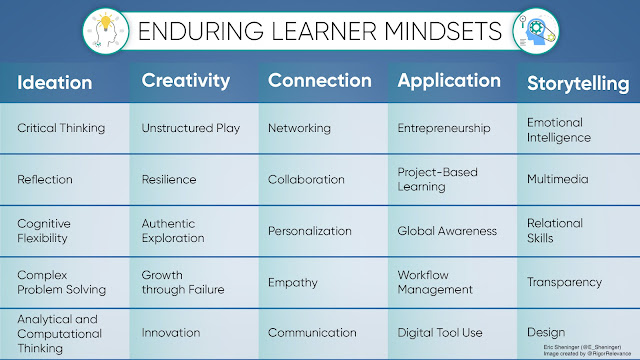

The chart identifies five key Learner Mindsets that will help learners prosper now and in the future.  Beneath each of the five overarching mindsets are five more specific Learner Behaviors our students need to acquire now and continue to refine tomorrow and throughout their learning and living journey.  To what extent are you developing the mindsets and behaviors depicted above within your learners?

Sunday, January 10, 2016

Every School's Obligation

Just because today’s students have grown up in a technology-rich world does not mean that they know how to effectively and responsibly utilize technology. It is a common misconception that today’s learners can seamlessly transition from the routine use of devices for personal reasons to using them for learning, research, and enhanced productivity. We routinely hear how students use digital tools inappropriately for sexting, cyberbullying, cheating, video recording teachers, and fights with peers, and plagiarizing. Unfortunately, these behaviors materialize as schools are not doing their part to educate students on digital responsibility, citizenship, and creating a positive footprint online. 

When I was principal at New Milford High School, we have made it our responsibility to integrate digital responsibility across the curriculum. Our program began early in the school year with assemblies for every grade level. During this time, we presented the root causes of cyberbullying as well as strategies and advice to prevent it. We then transitioned into online conduct in social media spaces and how that can impact college acceptances and employment. During this part of the presentation, I pointed out to students the fact that once they post something online (i.e., comments, pictures, videos, etc.), that information can be accessed, adapted, archived, and shared by anyone who has access to their accounts. Near the end of the presentation, I asked each student to Google themselves and share any content they discovered during the search that they were not aware of. It is at this point that reality really sets in. 

In addition to a presentation early in the year, we consistently integrated digital tools (social media, Web 2.0, mobile devices) throughout the school year to enhance learning, improve productivity,  develop critical digital literacies, and to conduct sound research. As students actively used these tools to connect, collaborate, contribute, and create, they were not only developing media literacy skills but also learning in a safe, transparent fashion. Teachers also worked with students to properly cite resources pulled from the Web, giving proper credit when they saw it was governed by a Creative Commons license. 

As they published their own work in the form of learning artifacts, they begin to create a positive digital footprint that they could be proud of. The systematic integration of technology, modeling of effective use by school staff, education programs for both student and parents, and an immersive culture (1:1 or BYOD) all aided in educating students on digital citizenship. Common Sense Media offers a free digital literacy and citizenship curriculum that leaders can easily begin to implement in their schools. 

In an ever-increasing digital world, our students need us more than ever to not only help them make sense of a tsunami of information but also more importantly how to be safe and responsible. Don't assume that these vital lessons are happening at home. It is the responsibility of schools to educate all learners regardless of age on these important topics. What are you and your school/district doing to address this? Are your current programs and initiatives up to par? Schools that work for kids make it their obligation.

Sunday, June 7, 2015

The Need For Digital Literacy

With 1:1 technology initiatives and BYOD (Bring Your Own Device) programs increasingly being implemented in schools across the globe, the need for digital literacy education has become more important than ever. Although technology enables students to access more information in much less time, it does not always foster learning. Teaching digital literacy helps to manage all of the benefits of technology while helping students understand how to safely weed through the vast amounts of information online.

Technology in the classroom has the following advantages:

  • Allows students to manipulate information and media to construct their own meanings
  • Enables students to share their ideas quickly and easily
  • Engages students of all cognitive levels and abilities
  • Prepares students to be college and career ready
These benefits, among others, are why technology has become a major part of the global curriculum. However, teaching digital literacy has its challenges. The aspects of e-safety, critical thinking, collaboration, creativity, and finding and evaluating information must all be addressed. Many teachers lose sight of creativity and collaboration because Common Core and other initiatives focus on gathering and evaluating information with very little emphasis on creativity.

Educators need to embrace the creative and collaborative aspects of digital literacy. So much great learning happens through creative and collaborative processes. Bridget Burns, Michael Crow and Mark Becker noted the benefits of collaboration in their article Innovating Together: Collaboration as a Driving Force to Improve Student Success, March 2, 2015. They state that collaboration spurs innovation because bringing together groups of people who have different ideas, approaches, experiences, and areas of expertise creates a fertile environment for generating new concepts and methods. Sharing insights allows ideas to be refined and improved. Charging a group with developing a promising idea incentivizes the group—not just a single individual—to commit to its success and paves the way for trusted collaboration.

Giving students the opportunity to broaden their ideas and experiences opens up pathways of learning that can be extremely beneficial.

Brianna Crowley, an educator in Hershey, PA, successfully teaches her students digital literacy while infusing creativity throughout. She says it took a series of small steps to begin the process. One thing in particular she does is refrain from introducing any new tools into her classroom unless she knows they are going to enhance learning. Often she utilizes tools to engage her students, such as A Google a Day which is teaching her students to search for information in a safe yet creative way.

Another challenge teachers face while teaching digital literacy is the differing views on social media in education. Many schools have strict policies in place to avoid educational use of social media, while others feel that these restrictions are stifling the creativity and collaboration capabilities of today’s students. Dan Haesler, a teacher and educational consultant, believes in proactive social media education, and allowing students to make use of all that it has to offer.

When asked by Common Sense Media about social media bans in schools Haesler replied, “What if we approached driver’s education in the same way?” He concluded: Driving lessons would be taught by adults with little or no driving experience, they would only focus on what not to do, and they would never take place in an actual car. Both driving a vehicle, and navigating the internet require experience and knowledge of safety precautions so as to avoid any major incidents.

The students at Maker’s Place in Homewood, Philadelphia, PA, are a prime example of digital literacy at its finest. Children from the inner city get together to work on their digital literacy through creative and collaborative projects. Instructor Jomari Peterson teaches the students to “take control of your destiny and change the world.” Her students work together to utilize different apps and programs that help them first build a business idea and then use collaborative tools to bring that idea to life.

Although there is no “secret sauce” to effectively help educators teach their students digital literacy, there are some key points to focus on:

  • Allow students to maintain blogs or webpages that enable them to track their own learning. Google Drive easily allows students to create blogs and sites that they can share and collaborate on with their peers.
  • Have students create digital stories that they can share and publish. Edu.buncee.com is a site where students can utilize hundreds of custom stickers, animations, multimedia and even record their voice into their project so they can make it “their” own, both figuratively and literally. For example, “My Day at the Beach” a student tells her story with stickers and animations and her voice recording. “Come to Istanbul” describes the city and all it has to offer.  Getting creative with Buncee is a breeze.
  • Offer students the ability to email and video chat with students in other countries. Skype Translate allows students to have a real time conversation with immediate translation.
  • Don’t get caught up in the need for strictly finding information and evaluating it. Always allow for creative ways to learn and produce.
With the help of great Ed Tech tools and dedicated educators, students can gain digital literacy and become fluent in safely finding and evaluating information, creating, and collaborating.