Showing posts with label Students. Show all posts

Sunday, May 28, 2023

5 Steps to Involve Students in Transformation Efforts

In my early days as an administrator, I thought that a positive school culture was one where strict rules were created and consistently enforced to keep students focused on learning. I believed that the more control I could exert over the environment, the better the results. There was not much flexibility in terms of the structure of the day and what students were “allowed” to do. The end result was either compliance or outright defiance. Those who were compliant were celebrated, while those who were defiant were disciplined accordingly.

I can look back on this early time in my administrative career and see how naïve I was. I now realize that the most significant piece to the change and transformation process is our students. This most important stakeholder group is often left out of the conversation.

So what are the secrets to transforming school culture? Below are some ideas.

  1. Make it a student-centered process. The first step is to involve students in the process of creating a positive school culture. This means giving them a voice and a platform to share their ideas. It also means listening to their concerns and taking their feedback seriously.
  2. Give up control. This can be a difficult one for many administrators, but it is essential if we want to create a truly student-centered culture. We need to be willing to let go of some of our control and empower students to make decisions about their own learning.
  3. Respect their ideas. When students share their ideas, we need to take them seriously. We need to listen to their concerns and be open to new ways of doing things. We also need to be respectful of their opinions, even if we don't agree with them.
  4. Implement their ideas. Once we have listened to students and taken their feedback into account, we need to be willing to implement their ideas. This means making changes to our policies, procedures, and practices. It also means giving students the resources they need to make their ideas a reality.
  5. Get out of the way. Once we have implemented students' ideas, we need to get out of the way and let them take ownership of their learning. This means giving them the freedom to make mistakes and learn from them. It also means providing them with the support they need to succeed.

Transforming school culture is not easy, but it is possible. By following these steps, we can create a learning environment where students feel empowered and engaged. To gain deeper insight and strategies on how to make this a reality be sure to check out Digital Leadership and Disruptive Thinking. 


Sunday, October 9, 2016

Stop the Homework Insanity and Let Kids Be Kids

I have so many fond memories of my childhood.  Growing up in a relatively rural area of Northwestern New Jersey sure had its benefits.  As we returned home from school each day, my brothers and I would jump off the bus and diligently make our way about a half-mile back to our house. Once home we would peel off the backpacks, get changed, and play outside for the remainder of the day until dinner was ready. I can still remember my parents yelling into the great abyss as many times we were either deep in the woods or down by the local farm.  There was homework, but is was very manageable to the point that my mom had to remind me that we actually had some during the elementary and middle years.

When not off on our adventures in the deep woods, we would be riding bikes, playing with the dog, swimming in the pool, shooting hoops, or getting into some kind of trouble. Life sure was good and relatively stress free.  Things changed a bit once Atari and Nintendo took hold. Most of our time was still dedicated to outdoor play, but time was definitely allocated to playing video games on these technological wonders.  On some days we couldn’t wait to get home from school to play Asteroids, Pac Man, Donkey Kong, Tecmo Bowl, and Mike Tyson’s Punch Out. 

As we grew older sports began to make up a great part of our afterschool activities. Outdoor activities and video games often took a backseat to baseball, soccer, football, swimming, and basketball practice.  Sports were such a huge part of our lives throughout the year.  Growing up in a rural area allowed my brothers and I to participate in many sports at a high level. Part of why I believe my childhood was so great was that there was a distinct balance between school and life.  From the time the bus dropped us off until when we hopped back on, the focus was on learning.  Once home, however, time was relatively sacred when it came to play and spending quality time with family and friends. 

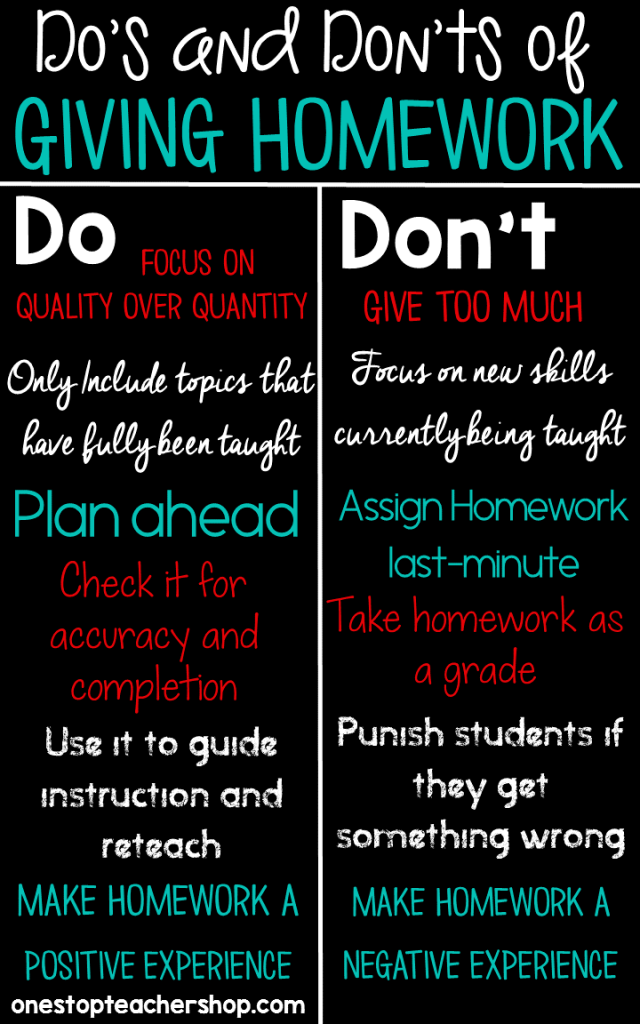
The life of a child today has changed dramatically.  Play both in and out of school has become a distant memory for many kids across the world.  For reasons that make no sense to me, children are given obscene amounts of homework. Instead of coming home to unwind, play, and spend valuable time with family, kids are stressed out beyond belief as high-stakes homework has become the norm.  Why have we veered off in this direction? There is little research to support the impact of homework on achievement for students in grades kindergarten through seven.  When it is assigned it should be no more than 30 minutes. Well, ask any parent and they will tell you that the amount of time spent far exceeds this.


Image credit http://www.todaysparent.com/

I am not against homework.  As a child I had homework, but it was a manageable amount that did not negatively impact social and play time.  It was also not used in a high stakes way. I want both my children to reinforce what they have learned during the school day, but more importantly I want them to be kids.  During my tenure as principal my district delved into the research with our students from all grade levels and changed our homework practices. Homework was still assigned, but there were time limits for each grade and it could not be used to punish students academically.   

The reasons for this post are not to debate the many issues I have with homework and the lack of reliable research to support it’s use. There will always be two sides to this debate.  It should be noted though that in my line of work I am able to make a pretty compelling case against current homework practices. However, I think we have to take a hard and objective look at the impact it is having on our kids. Current homework practices are making students dislike school and learning.  This is a fact.
"If your homework practices make kids dislike school and/or learning that alone should tell you something has to change."
Recently I was at an event in my community and parents were lamenting about homework.  This really hit home as every night my wife battles with my kids over homework.   My daughter cries and throws a fit.  She sits in the car and does homework to and from cheer practice. That is her after school life in a nutshell. She completes homework for 35 minutes on the way to cheer. After 2-3 hours of cheer practice she then again works on homework for another 35 minutes on the ride home. Sometimes she has even more work once she gets home. My son just sits and stares back at us with an empty gaze.  Ask any parent or child about their feelings on homework these days and you are bound to get a negative response.

If you currently work in a school consider this. Regardless of your views on homework, please take the time to reflect on whether it is actually having a positive impact. If homework makes kids dislike school and/or learning it is obvious there is a problem.  Parents also need to be proactive.  So what can you do? Share this post with your child’s teacher, administrator, school, or district. Share in the comments section below why homework is not working for your child.  Engage in conversations about homework balance and meaningful assignments that reinforce learning in a timely fashion. Together we need to address the gorilla in the room (homework) if student learning and success are the ultimate goal.


Below are some more resources that can move the homework conversation forward.
It's time to stop the insanity for the sake of our kids.

Sunday, July 17, 2016

Critical Conversations

We are in the midst of disruptive change that is engulfing our society. The second we get a grasp on a new technology there is an update, new version, or something entirely different. It is an exciting, yet terrifying time as many of us just try to keep up. This is the new normal in our world and advancements in virtually every field and profession will continue at an exponential rate. As educators you don’t need to like technology, but you do have to accept it. The reality is that not just technology, but an array of innovative ideas, are constantly at our fingertips. 

The disruptive changes we are seeing provide an opportunity to reflect on what we are in order to help better determine where we want to be. Taking all of this into account, how well are you meeting the needs of today’s learner? I ask this question in virtually every workshop I facilitate.  The responses run the spectrum from not very well to some pretty innovative ways.  Overall many schools, administrators, and teachers are quite content with where they are currently at in regards to meeting the needs of learners in the digital age.  Make no mistake about it, real change is happening in many schools, mostly in the form of isolated pockets of excellence.  


Image credit: http://www.slideshare.net/ccalahan/critical-conversations-54644002

The question above provides a great initial point of reflection as to where you are at with your change and transformation efforts. However, it falls short in terms of determining how well we are really doing as we are jaded by our own perception at times. Even though we might think we are doing a great job this might not be the reality of the ones we serve. The real question to drive meaningful change in our schools is asking our students how well we are meeting their needs. It is important to at first listen and then begin to take action on some of the thoughts and ideas they provide. They are, after all, our number one stakeholder and true boss.

If you want real change engage your learners in critical conversations about your school, district, or classroom experience. Even if you are integrating all of the latest technology, chances are teaching, learning, and leadership have not changed to allow for a transformation of school culture. Continue these conversations with your students throughout the school year by making it an embedded component of your professional practice. It will be difficult at first to hear from your students some of the issues that they have with the learning culture at your school. Over time though the relationships that are built through this honest dialogue will help drive the right changes that are needed.

For more tips on how to engage others in critical conversations click HERE.

Sunday, February 22, 2015

Looking at Teacher Accountability Through a New Lens

In case you haven’t noticed the education profession has been under attack as of late. The brunt of these attacks has been aimed at the very professionals who are tasked with positively impacting the lives of children each and every day – our teachers.  In my mind education is the noblest of professions.  Without education, at some level virtually all other professions would be non-existent. This places our teachers at the forefront of molding young minds into the next generation of doers, thinkers, creators, leaders, and entrepreneurs.  If there is ever a profession that should be revered as much as that of a doctor who saves lives it is that of a teacher.  


Image credit: https://larrycuban.files.wordpress.com/2011/12/parents.jpg

Unfortunately there is a growing rhetoric and sentiment that the education system in America is broken and our teachers are to blame for this.  New accountability systems have been championed and adopted across the country that reduce teacher effectiveness to a mere number.  The algorithm adopted by many states, which quite frankly makes little sense, crunches data sets in an attempt to measure the quality of a teacher against his or her peers. Each state has different factors that go into their value-added measurement (VAM) of a teacher, but the dominant component is standardized test scores.  Teachers are the true catalysts of change that can create schools that work for kids. Even though countless studies have debunked this means to truly assess teacher effectiveness states have moved full steam ahead ignoring the research.

With such a focus on standardization in schools, many teachers feel compelled to prepare students for a litany of exams, as the data extrapolated from them will be used for high-stakes evaluation. Administrators are also intimately tied to these results as well, so as a knee-jerk reaction an environment that resembles a test-taking factory is created.  The sole focus becomes one that emphasizes performing well on a test as opposed to learning.  What results is the proliferation of an industrialized model of education that reformers claim they want to get away from, but the policies they support only help to sustain it. This gloomy depiction of what is happening to schools across the country by people that have no business enacting education policy is forcing teachers to leave the profession at alarming rates. 

The structure and function of the majority of schools in this country is the exact opposite of the world that our learners are growing up in.  There is an automatic disconnect when students, regardless of their grade level, walk into schools due to the lack of engagement, relevancy, meaning, and authentic learning opportunities.  Our education system has become so efficient in sustaining a century-old model because it is easy and safe.  The resulting conformity has resulted in a learning epidemic among our students as they see so little value in the cookie-cutter learning exercises they are forced to go through each day. The bottom line is that they are bored. It is time that we create schools that work for our students as opposed to ones that have traditionally worked well for the adults.

Creating schools that work for students requires a bold vision for change that not only tackles the status quo inherent in the industrialized model of education but also current education reform efforts. Even though Common Core is not a curriculum, many schools and districts have become so engrossed with alignment and preparing for the new aligned tests that real learning has fallen by the wayside.   We need to realize that this, along with other traditional elements associated with education, no longer prevail.  How we go about doing this will vary from school to school, but the process begins with the simple notion of putting students first to allow them to follow their passions, create, tinker, invent, play, and collaborate.  Schools that work for students focus less on control and more on trust. 

There is a common fallacy that school administrators are the leaders of change. This makes a great sound bite, but the reality is that many individuals in a leadership position are not actually working directly with students. Teachers are the true catalysts of change that can create schools that work for kids. They are the ones, after all, who are tasked with implementing the myriad of directives and mandates that come their way. Leadership is about action, not position. Schools need more teacher leaders who are empowered through autonomy to take calculated risks in order to develop innovative approaches that enable deeper learning and higher order thinking without sacrificing accountability. If the goal, in fact, is to increase these elements in our education system then we have to allow students to demonstrate learning in a variety of ways.  

For change to be successful it must be sustained.   Teacher leaders must not only be willing to see the process through, but they must also create conditions that promote a change mentality. It really is about moving from a fixed to a growth mindset, something that many educators and schools are either unwilling or afraid to do. The essential elements that work as catalysts for the change process include the following:

  • Empowerment
  • Autonomy
  • Ownership
  • Removing the fear of failure
  • Risk-taking
  • Support
  • Modeling
  • Flexibility
  • Collaboration
  • Communication

What I have learned is that if someone understands why change is needed and the elements above become an embedded component of school culture he/she or the system ultimately experience the value for themselves. The change process then gets a boost from an intrinsic motivational force that not only jump-starts the initiative but allows for the embracement of change as opposed to looking for buy-in.  We should never have to "sell" people on better ways to do our noble work nor rely on mandates and directives. These traditional pathways used to drive change typically result in resentment, undermining, and failure.

Even in the face of adversity in the form of education reform mandates, Common Core alignment, impending PARCC exams, new educator evaluation systems, loss of funding, and an aging infrastructure, at my school, we have not only persevered but proven that positive change can happen with the right mindset.  Teachers were put in a position to overcome these challenges and experience success.  Others can as well. Throughout the past couple of years, I have seen improvements in the "traditional" indicators of success by mainly focusing on creating a school that works better for our students as opposed to one that has always worked well for us. Technology was a tool that my teachers harnessed and leveraged to do what they did better while creating a culture of learning that actually meant something to our students. My recent TEDx talk provides insight into how this was accomplished.  

My message is to everyone who has and continues to bash teachers by implementing accountability structures that will do nothing to help our students succeed in life and follow their dreams.  There need to be more creative ways to hold teachers accountable so that a school-wide focus on relevant learning becomes the norm. Teachers should no longer be forced to prepare students for a world that no longer exists and be held accountable through one-dimensional means.  Teacher success should be judged on the products students create with real-world tools to solve real-world problems.  If teachers are allowed to innovate and allow students to create artifacts of learning to demonstrate conceptual mastery, the end goal should be the acquisition of higher-order thinking skills.  

Sunday, November 9, 2014

#Internet4schools: Make Your Voice Heard

Back in 2009 when we began to transform teaching and learning at New Milford High School we were extremely fortunate at the time to have wireless Internet access throughout the school.  This was an extremely big deal five years ago and ultimately gave us an edge in terms of the many successful initiatives we rolled out including Bring Your Own Device (BYOD) and digital learning across the curriculum.  The ubiquitous access to the Internet eventual led to the implementation of more student-centered instructional practices where students began to take ownership over their learning. We began to create a school that worked better for them in that they could create learning artifacts to demonstrate conceptual mastery through the construction of new knowledge and application of skills. Access to the Internet allowed us and our students to harness and leverage thousands of free tools to support teaching and learning as described above.


Image credit: http://peopleint.files.wordpress.com/

Fast forward to 2014 and one would think that all schools would be in a position to provide Internet access to students like we were able to for the past five years.  Obviously I was extremely naive to think this. The typical K–12 public school has the same internet access as the average home, only with 200 times more users. That means that 2 out of every 3 students do not have the high speed internet access they need in their schools.  The Federal Communications Commission (FCC) is considering expanding Internet access in schools and we need your help telling them to vote “YES” to expanding E-rate in order to provide the nation’s students with the tools they need.

If you are like me you have seen the positive impact that Internet access can have on student learning both inside and outside of school.  Please take just a few minutes to create a 15 second video explaining why all students across the country deserve Internet access in their schools.  Here is the text you can use in a tweet or status update:

#Internet4schools matters - Tell @FCC to vote YES and bring Internet to all schools with a 15 second video


Video I created

Once your video is created share across social media channels such as Twitter, Facebook, Google+, and Instagram.  I made the video above quickly using Instagram. I suggest you also tag some of your connected friends in your social media update to make this initiative go viral in a similar way to the Ice Bucket Challenge earlier this year.  Bottom line - all students deserve quality Internet access in schools so that they can use real world tools to do real world work, develop digital literacy skills, collaborate with peers, unleash creativity, and find more relevance in their learning.

Sunday, August 10, 2014

Amazing Students Do Amazing Things

Earlier this year I shared the amazing work of New Milford High School student Sarah Almeda in a post titled Students Yearn For Creativity, Not Tests. Wherever I now speak across the country and soon the world I share the incredible project Sarah created.  Her passion for the arts and creativity serve as an catalyst for her learning. She has capitalized on the concept of student voice, taken ownership of her learning, and become an inspiration for me and countless other educators and students across the world.  I am always in awe of the art that she creates using a variety of mediums to demonstrate conceptual mastery.  It is these artifacts after all that truly measure the construction of new knowledge as well as both skill attainment and application.


So what does an amazing student like Sarah do over the summer?  She creates amazing art as a means to continually demonstrate her passions while learning new skills and techniques in the process.  Above is a picture of her entry into the 2014 Cover Contest held by Creative Outlook, a free magazine distributed to high school teachers and students immersed in art and music. She used her self-taught knowledge of Photoshop, bitmap generation, image distortion, photo-manipulation, digital painting, graphics tablet, and an iPhone to make it. I’m trying to share her entry with as many people as possible as only the top 10 entries that get the most votes will enter the final stage of judging. 

As Sarah took the time over the summer to share her work with me I have made the decision to reach out to my network to see if you can lend her a hand to get to the judging stage. I hope you’ll vote HERE for Sarah and consider sharing her amazing work! Regardless of how the contest turns out Sarah's desire to follow her passions and push her learning boundaries make her a winner in my book.  Her true reward has been the construction of new knowledge and the acquisition of new schools that will aid her as she pursues a future career in game design. She consciously makes the decision to learn over the summer, which is why she is an amazing student. I can't wait to see what work she shares with me once the school year starts.  

Friday, February 28, 2014

The Next Generation in Student Flashcards

People have been using flashcards as a revision aid for decades, but now it is time for learners to step away from their papers and pens, and move towards using internet-based flashcards instead. But why step away from a tried and tested method, and put your faith in something new? The reason that you should give it a go is that there are a number of important reasons why online flashcard systems, such as that which is provided by Cardkiwi, are better than the old-fashioned pen and paper method.


One of the reasons why Cardkiwi is so effective is because it utilizes a memory building technique known as spaced repetition. Numerous studies (Spitzer: 1939, Cepeda et al: 2008,) into human memory have shown that memory retention can be improved by spacing out your exposure to information, so that you review the information again at the optimal moment. Whilst pen and paper flashcards allow you to space out your exposure to new material, working out when would be the best time to look at the material again could be a waste of your time. Clever algorithms used by online flashcard systems mean that the flashcard app will know when to show you each flashcard for maximum effect. By allowing you to rate your understanding/memory of each specific card, the Cardkiwi app will start to show you the cards that you have a better understanding of less frequently, and the cards that you don’t understand yet, more frequently! For more information on spaced repetition, take a look HERE.

Cardkiwi also allows you the opportunity to share your flashcards with others so that you can build your knowledge with collaborative learning strategies. You can share your cards with anyone else in the world, without having to hand copy them out and send them over, and your friends can also share their flashcards with you. This can help you to develop a whole new perspective on the material that you are trying to learn. "I need flashcards for 10 chapters in my biology book. If I invite 9 friends to collaborate with me, I only have to do 10 % of the work. Amazing!"

Cardkiwi will also keep your flashcards safe, in the right category and out of the way, so that they are not cluttering up your desk or bag. You can create hundreds of different sets of flashcards on Cardkiwi without having to worry about getting them mixed up or running out of drawer space to keep them all in. Best of all, you don’t have to worry about wasting paper, because all of your flashcards are displayed on a computer screen.

With so many great reasons to try using flashcards online, it would be foolish not to take the opportunity to try out this new method of learning. When you consider that Cardkiwi is free to use and always will be free to use, there is nothing standing in your way.

Wednesday, February 12, 2014

Digital Learners Need (and Deserve) Digital Leaders #DigiLead

I recently read this Education Week post by  Jill Berkowicz and Ann Myers titled We Have 21st Century Learners Who Need 21st Century Leaders.  I couldn't agree more. They go on the summarize the following:
"Essentially, the 21st century leader has to develop a renewed understanding of how children are learning now.  It isn't about using technology because it exists. It is about how the technologies of the world have already influenced how children are learning. Bringing a technology agenda forward with the intention of improving student understanding and demonstrated success is essential.  Leading the transition from 20th century to 21st century schools includes attention to the human toll it takes when such large changes are being required.  Ongoing professional development, constant review and analysis of successful attempts at the changes in learning opportunities and the increasing use of technology offer momentum."

The world has changed and technology has had a big impact.  As the world and our lives have become more connected and influenced by the evolving technology-rich landscape our learners in turn have become wired differently.  Not only are they engaged more outside of school then in, but in many cases they are constructing new knowledge, communicating, collaborating, and attempting to make sense of an array of media messages.  All of these examples are at the core of essential skill sets that most schools "want" students to possess, but many schools do a poor job of creating a culture that integrates them across the curriculum. Students deserve leaders willing who are willing to extend themselves beyond their comfort zones in order to create a culture that aligns with a new vision for learning.  This involves a leader's desire to take calculated risks, adapt, learn, and ultimately evolve in ways to break free of the status quo in order to create digitally rich environments that meet the needs of today's digital learners.


Image credit: http://inspiringtheact.org.au/event/unconventional-gas/

The number one responsibility and challenge for digital leaders is to create a relevant, meaningful, and authentic learning culture that allows students to create learning artifacts to demonstrate conceptual mastery. It also requires an open mind, vision, and strategic plan to allow students access to real-world tools to do real-world work. A common misconception is that you have to be "tech savvy" in order to be a digital leader.  Of course it helps, but it is not a necessity.  What is needed is a thorough understanding of what constitutes effective leadership and determining how these characteristics, skills, and practices can be improved and/or enhanced with a new mindset that views technology as a tool to support learning as opposed to just a frivolous add on.  Some of the most effective digital leaders, or just leaders for that matter, build capacity in others to move the change process further.  If you are a leader looking to do so, begin to have conversations with your teachers, and more importantly your students, to collaboratively create a system that works for learners as opposed to one that just acts to control them.

Societal changes as a result of technology now demand leaders to also look at how they perform other essential responsibilities to improve and move schools forward in the digital age.  The Pillars of Digital Leadership provide a practical framework for any leader, regardless of technological proficiency, to improve professional practice.  The tenets of leadership still apply.  It should also be noted that this isn't about giving us more to do in a time when it seems like more and more is being dumped on a leader's plate. The guiding question is how can we do what we do better to become more effective and efficient while becoming improved learners, collaborators, communicators, storytellers, and change agents.  If we look at the digital age as an endless era of opportunity to engage students in deeper, more relevant learning then the next logical step is to act.

We can no longer stand by idly while everything changes except for schools and learning environments. View this post as a call to action.  If you are a digital leader how will you help support, cultivate, and inspire others to follow a similar path? The Age of Information and Personal Learning Networks (PLN's) provides ample resources for any leader (classroom, building, district) to find success, not to mention my new book on Digital Leadership.  The challenge is to get those who do not value the role of technology in learning today, are not connected, or who are blinded by fear, misconceptions, or lack of knowledge on board.  Learners across the globe are counting on our success in this endeavor.  Are you up for the challenge?

Thursday, October 24, 2013

The Voice: Student Edition

The following is a guest post by Cristy Vogel (@msfrenchteach).  She is a High School French Teacher in Columbia, SC, 2013-14 SCFLTA President, and #langchat Co-Moderator.  She blogs at theslantedapostrophe.blogspot.com.

This post is not about a special episode of teen singing sensations on The Voice. Hope you’re not disappointed! However, the show did come to mind when thinking about student voice. If you haven’t seen the show, essentially, it’s a contest for aspiring singers who must wow the judges and audience with their vocal abilities. The hope is that the judges will hit the buzzer and declare interest in mentoring the vocalist.  The judges are experienced and very successful celebrities who have industry insights from which the contestants can greatly benefit, in theory. 


Image credit: http://www.educationthroughleadership.com/giving-students-a-voice/

Much like our students, each contestant hopes to have his or her voice heard in order to learn, grow, and excel.  The classroom may not be a ridiculously loud contest like what we see on The Voice, but it is a place where all learners should have the opportunity to direct their learning. Recent interactions with my own students have inspired me to reflect on voice and its implications in the classroom. In fact, it has only been in the past couple of months that I have really gotten out of my comfort zone and given students the microphone so as to make decisions about their own learning.  It is my pleasure to share with you a few tips that are based on my personal experience. 

Get informed.
Giving students a voice is not an exact science, especially since each classroom is unique. There are ways to prepare yourself for such a risk-taking endeavor, so I recommend that educators take some time to engage in discussion with others who have done it before putting learners on the stage. Read a blog on the topic, talk to on-site colleagues who have success with it, ask your PLN for ideas, and maybe engage in a Twitter chat. Then, ask yourself how your students might direct their own learning in your particular environment. You know your students best!  

Tell stories.
Our learners need a little direction when we give them voice. In fact, all of us -- not just the learners in our classroom -- want to know how and why we’re doing what we’re doing. As educators, anecdotal stories can help as they have the potential to capture students’ attention and guide them to make meaningful recommendations. I tell my students that there are non-negotiable tasks that we must do in life, but we can suggest ways to tailor them to our needs.

My first anecdote this year was about the professional development sessions that our school faculty must attend every other Thursday.  I told them that the PD is non-negotiable, but that teachers can make recommendations for future meetings. I explained that I shares my ideas with our administration in hopes that we will get to try something different. Then, I transitioned into an explanation of the non-negotiable part of the project that we are doing with students at other schools.  We discussed some aspects that they could direct before I gave them a feedback form to complete. I found that the responses were more meaningful than they had been when I had made past attempts at seeking feedback, and I believe my anecdote and our discussion impacted the results.

Just as the contestants on The Voice are prepped before hitting the stage for their first performance, our learners also benefit from a little coaching. After all, don’t we want to make that empowering moment on the stage as successful as possible? Students might not have a voice in many of their classes, so make this time count!

Listen carefully and empower your learners. 
Now that your learners have spoken, reflect on what they said. Sometimes you may receive several comments that are not helpful, but concentrate on the serious ones. Stay positive! Even if only one or two students provide you with meaningful feedback, do your best to make their voices heard. Most students are going to use the power of voice at some point, and that might be when they are making individual, rather than collective, decisions. At any rate, announce the changes that you are going to make as a result of student feedback. I recommend that you let them know repeatedly how much you appreciate it.  In my own experience, learners are happy to hear, more than once, that their voice was heard and that it made a difference. 

The fact is, there is more potential for buy-in when the learning is student-directed. Let’s let our learners shine with the mic in hand!

I would like to thank Eric Sheninger (@NMHS_Principal) for inspiring and inviting me to contribute to his blog. It was my first time doing so!  He wrote a fantastic post on the need for educators to tell their classroom stories, and it inspired me to ask him about guest blogging. As a result, I wrote this post AND already invited one of my own students and colleagues to guest blog. Yet another example of the power of my PLN!

Check out Eric’s post HERE. 

Thank you, Eric, for giving me a voice! 

Wednesday, October 16, 2013

The Secrets to Creating a Positive School Culture

If someone would have asked me this question a few years ago I honestly would not have had a good answer.  I always thought a positive school culture was one where strict rules were created and consistently enforced to keep students focused on learning.  In my mind, the more I could control the environment that my students were a part of the better the results. There was not much flexibility in terms of the structure of the day and what students were “allowed” to do.  The end result was either compliance or outright defiance. Those who were compliant were celebrated while those who were defiant were disciplined accordingly.  

Image credit: http://www.kellogg.northwestern.edu/kwo/spr06/indepth/journey.htm

I can look back on this early time in my administrative career and really see how naïve I was.  All I have to do now is look at the status of our school culture today, which has led me to this mini reflection. Last week I had the opportunity to meet with some students who convened a meeting with me.  The purpose of this meeting was for them to share concerns they had with some of the inner functions of the school.  The main part of the meeting focused on how we run our fire and security drills, but the conversation later moved onto questioning our use of Study Island and inconsistencies in taking attendance.  

Herein lies one significant cultural shift; a meeting called by students as they have been empowered to become catalysts for change. Their ideas are valued, but the fact that they have more power than they think point has not been consistently reinforced. It was at this point that I looked each of them in the eyes and told them that they don’t work for us; we (teachers, administrators) work for them. Their jaws dropped when I said this.  Giving up control and empowering my students to take ownership of their educational experience has been one of the best decisions I have ever made.  Is this really a secret though?  Well, it obviously was to me, and had I known I would have done this much earlier in my administrative career.

Now back to the student meeting.  After addressing their concerns a student brought up how much she, and others, appreciated the fact that we allow them to bring their technology to school.  This meant the world to me, as many know that I have worked hard with my staff to initiate a meaningful Bring Your Own Device (BYOD) program.  I used this point in the meeting as an opportunity to challenge the students to be more proactive in their device use for learning. Each student was left with the task of working with his or her teachers and peers to strengthen our BYOD initiative so that it continues to focus on learning. The difference now was shifting the responsibility to improve the program from the professional staff to the students.  

I hear a great deal of conversation in the education world about transforming school culture.  Heck, I have even added to that dialogue on numerous occasions.  It wasn’t until now that I realized the most significant piece to the change and transformation process is our students.  This most important stakeholder group is often left out of this conversation.  So what are the secrets to transforming school culture? Make it a student-centered process, give up control, respect their ideas then implement them, and get out of the way. For it is they, our students, who ultimately transform school culture.  We are just playing in their sandbox. 

Friday, September 27, 2013

Inspiring Students to Think About College

One of our goals at New Milford High School is to present as many college options as possible to our students if that is the direction they want to pursue. When hiring some new guidance counselors a little over two years ago I asked them during the interview process how they would increase access to higher education options upon graduation. One idea that was developed by Michelle Harle, who is now in her third year at NMHS, was to organize and hold a college fair during the school day for all students to attend if they choose. not only did Michelle present the idea, but she was able to elicit the support of the Guidance Department.  Working together they have been able to implement and sustain an opportunity for all of your students in grades 9-12.


The best part about this college fair is that students do not miss any class time to attend, as we hold it during all three of our lunch periods.  Since lunch is 48 minutes, students can decide how quickly they want to eat and how much time they want to spend at the event.  In terms of the school day the college fair runs from 10:30 AM until 1:15 PM.  No student is forced to attend, but I can tell you that the main gym is jam packed with students eager to learn more about their options after high school.  I just got back to my office and was proud to see the gym packed with students engaged in conversations with college reps and each other about future learning.  On a personal note I was excited to see both my alma maters, Salisbury University (B.S.) and East Stroudsburg University (M.Ed.), in attendance.

The event was a huge success.  There were well over 100 colleges in attendance and the atmosphere was electric.  You can view the entire program that was distributed to our students HERE (I had to add a separate link for the front and back covers).  This was developed by my Guidance Department and includes information on all of the colleges that attended, as well as, a college fair cheat sheet.  Click HERE to view a Instagram video of the event. The following are some things my Guidance Department had to do, as well as, some pointers, if you want to organize a similar event:

  • Begin outreach to schools months before.  Michelle began doing this last May.  The key is to provide as many options for students.
  • Make sure you have enough tables for the reps.  We rent these and have them delivered the day before.
  • Organize a schedule where students do not miss any of their classes.
  • Reserve parking for the reps and communicate this to your students early on.
  • Provide food for the reps in the area where the fair will be held.  My counselors arrange for pizza, salads, and cookies.
  • Let your parents and other stakeholders know about the college fair in advance.  We email out a list of attending colleges, as well as, invite them to attend the event.
  • Create a program for your students that provides pertinent information on each school (location, website, majors).
  • Encourage your staff to wear apparel from their alma mater the day of the event to build excitement and pride in the event.
  • Have students on hand to help direct the reps where to go.
Having a forward-thinking guidance department at NMHS is providing our students with the right guidance to make informed decisions about their future. 

Thursday, February 28, 2013

There's An App For That

New Milford High School’s digital journalism class, which operates The Lance, the school’s online news source, is proud to announce the release of their very own free application.  The application is available for Apple and Android operating systems.


The Lance reports on news in and around New Milford’s community on a weekly basis.  The students of digital journalism partnered with Crescerance to develop an app that is easily accessible and touches on the features of the news site that students and residents of the community use the most.  The application is an easy way for New Milford residents to keep up-to-date on the mumblings of the heart of the community -- it’s students.  

Once users download this free app to a smart device, they can peruse the different features easily, with one-touch access to news, photos, the school calendar, The Lance’s blog and the complete athletics schedule.  Users can also take a picture with their device that is watermarked with the news source’s logo, which can then be sent to The Lance for publication on the site with credits to the photographer.

Additionally, there is easy access to weekly polls, staff biographies, and users can even contact the staff with leads and comments.  Perhaps the best feature of the app is the ability for users to add sports events to their calendars from the app, as well as receive push notifications about updates to the site or meeting/event cancellations.

This is a revolution in high school news reporting.  With readers from as far away as Australia, the staff of The Lance is finding that the application brings them that much closer to their readers and followers, bringing 21st century news reporting to their doorsteps at the touch of a finger.


Please feel free to download our app and let us know what you think so that I can share your thoughts with our students.

Monday, January 28, 2013

The Lowell Milken Center Discovery Award


Innovation and creativity are at the core of the American spirit and they are the qualities that build the foundation for progress in education, technology, business, and, well, just about everything. As a principal, I often write about of the importance of creativity, innovation, and discovery in the classroom.  

When it comes to innovating in the classroom, project-based learning has gained increased attention as teachers and reformers seek ways to the move our classrooms away from the often mundane textbook-based lesson plan and lecture structure. Giving students a more open path and an interactive way in which to make their journey can be the key to unlocking their creativity and engagement with learning, regardless of the subject.  

With this in mind, I wanted to share an exciting new opportunity to energize your students to try project-based learning for themselves through the Lowell Milken Center Discovery Award.  The Lowell Milken Center was named for and founded by education philanthropist Lowell Milken in 2007.  The Kansas-based organization has been churning out rather impressive projects that have resulted in  national and world news coverage ever since.  They are now offering students the chance to win a whopping $10,000 for their efforts in uncovering an unknown historical figure.  The winners of the Lowell Milken Center Discovery Award will be announced in September and I can't wait to see what history students and teachers have come up with in pursuit of this goal.  If you haven't yet heard about this award, the Lowell Milken Center asked students across America to create projects around the story of an unsung hero who has changed history.  Students can present their discovery as a documentary film, a performance, or a website, giving them the freedom to harness the best multi-media format for their projects. 

I encourage parents and teachers to share this opportunity with their kids. I'm certainly planning to promote this organization and its award to my students and colleagues. The Lowell Milken Center Discovery Award is the kind innovative contest that makes learning come alive for students.

Wednesday, May 18, 2011

Student Driven Schools

The following is a guest post by Disha Dass and Jessica Milne, two New Milford High School students.  They approached me with an idea and as a school we let them run with it.  Nothing like this had ever been organized at NMHS.  The end result of their unwavering commitment to make their peers aware of of an issue had a profound impact on the entire school community.  Students making a difference and having a say in the culture of our school are two of the many defining characteristics that make NMHS a special place.  Our job is to serve the students by listening and putting their ideas into action in order to improve all facets of education.  They should be in the driver's seat.

If you had walked down a hallway in New Milford High School on Friday, April 15th, you would have seen students greeting each other in silence, laughing silently at a silent joke, and a mass of red shirts, all reading: Day of Silence: A Million Voices. April 15, 2011 was the National Day of Silence, a movement protesting the bullying and harassment faced by Lesbian, Gay, Bisexual, and Transgender (LGBT) teens.
In New Milford, two students took the initiative to make the Day of Silence happen at their high school. They had witnessed firsthand some of the negative attitudes towards LGBT kids in the school, and decided to do something about it. Fueled by the knowledge that their cause was a good one, these students (senior Jessica Milne and junior Disha Dass) gained the support of Mrs. Zacher, the Student Assistance Counselor and head of BUDDY (Bullying Undermines the Development of Diverse Youths), an anti-bullying group at the high school. Along with BUDDY, Disha and Jessica approached Mr. Sheninger about New Milford High School participating in the Day of Silence.

Throughout the entire process, the staff and administration of the high school was nothing but accepting and supportive. Mr. Pevny designed and printed t-shirts; Mrs. Zacher organized lists of participating students and printed out "speaking cards," which students could show others on the fifteenth to explain their silence. Other teachers asked what they could do to help out, even if they themselves could be silent. Mr. Sheninger was there every step of the way to ensure that the day was a success.

On April 15th, the National Day of Silence came to New Milford High School. Shirts, stickers, and speaking cards were handed out. Students walked the halls in silence, some writing down messages to fellow students or teachers in order to communicate. In Mrs. Swarctz's chorus class, students listened to the music that they were learning to sing for the spring concert. In Mr. Tusa's A.P. U.S. History class, students nodded along with their teacher's words as they took diligent notes. The silence was only broken at 2:55, the end of the school day, when Disha made the announcement thanking everyone for participating and officially breaking the silence.

The experience could not have gone better. A small high school experienced the silence faced by LGBT teens every day of their lives. Students learned that if they have the initiative and the drive to get something done in their school, all they have to do is ask. The faculty at the high school was supportive, the administrators caring, the students open-minded. We hope this will be the first of many Days of Silence at New Milford High School.

Please share your thoughts on this initiative and the concept of students driving changes to school culture as both Disha and Jessica will be reading the comments.

Monday, March 21, 2011

Shining Moments

Recently one of my math teachers experienced a personal tragedy, which resulted in her missing over a week and a half of school.  A day or two later after this tragedy, first year math teacher Jeff Fiscina approached me about being relieved from his lunch duty.  He explained to me that he wished to use this time to develop video lessons for the Geometry and Algebra 2 classes of the teacher that, at the time, was out indefinitely.  In his verbal proposal he stated that he would seek out fellow math teacher April Millian as she is our resident expert on using the AverMedia document camera to record the solving of mathematical problems (April uploads these to her Google Site for her class to use outside of school).  I was so blown away by Jeff's initiative that I immediately approved his request.  
For the next week Jeff spent time during his duty period and after school developing these video lessons that were 7-8 minutes in length.  Each lesson completely covered the topic that would normally have been presented that day.  He then personally made sure that the videos he created were viewed in class. Check out this one example:
(You can view 6 of the videos HERE).  


As a Principal I was so proud of Jeff and his commitment to his fellow colleague as well as NMHS students that he did not even have in class.  Then I received this email from one of the students that was a recipient of the videos:


Dear Mr. Sheninger,

Please forward this email to Mr. Fiscina to let him know that I appreciate his math videos, and I appreciate how helpful he has been.  He has been very nice, and giving to all of Mrs. H's classes. 

Thank You! :)


Teachers like Jeff and moments like these truly define our profession.  Education is so much more than just standardized tests, lesson plans, and teacher evaluation methods.  It is about the embedded lessons that we might not realize at the time are being taught, inspiring others, and making the time to help all students succeed.  Thank you for this shining moment Jeff! You are an inspiration to New Milford High School and beyond!

Saturday, January 15, 2011

Empowering Students to Be Self-Advocates


Right before the holiday break I was contacted by Dwight Carter, the Principal of Gahanna Lincoln High School in Ohio. He wanted to pick my brain about technology integration strategies that I have used at New Milford High School in New Jersey. Somewhere in our conversation that spanned multiple areas of educational leadership, we talked about how we regularly meet with groups of students in our respective schools. The goals of these meetings are to challenge the students to be catalysts of change and work to make their school the best it can be for them.


Suddenly the light bulb went off in my head and I asked Dwight if he would consider holding a joint meeting between our student groups using Skype. Even though he had never used Skype before, the idea was immediately enthusiastically embraced. Upon our return to school in January, Dwight and I set up a few Skype test calls to get him acclimated to the tool, set an agenda, and prepare our students for the meeting on Friday January 11, 2011. We originally had the meeting set for Wednesday, but my school was closed due to heavy snow. After all of the preparation and excitement there was no way we were going to let Mother Nature ruin this genuine learning experience that we had been working on for weeks.


Our meeting was held yesterday and the dialogue between the students of our two schools exceeded our expectations. As facilitators, we challenged the students to openly discuss and develop strategies that addressed increasing academic rigor/accountability and improving learning environments. The student voice is crucial in school improvement efforts and most often this group is excluded entirely. One of the overriding theses that both Dwight and I stressed to our students is that they must not be afraid to advocate for themselves if they feel that they are not being challenged or learning is not taking place.


It was difficult to listen and take notes at the same time as I was thoroughly engrossed in the student discussion, but I did mange to jot a few main points down in Evernote. In terms of rigor and accountability our student groups had this to say:

  • Having a passionate teacher who makes the course challenging from beginning to end is essential. We want higher expectations set.
  • Relationships between teacher and student are key.
  • Instruction caters to all types of learners.
  • Homework needs to be meaningful, regularly assessed, and directly linked to class content. Too many teachers give homework that is not relevant to the lesson and does not tie in at all.
  • We learn more through interactive projects and our own successes/failures than through traditional means of assessment (i.e. note-taking, quizzes, tests, etc.).
  • The learning process is a partnership between teacher and student. The students want and need a voice in how they learn and how they demonstrate their learning. 
  • An interesting sidebar that came out of this was how the teachers dress impacts how seriously students take them.
  • Students have to see a purpose to using technology tools in the classroom. They want to create content using technology.
For the last 20 minutes of the hour long meeting, the students from Ohio and NJ discussed learning environments. One thing they all agreed on was that classrooms need to move away from desks to more open, collaborative spaces. I actually threw in that if I could have my way all of the classrooms in NMHS would look like a Starbucks lounge (they really liked this idea). One issue they were split on was technology. As the conversation began, there were those students that stated they didn't want technology to be integrated into instruction because of their immersion in it outside of school. Then there were others who felt exactly the opposite, that technology plays such a huge part in their outside lives that in order to motivate them it should be widely integrated. Well students never let us down! By the end of the conversation they came to the same consensus that all of us in education have and that is that there needs to be a balance between research-based instructional techniques and technology.


GLHS is in the process of building a state of the art, three story learning environment that will blend traditional and contemporary (Starbucks) learning spaces, high powered wireless connectivity, project-based learning, and student voice/choice.  The facility will house up to 350 juniors and seniors who choose to select classes that offer creativity and project-based learning opportunities.  The conversation that took place between the New Milford and Gahanna Lincoln students describes perfectly what Dwight expects to see in the new building.  


The student-driven conversation left Dwight and I inspired to continually seek out the student voice in an effort to transform the teaching and learning cultures of our schools. As we learned, students want to be challenged, have high expectations set, and be provided with meaningful learning opportunities. These are challenges that both Dwight and I are ready to address head on. Once our time came to an end, we in turn challenged all of the students that their role is vital in this process and that they must become self-advocates to assist us in school improvement efforts. Based on the overwhelming positive feedback both Dwight and I received, we plan to continue facilitating conversations between our students while looking to expand the dialogue to other students in schools across the country and world.


Do the students in your school have a voice? Are their ideas respected and acted upon?