Showing posts with label leader. Show all posts

Sunday, November 18, 2018

8 Ways to Overcome Management Fatigue

As a school administrator, I remember always having the best intentions when it came to instructional leadership.  During every summer, my team and I would reflect on the past year and establish a better vision and plan for how we all would collectively work to improve learning.  In theory, we devised ambitious, yet attainable goals during these months, or so we thought. Then reality would strike. It began immediately upon school starting with meetings and more meetings.  These were then followed by back to school nights and athletic events.  Throw in constant emails, texts, paperwork, parent issues, and calendar notifications, and the reality of educational leadership manifested itself in the form of management, which often came at the expense of instruction and school culture.


Now I am not saying management is not essential.  Effective school leaders can find a balance between the three. The challenge though is when the scale tips in the direction of management more time is spent here than is needed or wanted.  Herein lies the rub.  The digital age is both a blessing and a curse.  The latter takes form when administrators feel they are a slave to email, their calendars, and paperwork in the way of digital documents. Ask any school leader if this is what he or she honestly signed up for and the answer is most often a no. Management fatigue can be grueling.  It also takes an eye off the most critical job of any school leader – improving learning while developing a positive culture. 

I will be the first one to say that it is easier said than done when it comes to creating a balance between management, instruction, and school culture. It was a significant point of contention for me that finally came to a head when I reflected on this question:
How does the time I am spending actually impact learning?
In reality, the majority of my time was not being spent on improving instruction or building up school culture. Without a good focus on these areas, it is quite difficult to improve learning outcomes. The question above helped me to evaluate better where the majority of my time had to be spent. If it’s important, you will find a way. If not, then you will make an excuse. Don’t try to find the time to become a leader of learning. Make the time by committing to a few changes that will create a healthy balance between management and leadership that impacts the learning culture.  Below are eight ways to consider making this a reality.

  1. Commit to getting into classrooms more. First off, you can’t fix problems or issues with instruction if you don’t know about them. It is also impossible to give teachers valuable and needed feedback for the same reasons.  One of the most instrumental changes I ever made as a principal was committing to getting in classrooms every day, whether for unannounced observations and non-evaluative walks and sticking to it. 
  2. Build time into your calendar to write up observations. Here in lies another powerful way I broke free from the stranglehold my calendar had on me.  By turning the tables per se, I blocked time after every observation to write it up and in this case being at the mercy of my calendar was a good thing as time was directly spent on developing suggestions to improve instruction and learning. 
  3. Lead professional learning. Don’t ask others to do what you are not willing to do yourself. By planning and facilitating workshops and breakout sessions in your respective school or district, the chances of the specific strategy taking hold increase.  Remember, you get what you model.
  4. Attend professional learning. I know full well how tough it is to get out of your building or district for a day. However, you really need this break from management responsibilities as well as to give your brain a needed push.  It will also help keep you on the cutting edge of the latest strategies in education. Although difficult, you must resist the urge to check email and engage in work not related to the session. If need be, step out briefly to attend to this out of respect to the presenter. Be present at all times, not just physically.
  5. Cover classes. Better yet, teach a class. The former is a bit more manageable than the latter. During my first two years as an administrator, I taught a section of biology and wished I had continued to do so. Covering classes so teachers can observe their peers or attend professional learning not only gets you out of the office but provides you with an opportunity to connect with kids.
  6. Greet kids as they enter and leave the building. If you want this to work, then don’t plan meetings during this time and leave the device in your office.  There is no easier way to build culture and relationships with those who you serve by sharing a smile, handshake, or works of encouragement to start and end the day. 
  7. Eat lunch with the kids to get a pulse on culture. I loved spending my lunch in the cafeteria talking to my students. Not only did it give me a longer time to eat and relax but I also was able to receive Minecraft tips that I would later share with my son. The conversations also gave me valuable insight into what we could do to meet the needs of our kids better. 
  8. Delegate. The role of a leader is to create more leaders.  You cannot accomplish this if you do everything yourself.  When it comes to delegation, management tasks should be the first ones that are delved out.  Examples include meetings, testing schedules, and budget preparation. I had a role in all of this and more as an assistant principal but continued to be highly involved when I transitioned to the principalship.  Once I began to delegate more of these responsibilities out it freed up more time to focus on all of the above items.

Don’t let the managerial aspects of leadership drag you down. Everyone has the same amount of time during the day.  Go back to the original question I posed to determine how you are spending your time to be primarily a learning leader as opposed to a manager.  Difficult choices have to be made.  These are not them when it comes to lessening the burden of management. Yes, it will always be part of the job. Just don’t let it become the dominating component.  

Sunday, September 16, 2018

5 Strategies to Create a Culture of Accountability for Growth

In a world where ideas are a dime a dozen and shared openly on social media, it is incumbent upon all of us to critically reflect and determine if it is, in fact, a sound strategy.  Anyone who reads my blog knows that I am a huge proponent of research-influenced practice, evidence, accountability, and efficacy.  During workshops with administrators and teachers, I get to dive deep into these topics and outline the strategies that schools use to improve outcomes. In my opinion, this isn’t even really a debate for anyone that has worked in a school where outcomes were improved.  As any practitioner knows this is not the end or be all, but the reality is that results don’t come from pie in the sky sound bites.  Thus, improvement relies on an honest assessment of where current practice resides and making the necessary changes to move to where we need to be.

Let’s begin with this.  If you are an administrator, do you know what is going on in your classrooms? I for one did not know this for a while until we began to focus on ensuring a Return on Instruction (ROI).  It is hard to fix an issue if you don’t know it exists.  The same could be said about commending and then sharing effective strategies.  We don’t know what we don’t know.  Getting into classrooms more can be one of the most important decisions you make. If you are a teacher or coach, how often do you receive formal feedback on your practice and are given time to work on areas to improve upon? The only way to scale growth is to ensure that accountability structures are in place.  Formal observations are one means to help accomplish this. These differ from walk-throughs, as they are evaluative whereas learning walks are most often non-evaluative.


The primary purpose of an observation is to help teachers, coaches, administrators, and other staff improve through connections to research-based practices, data analysis, good feedback, and reflection. A good observation is all about growth. They became ineffective when used as an “I gotcha” moment or provide no real strategies to improve.  Let me expand on the latter part of the last sentence. There is no perfect lesson, project, teacher, or administrator. Herein lies my crucial point. No matter where an educator is in their career and regardless of experience, there is always room for growth and the majority of educators are more than open to this.  Accountability for this has to be emphasized either through self-efficacy or sound observation techniques. 

Everyone can benefit from good feedback. The question is how do you determine if that feedback has been reflected upon and used to improve practice?  Taking a critical lens to your observation protocols can go a long way to ensuring efficacy by raising the bar across your system. Claims of good and better have merit when supported with actual observations and evidence that this is, in fact, the case.  This is what instructional leadership is all about.  Below are some strategies that I utilized to help create a culture where there was accountability for growth. Please note that not every contact point or conversation has to be evaluative. In the end, though, some people won’t respond to non-evaluative measures. Consistency is key.
  • Get in classrooms more. Regardless of your role, commit to watching the practice of others to inform your own or to provide feedback later. 
  • Make it a priority. Develop a daily schedule that consists of a combination of walk-throughs (non-evaluative) and formal observations (evaluative) and stick to it. We formally observed each staff member unannounced three times a year regardless of experience. This meant I had to not only build time into my schedule to conduct the observations but also to write them up. That’s why I always blocked off the following period after an observation so that I could write it up.
  • Streamline the process as best you can. I created a template for myself and my admin team to use during observations. This allowed each of us to script by standard while also ensuring that the most essential sub-standards were front and center. You can view the template HERE. Note that this template was nowhere near as detailed as the actual tool uses, but it did greatly assist with the write-up process afterward. I also curated a document that had comments ready to go aligned to sound pedagogical practice and research where applicable. 
  • Provide timely and specific feedback, but also make sure to follow-up with more walks and observations to ensure that the feedback was reflected and acted upon. I made it a point to conduct each observation post-conference the very next school day.  
  • Create mechanisms for educators to share work through artifacts and portfolios. You can’t see everything during a walk-through or observation nor can you be everywhere all the time. These can be used to support what you don’t see during observations or to add more context. They can also be integrated as a way to add more substance and authenticity to mid and end of year evaluations. 

Complacency and mediocrity are a choice for many people. So is choosing to get better each day. The choice is yours. Every educator is ultimately accountable to the learners they serve. Thus, there is no real choice in this matter. Accountability should not be feared or frowned upon. It is prevalent in virtually every job sector as a means to improve performance.  When focused on promoting growth, accountability can help to create a culture of excellence while helping all learners achieve success. 


Sunday, July 29, 2018

Great Leaders Surround Themselves With Smart People

Leadership is a team sport.  It is not about what one person does, but instead the cumulative actions of everyone in an organization. Sure, a leader has to make some pretty important decisions at times that might require bypassing consensus or collaboration, but those are few and far between when you look at the big picture.  Success requires broad embracement of ideas where people are motivated to change because they want to, not necessarily because they are forced to. It’s both a two-way street and a give and takes relationship.  Effective leaders rely on the expertise of others regardless of where they are in the organizational hierarchy. 

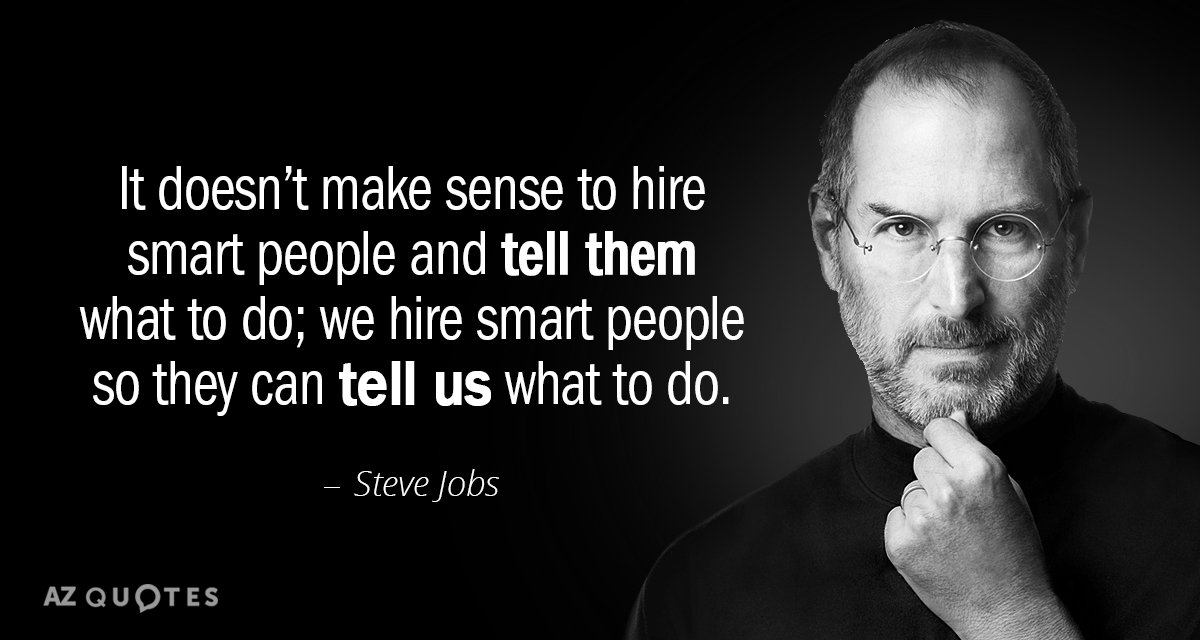
The best leaders surround themselves with intrinsically motivated individuals who will not only perform at a high level with little oversight but will also push the leader to reflect and grow continually.  One of the most important decisions a leader can make is either through hiring new employees or placing current staff in a position to lead change even if he or she doesn’t have a specific title.  Steve Jobs famously said, “It doesn’t make sense to hire smart people and tell them what to do; we hire smart people so they can tell us what to do.” Don’t ever think you have the best ideas or answers because you don’t. If you work with someone who thinks he or she does, then that person is not a leader.  Leadership means we must be willing to check our pride at the door if leading change and success are the ultimate goals.


Always try to hire or surround yourself with people that are smarter than you. This should be the most natural part of a two-step process.  The next step requires giving up some control and trust.  It is this next step where great leaders get out of the way of people who have been empowered for their respective expertise. When I think back to my time as a principal, I tried hard to embody this.  When a math position opened many years ago, I hired Kanchan Chellani.  She didn’t tell me what to do per se, but little did she know that her actions did.  Her ability to effectively implement and model flipped learning in a pedagogically-sound way sent the message to me as a leader that I needed to work better to support the rest of the math department in this area. 

Another great example was the hiring of Laura Fleming.  I desperately needed an innovative leader in the library who could transform the space in a quick amount of time.  She hit the ground running and had full control over her budget and the autonomy to make any decision related to the space that would benefit our learners.  Successfully launching a makerspace was what she is known for, but her real impact was how she empowered learners regardless of labels and perceived abilities to find success in ways that they never had.  Laura not only transformed the space but her actions and resolve helped to transform the entire learning culture of the school and ultimately the district. Her creation of a micro-credential platform came well before any companies began to monetize them and pushed our teachers to learn in different ways regardless of time or place.

Being told what to do can come in many forms. Laura and Kanchan represented just two of the many teachers that I hired as a principal who indirectly told me what I should do through their actions.  There were also may other teacher leaders, as well as members of my admin team, who were not only wicked smart but also leveraged the professional relationship they had with me to guide me in a better direction at times. Depending on others for guidance and wisdom is not a sign of weakness. On the contrary, it a definitive sign of strength. Effective leadership relies on making smart decisions. Make it easy on yourself. Hire or surround yourself with smart people, get out of their way, and don’t be afraid to let them “tell” you what to do. You need these people in your circle if you want to succeed as a leader. 


When it comes to leadership and people:
  1. Hire or surround yourself with smart people.
  2. Listen to them
  3. Get out of their way
  4. Leverage their expertise
Enough said.

Below are some more of my thoughts.


Sunday, July 17, 2016

Critical Conversations

We are in the midst of disruptive change that is engulfing our society. The second we get a grasp on a new technology there is an update, new version, or something entirely different. It is an exciting, yet terrifying time as many of us just try to keep up. This is the new normal in our world and advancements in virtually every field and profession will continue at an exponential rate. As educators you don’t need to like technology, but you do have to accept it. The reality is that not just technology, but an array of innovative ideas, are constantly at our fingertips. 

The disruptive changes we are seeing provide an opportunity to reflect on what we are in order to help better determine where we want to be. Taking all of this into account, how well are you meeting the needs of today’s learner? I ask this question in virtually every workshop I facilitate.  The responses run the spectrum from not very well to some pretty innovative ways.  Overall many schools, administrators, and teachers are quite content with where they are currently at in regards to meeting the needs of learners in the digital age.  Make no mistake about it, real change is happening in many schools, mostly in the form of isolated pockets of excellence.  


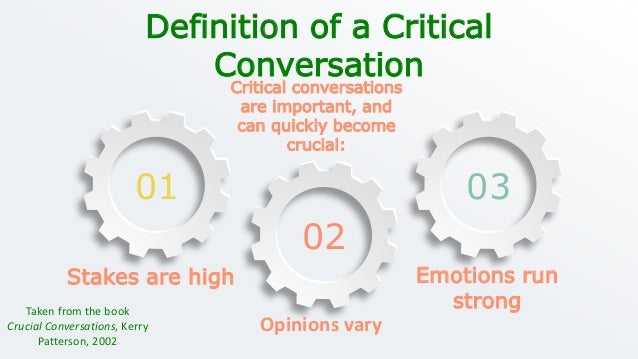
Image credit: http://www.slideshare.net/ccalahan/critical-conversations-54644002

The question above provides a great initial point of reflection as to where you are at with your change and transformation efforts. However, it falls short in terms of determining how well we are really doing as we are jaded by our own perception at times. Even though we might think we are doing a great job this might not be the reality of the ones we serve. The real question to drive meaningful change in our schools is asking our students how well we are meeting their needs. It is important to at first listen and then begin to take action on some of the thoughts and ideas they provide. They are, after all, our number one stakeholder and true boss.

If you want real change engage your learners in critical conversations about your school, district, or classroom experience. Even if you are integrating all of the latest technology, chances are teaching, learning, and leadership have not changed to allow for a transformation of school culture. Continue these conversations with your students throughout the school year by making it an embedded component of your professional practice. It will be difficult at first to hear from your students some of the issues that they have with the learning culture at your school. Over time though the relationships that are built through this honest dialogue will help drive the right changes that are needed.

For more tips on how to engage others in critical conversations click HERE.

Sunday, March 20, 2016

L .E. A. D. E. R.

"The greatest leader is not necessarily the one who does the greatest things. He is the one that gets the people to do the greatest things."  - Ronald Reagan

Lately I have really been focused on what true leadership actually is. Many times when I come across the word leader I see the word follower attached. In my opinion, leadership is not about attracting others to follow. To me, at least, this conveys a sense of power, authority, and control that might serve well in the short term by getting others to fall into line through conformity, but it doesn't create the conditions necessary for sustaining change.  I believe the definition and resulting perception of the term leader needs a makeover. 


Image credit: https://vladimerbotsvadze.files.wordpress.com/

Great leaders don't tell people what to do, but instead take them to where they need to be. There is no agenda to create a harem of followers or disciples.  True leaders know that their success is intimately tied to the work of the collective. One person doesn’t win a war, election, or football game.  It is a team approach where each person in the organization knows that he or she has an important role to play. I can also say with certainty that one person doesn’t single handedly build a successful business. This same principle definitely applies to schools and districts.  As I have written in the past, leadership is all about action, not position.

As an attempt to further begin the process of redefining the term leader I developed an acronym based on my thoughts shared above. The best leaders do the following on a consistent basis:

Learn 

Empower

Adapt 

Delegate

Engage

Reflect

Learn – Learning is the work. Great leaders take professional growth seriously as they know there is no perfection in any position, just daily improvement. Leaders make the time to learn and get better on a daily basis. They also make their learning visible to inspire others to follow suit. Leaders who lover their work are always learning.

Empower – A key element of effective leadership is to empower others to take risks, remove the fear of failure, and grant autonomy to innovate.  People that are empowered find greater value in the work they are engaged in. Empowerment leads to respect and trust, which builds powerful relationships where everyone is focused on attaining specified goals.

Adapt – Everything can change in a heartbeat.  As such, leaders must embrace a sense of flexibility and openness to change accordingly in certain cases. The ability to adapt to an array of situations, challenges, and pressures are pivotal to accomplish goals. Success in life is intimately intertwined into an organism’s ability to adapt in order to survive. As leaders adapt they evolve into better leaders.

Delegate – No leader can do everything by him or herself. The decisiveness to delegate certain tasks and responsibilities is not a weakness. On the contrary, it allows leaders to apply more focus to areas of greater importance.  It also builds confidence in others in their ability as co-leaders of an organization even if they don’t have a fancy title.

Engage – In the sharing economy there might not be anything more important than information. Leaders understand this fact and develop strategies to authentically engage their stakeholders through multi-dimensional communications, by taking control of public relations, and developing a positive brand presence. Increased engagement results by meeting stakeholders where they are at, encouraging two-way communications, and becoming the storyteller-in-chief. 

Reflect – It is quite difficult to find a great leader who does not reflect daily on his or her work.  Reflection in a digital world can take many forms and results in greater transparency. It is not how one chooses to reflect, but an emphasis to integrate this process consistently that defines a great leader. 

This is my stab at an acronym for L.E.A.D.E.R. that better identifies the characteristics, attributes, and mindset to create a much better meaning for the word. What are your thoughts on this? Are there any words you would replace for the ones I included and if so why?