Showing posts with label educational leadership. Show all posts

Sunday, June 25, 2023

Leading for Sustainability

Leadership embodies consistent qualities and characteristics that remain unchanged while the tools, research, and societal shifts influencing the work have evolved. Leadership combines artistic and scientific elements, aiming to mobilize people toward a shared objective. Despite my extensive writing on the subject, I continuously seek additional insights to assist others, including myself, in excelling in this role.


Co-create a vision

A shared and co-created vision has the potential to transform an organization's culture. However, true leadership lies in progressing from the visioning process to developing a strategic plan that transforms the vision into reality. While a shared vision is an attribute of great leaders, the best leaders ensure the formation and meticulous implementation of a strategic plan. A vision must be accompanied by a plan that directs the change initiative, and this plan should be monitored and evaluated for sustainable, transformative outcomes.

Establish boundaries

Leaders understand that an unregulated environment will not facilitate necessary change. Establishing boundaries helps align everyone with the vision and agreed-upon actions. Setting norms, though not overly restrictive, fosters an environment where people feel comfortable taking risks. Boundaries are crucial for establishing and maintaining relationships, as trust is the foundation for effective relationships, learning, and change.

Leverage intrinsic motivators

I recommend reading Dan Pink's book, "Drive." Extrinsic rewards are problematic as they create an expectation and seldom result in lasting cultural changes. As Pink revealed, autonomy, mastery, and purpose are the keys to unlocking and sustaining intrinsic motivation. Exceptional leaders assist others in recognizing the value of their work and the transformative potential it holds for their professional growth.

Navigate

Similar to plotting a course when a ship sets sail, leaders determine the direction by establishing practical and achievable goals that are clearly communicated. Effective communication is an essential trait of a successful leader. Without a clear understanding of their current position or the desired destination, the chances of success become limited.

Be an Example

Leadership is about action, not merely position, title, or power. Effective leaders do not command others but guide them to where they need to be. Leaders must model the behavior they expect from others and be an example. 

Build Capacity

Sustainable change cannot be sustained by a single individual. Although an individual can initiate the process, it requires a collective effort to make change stick. Delegation and trust-building empower others to actively participate in the process. Leadership is a collaborative endeavor.

Own Mistakes

Mistakes are inherent to being human, and admitting and owning them is crucial for establishing a culture of trust. Own your mistakes, but do not allow them to define you. Additionally, do not dwell on the mistake but rather focus on the lessons learned.

Tackle Challenges

Challenges come in various forms, whether it's a small percentage of individuals causing the majority of problems, unpopular decisions, resource constraints, or diminishing support. Effective leaders do not shy away from addressing these challenges, recognizing that leadership is not a popularity contest.

Overcome Fear

We all have fears, but they should not hinder our professional growth. Fear of the unknown or failure often holds us back from embracing change. I can’t stress enough the importance of facing our fears rather than running away from them. Choices shape our lives, and succumbing to fear prevents us from reaching our full potential. Embracing risks may lead to failure, but it also offers valuable learning experiences through reflection, enabling improvement in practice and personal growth.

Scalability

Leaders are evaluated based on their ability to guide their organizations to achieve and sustain success at a macro level. It is a calling and responsibility to propel a culture forward for improved outcomes in ways that are scalable. Effective leaders prioritize efficacy in ideas, strategies, decisions, and programs while embracing accountability. The result is scalability. 

Patience

Leadership is not an isolated event but an ongoing process. Meaningful change seldom occurs rapidly, and transforming a culture requires time and patience. While urgency is necessary for certain aspects, system-wide results and achievements take time. Setting expectations and goals while understanding that they may take years to fully materialize is essential.

Leadership is a demanding task, and achieving effectiveness in it is more challenging than mere words suggest. It's important to recognize that perfection and constant peak performance are not required. However, the key responsibility lies in assisting others in attaining a shared objective that yields tangible outcomes. Are you ready to embrace this challenge?


Sunday, July 5, 2020

Don’t Forget About Educator Safety When Reopening Schools

We are all in the midst of some very challenging times, regardless of our profession. When it comes to education, schools are grappling with reopening safely here in the United States. There are no easy answers or choices here.  As schools across the country are now virtually all closed for summer break, preparations are being made, and hopefully, comprehensive plans are being developed. However, in the midst of all of this, COVID-19 cases are rising in many states. Those planning to begin reopening in phases have pushed the pause button. On top of it all are conflicting messages about what is the best course of action.

When it comes to students, the American Academy of Pediatrics (AAP) has come out strongly in favor of schools having students return to the classroom in the fall despite the ongoing risks associated with COVID-19, as reported in the Huffington Post. Below is an excerpt.
"The AAP strongly advocates that all policy considerations for the coming school year should start with a goal of having students physically present in school," the group said in an update to its guidance for school re-entry. The guidance asserts that "the importance of in-person learning is well-documented," and that evidence already has emerged of "negative impacts" on children due to school closures in the spring.
It is tough to deny the negative impacts the pandemic has had on kids such as learning loss, widening achievement gaps, social-emotional issues, and in some cases, a lack of physical activity and proper nutrition. Education Week provides a wealth of information and resources for schools in this recent piece focusing on developing the right schedule to meet the student needs. The bottom line is that schools need to reopen for their sake, but at what cost? As much as kids need to be in school learning, there is mounting pressure and concerns, rightfully so I might add, from adults who fear for their health and safety.


A recent story from ABC News highlights the fear and frustration felt by many educators.
Some teachers around the country say they are nervous about returning because of underlying health conditions or concerns about infecting family members. Others say they are frustrated by the lack of clear guidance from officials about what's safe. And for some, it's about child care if their own kids are only back at school for a handful of days during the week. The result is an inevitable clash between leaders pushing aggressive reopening policies in states like Texas and Florida and teachers, some of whom say local officials need to think more about what they are asking teachers to do.
All re-entry plans must emphasize health and safety above all else, something that I highlight in this post. The process should be a collaborative one that enlists the input from teachers, students, administrators, and community members. Any plan that actually succeeds in helping people feel at ease about reopening schools will incorporate many of the ideas that the group decides upon based on consensus.


No matter how great the planning process is, the result won't be perfect or even acceptable for all. As many districts and schools are considering hybrid-learning models for kids that incorporate flexible schedules and choice, the same should be offered to teachers who are experiencing the issues laid out in the ABC News piece.  It is difficult for me even to suggest what this should look like. However, think about the different options and choices your district or school is offering students and adapt accordingly to teachers. A one-size-fits-all approach just won't cut it, and we owe it to them, to our teachers, to do everything possible to support them as they come back to work, whatever that form might be. Strong and compassionate leadership will be critical to ease concerns while developing a successful plan for reopening.


It's not just teachers we need to worry about, but also administrators and every other adult who is asked to work in a building.  Considerations should also be made for these people if the same COVID-19 concerns are prevalent.  The challenge and inherent opportunity are to begin to think about what types of work have to be done in-person and those that can be completed remotely.  

The time is now to put all the cards on the table while considering various options for staff that need them. Forcing anyone into a painful or uncomfortable decision because of COVD-19 risks, both direct and indirect, must be avoided. If not, then we might very well see a mass exodus of educators this school year.

Sunday, June 28, 2020

Leading in Uncertain Times

The concept of leadership hasn’t changed, although the conditions under which leaders work and learn sure have. Prior to COVID-19, the vast amount of uncertainty in education lay in societal changes resulting from the 4th Industrial Revolution. The world of work was being disrupted right before our eyes. A rapid evolution in artificial intelligence, automation, and advanced robotics should have served notice to anyone in the education space that things needed to change. No longer did a “this too shall pass” mantra carry any weight.  In the end, though, scalable change resulting in a transformation of teaching, learning, and leadership was more of an exception as opposed to the rule.

Then the COVID-19 pandemic came crashing down on the world.  Schools were not prepared, as nearly no one could have envisioned the mass closings for extended periods of time.  Triage resulted as educators valiantly put remote learning plans in place while attempting to overcome a myriad of challenges.  Curriculum must be revised, assumptions are taken head-on, and a school culture that focuses as much on equality and equity as it does everything else.

The bottom line is that the world has been turned upside down, and this is not necessarily a bad thing. In times of uncertainty, strong leadership is needed more than ever.  


Embrace vulnerability

It is a misconception that being vulnerable means you are weak.  On the contrary, it is a sign of strength. Brene Brown shares the following in Dare to Lead, “vulnerability is the emotion that we experience during times of uncertainty, risk, and emotional exposure. It is having the courage to show up, fully engage, and be seen when you can’t control the outcome.” Leaders use this as a tool to build strong relationships with the people they work alongside by making known what is going on in their heads. As the saying goes, …sharing is caring.

Demonstrate empathy

Empathy is the ability to understand and share the feelings of another. I shared the following in a previous post, “As leaders, it is important for us to imagine ourselves in the position of our students, staff, and community members. This gives us a better perspective on the challenges and feelings of those we are tasked to serve. Better, more informed decisions can result from “walking in the shoes” of those who will be most impacted by the decisions that we make.” Empathetic leadership builds trust and helps to create a culture where change will be more readily embraced in uncertain times. 

Exhibit courage

Now is the time to challenge assumptions, tackle bias, take risks, and make bold decisions. To move forward with needed change, we need leaders who are able to persevere in the face of uncomfortable situations and not back down when things get difficult. Don’t be afraid to step outside your comfort zone.

Be a great listener

There are many ways to earn respect and build trust, both of which are needed to get change efforts off the ground. Active listening helps to accomplish both while opening up a leader to new ideas, strategies, and feedback. Research has shown many positive outcomes associated with excellent listening skills.

Health & safety first

As we continue to move forward in unprecedented times, the pandemic has made painfully clear that health and safety must supersede everything else.  Closing achievement gaps and addressing learning loss will always be critical, but in challenging and disruptive times, leaders must emphasize Maslow’s over Bloom’s.  

Model the way

Leadership is not about telling people what to do. It’s about taking them where they need to be. Don’t ask others to do what you are not willing to do yourself. Empowerment rests on leading the way through observable actions. Modeling helps to instill belief.

Ask questions

No one has or will ever have all the answers. To assume as much is unrealistic, to say the least. One could even say that there are no definitive answers in uncertain times.  The best leaders ask questions, and the more of them, the better. Developing, asking, and following up on the right questions can lead to answers that will help usher in the changes that are needed now and in the future.

Provide support

Support can come in many forms, such as resources, time, and professional learning opportunities.  It can also manifest itself through many of the points listed above, such as showing empathy, listening, putting safety first, and modeling.  Leaders need to determine what types of support they can readily provide as well as those that need to be acquired, such as needed professional learning on personalized/blended learning, purposeful use of technology, relationships, Tier 1 instruction, and digital leadership, to name a few areas.

Relentlessly communicate

You will not find an effective leader who is not an effective communicator. It’s all about getting people the right information at the right time through the proper means. During uncertain times you can’t communicate too much. Digital leadership is essential, and it compels us to meet our stakeholders where they are while employing a multi-faceted approach.

Learn from the past

A great deal has been learned since the onset of the pandemic and the social justice movement. We can ill afford to continue to do what we have always done and expect a different or better result that aligns with reality. Critical lessons have been learned, which can lead to new opportunities to transform teaching, learning, and leadership.  Leaders need to make sure past mistakes are not repeated.

None of us know what the future holds in the face of these unprecedented times.  What we do know is that schools and educators need leaders to guide them in ways that help to subdue the fear and confusion that naturally arises during uncertain times. Leaders set the tone, and they are needed more than ever to step up and accept this responsibility.

Want to learn more? Check out the presentation I did on the topic below. 

Sunday, April 19, 2020

Leading in a Remote Learning World

It goes without saying that our teachers have done an incredible job when it comes to adapting to a remote learning world.  With little to no training, they are finding ways to make it work for their kids while overcoming a myriad of challenges in the process.  You could even say that they are the true leaders in a sense as their actions are leading to innovative change.  Administrators are also playing their part and rising to the occasion. Countless hours were spent planning once it was clear that schools would be shut down for an extended period of time.  Now more time is being spent refining plans as lessons are learned and, in some cases, are prepared for schools to be closed the remained of the year.


Flexibility and an Empathetic Lens

Everyone needs to understand that there is no one right way to implement remote learning. I can’t even say that mistakes are being made as this is uncharted territory for virtually everyone.  The best advice I can provide is to understand that making teachers go through the motions like it is a typical school day might not be the best course of action.  It is vital to take into consideration the pressure this is not only placing on them at home with their kids but also parents who are now working remotely. Adjustments are continually being made, and schedules are always in flux.

Additionally, teachers need to have the autonomy to make changes as needed while providing the right balance between synchronous and asynchronous instruction.  Try not to lock everyone into a one-size-fits-all plan. Regularly reflect on what is and isn’t working, adapt, listen to concerns, and most importantly, do what’s best for all the kids that you serve. In the end, flexibility will lead to success and is a hallmark of empathetic leadership.

Learn what others are doing

In times of crisis and disruptive change, you don’t need to reinvent the wheel.  By embracing digital leadership, you can connect with others near and far to find out what has been successful in other districts or schools and also veer away from roadblocks that others have encountered. So many resources are being shared daily on Twitter, Facebook, Instagram, LinkedIn, and Pinterest.  You can either lurk and learn or develop your own Personal Learning Network (PLN) to farm the best ideas and strategies that are actually working in similar demographics. 

Realistic and Fair Grading

I will admit that I am on the fence with this one.  In a previous post, I recommended that grading kids should be avoided as many have yet to complete one assignment since schools closed, and there are equity issues at a scale most have never seen before. However, I also recognize the need to help justify many of the remote learning plans in place and to support high school students, especially seniors, as they prepare for graduation.  The bottom line is there is no easy solution here. Work with teachers and other support staff to develop a responsible and equitable policy. Try to ensure that there is new content presented in a manageable fashion where students then have multiple opportunities to practice and then apply what has been learned.  Consider also eliciting feedback from parents and students themselves to create a policy that realistically and fairly depicts what has been learned.

Connect with families

You will not find an effective leader who is not an effective communicator.  In times of crisis, families need just as much support, empathy, and flexibility as teachers and students.  In Digital Leadership I recommend that all leaders consider using a multi-faceted approach that blends both digital and non-digital strategies to get the required information and updates to all stakeholders. This definitely applies now. When using social media, think about the platforms being used and mix it up by mashing together text, hyperlinks, images, and video.  Take a risk and make yourself vulnerable by delivering light-hearted messages using Snapchat and TikTok. Consider a daily or weekly YouTube video that can be embedded in a mass email to showcase how teachers are successfully implementing remote learning.  The bottom line is that you cannot overcommunicate.  

Provide professional learning support

A recent article highlighted how many teachers don't feel prepared for remote learning.  Just because schools are closed doesn’t mean professional learning should stop, especially now.  Funds have been allocated this year to provide this support for both teachers and administrators. As remote learning is a new venture for most, it is crucial to ensure that sound instructional techniques and pedagogy are embraced.  There is no better time than now to implement personalized and blended learning pathways, which really cater to a remote learning environment.  In cases where there is not equitable access, teachers need support developing and implementing non-digital strategies that challenge kids to think and apply their thinking in authentic ways.

Think about converting what would have been a face-to-face day to a virtual one.  I myself have facilitated several virtual presentations and coaching sessions with schools in lieu of being there on-site.  At Aspire Change EDU, we have modified all of our services for virtual delivery. Don’t hesitate to reach out if you want to get some more information on what can be done for your school or district. 

Make sure kids are safe

Many educators have embraced live video platforms such as Zoom and Google Hangouts/Meets. It is important that leaders make sure that requirements set for by COPPA and FERPA in the United States are being met (or the equivalent in other countries). What this means, in a nutshell, is no sharing of student information or identifiable features without permission.  In my opinion, teachers should be advised not to share video conferences or pictures from such sessions online regardless of whether or not waivers have been signed. Leaders should also update parents on the dangers of social media and online games since more and more kids are spending time in these spaces, thanks to social distancing.

Don't ignore self-care

These are stressful times for teachers. Leaders should be cognizant of this fact and encourage their staff to make time to take care of themselves.  In a previous post, I shared some ideas on how to build this in daily. It also goes without saying that leaders themselves should prioritize self-care to model for others.

Success in a remote learning world will require bold and courageous leadership.  As you grapple with decisions that have to be made, realize that everyone else is in the same boat.  Constantly reflect on where you are, but also where you want to be when the crisis ends.  The lessons learned today can help to build a brighter future and culture once schools reopen.

Be sure to check out my entire #remotelearning series. 

Sunday, February 16, 2020

Knowing Where We Are Paves the Way for Change: The Impact of Coaching

I often tell audiences during keynotes and workshops that my role isn’t to tell anyone what to do, but instead to get educators to think critically about what they do. It would be foolish of any speaker or presenter to do so, considering that we don’t really know the people who we are blessed to speak with, let alone the specific culture in which they work.  The fact for many in education is that we teach the way we were taught and lead the way we were led.  In some cases, this might still be effective. However, the opposite is more often true, and helping others come to this realization can be a tricky process.

Where I see the most change from my work is when I am fortunate to work with districts and schools on an on-going, long-term basis. This allows me to really get a pulse on the culture, understand the challenges that are faced, make observations, collect evidence as to where practices are, and ultimately build relationships in the process.  Trust and honesty are key, which compels me not to hold back when engaging both teachers and administrators in dialogue on feedback.  Often, we are blinded by our own bias or comfortable where we are. No matter the case, both can be detrimental to growth.


So how do we begin to move the needle? It starts with analyzing how feedback is given.  What I have learned from past experiences, and currently, when working in schools, is that a tendency remains to tell people what they want to hear as opposed to pushing them with critical conversations on practice. The latter might sting at first, but it is needed to create a sense of urgency.  Making people feel good is always crucial, and a critical component of a positive culture. However, it shouldn’t come at the expense of shying away from the problematic and thought-provoking conversations that are needed to drive change at the individual and systemic levels.  

One of the best ways to help others know where they are and lay the groundwork for meaningful changes to practice is through coaching.  Currently, I have several projects around the country where I have assumed this role. Last year alone, I visited over 1000 classrooms and pretty much followed the same process.  At the conclusion of each day, I submit a detailed report that contains general commendations and recommendations for growth to each school. If I am there for an extended period of time, the district receives a comprehensive report within 24 hours of completing my last school visit.


In addition to general feedback, I script what I see by classroom while aligning evidence to support the ratings for how I chart data across five indicators. This allows me to provide some simple data for districts and schools to get an idea of where their practices are. Here is how I code each lesson after scripting and providing recommendations for growth:
  • Rigor Relevance Framework Quad alignment (A, B, C, D)
  • Engaged (E) or disengaged (DE)
  • Tech (T) or no tech (NT)
  • Teacher-centered (TC)) or student-centered (SC)
  • Student agency: High (H) vs. Low (L)
Now, these are meant to be black and white in terms of whether it can be seen or validated with evidence (i.e., questions, assessments, tech used by kids for learning, student work, etc.). However, I always stress that there is gray inherent in what I provide and encourage dialogue and support between coaching visits. It goes without saying that these visits are just a snapshot and, by no means, are indicative as to what happens during the entire lesson or regularly throughout the year. It is up to the school and individual educators to make that determination. There is one non-negotiable that I establish, and that is an administrator or teacher who has to accompany me. The reason being to coach the individual(s) later on providing feedback and to ensure interrater reliability (do we see the same thing).

I am fortunate to be involved in several long-term projects where I have been able to document growth over time. Over the years, I have shared all of the wonderful things happening at Wells Elementary, as I am now in my third year as their coach. Other schools and districts are beginning to follow suit. One, in particular, is the Corinth School District in Mississippi. The stage was set over the summer for me to work six days in each of their three schools to assist with teaching, learning, and leadership associated with their 1:1 implementation.  Following the protocol described above, I facilitated coaching days.

Even though I have a few stories of significant growth to share, I want to focus on just one. During my first visit to the high school in August, I spent the entire day visiting classrooms and then providing feedback to the admin team. They, in turn, then shared recommendations for growth with their teachers.  One teacher took the feedback and ran with it. 

The next time I met with the teachers, I facilitated a workshop on digital pedagogy.  Something from this day and the feedback from the classroom observation clicked him. During my third visit, we saw him implementing a choice board with his economics class. Going from direct instruction primarily to this high agency approach represented a dramatic shift in practice.  I again provided feedback both in the form of commendations and recommendations for improvement, specifically when it came to assessment.  I can’t begin to tell you how pleased and excited I was during my fourth visit. When we visited his history class, he again had the students working on a choice board. The main difference from last time was that there were six different rubrics to go along with the activity.  


The growth story of this teacher is one of many in the Corinth School District. His colleagues across all content areas at the high school have begun to implement an array of innovative strategies such as station rotation, choice boards, self-pacing, digital check-ins with students, and the purposeful use of technology aligned to effective pedagogy.  The middle school has begun to make impressive progress with blended learning, especially at the 6th-grade level. Last but not least is the elementary school where evidence has been collected, demonstrating tremendous growth with high agency strategies.  To be honest, I could fill this post with picture after picture as validation.

We can’t allow ourselves to stick our heads in the sand or cuddle up to the status quo.  Sometimes a push is needed. In all the schools I work in, the catalyst for change is always the first coaching visit.  Using an unbiased and non-judgmental lens, the stage is set for assisting educators in coming to a determination as to where they are.  Initially, this can be a tough pill to swallow. However, the fact remains that nothing about public education is perfect. Sometimes it takes an outside view to help come to that realization.

If you would like to know more about our coaching process and on-going work for schools or districts, shoot me an email (esheninger@gmail.com).

Sunday, September 8, 2019

10 Ways to Empower Educators

What motivates you to be your best, take risks, and seek out opportunities to improve?  I’d be willing to wager that there are an array of responses you would give to this question. As such, I am going to try to sum it all up with one word or concept, depending on how you look at the actions that create this feeling.  Empowerment is the secret sauce.  I genuinely believe that you get more out of people by building them up as opposed to knocking them down. I love the following quote from Laura Garnett:
Leadership is shifting from telling everyone what to do to empowering others to come up with the best and brightest ideas that have either never been thought of before or implemented and acted upon in a respective environment. It’s about caring for and instilling a sense of belief in others that leads to greater confidence in one’s abilities as well as the place where he/she works or learns. This is how you empower people to be their best.
Empowerment isn’t just about making people feel good but more importantly valued.  It’s in this state where a vision, mission, and goals can actually become a reality as there is a unified desire to succeed.  Consider this from Brian Tracy:
Once you empower people by learning how to motivate and inspire them, they will want to work with you to help you achieve your goals in everything you do. Your ability to enlist the knowledge, energy, and resources of others enables you to become a multiplication sign, to leverage yourself so that you accomplish far more than the average person and in a considerably shorter period of time. 
So how can you empower others? It’s not as hard as you think. Below are some simple ways to create a culture of empowerment:
  • Be present during conversations (eye contact, body language, devices away)
  • Provide timely, meaningful, and specific feedback
  • Say thank you when the opportunity arises
  • Distribute praise equitably and away from yourself
  • Model what you expect
  • Speak less and listen more
  • Provide the autonomy to take risks
  • When making decisions utilize consensus as much as possible
  • Exhibit sincerity when complimenting others
  • Co-develop professional learning opportunities that best meet the needs of all


Never underestimate the impact that the above strategies can have.  Consider this thought from Archie Snowden:
To empower someone is to give them the means to achieve something.” It makes them stronger and more confident, ready to take control of their life and to also be an advocate for themselves. 
In the end, it is all about giving the people you work with (educators) or for (learners) a greater sense of purpose in what they do.

Sunday, June 9, 2019

Lead in the Now

“When you finally let go of the past, something better comes along.” – Anonymous

There are many reasons why we tend to fall back on what we are either comfortable with or have always done.  For one, comfort tends to be the enemy of growth.  In other cases, the fear of failure of the unknown can derail us from taking the needed risks to implement new and better ideas.  Then there is the most dangerous view in education that the way we have always done it is the best way.  One last factor has to do with our experiences.  We tend to teach the way we were taught and lead the way we were led and, in a sense, become victims of our past. My point here is that change can be hard, confusing, scary, and unpredictable.  None of these reasons should stop anyone from doing what’s best for kids.


With changing times, continuous reflection and learning are needed in order to move schools forward now.  As I have said over and over again, the world is changing. Jobs are changing. Expectations are changing.  As such, teaching, learning, and leadership must change if growth and improvement are the goals.  It requires all leaders, regardless of title, to seek out answers to crucial questions that can pave the way for innovative ideas aimed at improving outcomes for all learners while fostering better relationships with stakeholders.  The image below can help you get started with this process.

I am not implying that we throw out the baby with the bathwater, but instead work to do what we already do, better. Here is where the Pillars of Digital Leadership come into play.  


Each of the seven outlined below are either embedded components of school culture or an element of professional practice that leaders already focus on (or should be). Innovation in education is, in many cases, not an entirely new idea, but instead doing what we already do better. Let’s look at these Pillars and ways that we can lead in the now:

Student engagement, learning, and outcomes: We cannot expect to see increases in achievement if students are not learning. Students who are not engaged are not likely to be learning. Engagement is not a silver bullet, though. Students need to be empowered to think at the higher levels of cognition while applying what has been learned in relevant contexts. Leaders need to understand that schools should reflect real life and allow learners the opportunity to use real-world tools to do real-world work. As technology changes, so must pedagogy, especially assessment and feedback. Leaders should always be looking to improve instructional design and establishing accountability protocols to ensure efficacy in digital learning. 

Innovative learning spaces and environments: Would you want to learn under the same conditions as your students do, or in similar spaces? More often than not, the answer is no. Research has shown the positive impact that innovative spaces can have on learning outcomes. Leaders must begin to establish a vision and strategic plan to create classrooms and buildings that are more reflective of the real world while empowering learners to use technology in powerful ways through either personalized or blended strategies and increased access in the form of BYOD or 1:1. 

Professional learning:  Research has shown, and continues to show, that job-embedded, ongoing professional learning results in improved learning outcomes.  This needs to be prioritized. Additionally, leaders need and should want access to the latest trends, research, and ideas in the field. With the continual evolution of digital tools and increasing connectivity, schools can no longer be silos of information. All educators can now form their own Personal Learning Network (PLN) to meet their diverse learning needs; acquire resources; access knowledge; receive feedback; connect with experts in the field of education as well as practitioners; and discuss proven strategies to improve teaching, learning, and leadership. Digital leadership also compels educators to create more personalized learning pathways for adults during the school day and year. 

Communication: You will not find an effective leader who is not an effective communicator. Leaders can now provide stakeholders with relevant information in real time through a variety of devices by meeting them where they are. No longer do static, one-way methods such as newsletters and websites suffice.  A variety of types of information can be communicated through various tools and simple implementation strategies to create a more transparent culture. 

Public relations: If you don’t tell your story, someone else will, and more often than not, another’s version will not be the one you want to be told. Leaders need to become the storyteller-in-chief. Leaders can use free social media tools to form a positive public relations platform and become the de facto news source for their school or district. It is time to change the narrative by sharing all of the positives that happen in schools every day to create a much-needed level of transparency in an age of negative rhetoric toward education. 

Branding: This is how your school or district is defined. It is not something that you want to leave up to others. Businesses have long understood the value of the brand and its impact on current and potential consumers. Leaders can leverage social media to create a positive brand presence that emphasizes the positive aspects of school culture, increases community pride, and helps to attract/retain families looking for a place to send their children to school. Tell your story, build powerful relationships in the process, and empower learning with a brandED mindset. 

Opportunity: It is vital for leaders to consistently seek out ways to improve existing programs, resources, and professional learning opportunities.  It requires a commitment to leverage connections made through technology to take advantage of increased opportunities to make improvements across multiple areas of school culture. The other six pillars connect and work together to bring about unprecedented opportunities that would otherwise be impossible, such as securing donations, resources, authentic learning experiences for students, and mutually beneficial partnerships. As Milton Berle says, "If opportunity doesn't knock, build a door."

In the updated edition of Digital Leadership, I take readers on a deep dive into each pillar while providing pertinent research and evidence to better lead in the now as opposed to the past. Be sure to check out the video below that adds additional context on each as well as practical implementation strategies.


For even more insight, ideas, and strategies, you can take a listen to one (or all) of the following podcasts read an interview transcript that emphasizes how to lead in the now effectively. 
If the goal is a relevant culture of learning, then leaders must begin by modeling that at the individual level. Only then can the arduous, yet gratifying, process of systematic change can occur. 

Sunday, June 2, 2019

The Problem With Zeros

The dreaded zero. For many students, this number elicits a certain amount of fear and anxiety that all assignments are turned in on time. I, for one, felt this way and made sure that everything was turned in when it was due.  Compliance and following rules, even if I didn’t agree with them, were just natural parts of my view of school.  Unfortunately, the effect does not transcend to every kid. Sometimes they forget. Other times they just don’t care. Regardless of the reasons, I think it is essential to critically examine the message and lesson that we are imparting to our youth through this outdated and, quite frankly, insensitive practice. 

The policy for giving zeros to students who do not turn in assignments when they are due has pretty much been entrenched in schools across the world. It is one of many examples that fall into what I call the “death trap” in education – that’s the way we have always done it.  Just because something has been done in the past, or is a traditional component of school culture, does not mean it is an effective practice.  In my opinion, it is well beyond the time to revisit this practice and determine if it truly is in the best interests of our learners.  Take the scenario below shared by Powers Thaddeus “Teddy” Norrell.
Emily is an engaged student who always pays attention in class, has a high class rank, and has never made a grade lower than an A. Emily’s first four grades in physics are 100, 99, 99, and 98. Emily is set to have a 99 average for the term. However, she has had an unusually busy week, and when she arrives at school on the morning the final assignment is due, she realizes that she has completely forgotten to do it. She explains her situation to the teacher and begs to be allowed to turn it in the next day. The teacher is unsympathetic and assigns Emily a grade of zero for the final assignment, telling her that this will prepare her for the “real world.”
Let’s examine the last statement regarding preparation for the real world. Correct me if I am wrong, but in education, teachers and administrators don’t receive zeros if they:

  • Don’t arrive to work on time.
  • Fail to meet a determined deadline (i.e., turn in lesson plans, complete all observations/evaluations by a set date, etc.)
  • Don’t read or respond to email and as a result, are unprepared for meetings or don’t get needed information to colleagues when required.
  • Forget to call parents back

Now other professions might have stricter accountability, but more often than not, there is leeway.  The question then becomes what message or lesson are we really teaching students by giving zeros? If learning and growth is the goal, then it is our responsibility to tackle this issue as the negative impacts on our learners far outweigh the need to make an example or fall back on the “preparation for the real-world” rationale. 


As a principal, I worked with my staff to tackle this issue as well as the overall practice of grading. I’m not going to lie; it was one of the hardest change initiatives I ever engaged in during my tenure as principal. Now I am not saying our solution was perfect or the best by any means. However, it did represent a step in a better direction in that we focused more on learning as opposed to grades and marks. You can see the specific changes and associated rationale for our revamped grading philosophy HERE. Below is what the committee came to a consensus on in regard to zeros:
No zeros: Students are not to be assigned a grade of zero (0).  This not only reflects grading as punishment but also creates a hole that students cannot dig out of (Guskey, 2000; Reeves, 2004; Reeves, 2008; O'Conner and Wormeli, 2011).  This includes HW, quizzes, tests, projects, etc.  An exception to this would be cases that involved cheating, plagiarism, or a midterm/final exam no show without a justifiable excuse (i.e., doctor’s note, death in the family, etc.).
For some practical alternatives to dishing out zeros check out the latter portion of the article by Norrell titled Less Than Zero. It is important to determine why students don’t turn in specific assignments such as homework and projects as a way to mitigate even having to consider doling out zeros.  Consider the following questions:

  • Is the assignment meaningful and relevant? 
  • Does the learner see the purpose in it?
  • Will feedback be given?

Reflecting on these questions can help lead to the creation of better assignments that are more relevant, and kids actually want to complete.  Punishing learners with zeros destroys both morale and a love of learning by digging a hole that many cannot recover from (nor do they have any aspirations to do so).  They also create a mirage in terms of what was actually learned.  If a grade does not reflect learning than what’s the point? We owe it to our students to pave a better path forward. 

Guskey, T. R. (2000). Grading policies that work against standards … and how to fix them. NASSP Bulletin, 84(620), 20–29.

O'Connor, K. (2007). A repair kit for grading: 15 fixes for broken grades. Portland, OR: Educational Testing Service.


O’Connor, K., & Wormeli, R. (2011). Reporting student learning. Educational Leadership, 69(3), 40-44.


Reeves, D. B. (2004). The case against zero. Phi Delta Kappan, 86(4), 324–325.


Reeves, D. B. (2008). Effective grading practices. Educational Leadership, 65(5), 85–87. 


Sunday, May 12, 2019

Zoning in on Change

The comfort zone is the great enemy to creativity; moving beyond it necessitates intuition, which in turn configures new perspectives and conquers fears. - Dan Stevens

There are many impediments to the change process. One of the biggest culprits is fear.  Many times, this either clouds our judgment or inhibits our motivation to take needed risks to both challenge and upend the status quo.  In other cases, we might be afraid of failure.  I often reflect upon how, throughout the course of history, many of society’s most celebrated success stories went through the heartache and letdown of not succeeding at first.  To put it bluntly, these famous failures have influenced our current lives in countless ways.  In their eyes, the act of failing was a catalyst to learn from mistakes and eventually implement ideas or create solutions that have fundamentally changed the world. Henry Ford said it best, “Failure is the opportunity to begin again more intelligently.” 

Another factor that has a negative impact on change is contentment.  An aspect of human nature is that when we are in a state of comfort, there is no real urgency to do something differently or better.  These mental habits lead to the creation of comfort zones that we rarely step outside of. Why should we if everything is great, right?  Or so our mind has us believe in a false dichotomy. The result is that we often then reside in a zone that is most comfortable, resulting in risk-averse behavior that impedes personal and professional progress.  What typically morphs are fallbacks on some of the most dangerous phrases in any profession such as that’s the way we have always done it, or it’s always worked this way. 

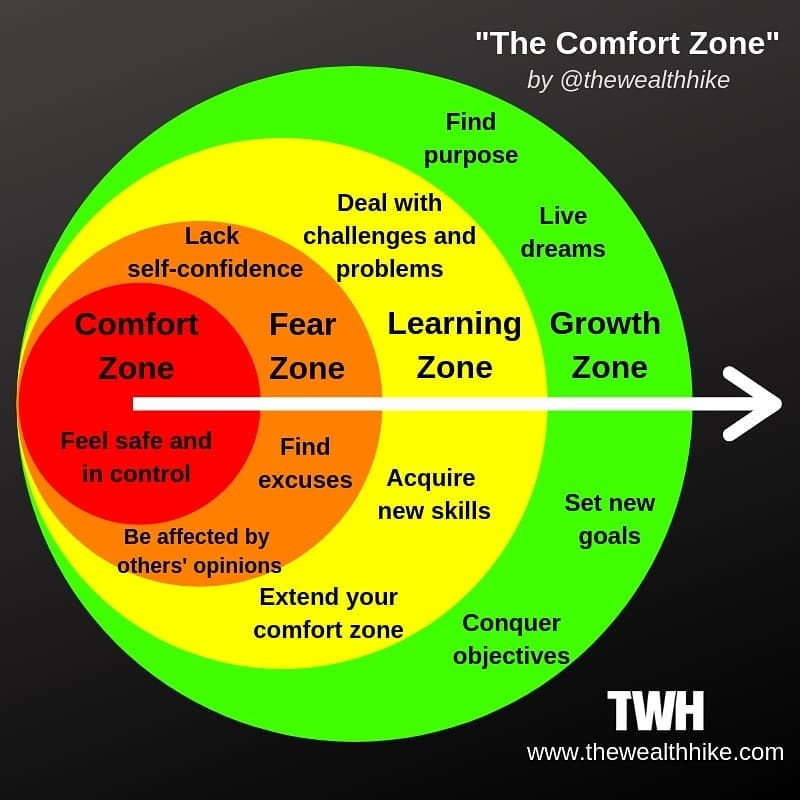
Comfort and fear are intimately connected. Whether separate or together they represent zones that many of us fall into and have trouble at times finding a way out of no matter how hard we try.  They work as powerful forces to keep us in respective lanes that are perceived to provide benefits, either individually or at the organizational level.  The reality though is that these zones hold us, and those who we serve, back.  For change to become business as usual and something that is pursued when needed, it is crucial that we identify where we are currently. The image below provides not only a great visual but also some critical context as to how we can put more energy into zones that lead to changes in practice. 


The main idea here is to find comfort in growth. As you look at the elements depicted in the image above, where do you see yourself dedicating the most time and energy? Be careful not to look at this as black or white.  There is a great deal of gray in each of the zones above.  I for one have added many additional elements through reflection to help move the majority of my efforts to learning and growth.  Consider developing questions aligned to each, using stems such as why, how, when, and what.  Improvement and ultimate success in the endeavors we are engaged in rely on acknowledging the zone where we spend the most time and making consistent efforts to invest more in learning and growth. 

Sunday, November 18, 2018

8 Ways to Overcome Management Fatigue

As a school administrator, I remember always having the best intentions when it came to instructional leadership.  During every summer, my team and I would reflect on the past year and establish a better vision and plan for how we all would collectively work to improve learning.  In theory, we devised ambitious, yet attainable goals during these months, or so we thought. Then reality would strike. It began immediately upon school starting with meetings and more meetings.  These were then followed by back to school nights and athletic events.  Throw in constant emails, texts, paperwork, parent issues, and calendar notifications, and the reality of educational leadership manifested itself in the form of management, which often came at the expense of instruction and school culture.


Now I am not saying management is not essential.  Effective school leaders can find a balance between the three. The challenge though is when the scale tips in the direction of management more time is spent here than is needed or wanted.  Herein lies the rub.  The digital age is both a blessing and a curse.  The latter takes form when administrators feel they are a slave to email, their calendars, and paperwork in the way of digital documents. Ask any school leader if this is what he or she honestly signed up for and the answer is most often a no. Management fatigue can be grueling.  It also takes an eye off the most critical job of any school leader – improving learning while developing a positive culture. 

I will be the first one to say that it is easier said than done when it comes to creating a balance between management, instruction, and school culture. It was a significant point of contention for me that finally came to a head when I reflected on this question:
How does the time I am spending actually impact learning?
In reality, the majority of my time was not being spent on improving instruction or building up school culture. Without a good focus on these areas, it is quite difficult to improve learning outcomes. The question above helped me to evaluate better where the majority of my time had to be spent. If it’s important, you will find a way. If not, then you will make an excuse. Don’t try to find the time to become a leader of learning. Make the time by committing to a few changes that will create a healthy balance between management and leadership that impacts the learning culture.  Below are eight ways to consider making this a reality.

  1. Commit to getting into classrooms more. First off, you can’t fix problems or issues with instruction if you don’t know about them. It is also impossible to give teachers valuable and needed feedback for the same reasons.  One of the most instrumental changes I ever made as a principal was committing to getting in classrooms every day, whether for unannounced observations and non-evaluative walks and sticking to it. 
  2. Build time into your calendar to write up observations. Here in lies another powerful way I broke free from the stranglehold my calendar had on me.  By turning the tables per se, I blocked time after every observation to write it up and in this case being at the mercy of my calendar was a good thing as time was directly spent on developing suggestions to improve instruction and learning. 
  3. Lead professional learning. Don’t ask others to do what you are not willing to do yourself. By planning and facilitating workshops and breakout sessions in your respective school or district, the chances of the specific strategy taking hold increase.  Remember, you get what you model.
  4. Attend professional learning. I know full well how tough it is to get out of your building or district for a day. However, you really need this break from management responsibilities as well as to give your brain a needed push.  It will also help keep you on the cutting edge of the latest strategies in education. Although difficult, you must resist the urge to check email and engage in work not related to the session. If need be, step out briefly to attend to this out of respect to the presenter. Be present at all times, not just physically.
  5. Cover classes. Better yet, teach a class. The former is a bit more manageable than the latter. During my first two years as an administrator, I taught a section of biology and wished I had continued to do so. Covering classes so teachers can observe their peers or attend professional learning not only gets you out of the office but provides you with an opportunity to connect with kids.
  6. Greet kids as they enter and leave the building. If you want this to work, then don’t plan meetings during this time and leave the device in your office.  There is no easier way to build culture and relationships with those who you serve by sharing a smile, handshake, or works of encouragement to start and end the day. 
  7. Eat lunch with the kids to get a pulse on culture. I loved spending my lunch in the cafeteria talking to my students. Not only did it give me a longer time to eat and relax but I also was able to receive Minecraft tips that I would later share with my son. The conversations also gave me valuable insight into what we could do to meet the needs of our kids better. 
  8. Delegate. The role of a leader is to create more leaders.  You cannot accomplish this if you do everything yourself.  When it comes to delegation, management tasks should be the first ones that are delved out.  Examples include meetings, testing schedules, and budget preparation. I had a role in all of this and more as an assistant principal but continued to be highly involved when I transitioned to the principalship.  Once I began to delegate more of these responsibilities out it freed up more time to focus on all of the above items.

Don’t let the managerial aspects of leadership drag you down. Everyone has the same amount of time during the day.  Go back to the original question I posed to determine how you are spending your time to be primarily a learning leader as opposed to a manager.  Difficult choices have to be made.  These are not them when it comes to lessening the burden of management. Yes, it will always be part of the job. Just don’t let it become the dominating component.  

Sunday, October 28, 2018

The Art and Science of Leadership

Leadership is far from a science. Many would even argue that it is more of a form of art. Since effective leadership means different things to different people, I wanted to dive a little deeper into this debate to glean a better understanding as to what great leaders do. It consists of a convergence of art and science. Tanveer Nasser shares this perspective:
Unlike science, art allows for a more subjective interpretation of ideas or concepts; that there’s no need for a singular, fixed answer or definition to understand it. As many artists say about their work, it’s not so much what they wanted you to see as it is what you choose to perceive within their construct. 
There are also many scientific disciplines that have helped us to gain insights into what makes one individual a more effective leader than others. Thanks to discoveries in the fields of organizational psychology and neuroscience, we can gain a better understanding of what human traits or behaviors are best suited for leadership, and why they are of benefit to the organizations and teams these individuals lead. While science might not provide us with a clear definition of what leadership is, it has proved to be vital to not only improving how we perceive this function but also how those who lead serve others through these roles.

Whether you are more on the side of art or leadership is beside the point.  Effective leaders consider not only specific requirements of the position and research, but also many unique components such as culture, environment, and the community. It is hard to say definitively that there is one style or technique that works best when all the variables are taken into consideration. Case in point. You could be a great leader in one position but be horrible in another if the same strategies are employed in different conditions. 

By employing strategies that intersect between art and science, leaders can excel in their position regardless of title.  Below are five main focus areas. 

People

It is the people who drive change, not one person.  They are the most critical resource in any organization. Great leaders don’t tell others what to do, but instead, take them to where they need to be.  It is about making the time to empower others to be great even if they think they’re not.  The best leaders take the time to understand the strengths, weaknesses, and needs of those who they serve to build a culture of success. Take care of your people and they, in turn, will take care of you. 

Alignment

Leadership can seem like a juggling act with all of the mandates, directives, and goals at play.  Great leaders understand the importance of the long game and ensure that the day to day work is always aligned with the bigger picture.  They understand that putting an enormous amount of energy into short-term goals that might not positively impact culture is not a prudent way to achieve lofty goals.  Always remember that implementing and sustaining change is more of a marathon than a race.

Collective

Success in organizations is never the result of one person.  Great leaders celebrate the accomplishments of others above their own.  They are always quick to build others up as a way to share how their efforts have led to better outcomes.  As the old cliché goes, there is no “I” in team. Great leaders understand that they have to get the majority of their people moving in the same direction not because they have to, but because they want to. A focus on the collective can help to achieve this.

Respect

For the most part, there are no handouts in life.  Just because someone has a title, position, or power does not mean they are a leader or deserve your respect.  Leadership is about action, empathy, modeling, and selflessness.  One of the best ways to earn respect is not to ask others to do what you are not willing to do or have not done yourself.  You don’t have to be likable to earn this. 

Integrity

There might not be a more critical focus than this one.  A person who possesses this quality is viewed as honest, moral, honorable, righteous, fair, and trustworthy.  In a recent article, Marcel Schwantes said this about integrity, “It holds intelligence and energy together, or everything crumbles.” He continues to go on by explaining that integrity is what makes it hard to question a person's decisions. His or her actions are open for everyone to see and you can rest assured that he or she will use good judgment. Integrity is the essence of great leadership. 

When it comes to effective leadership, and the qualities leaders possess, you don’t have to be on one side of the fence.  The key is to embrace both the artistic and scientific aspects while growing into the best leader for your respective organization, school, or district.