Showing posts with label SAMR. Show all posts

Monday, April 24, 2023

#EDvice: Choosing an Edtech Framework

When it comes to technology in education, there is a natural tendency to see it as just another thing that somebody must do. In other cases, it is viewed as being more work. Let me tackle the second issue first. When we try implementing anything new, there is always a learning curve. It is important to remember, though, that the time and effort put forth will reap the rewards when it comes to improving practice and, in turn, learning outcomes. I have learned from firsthand experience that figuring out how to use a new digital tool is the easy part. The more difficult mental hurdle is that using any digital tool is just another thing added to an already crazy workload.  


While I firmly believe in the merits of digital learning, it comes with a caveat, which I recently shared on social media:

Technology is just a tool and is definitely not a silver bullet. On its own, it WILL NOT lead to learning or improved outcomes. The focus must be on how the LEARNER is using it to LEARN in alignment with sound strategies and pedagogy.

My statement above is meant to reassure all educators that the tenets of good teaching, sound pedagogy, and research on learning are of the utmost importance. Clarity is also essential when it comes to purposeful use. This is why the Rigor Relevance Framework is a sound option compared to SAMR, TPACK, TIMS, and other tools that emphasize tech over learning. I dive a bit deeper into the concept in this piece of #EDvice.


As you look to refine or improve digital learning in your classroom, school, or district, consider keeping the RR Framework handy. I summed up its value in a previous post:

The overall goal, both with and without technology, should be to empower students to work and think. Another critical strategy is to focus on the purposeful use of technology when appropriate. Just because it is available doesn’t mean it can or will improve every lesson or project. Thus a focus on pedagogy first, technology second, if appropriate, will help ensure success, something that I emphasize extensively in Disruptive Thinking in Our Classrooms. While SAMR is a solid starting point, it is not the end-all or be-all. The multi-dimensional aspects of the Rigor Relevance Framework can be used to guide you in developing better questions and tasks as part of good pedagogy.


Sunday, June 5, 2022

Moving Beyond SAMR with the Relevant Thinking Framework

While there are many different frameworks to choose from when it comes to the effective integration of technology, SAMR is typically the one that most people and schools leverage. At face value, it is relatively straightforward while conveying how the use of technology can move from enhancement to transformation. The SAMR Model has provided us with a good lens to observe firsthand the need for proper planning prior to investing large amounts of money in technology. This is by no means a perfect framework to guide the effective implementation of technology initiatives, but it does give us a good idea of what should not be taking place.

Substitution – tech acts as a direct tool substitute with no functional change

Augmentation – tech acts as a direct tool substitute with functional improvement

Modification – tech allows for significant task redesign

Redefinition – tech allows for the creation of new tasks previously inconceivable 

While I don’t outright discount the value of SAMR, it does, in my opinion, have a dramatic shortcoming. I shared the following in Uncommon Learning:

For many educators, SAMR is the preferred model often associated with technology integration. It’s a catchy model and does have some value, mainly in the form of what we shouldn’t be doing (substitution). Take a close look at the tech-centric language used in each category and ask yourself what does the SAMR model really tell you about the level of student learning? This is why I love the Relevant Thinking Framework as a means to ensure that technology is integrated effectively. It provides a common language, constitutes the lens through which to examine all aspects of a learning culture (curriculum, instruction, assessment), and helps create a culture around a shared vision. 

The value of SAMR is that it can inform you what NOT to do with technology. However, the rub, though, is that it is a bit vague when it comes to the pedagogical shifts that need to occur to improve student learning. Here is where the Relevant Thinking Framework comes into play, as there is an emphasis on what the learner is doing as opposed to the technology. It is broken down into four (4) quads:

Quadrant A (Acquisition) -  Students gather and store bits of knowledge and information. Students are primarily expected to remember or understand this acquired knowledge. The teacher does most of the work by instructing. 

Quadrant B (Application) -  Students use acquired knowledge to solve problems, design solutions, and complete work. The highest level of application is to apply appropriate knowledge to new and unpredictable situations. 

Quadrant C (Assimilation) -  Students extend and refine their acquired knowledge to automatically and routinely analyze and solve problems as well as create unique solutions. They are doing most of the work. 

Quadrant D (Adaptation) Students have the competence to think in complex ways and apply knowledge and skills they have acquired. Even when confronted with perplexing unknowns, students are able to use extensive knowledge and skill to create solutions and take action that further develops their skills and knowledge. They work and think. 

While there isn’t a seamless alignment, I have made an attempt to connect them both. 


(S) Substituted acquisition (A) Teachers use tech to make tasks digital or elicit low-level student responses 

(A) Applied augmentation (B) Students apply learning in relevant ways

(M) Modified assimilation (C) Students demonstrate high levels of thinking through the purposeful use of technology

(R) Adapted redefinition (D) – Students work and think to innovatively redefine what is possible

The overall goal, both with and without technology, should be to empower students to work and think. Another critical strategy is to focus on the purposeful use of technology when appropriate. Just because it is available doesn’t mean it can or will improve every lesson or project. Thus a focus on pedagogy first, technology second, if appropriate, will help ensure success, something that I emphasize extensively in Disruptive Thinking in Our Classrooms. While SAMR is a solid starting point, it is not the end all or be all. The multi-dimensional aspects of the Relevant Thinking Framework can be used to guide you in developing better questions and tasks as part of good pedagogy. In the end, this will lead to developing critical competencies to thrive in a disruptive world. 

Sunday, February 12, 2017

Is Technology Being Integrated Effectively?

In many cases, there seems to be a tendency to water down expectations when it comes to integrating technology.  During a recent presentation on digital pedagogy for deeper learning I asked attendees to discuss then share out on TodaysMeet how they were effectively integrating technology in their classroom, school, or district.  There was an emphasis on describing in detail what effective use of technology meant to them.  As the results poured in there were a few consistent responses that stood out. Most attendees flat out stated that they or their schools/districts were not effectively integrating technology. Others confessed that they weren’t sure what effective use constituted.  Many of the remaining responses centered on just a listing of tools that were being used as a measure of effectiveness. 

The question about effective use provides a great opportunity for all of us to critically reflect upon the current role technology plays in education.  There is a great deal of potential in the numerous tools now available to support or enhance learning, but we must be mindful of how they are being used. Take Kahoot for example. This tool is used in so many classrooms across the world to get students more engaged and add a level of fun and excitement to the learning process. However, most of the time the questions that students are asked to answer in a Kahoot are focused on the lowest cognitive domains and mostly multiple choice.  I have nothing against Kahoot and think it is a great tool that has a great deal of promise. My issue is how this tool, and many others, are utilized in the classroom. 

The burden of responsibility here lies with both teachers and administrators. In many cases, the engagement factor is emphasized over learning outcomes and actual evidence of improvement aligned to standards. I get that this is not the be-all and end-all, but nevertheless, it is important. It goes without saying that effective technology integration should inform instruction and provide feedback as to the level of conceptual mastery students demonstrate. Then there is the unfortunate practice of putting the cart before the horse where acquiring technology and getting it into classrooms takes precedence over improving instructional design.  In either case, for technology to ever live up to the lofty, and at times baseless, expectations that have been established we must take a more critical look at pedagogy. 

For many educators SAMR is the preferred model often associated with technology integration. It’s a catchy model and does have some value mostly in the form of what we shouldn’t be doing (substitution). Take a close look at the tech-centric language used in each category and ask yourself what does the SAMR model really tell you about the level of student learning? This is why I love the Rigor Relevance Framework as a means to ensure that technology is integrated effectively.  It provides a common language, constitutes the lens through which to examine all aspects of a learning culture (curriculum, instruction, assessment), and helps to create a culture around a common vision. 

Technology should be integrated in a way that increases engagement through relevance. As students are utilizing technology are they just applying it in one discipline? I am not saying this is a bad thing, but we must eventually move beyond this typical comfort zone when it comes to tool use. When integrating technology does the task allow students:
  • to make connections across various disciplines and content areas?
  • to solve real-world predictable problems?
  • to solve real-world unpredictable problems?
The other aspect of this framework is the most important.  Are students working, thinking, or both? Successful technology integration is totally dependent on the level of questioning that is asked of our students.  This is why I always say that pedagogy trumps technology.  Think about the formative and summative assessments you either use or see in your respective role. Are students demonstrating high levels of cognitive thought? How do you know whether students have learned or not when integrating technology? What does the feedback loop look like? These are extremely important questions to ask as a teacher or administrator to determine the level of effectiveness. Check out this example to see how all the pieces (rigor, relevance, tech, assessment) come together to create a powerful learning experience).


The overall goal when integrating technology should be to provide opportunities for students to work and think. Another key strategy for successful integration is to use technology when appropriate. Technology will not improve every lesson or project, thus a focus on pedagogy first, technology second if appropriate with help ensure success. Many aspects of the Rigor Relevance Framework can be used to guide you in developing better questions as part of good pedagogy including:
  • anticipatory set/do-now
  • review of prior learning
  • checking for understanding (formative and summative)
  • closure
The most important aspects of pedagogy are assessment and feedback.  If technology (and innovation in general) is going to have a positive impact on learning, let’s ensure these areas are improved first. Then going forward always lend a critical eye to how technology is being used to address standards and inform instruction.

Sunday, July 19, 2015

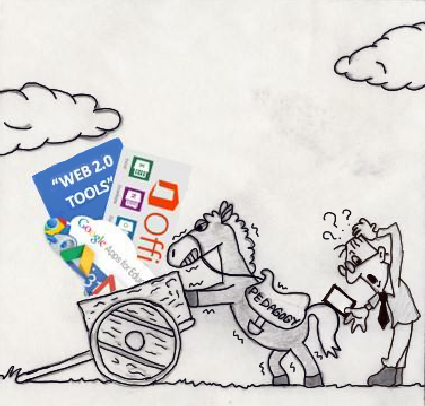
Be Wary of Putting the Cart Before the Horse

"Unless you get instructional design right, technology can only increase the speed and certainty of failure" - William Horton

As budgets expand or money becomes available at the end of a school year, the knee jerk reaction of many schools is to go all in and spend it as quickly as possible.  With advances in affordable technology, such as the ultra-cheap Chromebook, it has been tough for schools to resist spending these funds on devices.  Now don't get me wrong, I am all for schools increasing student and staff access to quality technology. However, the cart before the horse scenario has played out in so many schools across the globe. The end result has been a massive influx in tools, but a clear lack of vision and planning as to how these powerful tools can, and will, actually impact learning. In some cases, the technology resides unused in classrooms and schools due to the cart before the horse approach. There is nothing transformational about this.


Image credit: Eric Patnoudes

There are many technology frameworks out there for schools to refer to such as SAMR, TPACK, and the TIM. The SAMR Model has provided us with a good lens to observe firsthand the need for proper planning prior to investing large amounts of money on technology.  This by no means is a perfect framework to guide the effective implementation of technology initiatives, but it does give us a good idea of what should not be taking place.  I have visited one too many schools where I have seen time and time again devices being used in ways that serve as a direct substitute for the same ineffective practices that we are trying to move away from. Technology in itself will never transform teaching and learning. Students, teachers, and leaders who effectively integrate technology with purpose aligned to learning and leadership outcomes will.

The quote at the beginning of this post from William Horton provides an important reminder of the critical need for teachers to be supported in proper instructional design prior to any massive technology roll out. We found great success at my school during our digital conversion by focusing on a pedagogy first, technology second if appropriate mindset.  Not only was there a focus on solid instruction, but we also provided numerous supports for our teachers in the form of ongoing and job-embedded professional learning opportunities. If the expectation was to integrate technology with purpose to support and/or enhance learning we made sure everyone was prepared to do just that. As Michael Fullan has stated, pedagogy is the driver and technology the accelerator. 


Image credit: Shelly Terrell

It is not just teachers that need work on instructional design when it comes to effectively integrating technology. The same goes for school leaders who also deserve support in the form of professional learning so that they can properly observe and provide valuable feedback to teachers when technology is being integrated into lessons. Ultimately it is a leader’s overall responsibility to make sure technology purposes are having an impact on learning. Thus it is wise to put them in a better position to do just that.

The critical need for learning doesn't stop with teachers and leaders. It also extends to students and parents. As learning changes with successful technology integration and students begin to have more access to technology, a golden opportunity arises to not only address critical digital literacies, but also responsibility. When rolling out either Bring Your Own Device (BYOD) or 1:1 initiative create programs to prepare students for the purposeful use of technology to support their learning. In the end, this will mitigate many issues before they arise. At my school, I met with all the students in large-scale assemblies to educate and reinforce the role of mobile learning devices at the beginning of the school year. Having parent programs in place is also vital to the success of any major technology initiative. With large scale purchases, they will want to know the impact on learning and others will need guidance on the how teaching and learning are now changing.

The importance of getting instructional design right cannot be stressed enough. Don't fall victim to the cart before the horse scenario. If you or your school has the ability and funds to purchase technology, don't rush to get it into the hands of staff and students. Take the time to develop a shared vision and plan for integration that aligns with sound pedagogy, using a tool such as the Rigor Relevance Framework, which is much more robust than the other options mentioned earlier in this post. Reflect on instructional design within the context of student agency and higher-order thinking skills first. Provide professional learning opportunities before, during, and consistently after the roll out.  After a focus on instructional design, work with students and parents to build broader support. In the end, this will help to not only make the implementation process easier but also to have your technology initiatives primed to get results.