Showing posts with label #EDvice. Show all posts

Monday, May 22, 2023

#EDvice: Entry Points for Change

As we all know, navigating change is often a tricky process.  It requires a clear vision, a sound plan for implementation, and patience. Even with all these elements and many others in place, it is rarely a smooth journey.  One of the biggest obstacles to overcome is zeroing in on compelling reasons to change that will lead to better outcomes.  I refer to these as entry points, which can serve as a catalyst for any initiative or strategic plan.  One of the most powerful can be quality research, especially peer-reviewed studies.  I shared the following on social media recently:

Entry points for change are crucial. When trying to get the ball moving, leverage quality research. It can be used to identify areas for improvement to create new and innovative learning methods that better meet the needs of ALL learners. 

In this piece of #EDvice I discuss to vital role research plays in both initiating and sustaining the change process.  


Consider using Google Scholar, which is a great, FREE resource that anyone can use to search for peer-reviewed research on any topic.  Artificial Intelligence can also be used.  I prefer Google Bard over ChatGBT. Recently I asked the following question, "What peer-reviewed research studies support 1:1 laptops in schools?".  Below you can see the response.

There are a number of peer-reviewed research studies that support the use of 1:1 laptops in schools. These studies have found that laptops can improve student achievement, engagement, and motivation. For example, a study by the Pew Research Center found that students who used laptops in the classroom were more likely to say that they were engaged in their schoolwork and that they felt like they were learning more. Additionally, a study by the National Center for Education Statistics found that students who used laptops in the classroom were more likely to say that they enjoyed school and that they were motivated to learn.

Here are some specific examples of the benefits of 1:1 laptops in schools:

  • Laptops can help students to learn more effectively. For example, students can use laptops to access online resources, collaborate with classmates, and create multimedia projects.
  • Laptops can help students to be more engaged in their learning. For example, students can use laptops to take notes, participate in discussions, and complete assignments.
  • Laptops can help students to be more motivated to learn. For example, students can use laptops to explore their interests, learn at their own pace, and get immediate feedback on their work.
  • Of course, there are also some challenges associated with using laptops in schools. For example, laptops can be a distraction, and they can be expensive to purchase and maintain. However, the benefits of using laptops in schools generally outweigh the challenges.

Overall, the research suggests that 1:1 laptops can be a valuable tool for improving student achievement, engagement, and motivation. If you are considering implementing a 1:1 laptop program in your school, it is important to carefully consider the benefits and challenges involved.

I then asked Bard to cite specific studies.  Here is what was provided

  • Bebell, M., & Kay, A. (2010). Laptops and student achievement: Evidence from a large-scale, urban school district. Journal of Research on Technology in Education, 42(4), 357-377.
  • Cheung, A. C. K., & Slavin, R. E. (2013). Effects of one-to-one computing and teacher professional development on student achievement in high school mathematics. American Educational Research Journal, 50(3), 568-596.
  • DeWitt, S. L., & Watson, J. (2013). A review of the research on laptop computers in K-12 education. Journal of Research on Technology in Education, 45(4), 347-369.
  • Suhr, J. L., Johnson, C. C., & Lajoie, S. P. (2010). One-to-one computing: A review of the literature. Journal of Research on Technology in Education, 42(4), 307-329.
  • Watson, J., & DeWitt, S. L. (2010). Laptops and student achievement: A research synthesis. Journal of Research on Technology in Education, 42(4), 329-356.
Research can be a fantastic entry point, but it surely isn't the only one.  Other great options include evidence (qualitative and quantitative) as well as effective professional learning.  For more insight, check out this post. 


Tuesday, May 9, 2023

#EDvice: Less is More

To say that there is a great deal of pressure on educators today is a gross understatement.  It is shared with me during conversations that they feel it is difficult to catch their breath and keep up with all that is expected of them. While this has led to an increase in stress and anxiety, it is always made clear to me that they want to grow and improve. I shared the following piece of advice recently on social media:
Educators are overwhelmed and an endless array of initiatives, ideas, and strategies will do more harm than good. Meaningful change to improve learner outcomes can/will still happen with a moderated approach. Less is MORE.
As I shared in Disruptive Thinking, consistency and continuity far outweigh the sheer number of different ways to get better. The most essential element in learning is the teacher in the classroom. It is here where leaders can provide support through clarity, examples, feedback, and professional learning that focuses on concepts that can truly move the needle when implemented at scale. In this piece of #EDvice I discuss how the Rigor Relevance Framework can be used to lessen the number of balls in the air while zeroing in on just two critical aspects of learning. 


It is important to keep in mind that this framework is geared to help educators evaluate where their current practice resides and then make needed shifts to improve. This could come in the form of questioning techniques, assessment development, prioritizing standards, and creating performance tasks or projects.  

My main point here is twofold. You don’t need to throw out the baby with the bath water when it comes to improving practice and learning outcomes.  Most importantly, success relies on doing a few things really well where there is a natural alignment to what goes on in classrooms daily.

Monday, April 24, 2023

#EDvice: Choosing an Edtech Framework

When it comes to technology in education, there is a natural tendency to see it as just another thing that somebody must do. In other cases, it is viewed as being more work. Let me tackle the second issue first. When we try implementing anything new, there is always a learning curve. It is important to remember, though, that the time and effort put forth will reap the rewards when it comes to improving practice and, in turn, learning outcomes. I have learned from firsthand experience that figuring out how to use a new digital tool is the easy part. The more difficult mental hurdle is that using any digital tool is just another thing added to an already crazy workload.  


While I firmly believe in the merits of digital learning, it comes with a caveat, which I recently shared on social media:

Technology is just a tool and is definitely not a silver bullet. On its own, it WILL NOT lead to learning or improved outcomes. The focus must be on how the LEARNER is using it to LEARN in alignment with sound strategies and pedagogy.

My statement above is meant to reassure all educators that the tenets of good teaching, sound pedagogy, and research on learning are of the utmost importance. Clarity is also essential when it comes to purposeful use. This is why the Rigor Relevance Framework is a sound option compared to SAMR, TPACK, TIMS, and other tools that emphasize tech over learning. I dive a bit deeper into the concept in this piece of #EDvice.


As you look to refine or improve digital learning in your classroom, school, or district, consider keeping the RR Framework handy. I summed up its value in a previous post:

The overall goal, both with and without technology, should be to empower students to work and think. Another critical strategy is to focus on the purposeful use of technology when appropriate. Just because it is available doesn’t mean it can or will improve every lesson or project. Thus a focus on pedagogy first, technology second, if appropriate, will help ensure success, something that I emphasize extensively in Disruptive Thinking in Our Classrooms. While SAMR is a solid starting point, it is not the end-all or be-all. The multi-dimensional aspects of the Rigor Relevance Framework can be used to guide you in developing better questions and tasks as part of good pedagogy.


Sunday, April 9, 2023

#EDvice: Moving from PD to Professional Learning

When it comes to education training, the main pathway to improvement is through professional development. Depending on where you reside or your school system, this typically consists of a few days to begin the new academic year and a few random days going forward that are often associated with student holidays. While the premise is positive, the result doesn’t always lead to sustainable change. I have a theory as to why this is sometimes the case.  

Professional development (PD) is something that is typically "done" to educators. On the other hand, professional learning is something they actively WANT to engage in to grow. The latter involves choice, context, and practicality driven by an intrinsic desire to grow.

Think about this for a second. Most “PD” days are often scripted and, in some cases, dictated” based on mandates from various levels. What often results is little personal connection to the concepts or a feeling that there is no alignment with one’s specific role. When this happens, many people are naturally disinterested from the start. That’s not a good thing. Another glaring issue is that “PD” days often consist of one-and-done or drive-by sessions that offer little in terms of reflection, diverse perspectives, time to apply, and needed feedback afterward to see progress in the implementation of strategies covered. In this piece of #EDvice below, I dive into a mindset shift from professional development to professional learning.


Now I am not saying that PD doesn’t have value. My point is to reflect to determine if the resources and time allocated lead to evidence that educator practice is improving. It is essential to view adults just like learners in our classrooms. Thus, any professional learning should be personalized, interest-based, and aligned with a sound body of research. Below are three pathways to consider that meet these criteria:

  • Create or advocate for job-embedded coaching to complement any workshops of stand-alone days.
  • Develop a Personal Learning Network (PLN)
  • Attend events such as the Model Schools Conference, where the program focuses on educators and schools who are doing the work and have results to illustrate efficacy.
  • Move to well-structured Professional Learning Communities (PLCs) where data, research, and effective strategies are the focus. 


Learning is a process, not an event or day. Keep that in mind when developing, implementing, or participating in any growth opportunity. 

Monday, March 27, 2023

#EDvice: Moving from Impersonal to Personalized

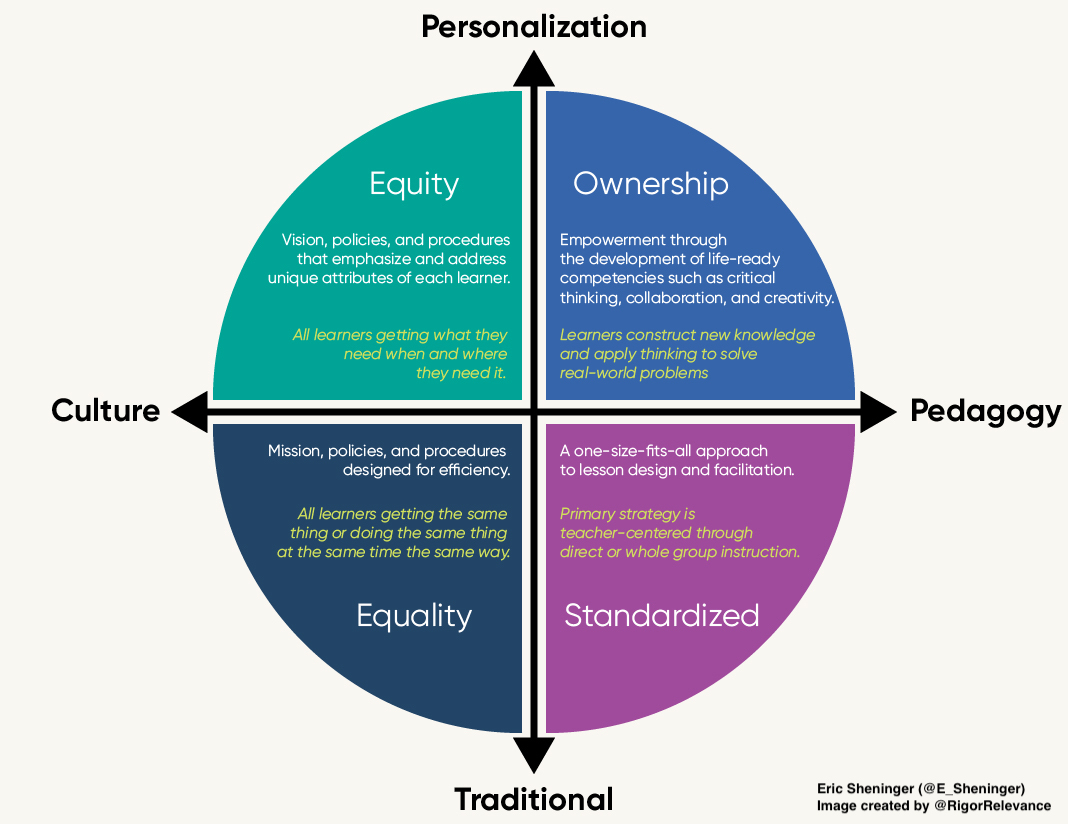
There is a great deal of confusion out there as to what personalization is when it comes to learning in and out of the classroom. When terms that are new materialize, there is a natural inclination to develop a meaning that works for a particular narrative or goal.  A lack of clarity or pedagogical understanding translates to people and organizations making up whatever fits best.  From my lens, this is exactly what has occurred with personalized learning.  Below is my strong opinion on the issue, which I shared in Disruptive Thinking in Our Classrooms:

Putting all kids on a device and having them use an adaptive tool at the same time is NOT personalization. Understanding WHO our students are and helping them ALL succeed with or without tech is at the heart of personalized approaches that ensure equity in the classroom.

The last few words above are the most critical.  Personalized learning encompasses an array of strategies that provide all learners with what they need, when and where they need it to succeed. This flies in the face of all students doing the same thing, the same way, at the same time during the majority of a lesson, especially the instructional component, or a task. I dive a bit deeper into the concept in this piece of #EDvice. 


There is not one right or best way to personalize. However, a significant culture shift is required at all levels, including district, school, and classroom. I shared the following in a past post:

An impersonal approach is all students doing the same thing the same way at the same time. While this can have merit in moderation, excessive use of one-size-fits-all approaches is inequitable. They also tend to focus on the “what .”On the other hand, personalization is where all learners get what they need when and where they need it through equitable experiences. There is also clarity in terms of why they are learning what they are and how it will be used outside of school. 


Personalization can occur through many high-agency approaches such as rotational models, choice activities, playlists, flipped lessons, and virtual courses. It can also be achieved through an array of strategies that have been around, in some form or another, for years, including differentiation, response to intervention (RTI), and the purposeful use of technology in alignment with Tier 1 instruction. 

If we are serious about equity in learning, then the best path forward is to make concerted efforts to develop a shared vision that emphasizes who we serve and work from there. 

Monday, March 13, 2023

#EDvice: The Power of Stories

Everyone loves a great story. We spend countless hours visualizing how they unfold when reading and watching them come to life through our device of choice.  It comes as no surprise that civilizations across the globe have been curating and sharing them since the beginning of time. From cave paintings, stone carvings, and ancient papyrus paper, the most significant stories of our past have been preserved. In the modern era, the invention of the printing press and advances in technology have proliferated storytelling and allowed virtually everyone to evolve into a storyteller role if they so choose. 

While the means to share has changed, the overall impact has not. The power of well-told stories is undeniable and can transcend time. They CONNECT, INSPIRE, EMPOWER, and UNITE us often when it is most needed. We need stories, as do those who we serve, especially students. In this piece of #EDvice I dive into the various research-based components that great storytellers leverage, whether they know it or not. 


In both Digital Leadership and BrandED I dive into the intricacies to unleash the power of stories.  While research paves the way and shows us how to elicit emotion to engage others, there are also many other critical elements to be aware of when developing a narrative.  Below are two images that provide additional context.

My call to action to all educators is to become the storyteller-in-chief.  This is not a relatively hard thing to do. Social media allows us to take sole control of our public relations and tell our classroom, district, and school stories consistently, accurately, and transparently. Educators are making a difference every day and these success stories resonate with local, national, and even international stakeholders.  Telling stories of student successes and staff accomplishments help to combat and drown out the negative rhetoric that has become rampant in the education profession. 

Your work and that of your students is downright amazing. Be proud and share. 

Monday, February 27, 2023

#EDvice: The Significance of Student Voice

I see student voice as the gateway to personalization.  Educators can easily implement it as part of Tier 1 instruction and for students to report out during cooperative learning, projects, and choice activities.  It can also allow students to advocate for needed changes to school culture.  You would be hard-pressed to find a more valuable strategy that is universal in nature across virtually all pedagogical techniques.  The reason for this statement is straightforward. For learning to occur, students both NEED and WANT to be involved. If the goal is to have kids engaged and to set the stage for empowerment, it is critical to utilize strategies that amplify student voice.

In this episode for #EDvice I dive into the concept a little deeper to unpack its significance while also providing some K-12 examples.

I shared the following in Disruptive Thinking in Our Classrooms:

In the classroom, it can be facilitated by posing questions or problems to solve and then allowing students to use digital tools to respond through text, video, audio, drawings, images, and gifs. Having every student respond on an individual whiteboard and then holding their board up for the teacher to see is a non-tech example. In many cases, voice can be amplified through the cover of anonymity, which is critical for introverts and shy students. They can also be provided with opportunities to share opinions on classroom design, assessments, and feedback. Student voice includes any act that empowers a student or students to make their voices heard when shaping their learning experiences. The main takeaway here is that everyone is involved in the classroom and feels more of a part of the experience.

As you look to further integrate or begin to develop strategies that amplify student voice you can refer to the images below. 


Read the blog post HERE


Read the blog post HERE

How are you or your teachers amplifying voice in the classroom or school? Please share in the comments below. 


Monday, February 13, 2023

#EDvice: Timeliness of Feedback is Vital

Assisting others to be their best is something that we all can do through feedback. Sometimes it is as simple as making an effort to point out commendations that serve as validation and pieces of advice to improve performance. However, sometimes our delivery and words mean otherwise. It is vital to make the distinction between feedback and criticism. Feedback is information about reactions to a product or a person's performance of a task, which serves as a basis for improvement. Criticism, on the other hand, is the expression of disapproval of someone or something based on perceived faults or mistakes. With growth being the end goal, feedback must be facilitated in a way that moves others to reflect on their work and take the necessary steps to get better.  

"The importance of feedback to grow and improve is undeniable. EVERYONE benefits when it becomes a consistent component of culture. However, we must make sure feedback is TIMELY for it to have value to those we are trying to help."


If the main goal is to use feedback as a catalyst for improvement, then why delay it? This is one of the reasons why I don’t really like final exams. Students rarely receive good feedback that informs their learning as they are typically given these exams at the end of the school year and are then graded up until the last minute. Delaying feedback allows minor problems to fester into larger ones potentially. The bottom line is that the more time that goes by the feedback that could have really made an impact will not be valued as much, if at all.


Feedback stings when it is not: 

  1. Delivered with sincerity
  2. Grounded in practicality
  3. Given in a timely manner

As I shared in Disruptive Thinking, timeliness is critical, but keep in mind that it must be practical, specific, consistent, and facilitated positively. It is also crucial to determine the right strategy or medium for facilitation. 

Monday, January 30, 2023

#EDvice: Interest Powers Learning and Outcomes

Humans crave a deep connection when it comes to learning something new, especially if they initially don't see any value in what's being taught or facilitated. We expect this as adult learners, so it goes without saying that our students both want and need this as well. In the absence of authentic meaning there is a tendency to disconnect or go off task, putting the learning experience at hand in jeopardy of not being successful. No one wants this, especially teachers who have spent a great deal of time planning lessons. 

In the classroom making connections to content and concepts embedded within standards is of utmost importance, but these have to be captivating as some kids naturally won't be jazzed up about certain content. The key is to elicit attending behavior. Interest is a powerful element that acts as a motivator and is a key component that drives learning. NEVER underestimate the importance of a "hook" during the opening movements of a lesson to empower ALL learners. In this piece of #EDvice I unpack some tips on how utilize simple strategies as well as share some practical examples. 

Whether you refer to the strategy as a hook or anticipatory set, they key is to infuse relevance that piques the interest of diverse learners.  Below are some of the startefgies I shared in Disruptive Thinking in Our Classrooms:

  • Picture prompt
  • Real-world problem of the day
  • Current event or personal story
  • Open-ended writing prompt that sparks inquiry and creativity
  • Riddle
  • Short, engaging video followed by a turn and talk
  • Sensory exploration 
If we want to improve outcomes, in the classrooms or during professional learning, we must make efforts to impart interest. 

Monday, January 16, 2023

#EDvice: Closing Learning Gaps with Rotational Models

Education is still reeling from the impacts of COVID-19. The rapid shift to virtual learning was a necessity and, like always, educators rose to the occasion like they always do even though training in this area didn’t really exist at scale.  A few years later, we are beginning to get an idea of the most pressing issue at hand, which is learning recovery. During coaching visits across the country, educators share the difficulty of having classrooms of students where the majority are at different grade levels. So how do we begin to address this issue? 

Knowing where kids are and then developing strategies to meet their respective needs is one of the most effective ways to close learning gaps post-pandemic. While the challenge is real, rotational models can stem the tide. In this piece of #EDvice I unpack this strategy and how it can be easily implemented in K-12 classrooms.

Success using rotational models relies on maximizing available class time, understanding sound pedagogy, and leveraging actionable data.  Below are some resources I created to help educators with effective implementation.  


At the International Center for Leadership in Education (ICLE), we have developed research and evidence-based professional learning solutions to scale personalized strategies that are integral for learner success in a post-pandemic world. If you are interested in learning more, drop your email in the comments section. 


Monday, December 12, 2022

#EDvice: Practical Strategies in 90 Seconds or Less

I never saw myself as a writer until I started blogging back in March 2010. It all began with goal setting for the Google Teacher Academy for Administrators, and I haven’t looked back. Consistency has been vital for me, as I have published a post every week since. Therein lies the dilemma I am currently facing. The struggle is real in my case when it comes to finding new topics to blog about or adding an innovative spin to already-prevalent concepts. I find myself spending an immense amount of time just to churn out 500 words. Upon reflection, this might be one sign to change things up a bit. The time has come for me to challenge my personal status quo. 

In a world where multimedia content is virtually at everyone’s fingertips, written content that dives into concepts and strategies might not have the same impact as it once did. Attention spans are not what they used to be, and this is something we all need to be cognizant of when sharing ideas. In the digital age, brevity is virtue when it comes to processing and implementing strategies. Upon further reflection—and so I can grow—I decided to dedicate more time to developing short video clips in lieu of blogging each week. I will not stop writing regularly because I still see immense value in the process, but I plan to change my routine and shift to a bi-weekly schedule. Every other week I will share a simple, practical strategy that educators can use right away *in 90 seconds or less* called #EDvice. 


Leveraging my current experiences in classrooms, schools, and districts working with educators, my plan is to articulate one strategy from the following three-step perspective:

  • Why is this strategy important?
  • How can it be readily implemented?
  • What could it look like in practice?

For my first clip, I decided to share some advice on developing choice boards. (Special thanks to Dan MacCracken, another ICLE colleague, who edited and tweaked my raw video.)  During a recent coaching visit with Quest Academy Junior High School, l I observed teachers readily implementing strategies that we’d collaborated on over the course of the year. Hats off to Principal Nicki Slaugh for following through on the feedback I provide after each visit. The video below shares a practical strategy educators can use when developing effective choice boards:

While I’d dabbled in video content in the past, I believe that returning to this medium now is coming at the right time for me—and hopefully, it is for you, too. Ultimately, I want to expand the opportunities for us to connect around our daily, meaningful work and amplify conversations between educators to elevate our practice one behavior at a time. On that note, I invite you to send me your own ideas, questions, and wonderings for #EDvice—what’s on your mind? I look forward to hearing from you—thanks, as always.