Showing posts with label student voice. Show all posts

Sunday, November 10, 2024

Using Student Discourse to Increase Engagement

As my Aspire Change EDU consultant team and I visit classrooms on a routine basis, we strive to lead administrators, coaches, and teachers in reflecting on their practice using questioning techniques.  The majority of these often revolve around engagement, and it is quickly realized that when students are compliant, it is because the adult is doing all the work or talking. A simple yet powerful strategy to move from compliance to engagement is discourse through turn & talk. 

So why is this so important when it comes to engagement? Student discourse, the interaction and exchange of ideas among students, is a vital component of learning. When students engage in meaningful conversations, they are not only actively constructing knowledge but also developing essential competencies for academic and personal success.

Cognitive Development and Critical Thinking

Research has consistently shown that student discourse is a powerful tool for cognitive development. As Mercer (2000) argues, "Talk is not simply a vehicle for transmitting information; it is a tool for thinking." When students articulate their thoughts and listen to the perspectives of their peers, they are challenged to think critically, analyze information, and construct new knowledge. This process helps students identify gaps in their understanding, refine their ideas, and develop a deeper appreciation for diverse viewpoints. 

Enhanced Communication 

The ability to articulate ideas clearly and persuasively is highly valued in today's interconnected world. Through classroom discussions, students learn to express themselves effectively orally and in writing. They also develop the ability to listen attentively, ask probing questions, and respond thoughtfully to the ideas of others. These skills are not only valuable for academic success but also for personal and professional growth.

Building Community and Belonging

When students feel safe and supported to share their thoughts and ideas, they are more likely to develop positive relationships with their peers and teachers. This sense of community can create a more inclusive and welcoming learning environment where all students feel valued and empowered to contribute, something Nicki Slaugh and I emphasize in Personalize. 

Nurturing Environments Conducive to Learning 

To maximize the benefits of student discourse through turn & talk or think-pair-share, educators must create a supportive classroom culture that encourages open dialogue and critical thinking. This involves establishing clear expectations for respectful interaction, providing opportunities for students to practice their communication skills, utilizing scaffolded questions, and modeling effective discourse practices themselves. As Weimer (2015) suggests, learner-centered teaching approaches, which prioritize student voice and active participation, can significantly enhance the impact of student discourse.

Quality discussion involves purposeful questions prepared in advance, assessment, and starting points for further conversations. I shared the following ideas in Disruptive Thinking:

  • Facilitate face-to-face interaction 
  • Pose open-ended questions 
  • Encourage peer-to-peer dialogue 
  • Prompt students to explain their reasoning 
  • Diversify question formats
  • Provide opportunities for all students to share out following the discussion to amplify voice (individual whiteboards, dry-erase surfaces, Post-it notes, technology)

By creating a space for authentic conversation, teachers can transform their classrooms into vibrant learning communities where students thrive. As the National Academies of Sciences, Engineering, and Medicine (2018) emphasize, student engagement is a key factor in promoting deep learning and long-lasting knowledge retention.

Student discourse is a powerful tool for fostering critical thinking, enhancing communication skills, and building a strong sense of community within the classroom. By prioritizing student voice and creating opportunities for meaningful conversation, teachers can create more engaging, inclusive, and transformative learning experiences for all students.

Mercer, N. (2000). Words and minds: How we use language to think together. Routledge.

National Academies of Sciences, Engineering, and Medicine. (2018). The science of learning: Organization, motivation, and engagement. National Academies Press.

Weimer, M. (2015). Learner-centered teaching: Five key changes to practice. Jossey-Bass.


Sunday, August 4, 2024

The Six Myths of Personalization

Myths often arise from misunderstandings, oversimplifications, or a desire to maintain the status quo. They can also be intentionally created to mislead or manipulate, serving as barriers to embracing innovative practices or protecting existing power structures. Additionally, some myths may originate from well-intentioned but inaccurate assumptions or generalizations about an idea or strategy.  

Many misconceptions about personalized learning have led to the formation of numerous myths.  Before I tackle these, let’s first start with a realistic definition that Nicki Slaugh and I shared in our book Personalize:

Personalization is all students getting what they need when and where they need it to learn.

The definition we developed was strategic in nature.  It acknowledges the fact that we all learn differently and leaves out some common words often associated with personalized learning.  Let’s now dive into the most popular myths that hold educators back when it comes to personalization. 

Myth 1: Technology is needed to personalize

Years ago, almost every educational technology company jumped on the personalized learning bandwagon and hailed it as a holy grail for improving outcomes.  The ads and pitches contained compelling messages about how various tools would meet the needs of every learner while closing achievement gaps. Apparently, this was not the case.  Having all students on technology at the same time using an adaptive learning tool where there is no discourse, collaboration, or relationship building is impersonal at best.  

The “personal” in personalized is the most critical aspect.  Don’t fall into the trap that you need technology to personalize. Emphasize relationships, relevance, learner preferences, feedback, and competency-based pathways, which Nicki Slaugh and I elaborate on in Personalize. At the secondary level, you can look to implement academy programs or smaller learning communities (SLCs) to create a school-within-a-school model based on constructivist learning theory and interests.  No matter what you choose, the key element is the creation of personal experiences with and without technology. 

Myth 2: There is one right or best way to personalize

When it comes to myths, this one irks me the most.  I routinely see professional development companies championing only competency-based solutions or those where students must watch a video.  Let me be clear: there is no right or best way to personalize learning.  There are an array of pedagogical shifts and high-agency strategies at your disposal.  Maybe you want to leverage station rotation, choice boards, playlists, self-paced courses, flipped lessons, or must-do/may-do menus. Take your pick and mix it up as it suits you.  

The same can be said regarding high-agency strategies such as voice, choice, path, pace, and place.  Nicki and I suggest you focus on at least one during every lesson, not all five. Personalization is all about maximizing the time you have with students.  There is no “best” way, as learner preferences and needs change over time.  However, there are effective strategies at your disposal.  Which ones you implement and when is your call. 

Myth 3: Direct instruction has no place in a personalized classroom

When it comes to high-effect strategies, direct instruction still has a great deal of impact on achievement.  The key is to ensure it is chunked and doesn’t compromise most of the period or block.  When this occurs, the overload of content leads to disengagement.  Tier 1 instruction matters, plain and simple.  Here is where student voice comes in, something I refer to as the gateway to personalization at every grade level. When implementing reviews of prior learning, checks for understanding, or closure tasks, educators can empower all students to be heard using mini whiteboards, dry-erase surfaces, Post-it notes, or technology.  I am particularly a big fan of digital exit tickets that provide the teacher with instant data and feedback, which can be used the next day to reteach if needed or identify students for targeted support. Hooks can also be implemented at the beginning of the lesson for relevance.  

Myth 4: Data must be used to personalize

In Personalize, Nicki and I state the value of data-enhanced teaching, not data-driven. Too much of something tends to diminish its value.  While we all know data can be an invaluable tool to personalize learning, it is not a silver bullet.  Learning is so much more than a number. Begin with establishing positive relationships as these are the foundation of learning, Next, focus on relevance to create a more personal connection to the concepts.  Then, leverage qualitative evidence such as student work and rubrics, which can be just as effective, if not more, than data.  

Myth 5: All learning is personalized

I have heard this broadcast over the years and respectfully disagree. Just ask students in a classroom where they consistently do the same thing at the same time in the same way, and I bet their responses would equate to an impersonal experience. Personalization requires a shift from the “what” to the “who” to emphasize ownership of learning. Without this, the act of learning becomes something that is mandated rather than embraced. 

Myth 6: It’s more work

Changes to practice often spark the “yeah, but” response. When it comes to personalized learning, many people see it as more work. The fact of the matter is that this shift represents better work, as available time is being maximized to support struggling students while providing more challenge to those who are already at or beyond the standard. Don’t let comfort stagnate progress. The small shifts to practice implemented consistently are the epitome of personalization. 

While I might have missed a few myths, the ones listed above have worked to hold back personalization from reaching its full potential in schools and, in the process, students.  When it comes to learning, there is not just one way.  The same can be said about how you implement personalized learning in your district, school, or classroom. I hope you will see opportunities for growth in your practice, no matter your role, to usher in experiences that support the whole child.  Just because it has been done or worked in the past doesn’t mean it is the most effective approach for students today. 


Sunday, June 16, 2024

Student Voice as an Engagement Strategy

Imagine a classroom buzzing with curiosity, where questions fly like sparks and exploration thrives. Engaged learners are joyful learners. When students are genuinely invested, a sense of wonder takes hold. They delve into challenges with a smile, their eyes alight with the thrill of discovery. This joy of learning is contagious, fueling a classroom where knowledge isn't just absorbed; it's embraced. In this empowering environment, students blossom, reaching their full potential and embarking on a lifelong journey that sets them up for current and future success. 

Engaging students today is a complex task. Educators often express the challenge of keeping students focused and interested in the learning process. This can be particularly difficult in today's world, where students are bombarded with distractions and have a multitude of competing priorities. However, research provides a beacon of hope, offering valuable insights into fostering a thriving learning environment. According to a study by Fredricks et al. (2004), students who are actively engaged in lessons demonstrate a deeper understanding of content and develop stronger critical thinking skills. By implementing effective strategies, educators can transform classrooms from places of passive absorption into dynamic hubs of active participation and intellectual growth. The following passage explores some of these strategies that can ignite a passion for learning within students.


Student voice in the classroom is not just a concept; it's a catalyst for a more engaged and successful learning environment. When students feel their ideas and perspectives are heard and valued, they become more than just participants in the learning process; they become active contributors. This can lead to many benefits, including increased motivation, a deeper understanding of concepts, and a greater sense of ownership over their education. Students who believe they have a voice are more likely to be academically motivated. Teachers can tailor their lessons by listening to students to better resonate with their interests and learning styles. This two-way communication builds trust and empowers students to take an active role in their own education, preparing them to be critical thinkers and lifelong learners.

Nicki Slaugh and I shared the following in our book Personalize:

Student voice denotes any action that empowers students to express their perspectives when shaping their learning journey. The primary message here is that classroom participation is all-inclusive, promoting a greater sense of involvement for everyone. 

Student voice.....

  • Involves all kids in the learning process 
  • Fosters active participation
  • Builds confidence leading to self-efficacy, especially when students can respond under cover of anonymity
  • Promotes open reflection and collaboration
  • Sets the stage for instant feedback
  • Develops a sense of community 

We see student voice as a gateway to personalization, especially during instruction. The image above details the many positive outcomes of this high-agency strategy. When asking questions, you can use the following to amplify the voices of your learners:

  • Individual whiteboards
  • Dry-erase surfaces
  • Post-Its
  • Digital tools
  • Physical objects such as clothespins or signs (these can be colored red and green for students to attach to their devices or hold up during group work)

Understanding that there is no right way to amplify student voice is crucial. While the list above provides a good foundation, keep in mind that you or your teachers might develop more innovative ways to let all students be heard, increasing engagement in the process while gaining valuable insight that can be used to strengthen Tier 1 instruction or improve Tier 2 supports.   

Students who feel their ideas and perspectives are valued are more invested in learning. This can lead to increased motivation, a deeper understanding of concepts, and a greater sense of ownership over their education. Teachers can tailor their lessons by listening to students to better resonate with their interests and learning styles. In short, student voice is a gateway to a more successful learning experience.

Take a deep dive into personalized learning by grabbing your copy of Personalize: Meeting the Needs of All Learners on Amazon. 

Fredricks, A. C., Blumenfeld, P. C., & Paris, A. H. (2004). School engagement: Importance and development. The Educational Psychologist, 39(1), 18-24.


Monday, February 27, 2023

#EDvice: The Significance of Student Voice

I see student voice as the gateway to personalization.  Educators can easily implement it as part of Tier 1 instruction and for students to report out during cooperative learning, projects, and choice activities.  It can also allow students to advocate for needed changes to school culture.  You would be hard-pressed to find a more valuable strategy that is universal in nature across virtually all pedagogical techniques.  The reason for this statement is straightforward. For learning to occur, students both NEED and WANT to be involved. If the goal is to have kids engaged and to set the stage for empowerment, it is critical to utilize strategies that amplify student voice.

In this episode for #EDvice I dive into the concept a little deeper to unpack its significance while also providing some K-12 examples.

I shared the following in Disruptive Thinking in Our Classrooms:

In the classroom, it can be facilitated by posing questions or problems to solve and then allowing students to use digital tools to respond through text, video, audio, drawings, images, and gifs. Having every student respond on an individual whiteboard and then holding their board up for the teacher to see is a non-tech example. In many cases, voice can be amplified through the cover of anonymity, which is critical for introverts and shy students. They can also be provided with opportunities to share opinions on classroom design, assessments, and feedback. Student voice includes any act that empowers a student or students to make their voices heard when shaping their learning experiences. The main takeaway here is that everyone is involved in the classroom and feels more of a part of the experience.

As you look to further integrate or begin to develop strategies that amplify student voice you can refer to the images below. 


Read the blog post HERE


Read the blog post HERE

How are you or your teachers amplifying voice in the classroom or school? Please share in the comments below. 


Sunday, October 31, 2021

Different Ways to Show Learning

For many of us, our preparation to become teachers consisted of courses focusing on classroom management, lesson design, grading, and proven strategies that had withstood the test of time.  We were also exposed to learning style theory and the many benefits it had on meeting the diverse needs of students. To this day, it is still heavily referenced, even though it has been debunked extensively.  Cindi May shared the following in Scientific American:

Just because a notion is popular, however, doesn't make it accurate. A recent review of the scientific literature on learning styles found scant evidence to clearly support the idea that outcomes are best when instructional techniques align with individuals' learning styles. In fact, several studies contradict this belief. It is clear that people have a strong sense of their own learning preferences (e.g., visual, kinesthetic, intuitive), but it is less clear that these preferences matter.

There is little scientific support for this fashionable idea—and stronger evidence for other learning strategies.

Research continues to provide further evidence that the conventional wisdom about learning styles should be rejected by educators and students alike (Kirschner, 2017; Husmann & O'Loughlin, 2018; Riener & Willingham, 2010).  While this challenge to conventional wisdom might be hard to swallow, some good news comes in the form of a silver lining. There isn't one best way to learn as the path and preference are different for everyone. Hence the need to incorporate an array of strategies that pull on the strengths of some learners while addressing weaknesses in others.  

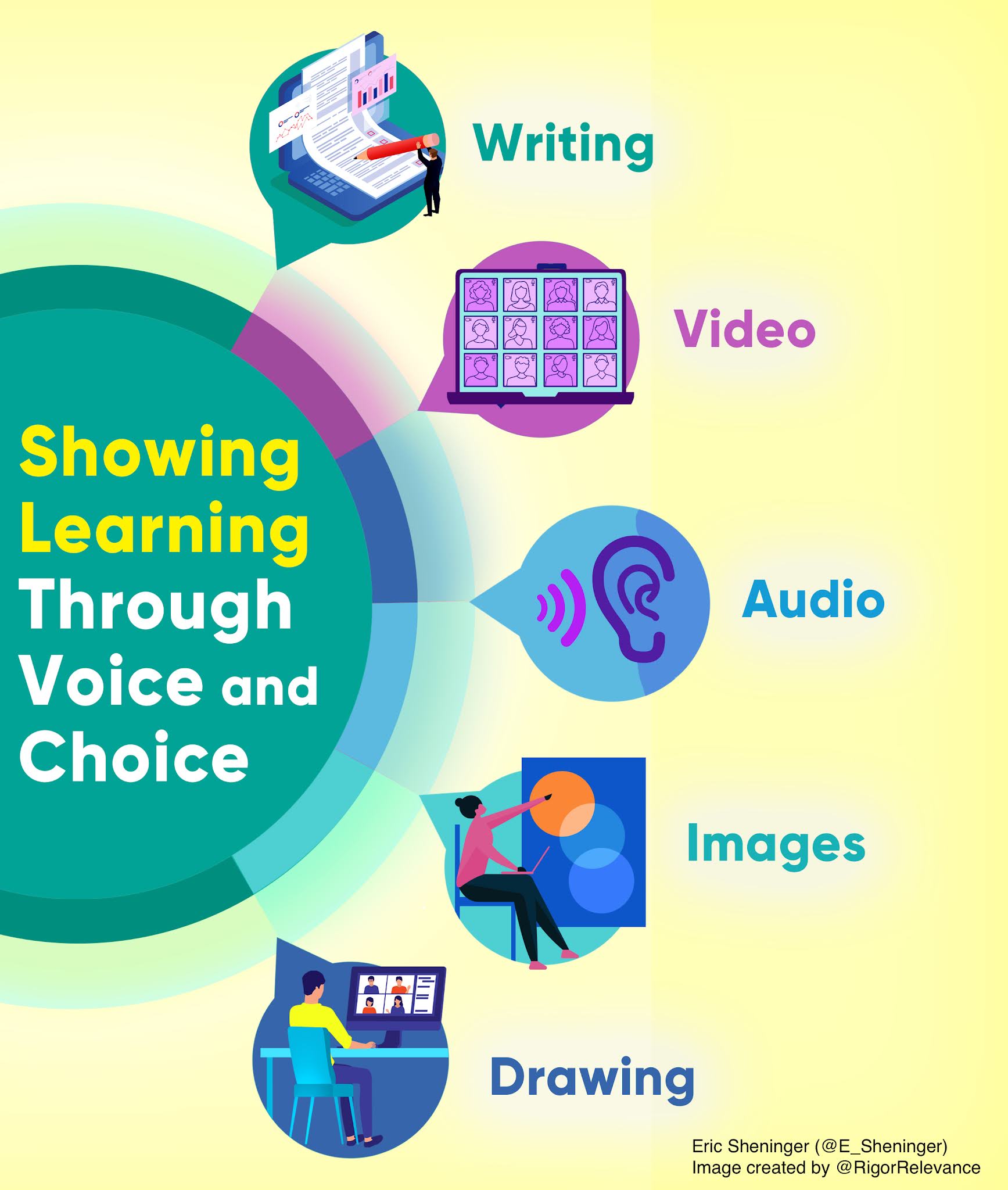
In Disruptive Thinking in Our Classrooms, I laid out an array of personalized strategies that can be implemented after a mini-lesson is facilitated.  While these take some planning upfront, there are some simpler techniques that can be readily integrated into any lesson in the form of voice and choice.  When reviewing prior learning, checking for understanding, or closing lessons, allow students to choose how to show what they have learned through the following means:

  • Writing (digital tools, individual whiteboards)
  • Video (Flipgrid, Padlet, Seesaw)
  • Audio (Padlet, Seesaw)
  • Images (Padlet Jamboard)
  • Drawing (Nearpod, Pear Deck, Padlet, individual whiteboards)

While tech presents a myriad of options for students to show learning, traditional mini-whiteboards can also be used in some cases. None of the pathways above are meant to replace summative assessments, but using varied formative means caters to a learner's preference by giving them the best opportunity to show what they have learned. It builds confidence, fosters creativity, and empowers students during lessons. 

Husmann, P.R., and V.D. O'Loughlin. 2019. "Another Nail in the Coffin for Learning Styles? Disparities among Undergraduate Anatomy Students' Study Strategies, Class Performance, and Reported Vark Learning Styles." Anatomical Sciences Education 12, 6–19. 

Kirschner, P. 2017. "Stop Propagating the Learning Styles Myth." Computers and Education 106, 166–171.

Riener, C., and D.T. Willingham, 2010. "The Myth of Learning Styles." Change: The Magazine of Higher Learning 42(5), 32–35.

Sunday, June 27, 2021

The Many Faces of Student Voice

There are many ways to both engage and empower students that lead to ownership of learning.  Creating what I call a “free-range” experience that replicates real-world contexts and develops critical competencies while tapping into passions might be the holy grail, in my humble opinion. While there is a slew of strategies a teacher can use to accomplish this, a focus on high-agency elements is both powerful and realistic.  These include voice, choice, path, pace, and place.  They can be integrated into a holistic experience or leveraged individually to personalize learning.  Of them all, voice might be the easiest to implement every day. 

Student voice.....

  • Involves all kids in the learning process 
  • Fosters active participation
  • Builds confidence leading to self-efficacy, especially when students can respond under cover of anonymity
  • Promotes open reflection and collaboration
  • Sets the stage for instant feedback
  • Develops a sense of community

As you look above at all the many powerful outcomes of this high agency strategy, it is crucial to understand that there is no one right way to foster student voice.  It could be as simple as all kids using an individual whiteboard or dry-erase surface to respond. Technology also provides an ever-growing selection of tools that involve kids in the learning process in ways that lead to greater empowerment.  Think about how audio, video, or the ability to draw can help a child find their voice. At a macro level, open forums and surveys can be used to elicit ideas for improving school culture.  The point is that voice takes on many faces, each with positive outcomes.  

During my longitudinal work with the Corinth School District over the past couple of years, I have seen many teachers embrace student voice. For the most part, technology has been their pathway of choice where tools such as Blooket, Gimkit, Mentimeter, Padlet, Edpuzzle, and Kahoot have been integrated.  During a recent visit, I saw something that completely blew my mind as it was simple yet highly effective.  You will see this in the video below, as well as a textbook personalized classroom using sound blended pedagogies.  The opening frame shows a choice board that students were able to access in Canvas along with standards-aligned learning targets.  As the video progresses, see if you are able to identify the voice strategy this teacher developed. 


Were you able to identify the strategy?  At first, I didn’t catch it as I was so impressed with the choice board and observable evidence of how empowered the learners were.  If you look closely, though, you will see that some computers had a green clothespin while the group at the end of the clip had red.  

When a question or challenge arose, the students would clip the red one to their laptops. This signified to the teacher that a group needed help. At the end of the video, you see where some students were getting needed support. If everything was good, the green clip remained on the computer.  Not only was this a fantastic way to foster student voice, but it also allowed the teacher to focus her time on the learners that needed it the most. 

As you look to include or improve student voice in your classroom (or school), keep in mind the intended outcomes listed at the beginning of this post.  Work backward from here and find the strategy that works best for your learners, and don’t be afraid to mix it up now and again. In the end, it is difficult for kids to own their learning if they don’t have a say. 

I am always on the lookout for great ideas that educators around the world have implemented with fidelity. How have you effectively implemented voice in your classroom or school? 

Sunday, September 18, 2016

Student Agency: Moving From Talk to Action

When I reflect back on what we were able to accomplish at New Milford High School, I am overtaken by a great sense of pride. We were able to transform the learning culture of a traditional school and in the process got results while becoming an example that others emulated. This was achieved during a time of tumultuous change as the education reform movement was just gaining steam. Even when doubt entered out minds, which it always does when change is involved, we persevered as a school community thanks to a unified vision that we could better serve our students.  

In a sense, all of our major changes really started when we began involving our students in the process. This was also the reason, in my opinion, as to why change became sustainable.  More often than not change is orchestrated and directed at the adult level. There is often a great deal of talk about how many changes are being spearheaded for the betterment of students, but rarely are the students themselves asked for their input or unique ideas.  Schools need to work for our students, as they are our number one stakeholder and ultimate boss. 

Image credit: https://andrewherrick.files.wordpress.com

If we are to improve learning and ultimately school-based outcomes student agency needs to be a real element of school culture. Student agency is about empowering kids to own their learning (and school) through greater autonomy. It is driven by choice, voice, and advocacy.  We learned a great deal about student agency during our school transformation. Below are a few practical tips to make student agency a reality in your classroom, school, or district:

  • Develop pedagogically sound learning activities with standards-aligned assessments and allow students to select the right tool for the task to demonstrate conceptual mastery 
  • Allow students to co-create rules and expectations.
  • Provide avenues for students to provide honest feedback on school culture. I held monthly meetings with all members of school government across all grade levels giving them an open forum to provide improvement ideas. We also set up an Edmodo group to continue the conversation. The key, however, was the follow-up and implementation on some of the ideas suggested. Tools like TodaysMeet and Mentimeter can also be used to gather perception data from kids 
  • Implement portfolios as a means of authentic assessment 
  • When hiring new teachers and administrators have kids on the interview committee
  • As policies that impact students are created or updated (i.e. BYOD, 1;1, grading, homework, technology purchases, space renovations, etc.) provide a forum for kids to give feedback 
  • Integrate personalized and personal learning pathways such as blended and virtual
  • Have protocols established for students to suggest new courses and extra-curricular activities
  • Implement Academies or Smaller Learning Communities (SLC’s)
  • Let students select books for independent reading based on their interests and reading level

Image credit: Jackie Gerstein


Above are some of the ways we increase student agency. What would you add? Please share some of your ideas in the comments below.

Meaningful change must begin with active student involvement. Advocacy, choice, and voice should occur in the classroom as well as the school setting. Relevancy and value on the part of our learners are central elements to success. Let’s move away from the catchy sound bites and clichés and begin to implement real strategies that will better prepare students for an ever-changing world.