Showing posts with label instructional design. Show all posts

Sunday, September 14, 2025

Purposeful Minutes, Powerful Learning

Recently, on my podcast Unpacking the Backpack, I shared some thoughts on maximizing instructional time.   Let's dive a little deeper.

Think about a typical school day. There's so much to fit in—lessons, activities, assessments, and, of course, the inevitable transitions, interruptions, and administrative tasks that eat away at our precious minutes. So, how do we make the most of every second we have with our students? Let's look at the "why," the "what," and the "how" of maximizing instructional time.

The "Why": Why Does Instructional Time Matter So Much?

First, let's get to the heart of it. Why is this even a big deal? Instructional time isn't just about covering curriculum; it's about student learning and success. When we use our time effectively, we're not just moving through a checklist; we're creating a rich, engaging, and productive learning environment. More time on task leads to deeper understanding, better retention, and ultimately, improved academic outcomes.

Think of it like this: a surgeon has a limited amount of time in an operating room. Every single action must be purposeful and efficient.

A teacher's classroom is similar. We have a set number of minutes, and every minute counts. Wasted time in the classroom isn't just a loss of minutes; it's a lost opportunity for a student to grasp a concept, practice a skill, or engage in a meaningful discussion.

So, the why is simple: maximizing instructional time is a direct pathway to better student learning. It allows us to personalize, provide targeted support to students who need it, and create space for creative and critical thinking that often gets overlooked when we're under time pressure.

The "What": What Exactly Are We Maximizing?

Now that we know why it's important, let's define what we're actually talking about. When we say "instructional time," we're not just referring to the time when you're standing in front of the class lecturing. We're talking about the total amount of time students are actively engaged in learning. This includes:

  • Active instructional time: When you're directly teaching, explaining, or demonstrating.
  • Guided practice: When students are working on tasks with your support and guidance.
  • Independent practice: When students are working on their own to solidify their understanding.
  • Meaningful transitions: The time between activities, when students are moving from one task to the next in a purposeful way.

The goal isn't just to fill every moment; it's to fill it with purposeful, high-quality, and meaningful learning activities. This means minimizing the "dead time" in a classroom—the time spent on non-instructional tasks like waiting for students to settle down, passing out papers, or dealing with behavioral disruptions.

The "How": Practical Strategies for Your Classroom

Okay, here's the part you've been waiting for. How do we actually do this? I've broken down some of the most effective strategies into a few key areas.

1. The Art of the Efficient Beginning

The first few minutes of class can set the tone for the entire period. Instead of using this time for routine tasks, turn it into a learning opportunity.

  • Implement a "Do Now" or Bell Ringer: As soon as students enter the classroom, they should have a short, purposeful task waiting for them on the board or their desk. This could be a quick review question, a journal prompt, or a problem to solve. This gets their brains in "learning mode" immediately and buys you time to take attendance or handle administrative tasks without losing instructional time.
  • Establish a Clear Routine: Students thrive on routine. When they know exactly what to do when they enter the classroom, the process becomes automatic. A simple routine like "hang up your backpack, grab your notebook, and start the 'Do Now'" can save several minutes every single day.

2. Streamlining Transitions

Transitions are a notorious time-waster in many classrooms. A 3-minute transition between activities can easily turn into 10 minutes if not managed properly.

  • Use Signals and Cues: Instead of yelling over a noisy class, use a non-verbal signal like a hand clap, a specific bell sound, or turning the lights on and off. Practice these signals until they become second nature.
  • "Chunk" Your Transitions: Break down the transition into small, manageable steps. Instead of saying, "Okay, everyone, put your books away, get out your science binders, and move to your lab groups," break it down: "Step 1: Put your books away." "Step 2: Take out your science binders." This reduces cognitive load and helps students stay on track.
  • Prepare in Advance: Have all your materials ready before the students arrive. Have handouts stacked, lab equipment set up, or links for digital resources pre-loaded. The less time you spend fumbling for materials, the more time you have for instruction.

3. Purposeful Planning and Pacing

Effective time management starts long before students enter the classroom. It begins with your lesson plan.

  • Over-plan, but Don't Over-teach: Plan for more activities than you think you'll have time for. This ensures you always have a meaningful task ready, even if you finish a section early. However, be prepared to adjust and cut things out if a topic requires more time. The goal isn't to race through the curriculum; it's to ensure understanding.
  • Use a Timer: A timer can be a powerful tool for both you and your students. Use it to set a time limit for a group discussion, an independent practice task, or a writing exercise. This creates a sense of urgency and helps everyone stay focused. It also helps you, the teacher, from getting bogged down in one part of the lesson.
  • Integrate Assessments: Don't see assessments as a separate, time-consuming task. Build them into your lessons. Quick checks for understanding, like a one-minute reflection or a quick-write, provide you with valuable feedback while keeping the lesson moving.

4. Classroom Management as Time Management

Behavioral disruptions are a massive drain on instructional time. A well-managed classroom is an efficient classroom.

  • Clear Expectations and Consequences: From day one, be crystal clear about your expectations for behavior. When students know what's expected, they're more likely to meet those expectations. When a rule is broken, have a consistent and predictable consequence. This minimizes the time spent on reacting to misbehavior.
  • Address Issues Privately and Proactively: Minor behavioral issues can often be addressed with a quiet word or a non-verbal cue. The less time you spend having a public confrontation, the more time you have for teaching.
  • Build Relationships: Students are more likely to stay engaged and on task when they feel a positive connection with you. Take the time to get to know your students. When they feel respected and cared for, they are more likely to respect the classroom and the learning process.

5. Leveraging Technology and Tools

As I shared in Digital Leadership, technology, when used wisely, can be a huge time-saver.

  • Digital Tools for Handouts: Instead of physically passing out papers, use a digital platform like Google Classroom, Canvas, or Microsoft Teams to share documents. This eliminates the time spent distributing and collecting papers.
  • Pre-recorded Explanations: For complex concepts, consider recording a short video explanation for students to watch before class. This "flipped classroom" model allows you to use class time for hands-on activities, discussions, and addressing specific questions, rather than just lecturing.
  • Use Collaborative Platforms: Tools like Padlet or Linoit allow multiple students to contribute simultaneously, making group work and brainstorming sessions far more efficient than traditional methods.

6. The Power of "Small Talk"

Finally, don't underestimate the power of using small, seemingly inconsequential moments for learning.

  • Exit Tickets: The last few minutes of class are often wasted. Use this time for a quick "exit ticket." It could be a single question on a sticky note, a summary of the main idea, or a question they still have. This provides you with valuable data and keeps students engaged until the very end.
  • The "One Last Thing" Moment: As students are packing up, seize the opportunity to reinforce a key concept or ask a thought-provoking question related to the day's lesson. This keeps learning at the forefront, even during the final moments.

This isn't just a teacher's job; it's a school-wide effort. Leaders, from principals to department heads, play a critical role in creating an environment where maximizing instructional time is not only possible but prioritized. A great leader can protect their teachers' time by first looking at the school's own practices. This means scrutinizing the schedule to reduce unnecessary interruptions and staggering student pull-outs for services so they don't always happen during core instructional periods. It also involves critically evaluating meetings and administrative tasks. Are all meetings necessary? Can some information be shared in a quick email? Reducing the burden of paperwork and non-instructional duties directly gives teachers back the most valuable resource they have: time to plan, prepare, and reflect on their lessons.

Beyond protecting time, leaders can empower teachers with the tools and professional development needed for efficiency. This could be providing training on new classroom management techniques that reduce behavioral disruptions or offering workshops on using technology to streamline lesson delivery. A supportive leader models good time management and sets a clear school-wide expectation that every minute in the classroom is valuable. By fostering a culture that values efficiency, and by proactively removing systemic barriers, leaders can make a powerful statement that student learning is the top priority, and they will do everything in their power to help their teachers make the most of every second.

Maximizing instructional time isn't about rushing through the day. It's about being intentional and purposeful with every single minute. It's about creating a smooth, predictable, and engaging learning environment where students can truly thrive. By implementing just a few of these strategies, you can reclaim minutes that turn into hours, and those hours translate into deeper learning and greater success for your students.


Sunday, August 29, 2021

The 6 Dimensions of Disruptive Thinkers

What is really needed for success in the world today?  I think this might be the million-dollar question. Even though it is difficult, if not impossible, to predict the future, we can examine current trends and societal forces to determine the competencies that learners need to thrive.  While some will remain the same, others will evolve or change completely depending on the disruption at the moment. What I think we can all agree on is that in the face of disruptive forces, conditions in classrooms need to empower learners to replace conventional ideas with innovative solutions to authentic problems.  This is how I define disruptive thinking.

On the front lines of this endeavor are educators tasked with balancing mandated curriculum and testing with the responsibility to prepare students for college and careers. The former can result in perceived roadblocks to accomplishing the latter.  Success relies on instructional strategies and pedagogical techniques that both engage and empower students to dive deep into standards and concepts while applying them in meaningful ways.  While there is a time and place for content to be disseminated through instruction, the key to accomplishing all that educators are tasked with is how the learning experience develops a student’s ability to think and do in relation to the current and future workforce.

In Disruptive Thinking in Our Classrooms, I identified six dimensions of disruptive thinking. Now I didn’t refer to them as these in the book, but the purpose of my blogging is to share my reflections and expand on ideas. Maybe dimensions aren’t the proper term, but to create a culture of disruptive thinking in a classroom or school, learning should result in students developing into:

Creative scholars generate and explore ideas and make original con­nections. They try different ways to tackle a problem, working with others to find imaginative solutions and outcomes that are of value.

Reflective learners evaluate their strengths and limitations, setting realistic goals with criteria for success. They monitor their performance and progress, inviting feedback from others and making changes to fur­ther their learning.

Collaborative workers engage confidently with others, adapting to different contexts and taking responsibility for their own role on the team. They listen to and take into account different perspectives. They form collaborative relationships, resolving issues to reach agreed-upon outcomes.

Active engagers readily explore issues that affect them and those around them. They actively engage in the life of their school, college, workplace, or wider community by taking responsible action to improve others as well as themselves.

Self-directed managers organize themselves, showing personal responsibility, initiative, creativity, and enterprise with a commitment to learning and self-improvement. They actively embrace change, respond positively to new priorities, cope with challenges and look for growth opportunities.

Autonomous inquirers process and evaluate information in their investigations, planning what to do and how to go about it. They make informed and well-reasoned decisions while recognizing that others may have different beliefs and attitudes.

Preparation just for promotion, graduation, or an exam doesn’t serve the best interests of kids. Each of the dimensions above allows for students to explore the curriculum in relevant and authentic ways while more than adequately preparing them for any standardized test they are forced to take. Each plays a critical component in fostering a disruptive thinking mindset. More importantly, they empower learners to develop essential competencies that will serve them well no matter the chosen path in life.

Incorporating these are not as difficult as you think as they naturally result when sound pedagogical strategies are employed, such as cooperative, personalized, problem-based, blended, and project-based learning, just to name a few. Many can also be developed or amplified through extracurricular programs, virtual courses, independent study, and work-study options.  Disruptive thinkers are what the world will always need. Let’s make sure they are readily available.

Sunday, March 7, 2021

Digitally-Enhanced Exit Tickets

I love coaching as it provides a lens to see how teachers and administrators act on feedback to grow and improve. It also provides evidence that strategies aligned to research and sound instructional design are implemented in practical ways. Even though this year has been dramatically different as a result of the pandemic, I have found myself even more busy supporting districts through job-embedded and on-going professional learning.  Whether face-to-face, hybrid or remote, the elements of learning and good teaching remain the same.  

No matter where I am, one aspect of instructional design that I often identify as an area for growth is closure.   I have written in the past how important including this strategy is, no matter the grade level of students or the content being addressed.  Closure draws attention to the end of the lesson, helps students organize their learning, reinforces the significant aspects of the concepts explored, allows students to practice what was learned, and provides an opportunity for feedback, review, and reflective thinking. It is hard to determine the effectiveness of a lesson or whether learners understood the concepts presented without some form of closure.  


While there are many strategies out there, the exit ticket is probably the one that is utilized the most. While learners can solve problems or answer specific questions related to the content or concepts addressed, more general prompts can also be used, such as:

  • What exactly did I learn?
  • Why did we learn this?
  • How will I use what was learned today outside of school, and how does it connect to the real world?

A few weeks ago, I received an email from Dr. Nathan Hall, the Corinth Middle School principal in Mississippi.  I have been coaching in the district for over two years now and have written extensively about how the schools' staff have been open to innovative change with the evidence to back it up.  Below is a message that Lori Snyder, one of his 7/8th grade math teachers, sent him regarding using exit tickets for closure:

I had asked about a program for my exit tickets.  I need something like Padlet that allows them to enter their answer anonymously but will not show everyone's answer until I am ready.  I want to use it for real-time feedback. The trouble with Padlet is that they can see everyone's responses as they are posted, and some are copying others' answers instead of doing their own work. Mentimeter won't let them type in numbers. Canvas discussion is not anonymous. You had said something about asking Mr. Sheninger before he came for his next visit.

After thinking about it, I suggested GoSoapBox.  Dr. Hall then passed this along to Ms. Snyder, and her feedback is below:

When they are online answering, the barometer at the top tells me if they need help.  After seeing that some require the problem worked out, I add it to the exit ticket page.

It is always a great day when a teacher or administrator shoots me an email looking for ways to improve.  Little did I know that I would see the GoSoapBox exit ticket in action a few weeks later.  As I conducted my monthly coaching visit at Corinth Middle School, here is what I saw in Ms. Snyder's class:

  • Students solved math problems on dry-erase desks and then submitted their answers.
  • Their work was added to their notebook, which both they and the teacher could refer to see where issues were.
  • The teacher was able to see where misconceptions were immediately.
  • Names were removed from public view, so students weren't embarrassed.
  • The teacher was able to address issues that the majority of the class was having right away by modeling or re-teaching.
  • Individual students who had misconceptions were emailed after school to maximize class time.


I am so proud of this teacher for looking for ways to implement exit tickets using technology.  From the bullets above, you can see the many positive outcomes one small, yet significant, change made.  The key lesson here is that there are always elements of practice that can be tweaked, adapted, or changed in order to improve.  Great educators never stop chasing growth. 

Corinth has been selected as an Innovative District and will be presenting at the Model Schools Conference this June in Nashville. To learn more and register click HERE.

Sunday, February 23, 2020

Bookend Pedagogy

As I work with more and more schools in a coaching role, I am beginning to see specific trends emerge. Now, before I go any further, it goes without saying that I see fantastic examples of sound pedagogical practices and innovative strategies that are leading to improved learning outcomes.  However, my role, as the schools I partner with and I see it, isn't to just spit out platitudes and tell them what they want to hear.  The most important aspect is to empower them to take a critical lens to their work through evidence and begin to think deeply about needed changes to practice.

In a previous post, I outlined what a typical coaching day with me looks like, as well as the most common areas where growth can be achieved based on many classroom visits.  Wells Elementary has been taking the feedback that I provide for over three years and recently asked me to create a session that focused on strategies for opening and closing lessons. I was excited about this opportunity as I was going to have the honor of meeting with all teachers by grade level and presenting newly created content. As I pondered over what I was going to call this presentation, the idea of bookend pedagogy popped into my mind.  I ran the title by my wife as she never hesitates to tell me how it is. She liked it, and off I went to create a new slide deck.


The more I think about it, I really see bookend pedagogy as a critical element of any successful lesson. How a lesson begins typically makes or breaks it in the eyes of a learner. A well-structured anticipatory set gets the ball rolling, while a review or prior learning right after helps to ensure that the kids understand what was covered previously. The end provides valuable feedback to both the teacher and student to determine if the objective/target was met and that learning occurred. Without closure, it is difficult, if not impossible, to evaluate whether a specific lesson was a success. For my session with the Wells staff, I developed and then implemented a mini-lesson on personalized learning while ensuring that I included an anticipatory set, a review of prior learning, direct instruction, and closure. 

In the past, I have written posts on all three of these elements, but a quick review never hurt anyone.  In addition, I will provide additional strategies and resources. The anticipatory set is used to prepare students for the lesson by setting the students' minds for instruction. This is achieved by asking a question or making statements to pique interest, create mental images, review information, focus student attention, and initiate the learning process. Types of sets can include the following:
  • Short video clips
  • Relevant writing prompts
  • Riddles
  • Personal stories or real-world scenarios
  • Current events
  • Picture prompts
  • Props
  • Open-ended questions
For more context, check out this video.


Just because something was presented in class, the assumption cannot be made that students actually learned it, which makes reviewing prior learning critical.  Research in cognitive science has shown that eliciting prior understandings is a necessary component of the learning process. Research also has demonstrated that expert learners are much more adept at the transfer of learning than novices and that practice in the transfer of learning is required in good instruction (Bransford, Brown, and Cocking 2000). Check out this article from TeachThought, which outlines 27 strategies to review prior learning.

How do you know if the class got it at the end of a lesson? Learning increases when lessons are concluded in a manner that helps students organize and remember the point of the lesson. Closure draws attention to the end of the lesson, helps students organize their learning, reinforces the significant aspects of the lesson, allows students to practice what is learned, and provides an opportunity for feedback and review. Time must be set aside for closure, and efforts should be made to include it in lesson plans. A straightforward way to do this is to provide three scaffolded questions (easy, moderate, and challenging) as a means of formative assessment. Below are some general closure examples:
  • Explain one thing you learned today.
  • What was the most challenging concept, and why?
  • Identify the most significant learning from the lesson and explain why.
  • What do you need to do to develop a deeper understanding?
  • How did the lesson impact your understanding?
  • How would you summarize what you learned for someone who wasn't here?
  • What was one thing you were unsure of?
  • Discuss an "aha" you had and how it connects to the learning target/objective.
The above only represents some ideas on how to close a lesson.  As is the case with anticipatory sets, reviews of prior learning, and closure, there is no one right way.  Many tools can help facilitate all of the above. Here they are in no particular order:
  • Whiteboards (no tech)
  • Paper exit tickets
  • Plickers (best tech option)
  • Mentimeter
  • Pear Deck
  • Nearpod
  • Google Forms
  • Kahoot
  • Quizizz
  • Quiz Whizzer
  • Gimkit
  • GoSoapBox
  • Padlet
  • Linoit
  • AnswerGarden
  • Flipgrid
It should be noted that bookend pedagogy might not be necessary during lessons that involve high-agency strategies such as station rotation, choice boards, playlists, or those involving extended inquiry and project-based learning. However, with any of these pedagogical techniques, there should be an opening and an end at some point, so always keep bookend pedagogy in mind. 

Sunday, December 22, 2019

Mitigating #EdTech Issues in the Classroom

With all the promise that educational technology holds, several pitfalls are always on the minds of educators. The top two issues that commonly come up in my talks with educators are the technology (Internet, hardware, devices, apps) not working or off-task behavior on the part of students.  While there are some serious challenges that can derail any lesson, there are some strategic ways to mitigate them ground in instructional design. Here are some of the most commonly implemented strategies, which I will describe in more detail in this post.
  • Classroom Management
  • Pedagogically sound lessons
  • Monitoring
  • Accountability for learning
  • Feedback
  • Assessment
Classroom Management

It is tough to argue the fact that many learners will quickly go off and remain off task if a classroom is not managed effectively. The key above all else is to build positive relationships with kids. One great way to do this is to co-construct rules with them as well as ramifications if they are not followed or broken. Addressing issues immediately as they arise, re-directing adverse behaviors, and utilizing positive reinforcement at opportune times all aid in creating a classroom conducive to learning.

Pedagogically Sound Lessons

If you are a reader of this blog, then you know that this is one area that I focus on extensively with my writing. Instructional design is one of the best deterrents to off-task behavior. If a student, or adult for that matter, is bored, then we better accept what might happen. It is critical to get kids so immersed in their learning that they don’t think about surfing the web aimlessly, texting their friends, or accessing social media. Sound pedagogy consists of effective instructional strategies that involve all learners, a focus on higher-order thinking skills, scaffolding techniques, construction of new knowledge, and relevant application of thinking. Mitigating edtech related issues rests on authentically engaging as many learners as possible.


Monitoring

If kids are given a task to complete on a device, whether independently, in cooperative groups, or as a part of many different blended learning models, sitting or standing in the same place in the front of the room might lead to unintended consequences. During situations like this is when I commonly observe kids focused on anything but the learning at hand. It is vital to move about the room to not only look at what is on a learner’s screen but to also be in a position to either re-direct any off-task behavior or provide needed guidance. 

Accountability for learning

When I say accountability, I am not talking about grades. I can go on and on about the fact that many grading practices are outdated, ineffective, and do not adequately reflect what a student has learned. What I am referring to are specific strategies that keep kids focused on the task at hand while ensuring that his or her part in the learning process is completed. Some ways to accomplish this include assigning equitable roles to each individual student in a cooperative group, handing in an assignment, developing performance tasks where a product is created, or using digital tools in a way where every student can report out using his/her real name.

Feedback

Continuous feedback is essential on so many levels. It helps to justify a grade, establishes criteria for improvement, provides motivation for the next assessment, reinforces good work, and serves a catalyst for reflection. Blended learning strategies lend themselves to providing continuous feedback during class time, which in turn helps to keep kids on task. Keep in mind that it doesn’t have to be just a teacher to teacher pathway. Creating opportunities for learners to give each other peer feedback is just as valuable.

Assessment

I would be remised if I didn’t include this strategy.  Assessment determines whether learning occurred, what learning occurred, and if the learning relates to stated targets, standards, and objectives. For many learners knowing that they will ultimately be assessed based on the activities and tasks they have engaged in increases attentive behavior. A variety of strategies beyond traditional tests can be used, such as performance-based activities, portfolios, and rubrics.

The reality is that no matter how well you implement the above strategies, the chances are that a few students might still go off task.  I am a realist. It is extremely challenging, no matter how great the lesson is, to engage each and every learner. What I do know is that the strategies listed above will help to mitigate common issues that arise when technology is utilized in the classroom. So, what did I miss? Please share any other successful strategies that you have successfully implemented.


Sunday, October 27, 2019

Don't Forget Closure

There are many pedagogical techniques that run the gambit when it comes to instruction and learning. In a previous post, I discussed the importance of opening lessons with a bang, using an anticipatory set. Whether you call it a set, hook, or bell ringer is not the issue. What is, though, is the value the strategy has as part of a comprehensive lesson. Here’s why:
The anticipatory set is used to prepare learners for the lesson or task by setting their minds for instruction or learning. This is achieved by asking a question, adding a relevant context, or making statements to pique interest, create mental images, review information, and initiate the learning process. A good do-now activity can accomplish this.
While the opening moments with students are crucial, so are the final minutes. Think about this for a second. What’s the point of an objective or learning target, whether stated, on the board, or students have the opportunity to later discover for themselves, if there is no opportunity at the end to determine if it was met or reflected upon? Closure matters, yet virtually every lesson I observe in schools across the country are missing the crucial component. Here’s why. Learning increases when lessons are concluded in a manner that helps students organize and remember the point of the lesson. Closure draws attention to the end of the lesson, helps students organize their learning, reinforces the significant aspects of the lesson, allows students to practice what is learned, and provides an opportunity for feedback, review, and reflective thinking.


Kathy Ganske provides this take.
As in a puzzle, an effective lesson has many pieces that must fit together. We typically give considerable thought to how we initiate lessons: activate or build background knowledge, teach essential vocabulary, engage learners, and set a purpose for the lesson. And we carefully select tasks or activities and texts for use during the lesson. But closure is often given short shrift or omitted entirely. We need to be sure we plan time to cycle back to the what, why, and how of students’ learning to help them actively synthesize the parts into a whole. Lesson closure provides space for students to digest and assimilate their learning and to realize why it all matters. Closure is a component of planning and teaching that we can't afford to leave out.
A Google search will turn up a slew of ideas on how to close lessons. I prefer to keep it simple. First, make sure it is planned for and that at least three to five minutes are set-aside at the end of every period or block. Second, consider the following questions that students should answer or reflect upon in relation to the objective or learning target.

  • What exactly did I learn?
  • Why did we learn this?
  • How will I use what was learned today outside of school, and how does it connect to the real world?

Whether exit tickets, journals, whiteboards, or technology are used doesn’t really matter. What does is that closure is prioritized.

Sunday, December 30, 2018

Top Posts of 2018

Get up and write!  Well, this isn’t the saying that I abide by, but making the time to reflect and hammer away at the keyboard is something that I still consistently commit to doing.  There are many reasons I continue to blog regularly, but the biggest is trying to add a practical lens to many of the ideas we either see or hear about on social media. During the past year, I attempted to connect more research to either further validate my thoughts or illustrate how educators were implementing proven strategies with an innovative angle into practice.  An increase in the amount of job-embedded coaching work I did in schools over an extended period of time also influenced my thinking.  There is nothing better in my opinion than to see either growth or success in schools where real challenges were overcome. 


In my opinion, you don’t have to be a great writer to blog. Begin with a focus on your work and that of others you spend your days with as a starting point.  Remember, the act of blogging is first and foremost you and the impact that it has on your growth and development. Another outcome is the impact that it has on readers near and far. Never discount how your ideas and experiences might positively influence the work of others.  Back to the whole writing thing. If you ever doubt your ability fall back on a proofreader (thanks mom) on Grammarly as I do. 

Here are my top posts of 2018.

Preparing Learners for the Fourth Industrial Revolution

Change isn’t coming. It’s already on our doorstep.  You can’t run or hide from it. The revolution, or evolution depending on your respective lens, of our world, will transform everything as we know it. We must adapt, but more importantly, prepare our learners for a bold new world that is unpredictable.  Welcome to the Fourth Industrial Revolution.  It is characterized by a fusion of technologies that is blurring the lines between the physical, digital, and biological spheres marked by emerging technology breakthroughs in a number of fields, including robotics, artificial intelligence, nanotechnology, quantum computing, biotechnology, the Internet of Things, 3D printing, and fully autonomous vehicles. Education remains the key to the future. Don’t prepare students for something. Prepare them for anything!

Scaffolding Questions to Develop Deeper Understanding

The key to future-proofing school and learning is to empower all kids to think regardless of label or zip code. By using the Rigor Relevance Framework as a guide, we can begin by asking learners better questions with the goal being that they start to formulate questions on their own. With and without technology, it is crucial to create a thinking culture. Scaffolding questions enhance learning and aids in the mastery of concepts by systematically building on knowledge and relevance. The ultimate goal is to develop competent thinkers and doers who can not only use knowledge in new ways but also construct their own.


The Pivotal Role Movement Plays in Learning

Research has shown that movement in the form of brain breaks, recess, and physical education positively impacts learning. Don’t look at kids moving in class as a break or poor use of instructional time. Schools need to do more to ensure that movement is being integrated into all classes. The brain needs regular stimulation to properly function and this can come in the form of exercise or movement. Based on what is now known about the brain, this has been shown to be an effective cognitive strategy to improve memory and retrieval, strengthen learning, and enhance motivation among all learners. As research has shown, movement is an essential component of learning. If the goal is to help kids be better learners, then we have to be better at getting them up and moving in school. 

Five Components of Good Feedback

Feedback is essential to improvement and growth. There is nothing more vital to our professional roles than a good discussion around evidence-based practice that paints a picture not only of what we are doing well but areas where we can either become much better or outright improve. However, for it to be effective, it must be delivered positively, timely, practical and specific, consistent, and delivered using the right medium.  

To Improve Outcomes, We Need to Take a Critical Lens to Instructional Design

There is no perfection in education; thus there is always room for improvement.  To get to where we want, and our learners need us to be, a routine audit of pedagogical practice is necessary.  In this post, I identify five areas to look at when implementing any digital tool or innovative idea to determine whether or not improvements to pedagogy are changing. These include the level of questioning, authentic and/or interdisciplinary contexts, rigorous performance tasks, innovative assessment, and improved feedback.  A question or two as a means to help self-assess where you are and if improvements can be made follows each of these areas. 

Thanks to everyone who has made the time to visit my blog, read posts, and provide comments.  Here’s to a fantastic 2019!  

Sunday, February 25, 2018

Empowering Learners to Think with Performance Tasks

Pedagogy has been at the forefront of my thinking and work as of late.  Decades of solid research have laid the foundation for current studies that bring to light how we can improve teaching, learning, and leadership.  As Tom Murray and I highlighted in Learning Transformed, this research has been taken to heart by schools across the world as they have transformed learning while improving results in the process. It is important not to lose sight of what has been found to work.  With all of the great ideas that educators are exposed to thanks to social media and live events, it is essential that we pause to reflect on what it takes to move from what sounds good in theory to successful implementation into practice.  Ideas shouldn't just seem right. They must lead push learners to think while providing validation of improvement through evidence. 

During my work as a principal, I wanted to transform the learning culture of my school.  For so long my students, like many others across the world, just did school. Learning, or at least what we referred to it as was more or less a monotonous task consisting of the same types of activities and assessments that occurred over and over again.  We weren't consistently getting our students to think deeply or authentically apply what they had learned.  Getting in classrooms more, taking a critical lens to our work, and working towards a Return on Instruction (ROI) helped us take the needed steps to raise the learning bar while expecting more from our students. We began by improving the level of questioning across the board.  From there, our focus was on the development of performance tasks that took into account objectives, learning targets, and curriculum alignment.  

Performance tasks afford students an opportunity to actively apply what they have learned and create a product to demonstrate conceptual mastery aligned to standards. Jay McTighe describes performance tasks as follows:
A performance task is any learning activity or assessment that asks students to perform to demonstrate their knowledge, understanding, and proficiency. Performance tasks yield a tangible product or performance that serve as evidence of learning. Unlike a selected-response item (e.g., multiple-choice or matching) that asks students to select from given alternatives, a performance task presents a situation that calls for learners to apply their learning in context.
Learning in highly successful schools enables students to know what to do when they don't know what to do. This is also referred to as cognitive flexibility, the mental ability to switch between thinking about two different concepts and to think about multiple ideas simultaneously. To gain that competence, students need to acquire depth of knowledge and a rich set of skills and then be taught how to apply their skills/knowledge to unpredictable situations in the world beyond school.  This is critical if we are to prepare students for the new world of work adequately.  

By using the Rigor Relevance Framework as a guide, educators can begin to develop performance tasks that push learners to show that they understand while applying what has been learned in relevant contexts. McTighe identifies seven characteristics to consider during development:

  1. Performance tasks call for the application of knowledge and skills, not just recall or recognition.
  2. Performance tasks are open-ended and typically do not yield a single, correct answer.
  3. Performance tasks establish novel and authentic contexts for performance.
  4. Performance tasks provide evidence of understanding via transfer.
  5. Performance tasks are multi-faceted.
  6. Performance tasks can integrate two or more subjects as well as 21st-century skills.
  7. Performances on open-ended tasks are evaluated with established criteria and rubrics.

The GRASPS model (Wiggins & McTighe, 2004) can greatly assist educators in the construction of quality performance tasks. The GRASP acronym stands for the following: Goals, Role, Audience, Situation, Products or Performances, and Standards.


It is important to remember that the two critical elements in any quality performance task is evidence of learning and relevant application.  As we began progressing through our digital transformation at New Milford High School, technology became a vital component of performance tasks.  To see some examples, take a look at this post.  

The Independent OpenCourseWare Study (IOCS) that we created is another excellent example. It allowed students to fully utilize OCW to pursue learning that focused on their passions, interests, and career aspirations.  They could select offerings from such schools as the MIT Harvard, Yale, University of California at Berkeley, and Stanford, applying their learning to earn high school credit. Students combined their creativity with their newfound knowledge to synthesize a unique product that demonstrated and implemented the new knowledge and skills they gained from the OCW. The aim was for students to produce an actual product, whether it was the demonstration of a new skill, the creation of a physical model, the designing and conducting of an experiment, the formulation of a theory, or some other creative way to show what they've learned. 

If it's easy, then it probably isn't learning.  Performance tasks push students to think more deeply about their learning while developing a greater sense of relevance beyond the classroom.  

Wiggins, G., & McTighe, J. (2004).  Understanding by Design Professional Development  Workbook. Association for Supervision and Curriculum Development: Alexandria, VA.

Sunday, February 18, 2018

Scaffolding Questions to Develop Deeper Understanding

Over the past couple of months, I have been working with a variety of schools and districts in the role of a coach.  Most of this work is focused on digital pedagogy, so naturally, I am focused on observing and collecting evidence to get a handle on both the level of instruction and the learning that is taking place.  To allow educators to critically reflect on their practice, I take many pictures of what I see, especially the types of learning activities with which students are engaged.  After numerous visits, we all debriefed and discussed the good practices that were observed but also areas needing improvement.

The message that I try to convey is that technology should not be separate from sound instructional design but instead serve as a ubiquitous entity that supports or enhances curriculum, instruction, and assessment.  There are five main areas that are critical components of sound instructional design that I tend to focus on during debriefing conversations: level of questioning, authentic or interdisciplinary contexts, rigorous performance tasks, innovative assessments, and improved feedback. Of these five components, questioning techniques are something teachers and administrators can work to improve in every lesson. 

Here is what I struggle with based on what I actually see in practice.  In many cases, the "wow" factor of technology is placed ahead of getting kids to think deeply or authentically apply their learning.  Take tools like Kahoot and Quizizz.  There are no inherent issues with the tools themselves; educators just have to be more mindful of how they are being used.  Many of these tools add either a fun or competitive factor to the process of answering low-level, multiple-choice questions. Now I am not saying that foundational knowledge is not important. It is in many cases. However, if this is the only way tools like this are utilized, then we are missing a golden opportunity to challenge our learners to think deeply about concepts.

While conducting some coaching visits at Wells Elementary School recently, I saw Ms. Mican using Quizizz.  At first glance, all I saw were student responses to knowledge-based questions on the interactive whiteboard to check for understanding.  What I saw next really made me smile.  With the students sitting on the floor around the IWB, Ms. Mican displayed the Quizziz results and then had the kids explain why they answered the way they did.  This is a great example of scaffolding and building on the content.  As I said previously, foundational knowledge provides a bridge to higher-level thinking and application.  The key is to make sure when using response-based technologies that the level of questioning is addressed through scaffolding techniques. The same can be said in regard to any type of activity without technology.

Scaffolding refers to a variety of instructional techniques used to move students progressively toward stronger understanding and, ultimately, greater independence in the learning process. Questioning is an integral component of this process. NSEAD provides this synopsis on the importance of good questioning techniques. Check out the link in the previous sentence it contains a wealth of information to improve the level of questioning in any class. 
Historically, teachers have asked questions to check what has been learned and understood, to help them gauge whether to further review previous learning, increase or decrease the challenge, and assess whether students are ready to move forward and learn new information (factual checks - ie 'Closed' questions). This can be structured as a simple 'teacher versus the class' approach (Bat and Ball), where the teacher asks a question and accepts an answer from a volunteer, or selects/conscripts a specific student to answer. These approaches are implicit in any pedagogy, but teachers need a range of 'Open' questioning strategies to address different learning needs and situations. Teachers must also pitch questions effectively to raise the thinking challenge, target specific students or groups within the class.
The Relevant Thinking Framework provides all educators with guidance to scaffold questions.  It is an action-oriented continuum that describes putting knowledge to use by giving teachers a way to develop both instruction and assessment and gives students a way to project learning goals. This framework, based on traditional elements of education yet encouraging movement from the acquisition of knowledge to the application of knowledge, charts learning along the two dimensions of higher standards and student performance. 


Below is a breakdown of the four quadrants:

  • Quad A - Students gather and store bits of knowledge and information. Students are primarily expected to remember or understand this knowledge.
  • Quad B - Students use acquired knowledge to solve problems, design solutions, and complete work. The highest level of application is to apply knowledge to new and unpredictable situations.
  • Quad C - Students extend and refine their acquired knowledge to be able to use that knowledge automatically and routinely to analyze and solve problems and create solutions.
  • Quad D - Students have the competence to think in complex ways and to apply their knowledge and skills they have acquired. Even when confronted with perplexing unknowns, students are able to use extensive knowledge and skill to create solutions and take action that further develops their skills and knowledge.
Below you will see how questions can be scaffolded according to each quadrant of the Rigor Relevance Framework.


With and without technology, it is important to empower our learners to think. Scaffolding questions enhance learning and aid in the mastery of concepts by systematically building on knowledge and relevance. The ultimate goal is to develop competent thinkers and doers who can not only use knowledge in new ways but also construct their own.

Sunday, December 10, 2017

Blended Instruction vs Blended Learning

Schools continue to make investments in technology to engage students better, improve outcomes, and prepare all learners for the new world of work.  We are beginning to see more and more innovative uses of technology not just to personalize, but also to make the learning process more personal.  When a solid pedagogical foundation is in place, the stage is set to challenge students to demonstrate thinking and learning in ways that we could never have imagined a few short years ago. This, combined with relevance grounded in authentic contexts and applications, empowers students to own their learning. 

As I continue to think through the use of technology in schools I am always drawn back to this guiding question – How can students use technology in ways that they couldn’t without it?  To improve the learning experience for kids, we must continue to develop ways where technology becomes a ubiquitous component of our work, but also leads to a demonstrated improvement in practice.  Here is where the tool supports or enhances the pedagogical technique to aid in conceptual mastery, construct new knowledge, or demonstrate learning through the creation of a learning artifact. One such method that is rapidly gaining traction is blended learning. 


Blended learning is one of many strategies that can add a level of personalization while also making the experience a bit more personal with the right conditions.  However, there seems to be a bit of confusion as to what blended learning is or the conditions that have to be established for it to improve feedback, differentiate instruction and empower learners.  Based on what I have seen during my work in schools and through the sharing on social media, the majority of what educators are calling blended learning is blended instruction.  Here is the difference:
Blended instruction is what the teacher does with technology. Blended learning is where students use tech to have control over path, place, and pace. 
For me at least, the distinction above brings a great deal of context to the discussion of how technology can improve learning for our students.  Now I am not saying it is bad practice when educators integrate tools such as Kahoot, Plickers, Socrative, Mentimeter, Padlet, and much more into their instruction.  As long as the level of questioning focuses on the higher levels of knowledge, technology and students can show what they understand that’s a good thing. However, this is not blended learning.  To see some of the many-blended learning models available click HERE.  If students genuinely own their learning, then they have to have some level of control over path, place, and pace while receiving more personalized feedback regarding standard and concept attainment. 

The image below outlines some critical considerations when incorporating blended learning in the classroom or school.


I have been very impressed by how Kirk Elementary and Wells Elementary in the Cypress-Fairbanks Independent School District (CFISD) have been implementing blended learning on their campuses. In each case, the station rotation model has been the preferred strategy. I have observed students rotating through various stations that include teacher-directed, independent reading or practice using technology, formative assessment, flipped activity, and collaborative problem-solving.  In some cases, students have individual learning playlists to work through. Students rotate through the various stations, and this is typically triggered by music.  The use of mobile technology and flexible seating provides students choices as to where they will learn. In the example above technology is blended into their learning experience so that students have some control over path, pace, and place.

All in all, the significant shift that we should focus on is what the student is purposefully doing with the technology. Student agency is at the heart of effective blended learning. It is also important that it supports high-level learning, provides better means of assessment, and improves feedback. Blended instruction is a start, but blended learning is where our practice should move.

Sunday, July 19, 2015

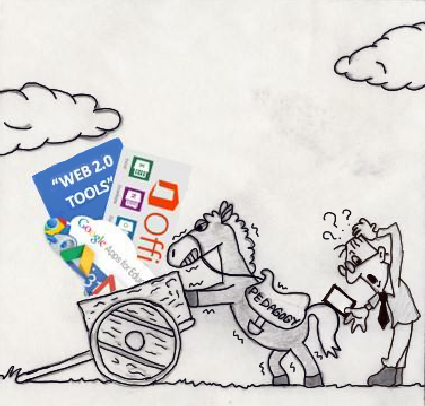
Be Wary of Putting the Cart Before the Horse

"Unless you get instructional design right, technology can only increase the speed and certainty of failure" - William Horton

As budgets expand or money becomes available at the end of a school year, the knee jerk reaction of many schools is to go all in and spend it as quickly as possible.  With advances in affordable technology, such as the ultra-cheap Chromebook, it has been tough for schools to resist spending these funds on devices.  Now don't get me wrong, I am all for schools increasing student and staff access to quality technology. However, the cart before the horse scenario has played out in so many schools across the globe. The end result has been a massive influx in tools, but a clear lack of vision and planning as to how these powerful tools can, and will, actually impact learning. In some cases, the technology resides unused in classrooms and schools due to the cart before the horse approach. There is nothing transformational about this.


Image credit: Eric Patnoudes

There are many technology frameworks out there for schools to refer to such as SAMR, TPACK, and the TIM. The SAMR Model has provided us with a good lens to observe firsthand the need for proper planning prior to investing large amounts of money on technology.  This by no means is a perfect framework to guide the effective implementation of technology initiatives, but it does give us a good idea of what should not be taking place.  I have visited one too many schools where I have seen time and time again devices being used in ways that serve as a direct substitute for the same ineffective practices that we are trying to move away from. Technology in itself will never transform teaching and learning. Students, teachers, and leaders who effectively integrate technology with purpose aligned to learning and leadership outcomes will.

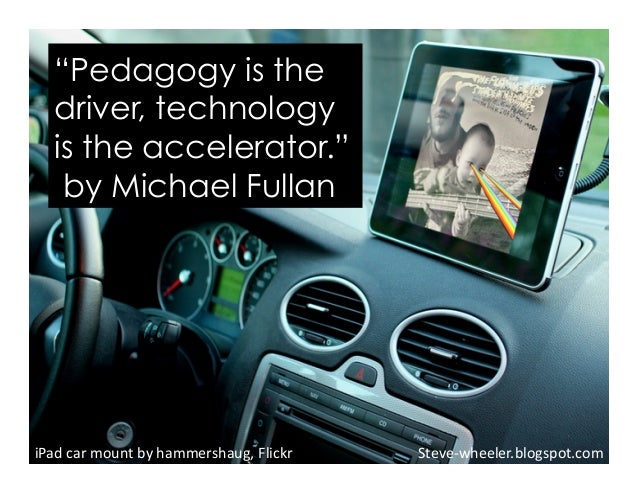
The quote at the beginning of this post from William Horton provides an important reminder of the critical need for teachers to be supported in proper instructional design prior to any massive technology roll out. We found great success at my school during our digital conversion by focusing on a pedagogy first, technology second if appropriate mindset.  Not only was there a focus on solid instruction, but we also provided numerous supports for our teachers in the form of ongoing and job-embedded professional learning opportunities. If the expectation was to integrate technology with purpose to support and/or enhance learning we made sure everyone was prepared to do just that. As Michael Fullan has stated, pedagogy is the driver and technology the accelerator. 


Image credit: Shelly Terrell

It is not just teachers that need work on instructional design when it comes to effectively integrating technology. The same goes for school leaders who also deserve support in the form of professional learning so that they can properly observe and provide valuable feedback to teachers when technology is being integrated into lessons. Ultimately it is a leader’s overall responsibility to make sure technology purposes are having an impact on learning. Thus it is wise to put them in a better position to do just that.

The critical need for learning doesn't stop with teachers and leaders. It also extends to students and parents. As learning changes with successful technology integration and students begin to have more access to technology, a golden opportunity arises to not only address critical digital literacies, but also responsibility. When rolling out either Bring Your Own Device (BYOD) or 1:1 initiative create programs to prepare students for the purposeful use of technology to support their learning. In the end, this will mitigate many issues before they arise. At my school, I met with all the students in large-scale assemblies to educate and reinforce the role of mobile learning devices at the beginning of the school year. Having parent programs in place is also vital to the success of any major technology initiative. With large scale purchases, they will want to know the impact on learning and others will need guidance on the how teaching and learning are now changing.

The importance of getting instructional design right cannot be stressed enough. Don't fall victim to the cart before the horse scenario. If you or your school has the ability and funds to purchase technology, don't rush to get it into the hands of staff and students. Take the time to develop a shared vision and plan for integration that aligns with sound pedagogy, using a tool such as the Rigor Relevance Framework, which is much more robust than the other options mentioned earlier in this post. Reflect on instructional design within the context of student agency and higher-order thinking skills first. Provide professional learning opportunities before, during, and consistently after the roll out.  After a focus on instructional design, work with students and parents to build broader support. In the end, this will help to not only make the implementation process easier but also to have your technology initiatives primed to get results.