Showing posts with label 1:1 laptop program. Show all posts

Sunday, July 12, 2020

Purchasing Devices Does Not Equate to Learning

The COVID19 pandemic unearthed many harsh realities for education across the globe. One of the more glaring issues was the vast digital divide that still exists in many places, especially the United States.  Inadequate WIFI and the availability of computers at home for kids to use for learning caught many educators off guard. Remote learning was a monumental challenge for districts and schools that already had made large-scale investments in devices, but it was even more so where inequity was prevalent.  Many kids were automatically at a severe disadvantage as a result, which will most likely result in extreme learning loss and ever-widening achievement gaps.

It is okay to admit that we were ill-prepared before and during the pandemic.  Now is the time to seize on lessons learned as schools prepare to move into uncharted territory whether the COVID19 rages on or begins to subside. Teaching will and must be different. Leadership must and will be different. Most of all, the learning culture will most certainly be different, and it will be a travesty if it is not. We have begun to see some change as more and more school districts are purchasing devices for all of their students.  Every day I see new articles highlighting the millions of dollars; in some cases, spent to either begin to close or eradicate the digital divide. There are also forward-thinking districts who either purchase WIFI hotspots for kids or park WIFI-enabled busses around the community for family access.  All of these efforts are to be commended.

Here is the rub in all of this. Time and time again, even well before the pandemic hit, schools had a thirst for ensuring that there was a device in the hands of every student. William Horton says it best, "Unless you get instructional design right, technology can only increase the speed and certainty of failure." 


Below are some lessons we learned after hitting the reset button on our Bring Your Own Device (BYOD) initiative in order to get it right that I captured in a 2015 post.
We found great success at my school during our digital transformation by focusing on pedagogy first, technology second if appropriate mindset. Not only was there a focus on solid instruction, but we also provided numerous supports for our teachers in the form of ongoing and job-embedded professional learning opportunities. If the expectation was to integrate technology with purpose to support or enhance learning, we made sure everyone was prepared to do just that. 
For technology to live up to the hype, pedagogy must change, whether learning is face-to-face, remote, or based on a hybrid model to ensure student and staff safety. Drive-by professional development did not work in the past. What has and will continue to make a difference are supports that incorporate the following:
  • Ongoing
  • Job-embedded
  • Supported with coaching (face-to-face or virtual)
  • Personalized and differentiated
  • Facilitated by people who have done the work and implemented successful change that resulted in improved student learning outcomes and achievement
  • Directly correlated to professional practice
  • Aligned with research and case studies
  • Addresses real challenges educators face
  • Sustainable over time
Before COVID19, I always cautioned districts and schools to be wary of putting the cart before the horse. I am not sure that I would offer the same advice as we now know there is a great deal of work to be done to ensure digital equity for all kids. However, I am still steadfast in my opinion that just purchasing devices does not equate to learning, nor will it in the future if proper supports are not in place. Teachers need training and job-embedded coaching. Principals need support so that they know what to look for and can give their staff actionable feedback. Superintendents and central office administrators need to be able to determine the efficacy of the investment.  


Just putting a device in kids' hands and expecting learning miracles to materialize is wishful thinking at best. Ongoing support is needed to usher in pedagogical change while building capacity. Teachers and administrators deserve this investment if large sums of money are being spent on devices.  Without this support, the overall goal of the purchase might never be realized.

Sunday, July 3, 2016

Asking the Right Questions About Mobile Learning

As of late, I have been engaged in a great amount of work, either assisting districts and schools as they begin to implement mobile learning (1:1, BYOD) or helping them get their programs on track.  Over six and a half years ago, I helped successfully implement a Bring Your Own Device initiative in my school. Not only were we the first to do it in my state, but there weren't many great examples to pull from at the time.  Thus, many lessons were learned the hard way. It is important to remember that change has to be treated like a process as opposed to one single event. The success of mobile learning relies on proper planning, reflection, and evaluation to improve. 

The key to successfully implementing sustainable change begins with asking the right question(s). Below are some questions to help you ascertain where you are, but more importantly, where you want to be with either 1:1 or BYOD. 
  • Is your infrastructure ready? Has an infrastructure audit been completed?
  • Have you developed a shared vision that takes into account staff, student, and community input? For success, all stakeholders must be on board and have clear outcomes developed.
  • Have you developed a strategic plan to ensure the initiative will positively impact student learning? How will you measure success and evaluate effectiveness? Has curriculum been updated and other resources explored?
  • Have you created policies that protect students and staff while promoting creativity?
  • Has staff been trained in digital pedagogy (lesson/project design, assessment, etc.)? Do they possess the confidence to integrate the devices with purpose to support/enhance learning? Have administrators been trained on digital pedagogical techniques in order to provide valuable feedback to staff? Have fears and challenges been addressed? How will equity be ensured in a BYOD environment? What will you do if students forget their devices, don’t have them, or have no access to WiFi outside of school?
  • Has a plan been developed to train students? What will be done to educate parents?
  • How will you build community support?
  • What evidence will be provided to the BOE and community that the initiative is a success?
Determine where you want to be and how you are going to get there with your mobile initiative. Once you have answers to the previous questions, reflect on the drivers of a successful mobile learning initiative to ensure that the stage is set for improved student learning outcomes. 


Sunday, December 6, 2015

Implementing Mobile Devices With a Focus on Learning

The following post is a modified excerpt from Uncommon Learning.

“Mobile learning provides enhanced collaboration among learners, access to information, and a deeper contextualization of learning. Hypothetically, effective mobile learning can empower learners by enabling them to better assess and select relevant information, redefine their goals, and reconsider their understanding of concepts within a shifting and growing frame of reference (the information context).” — Marguerite L. Koole (2009) 

No one will deny the impact that mobile is having on the world.  All one has to do is take a look at how mobile devices are changing everyone’s perception of computing as it is more accessible and personal than ever. Over the years I have written extensively on the topic, including a chapter in my new book Uncommon Learning.  As a principal I quickly saw the potential in mobile learning and as a result our school became the first to embrace Bring Your Own Device (BYOD) back in 2010. 

Mobile devices offer a new and exciting avenue to engage students and promote learning while increasing academic achievement. Research by Cristol and Gimbert (2013) found that students utilizing mobile learning devices scored, on average, 52.34 points higher on the state assessments than their peers who did not use them. Students are more connected than ever with their devices, and it is necessary for teachers to capitalize on this opportunity to drive student learning and outcomes.  With any initiative, especially BYOD or 1:1, the focus has to be on learning. 

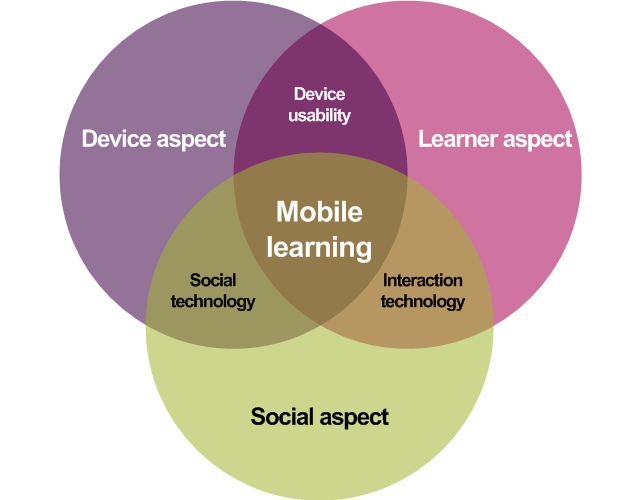
Koole’s (2009) Framework for the Rational Analysis of Mobile Education (FRAME) model provides a more holistic framework for mobile learning. In this framework, mobile learning is a combination of the interactions among learners, their devices, and other people. Koole provides a useful checklist that schools and educators can refer to when looking to integrate mobile learning effectively as part of a BYOD or 1:1 initiative. 


Image credit: https://mobilelearninginfokit.pbworks.com/f/1314179784/frame-venn-i1.png

Have you considered the following in your mobile learning ecosystem? 

  1. How use of mobile devices might change the process of interactions among learners, communities, and systems 

  2. How learners may most effectively use mobile access to other learners, systems, and devices to recognize and evaluate information and processes to achieve their goals 

  3. How learners can become more independent in navigating through and filtering information; how to prepare them for that change 

Be aware of the many pitfalls that are associated with educational technology. Access alone will not translate into enhanced student learning outcomes.  At the International Center for Leadership in Education (ICLE) my team and I work with schools and districts to get mobile learning initiatives right before an all out rollout. It is critical to plan well ahead of any major BYOD or 1:1 initiative at least a year in advance to ensure that all the necessary elements are in place to support student learning. These elements are listed below, but I encourage you to read this post that provides more detail on each:

  • Infrastructure
  • Shared Vision
  • Strategic Plan
  • Policy Development
  • Professional Development
  • Student/Parent Programs
  • Budget Allocations

I encourage you to take a critical look at the mobile learning initiatives in your district and determine what can be done to improve them. In education there is no such thing as perfection and as such we must always look for opportunities to improve existing initiatives, not just new ones to be implemented. 

Cristol, D., & Gimbert, B. (2013). Academic achievement in BYOD classrooms. Proceedings from QScience 12th World     
          Conference on Mobile and Contextual Learning. mLearn, 15.

Koole, M. L. (2009). A model for framing mobile learning. In M. Ally (Ed.), Mobile learning: Transforming the delivery of 
          education and training (pp. 25–47). Edmonton, AB: Athabasca University Press.

Sunday, October 25, 2015

It's Not a Technology Issue

Technology still gets a bad rap in many education circles. Perception and lack of information influence the decision making process.  This ends up resulting in the formation of rules and policies that severely restrict or prohibit student use of mobile technology and social media as tools to support and/or enhance learning. Even with the proliferation of technology across all facets of society, we still see schools moving at a snail’s pace (if at all) to adapt, or better yet evolve, to a digital world.  In my opinion, sheer ignorance is to blame. From this ignorance a plethora of excuses arise. Educators and administrators are quick to point to technology as the main culprit for an array of issues. 

Case in point.  Over the summer I was working with a couple hundred school leaders on digital leadership. As the presentation began to focus on mobile learning initiatives a hand immediately went up. In a polite tone the school leader expressed his apprehension with allowing students to bring or use their own devices in school.  His main fear was a concern that students would be constantly off task texting or checking their social media accounts.  I paused for a moment to decide on an appropriate response.  Herein lies some irony. For the majority of my presentation this school leader had been disengaged himself with his technology.  As the majority of the group intently listed or participated in planned activities to apply what had been learned this individual and his buddies checked their email, surfed the web, and accessed their own social media sites.

The off-task behavior in the example above was glaring. I seized the opportunity to not only call the group out tactfully and with respect, but to also hammer home a few points. Adults can be just as bad, if not worse, than our students when it comes to technology. How can we as adults set expectations for device use for kids if we ourselves are not willing to abide by those same expectations?  This is quite hypocritical don’t you think?  Change in mindset hinges on our ability to challenge certain assumptions that we have in terms of mobile technologies.  When we do, the end result is that every one of us has been guilty of the same types of behaviors that students are chastised for. 

Stay with me on this as we take a walk down memory lane.  I want you to think back to your days as a student before the proliferation of mobile technology. Through a series of questions I am going to not only ask you to reflect on what you did, but also in the process challenge some firmly entrenched assumptions regarding technology. Here we go!
  • Did you ever write a note and pass it? Today’s students text or communicate via social media.
  • Were you ever so bored in class that you doodled or daydreamed? Well, now kids check their social media accounts or use apps to engage themselves.
  • Did any of you ever see someone with a cheat sheet or answers written on their hand? Now I know as educators you never did this, but I think you get my point. Obviously kids can use technology to do this now as well.
  • Did you ever break any school rules that you didn't agree with? Students do this all the time when dictator-like policies and rules govern technology use.
The point here is that it is not a technology issue, but many people make it one. The behavior argument that many make is flawed. It is first and foremost a school culture issue, which falls on the shoulders of leaders. Schools and districts that have embraced technology through a shared vision and resulting plan focused on learning reinforce appropriate use. The other issue is a classroom management one.  It goes without saying that if lessons are not authentically engaging and there is a lack of monitoring, students will at times go off task. With any learning activity, with or without technology, effective pedagogy is key.

The process of effectively integrating devices begins with our ability to model appropriate use while reinforcing student expectations for the role of mobile devices.  Make sure the essential elements are in place to ensure that devices afford students the opportunity to:
  • Support and/or enhance their learning
  • Conduct better research
  • Improve personal productivity
  • Develop and model digital responsibility and citizenship
  • Acquire and apply critical digital literacies

Image credit: http://www.educatorstechnology.com/2013/04/the-modern-taxonomy-wheel.html

It is time to not only perform the job that we signed up for, educating kids, but also do so in a way that prepares them to harness the learning power of mobile technologies. Excuses plague education systems around the world. Stop making it about the adults and focus on what’s best for learners today. 

Thursday, March 28, 2013

The Device Conundrum - 1:1 vs BYOD


Cross-posted at the Huffington Post.

As we continue to advance in the digital age schools and districts are beginning to re-think pedagogy and learning environments by instituting either 1:1 device programs or Bring Your Own Device (BYOD) initiatives. In my opinion, schools that wish to create the most relevant and meaningful learning culture will go in one of these directions. It is tough to argue the potential impact of either program that is implemented diligently and with a focus on learning that will not result in the enhancement of essential skills sets that our students need to succeed in today's digital world. Probably the most significant impact, either 1:1 or BYOD can have is in the area of teaching digital responsibility, citizenship, and the creation of positive footprints online. After all, in the real world that we are preparing our students for, technological literacies and proficiencies are the cornerstones of numerous career paths.


Image credit: Tony Vincent learninginhand.com

The decision on which way to go is usually determined by finances, which is unfortunate for those schools and districts who have their hearts set on getting a device in the hands of each and every student. Competition resulting from the continuous evolution of tablets, laptops, and now Chrome books, puts schools in a better position to make large-scale investments in mobile technology. In theory and on paper, a 1:1 program seems to be the best program for schools wanting to integrate technology on a macro level to enhance teaching and learning. Advocates for 1:1 programs will claim that it is the only way to go as it ensures equitable access to all students regardless of socioeconomic status.

With each student possessing a device, collaborative work using Web 2.0 tools is a reality for all students, both in an out of school, provided there is Internet access at home. In this day and age, finding a location with free WiFi is not such a difficult task. Maintenance becomes less of a headache for the IT department, as they only have to worry about one type of device. It also figures to entail a more streamlined approach when it comes to providing professional development to staff so that the devices are consistently utilized to support student learning.

The general case I make for 1:1 programs above is compelling, but is it the best option for our students today? The more I read about others' thoughts on this and reflect on the BYOD program we have instituted at New Milford High School, I am beginning to think that 1:1 programs are not necessarily the best option for our students. My main reason for this shift in thought is why would we want to pigeonhole our students to one single device and/or platform? Is that reminiscent of the real world that we are supposedly preparing them to flourish and succeed in? The fact is many students own and are comfortable with their devices. The digital divide in schools becomes smaller when bold districts, schools, and educators work to effectively integrate the technology that has been available for years outside their walls. BYOD has the ability to save districts money, but the real impact comes in the form or engagement and empowerment of students to learn on their terms. I have grown quite tired of the myriad of excuses to not move towards BYOD because it can and will have a positive impact with the right mindset, training, and support.

It makes sense to me to create a technology-rich learning environment that leverages available technology with that, which the students already own. This is what we have done at my school and experienced a great deal of success. In addition to BYOD, students and teachers have access to three PC labs, one iMac lab, one Macbook cart, one PC cart, and one netbook cart. The equity issue with BYOD in classrooms has been overcome with school purchased technology and the use of cooperative learning after my teachers determine which device(s) each student possesses and brings to school on a regular basis. In my eyes we are accomplishing the same goals, for the most part, as we would if a 1:1 program had been instituted. Students have access to technology and are using it on a daily basis to communicate, collaborate, create artifacts of learning, problem solve, think critically, become more technologically proficient, and develop a greater global awareness. The should most certainly be able to use it to replace more archaic forms of technology (i.e. pencil and paper) if they wish.

I am extremely interested to hear what others think about 1:1 vs. BYOD in schools. Do you think one is better than the other and if so why? If you are considering going down one of these paths, which one would you lean towards?

Sunday, October 10, 2010

Field of Dreams

As I write this post I am sitting in the Des Moines airport waiting for my flight back to the East Coast.  I was fortunate to spend the last few days here in Iowa as a guest of Scott McLeod who founded and runs the C.A.S.T.L.E. program at Iowa State University.  The purpose of my trip here was to learn about the deployment, facilitation, and observable impact of 1:1 laptop programs in various Iowa school districts.  I have little experience in this area as I only know of a handful of districts in New Jersey that have these programs. 

On Wednesday when I arrived my head was filled with unclear expectations as to what my takeaways would be upon my return east.   Although I could envision some benefits of a 1:1 program in my school, I had no plans to pursue implementing one.  Little did I know that I would be leaving with a wealth of information that could have the potential to radically transform the learning culture at New Milford High School.  I also was unprepared for the amount of corn I would see virtually every minute of my journey through a state that really gets it from an educational standpoint. 

First a little history on 1:1 laptop programs in Iowa.  Last year approximately 17 Districts had deployed these programs in their schools.  That number has now grown to 51 this year (see this map).  Obviously the state of Iowa noticed something beneficial result from these programs as the number of 1:1 laptop schools tripled.   Here are my observations and thoughts after touring three schools (K-12, 7-12, K-6) located throughout central Iowa:
  • We need to prepare our students to be doers and creative thinkers who can compete with their peers globally for jobs that have yet to evolve.  Many schools across the country are not doing this and as a result our students are at a disadvantage.
  • A common message of change must be embraced by all stakeholders, especially Boards of Education and Central Office Administration, for 1:1 programs to be rolled out in schools.  Additionally, the community needs to speak up and ask schools to do things differently if Districts would rather not break from the status quo.  This last point was the driving force in one District we visited.
  • Students in schools with 1:1 programs don’t ask what they have to do to get the right answer as do those in other schools structured to teach to the test.  Instead, they are asking thought-provoking questions, challenging assumptions, making interdisciplinary connections, applying acquired knowledge, and are immersing themselves in authentic learning experiences.  These students are permitted to follow their passion, which results in the active pursuit of self-directed learning opportunities.
  • Teachers can easily and effectively differentiate content, projects, and assessments for students.  I observed a great example of this in a 6th grade class.  As students finished work on their vertebrate Keynote projects, they immediately began working on math or language arts content that was found on their teacher’s website. 
  • I observed students performing various tasks on the laptops that many teachers and administrators do not know how to do such as hyperlinking content, creating custom music using Garage Band for their presentations, constructing Wordles, using Paintbrush, and adding customized slide transitions.  The latter two, I don’t even know how to do on Keynote.  The significance of this is that students are then empowered to not only collaborate with each other, but to also teach the teacher.  This can only occur in learning environments where control is relinquished, as was the case in many classrooms we visited.
  • Many teachers seamlessly integrated technology and computer skills into their lessons through modeling and reinforcement.  In my opinion, this served to significantly enhance the curriculum as well as to refine and introduce advanced technology skills.
  • When asked whether or not parents embraced and accepted these programs, the uniform message was quite surprising.  Parents were initially fearful of the program (i.e. cost to fix or replace), but those fears soon subsided.  Each school then explained how the laptops were bringing families together outside of school.   Engagement in many homes increased as families began to use the laptops together.  I even heard about how some parents were annoyed that they couldn’t get their students to bed at a reasonable hour because they were constantly up late solving math problems on their laptops (this is a positive in my book).  Other positives associated with the 1:1 programs include increases in student engagement and attendance, as well as decreases in tardiness and discipline referrals.   You could see that the students thoroughly enjoyed coming to school and were not bored.  I found it particularly fascinating that in one elementary school they found that the students’ enhanced presentation skills acquired from class gave them the confidence to speak in front of large adult groups.  These same students Skype back into their classes when on vacation, sharing, with their peers, pictures and the history of the location they are visiting.
  • Recommendations: More professional development would go a long way in assisting the staff to effectively integrate the laptops in each school. Check out this post on Dangerously Irrelevant.

Each 1:1 school in Iowa represents a “Field of Dreams” to each and every student enrolled there.  The students are afforded the opportunity to follow their passion, be creative, collaborate, and become active participants in the learning process.  What struck me the most were the high levels of student engagement in classrooms where the tool was combined with a sound pedagogical foundation.  In all cases, students were being prepared for the future.  I leave Iowa motivated to provide my students with their own field of dreams.  Thank you Scott McLeod!