Showing posts with label digital badges. Show all posts

Sunday, February 19, 2017

Agency: Important for Students and Educators

There is a great deal of talk and focus on the need to improve student agency in our schools and rightfully so (see my post on this topic HERE).  Empowerment and ownership need and should be associated with learning to increase relevancy, value, meaning, and outcomes.  The desire to increase agency in the form of voice, choice, and advocacy should be viewed as just as important for educators (teachers and administrators) as it is for students.  For sustainable change and innovative practices to take hold let’s evaluate the level of educator agency in our schools. 


Image credit: www.peoplematters.in

Voice

Educators, both teachers and administrators, should have a say in many elements that influence a school’s learning culture.  When we don’t listen to the ideas and concerns of others people will shut down and withdraw. This results in a negative impact on motivation, respect, enthusiasm and a willingness to innovate.  In terms of communication, the aspect of listening is just as important in leading and sustaining change as the use of verbal and non-verbal strategies.  Educator voice can be cultivated using the following strategies:
  • Flipped staff meetings – Everyone who plans a meeting works terribly hard to develop and then get through an agenda.  This results in a death-by-meeting scenario and is a main reason why most people hate meetings. Consider developing a meeting agenda using Google Docs. The added bonus here is that other documents, images, and videos can be embedded, which really creates a more dynamic agenda.  Complete this a week prior and then send out to your staff where they can add comments and content to the agenda.  Then during the actual meeting focus on one or two very important goals such as the following: How do we improve learning for our students? Have a back channel established and monitored using a tool like TodaysMeet to take educator voice to the next level.  Creating a trusting environment where staff can respond under the cover of anonymity amplifies voice even more.   
  • Planning professional learning – How many of us dreaded professional development (PD) days? Historically PD has always been something that was done to us, not something that we wanted to engage in.  The best way to change the paradigm here is to afford educators opportunities to use their voice and ideas to plan powerful learning experiences.  This could consist of speaker recommendations, workshop topics, hosting your own event, or even the development of an unconference.  Just as we want students to own their learning the same should apply to adults. 
  • Comment box – This strategy has been used in the hospitality business for ages.  Some people just want their concerns to be heard, but acting on certain concerns can be empowering on many levels.  Consider having some of your talented students create a wood box do this the traditional way and then leave it in the faculty room.  If digital leadership is your thing, set up a few tools (Padlet, TodaysMeet, Tackk) and allow anonymous comments to be posted.  Establish some ground rules prior such as including a solution to go along with the identified problem, as you don’t want this to turn into a gripe session.  The comment box should also be used as an opportunity to provide compliments and positive reinforcement.

Choice

In the classroom, agency empowers a shift where students can choose the right tool for the right task to demonstrate conceptual understanding and mastery. Various pathways to personalize learning and make it more personal are also emphasized.  Educators should have more choice over how they learn themselves. They should also have choice over resources that they, the experts who work with students the most on a day to day basis, feel are valuable to support and enhance learning.  Below are some ideas on how to promote educator choice:
  • Micro-credentials – The use of digital badges, otherwise known as micro-credentials, can afford educators choice over what they want to learn about as well as the specific time that they want to learn a new skill or pedagogical technique.  Accountability for learning is ensured through a vetting process and the badge represents the successful achievement of a learning goal. Thanks to the leadership of Laura Fleming we implemented a micro-credential system to acknowledge the informal learning of our teachers and administrators.  You can visit her site HERE and begin to earn your own badges through choice or work to implement your own system.
  • Genius Hour - Genius hour is a movement that allows students to explore their own passions and encourages creativity in the classroom.  It provides students a choice in what they learn during a set period of time during school.  This concept can be applied for educators as well.  As principal I created the Professional Growth Period (PGP) where in lieu of a non-instructional duty my staff were given 2-3 forty-eight minute periods per week to follow their learning passions.  A learning portfolio was required as part of this process and presented at the end of year evaluation conference. You can learn more about the PGP process HERE. 
  • Distributive budgeting – Distributive leadership conveys the importance of a shared, collective and extended leadership practice that builds the capacity for change and improvement. This can be applied to the budgeting process when it comes time to purchase learning tools, resources, and services (PD providers). The choice factor honors the expertise found in our classrooms and schools and can serve as a great catalyst for sustainable change. 

Advocacy

Educators need to be put in a position where they can actively advocate for system improvements without the fear of repercussion.  It is important to understand that there is no perfect teacher, classroom, administrator, school, district, or system. In education, we must focus on areas where our data tells us we can improve, but also continue to push the envelope by embracing innovative ideas and an edupreneurial mindset (learn more about this concept in my book BrandED). Advocacy educators consider voice and support for a cause to bring about needed change.  Let’s face it, even with progress in schools there still are many areas that need improvement. Forums should be established where advocates for grading, homework, schedule, curriculum, budget, and professional development reform can not only be heard, but also offer recommendations for improvement.  These need to be safe places where open dialogue is encouraged and action results. 

These are my thoughts on improving educator agency in our schools to compliment student agency. When looking at the three essential elements (voice, choice, advocacy) what examples would you add?

Sunday, February 21, 2016

The Growing Potential of Micro-Credentials

There is a great deal of talk these days about micro-credentials and digital badging as a means to acknowledge professional learning of educators. While many organizations are trying to seize an opportunity to monetize this space for their own benefit, a pioneer in micro-credentials created a free platform for any educator to use over three years ago. In Uncommon Learning, I provide insight into Laura Fleming’s pioneering work in this area with the simple premise of acknowledging the informal learning that many educators now engage in on a daily basis. 

Micro-credentials can be used to guide, motivate, and validate informal learning. Check out what Mozilla has created with its Open Badges platform. Acknowledging the informal learning of educators had been a long-neglected area in schools, and Ms. Fleming felt she could make a big impact there. She felt that a digital badge-based system would allow participating educators to learn and earn badges anytime and anywhere. Educators could then use those badges to build and communicate their own reputations to their colleagues and to senior staff, capturing a complete picture of their own professional development for others to see. 

Worlds of Learning provides a framework that allows any educator to earn micro-credentials for free through learning about a range of technology tools and applications and then putting what they learn into practice in their own teaching. The platform developed by Laura Fleming in 2013 has been designed so that its resources will help to prepare educators to fully leverage the potential for mastering digital-age skills as embodied in the International Society for Technology in Education (ISTE) Standards for Teachers as well as assisting them to achieve the seamless integration of technology as addressed by the Common Core State Standards. 

As technology convergence and integration continue to increase generally in our society, it is paramount that teachers possess the skills and behaviors of digital-age professionals. Educators should be comfortable teaching, working, and learning in an increasingly connected global digital society. The real aim of educational technology should be to modernize pedagogy and to shape the education of the future. Registered users on the Worlds of Learning site can take the tools presented on the platform and integrate them seamlessly into meaningful learning that addresses the standards in their respective content areas for free.

Laura has streamlined the user experience on the platform as much as possible. Teachers (or indeed anyone who wants to join) simply register on the platform. Members can then choose to learn about a tool from among the (growing) selection of badges she has on the site. Her badges include those for mastering tools like Buncee, Padlet, and ThingLink, as well as a variety of other web-based tools. 

To learn about each tool, Laura provides a deliberately brief description of what the tool is. She also includes a very short screencast that provides an overview of how to use each tool and a brief written description of how the tool can be used and how the tool can be integrated effectively into the curriculum through the Common Core. Educators can earn the badge by then assimilating what they’ve learned into their own instruction in some way. Users submit “proof” to her that they have done so. Their evidence might consist of a web link to a page or site that demonstrates what they have done, a lesson plan, a video of classroom practice, or even a text description of how they or their students have used the tool. Upon receiving documentation, she issues a digital badge for their learning. 

Educators want to create their own professional learning paths, they want to learn anytime and anywhere, and they want to receive appropriate and authoritative credit for their informal learning. Laura believes that the success of this platform rests on the fact that educators can take control of their own learning and that they can therefore learn what they want to learn when they want to learn it.  I, for one, could not be more proud of what Laura created and that this resource is free for anyone to use. Those organizations pirating her work for profit and claiming it to be their own should, at the very least, give her the proper credit that she deserves.

So what are your thoughts about using micro-credentials as a way to guide, motivate, and validate both the formal and informal learning of educators?

Sunday, December 21, 2014

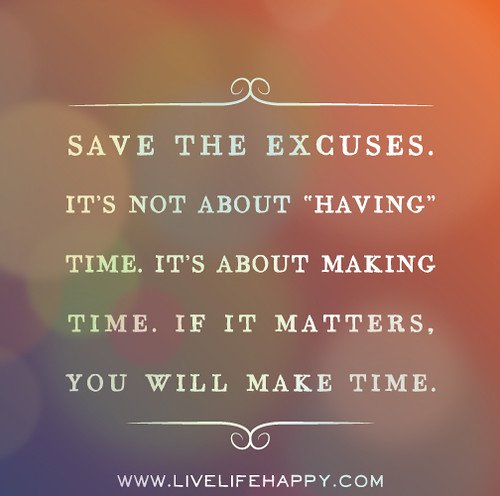
Making Time vs Finding Time

One of the most utilized excuses in education when it comes to change is lack of time. At one point or another, we have all used the time excuse when it comes to our professional work.  With all of the mandates and directives that are thrown our way, time becomes a relatively easy scapegoat when it comes to skirting the issue of change. Whether it be in the form of endless piles of paperwork, never ending observations, meetings with parents, attending events, developing a master schedule, or constructing a school budget – there never seemed like enough time in my day to even get those responsibilities done. It is never easy in the role of a teacher either. Lesson planning, grading, meeting with students before/after school, running clubs, and coaching all take up a great deal of their time as well.  Time is the number one enemy of needed change and improvement in my opinion.


Image credit: https://farm8.staticflickr.com/7382/12354248703_f23b955afe.jpg

Let’s face the perceived fact that there will never be enough time in any of our days to get everything done.  Or is there? Regardless of your respective role in education, time will always be your enemy if you look at it with a fixed as opposed to a growth mindset. This is where you need to focus less on finding time and more on making time to complete necessary tasks that are not only required, but also ones that will allow you to grow, innovate, and develop more of a passion for your work. Before getting to this point you must look at how you currently utilize the time you have. In my case I was more of a manager as opposed to a leader. In response I began to either delegate the managerial aspects of my position as a principal to my assistants or I just got rid of obligatory routines shrouded in monotony such as certain meetings.  For teachers it is important to look at how time is spent during areas of opportunity during the day (i.e. prep periods, lunch) to see where a growth mindset can be employed.  

No matter how you slice it the time game will always be challenging, but there is hope. First and foremost, make the time to learn, grown, and get better as opposed to finding the time.  There is nothing more important to an educator, outside of working with kids, than professional learning. Carve out some time each day if possible. Through social media a Personal Learning Network (PLN) provides a great antidote to the age-old time excuse. You can now learn anywhere, with anyone, at anytime you want for free.  While online consider making some time to learn and then apply a new skill while earning a digital badge to acknowledge your informal learning.  As great as a PLN is to professional growth, make the time to connect face to face with colleagues at conferences and workshops. Hands-on learning and networking experiences are invaluable to any educator who aspires to and models life-long learning.

If you are an educational leader one of your responsibilities is to take the time excuse away from your staff. Consider flipping your faculty meetings.  This concept is based on the popular flipped classroom model. When flipping a faculty meeting teachers are given informational items to read and view in advance. This results in a shift from a leader-driven meeting to one where leadership is distributed. Instead of reviewing items off an agenda, time is spent more creatively as teachers take on a more active, creative role. For example, a short video outlining the agenda items can be created and viewed by teachers beforehand. Or articles and data sets can be distributed prior to the meeting for staff to review.  Actual meeting time can then be dedicated to analyzing data, developing common assessments, making policy revisions, discussing and/or modeling effective pedagogical techniques, or engaging in hands-on technology trainings.  Either way time is made available for all staff to do things on a consistent basis that normally fall by the wayside. To learn more about flipped leadership check out the latest book by Peter DeWitt.

Another way leaders can make time for teachers to engage in professional learning is to look for and then take advantage of opportunities embedded in the school schedule. During my tenure as principal I cut all non-instructional duties in half that each teacher had by contract to create the Professional Growth Period (PGP). This essentially freed up every single teacher at least two periods a week to engage in professional learning experiences that he/she was passionate about. You can read more about the journey to implement this initiative HERE. 

In 2015 and beyond how will you make time for yourself and others to grow and innovate?

Image credit: http://www.beliefnet.com/columnists/blissblog/files/2014/02/whatmattersmost.jpg

Monday, October 7, 2013

Integration of Micro-credentials to Acknowledge Professional Learning

The following is cross-posted at Laura Fleming's blog titled Worlds of Learning.  Laura is the new media specialist at NMHS and  has been challenged to develop innovative ways to create structures to recognize informal learning of both teachers and students.

As a 21st Century Library Media Specialist, part of what I strive to do is to serve as an instructional technology resource for both educators and learners.  In my new position here at New Milford High School, I face the exciting challenge of reaching as many staff members as I could at one time.  I threw around many models in my head until I finally found one that seems right for us.   

I am proud to announce Worlds of Learning @ New Milford High School, a micro-credential/digital badge professional learning platform. The idea behind this platform is to provide professional learning with a pinch of gamification.  For some time now, we have been hearing about digital badges and how they can be used to guide, motivate, document and validate formal and informal learning.  In recent years, Digital Badges have evolved from what were originally static images, to a tool used for capturing and communicating knowledge. Badges can now contain critical metadata that reflects who is issuing the badge, who has earned the badge, the date upon which it was earned, and any relevant criteria for earning the badge.  Digital badges are flexible enough to be able to recognize granular skills that one acquires as well as an individual’s entire learning.   I designed the platform in WordPress using a plugin called BadgeOS  - through this plugin, I am able to easily define the achievements and organize the badge requirements. 


Worlds of Learning @ New Milford High School provides a framework to allow our teachers to earn micro-credentials through learning about a range of technology tools and applications.  The platform has been designed so that its resources will help to prepare our educators to fully leverage the potential for mastering digital age skills embodied in the ISTE NETs Standards for Teachers, as well as the seamless integration of technology addressed in the Common Core Standards.  After registering, teachers can earn badges by learning about a tool and then demonstrating how they have successfully integrated it into their instruction. Teachers must register to access all features of the site.   Once completing tasks and earning their badges, they can then showcase their knowledge by displaying their digital learning badges in a number of possible ways:

  • By putting them onto Credly, the free web service for issuing, earning and sharing badges - Credly is a universal way for people to earn and showcase their achievements and badges. 
  • By putting them on Mozilla OpenBadge.   
  • By embedding them into their own sites or blogs and pushed out to their social networks. 
  • The badges will also of course be showcased on the Worlds of Learning @ NMHS site.

As technology convergence and integration continues to increase generally in our society, it is paramount that teachers possess the skills and behaviors of digital age professionals. Educators should be comfortable teaching, working and learning in an increasingly connected global digital society.   The real aim of educational technology is to modernize pedagogy and to shape the education of the future. NMHS teachers will be able to take the tools presented in this platform and seamlessly integrate them into meaningful learning that addresses the standards in their respective content areas.

By flipping our professional learning, teachers will receive job-embedded coaching and will be supported by face to face, personalized support.    I will be available to collaborate with teachers on implementing these tools into their instruction as well as offering both face-to-face and virtual support and encouragement. This platform was not designed to be used as a formal evaluation tool.  Instead the purpose of this platform is to track, share, celebrate and be given credit for informal learning.

Teachers at New Milford High School document their learning journey throughout the school year so that it can be incorporated into Professional Growth Period (PGP) portfolios (that teachers present at their end-of-year evaluation conferences.  The PGP, created by our principal Eric Sheninger, was launched in New Milford High School in September of 2011.   As a result, every New Milford High School teacher has two to three, forty eight minute periods a week, to engage in growth opportunities of personal interest.  Each staff member has to create and present a learning portfolio at his/ her end of year evaluation conference.   This learning portfolio articulates how they integrated what was learned during this time into professional practice.  The badges teachers that earn will be a part of their year-long action plan goal. 

I hope that New Milford High School teachers will be able to benefit greatly from this sustained initiative because of the professional learning flexibility an online platform provides as well as it being a means to document and showcase the skills they have gained and  putting their learnings into practice in the classroom. With only a handful of badges available to be earned on the site at the moment, I will be adding to the list considerably all throughout the school year. 

Needless to say I am extremely excited about how Laura has risen to the occasion and created a model for a program that will acknowledge informal learning of teachers that is aligned to professional standards. Once we have this up and running the next challenge will be to set up something similar for students.  In the meantime please share your thoughts on Worlds of Learning @ NMHS.