Showing posts sorted by relevance for query leading is not easy. Sort by date Show all posts

Sunday, August 13, 2017

Leading is Not Easy

This post, like so many, has been inspired by something I read.  One of my favorite sites to glean more insight and knowledge on leadership is Inc.  Even though the site shares content specific to business growth and innovation so many of the articles and opinion pieces connect to leadership in the education space.  By using Flipboard I have instant access to many of the pieces that appear on Inc thanks to the fact that I have leadership set as one of my magazine categories.  If you are not using this app please download it to your mobile device.  It is one of the best ways to create your own personalized magazine based on your interests and social network activity that you can literally flip through.

The other day Flipboard exposed me to this gem written by Nicolas Cole titled The Brutal Truth About Why Being a Leader is So Hard.  The premise of the article, as the title implies, is the inherent difficulties associated with any leadership position. Cole goes on to explain the following:


"What's difficult about leadership is that nobody ever sits you down and "teaches" you what being a real leader is all about. There's no class in early education that defines leadership. Peers in group projects tend to label leaders as "overachievers" (and not in a good way). In college, leadership is reduced down to who is going to talk the most during a presentation. And even on sports teams, the leader is usually the best player--and wears a letter on his or her jersey as a trophy of their accomplishments."

His synopsis really resonated with me.  It is difficult to adequately prepare any leader for the challenges he or she will face as well as the decisions that will have to be made.  There are so many unique variables that just cannot be taught.  Learning about how to prepare a budget is entirely different than creating one on your own when all the unique challenges are factored in.  It’s tough work knowing that difficult decisions will have to be made at times, including letting staff go.  Making decisions in time of crisis is also a topic that is regularly explored in leadership courses.  The solutions addressed always sound great in theory, but their application typically isn’t very practical.  

Looks can be, and are, deceiving.  Talking the talk has to be accompanied with walking the walk. That’s the hard part. It’s relatively easy for people to tell others what they should do. However, true leaders go through the challenging work of showing how it can be done.  Here is some sage advice that I learned long ago as a new principal who started drinking the digital and innovation Kool-Aid long ago – “Don’t ask others to do what you are not willing or have not done yourself.” Modeling is one of the most impactful elements of leadership. It builds trust leading to powerful relationships.  

Accomplishments and success are earned through the actions that are taken that result in evidence of improvement.   Leaders know that it is not the work of one person that moves an organization in a positive direction, but rather the collective efforts of all.  The premise of every decision and action has to be geared towards the “We” instead of “I”.  It’s not about coming up with all the ideas, but helping people implement not only the ones you develop, but also the ones that they develop. Leading from the front is an outdated style that doesn’t foster shared ownership.  


It’s our experiences that help all of us to develop into better leaders coupled with the support we get from colleagues. From experience, we learn that trying to be right all the time only makes the job exponentially harder.  Work inside out to make leading a little easier by focusing on the why, how, and what in that order. Make the time to hone your communication skills, as you will not find an effective leader who is not an effective communicator.  Mastering this art is no easy task and takes constant practice and reflection in order to improve.

Regardless of your position leading is hard, yet gratifying work.  Keep an open mind, regularly reflect, pursue learning opportunities that push your thinking, and understand that you will never have all the answers (which is quite ok).  It is also helpful to be flexible.  I leave you with some more thoughts from Nicholas Cole that might just build greater leadership capacity in you and others:


"True leadership is the ability to communicate and effectively reach each and every person you work with, in the way that works best for them. 
It's the ability to be flexible. 
When everyone else is stressed, you're calm. 
When everyone else is out of gas, you inject more fuel. 
When everyone else doesn't know what to do next, you lead by example. 
When someone has an issue, you work with them and listen to them on a personal level."

Stealing from Ghandi, be the change you wish to see in education.  Just know that any change journey is not an easy one. 

Sunday, March 10, 2019

12 Leadership Fundamentals

Leadership is leadership.  The same essential qualities and characteristics that exemplify what great leaders do have pretty much stayed the same.  What has changed are the tools, research, and societal shifts that impact the work.  Leadership is both an art and a science with the goal of moving the masses towards achieving a common goal.  Even though I have written extensively on the topic over the years, I am always on the lookout for more insight that can help others, including myself, excel in the role. Recently I came across the image below titled the Art of Leadersheep by it-agile. Not only does it align with what we know about effective leadership, but it also reminds us to keep our focus on the important stuff.


Using the image above as I springboard, I am going to try to add a little more context to the fundamentals highlighted.

Create a strong vision

A vision can undoubtedly change the culture of any organization if it is shared and co-created, but the real work and testament to great leadership is moving from the visioning process by developing a strategic plan to turn vision into reality. Whereas developing a shared vision is an attribute linked to all great leaders, the best leaders ensure that a strategic plan is formed and then meticulously implemented.  A vision has to result in a plan, which provides a focus for the change initiative.  The plan then has to be monitored and evaluated if the desired outcome is sustainable change that leads to transformation. 

Set the direction

When a ship sets sail a course is plotted, and different elements are used to arrive at the desired destination.  Leaders set the direction by developing achievable and practical goals that are clearly communicated. You will not find an effective leader who is not an effective communicator. If people are unclear where they are, or should be headed, the chances of success or limited. 

Set boundaries

Leaders know that a free for all will not necessitate needed change. Boundaries need to be established to keep everyone in tune with the vision and agreed upon course of action.  The best way to accomplish this is to set some norms and stick to them. Just make sure these are not too restrictive as you want your people to be open to taking risks. Boundaries are crucial to establishing and sustaining relationships. Without trust, there is no relationship. If there is no relationship, no real learning or change will occur.

Forget carrots & sticks 

If you have not read Drive by Dan Pink, I suggest you do.  The problem with extrinsic rewards is that people will always expect them, and they rarely result in sustained changes to culture.  As Pink revealed, the keys unlocking and sustaining intrinsic motivation are autonomy, mastery, and purpose. Great leaders help others see the value in the work and change in terms of how it will help to improve their practice. 

Be a teacher

The best leaders are the best teachers according to research by Sydney Finkelstein who spent ten years studying the difference between world-class and typical people in leadership positions. She found that the stars emphasized ongoing, intensive one-on-one tutoring of the people who worked for and with them, either in person or virtually, in the course of daily work. This personalized approach is what we see from highly effective teachers who work tirelessly to meet the needs of all their students. Finklestein shares the following, “The best leaders routinely spent time in the trenches with employees, passing on technical skills, general tactics, business principles, and life lessons. Their teaching was informal and organic, flowing out of the tasks at hand. And it had an unmistakable impact: Their teams and organizations were some of the highest-performing in their sectors.

Admit mistakes

Everyone makes mistakes. However, by not admitting or owning up to this fact, a culture of trust is hard to come by.  Being human means that you will screw up once in a while. Own your mistakes, but don’t let them own you. One final thought. Don’t dwell on the mistake. Remember what you learned from it.

Lead by example

Don’t ask others to do what you are not willing to do or have not done yourself. Leadership is about action - not position, title or power. When it is all said and done effective leaders, don’t tell others what to do, but instead take them to where they need to be. You get what you model. 

Encourage leadership at all levels

One woman or man does not sustain change.  Think about this for a second. Have you ever seen a leader personally implement the vision or every idea he or she comes up with? Sure, an individual can begin the process, but it takes a collective effort to make change stick.  Building capacity through delegation and trust empowers others to be an active part of the process. Leadership is a team sport.

Address the elephant in the room

The elephant can come in many shapes and sizes. In some cases, it is the 5% of the people in the system that give you 95% of the problems.  In other situations, it can be an unpopular decision, lack of resources, or dwindling support. Regardless of what the issue is, the most effective leaders don’t shy away from addressing them. Leadership is not a popularity contest. 

Improve the system

Leaders sink or swim based on how well they can help their organization find and sustain success.  It is a calling and a responsibility to move a culture forward in a way that achieves better results. The best leaders are all about ensuring efficacy in any idea, strategy, decision, or program. They also embrace accountability as part of the process.

Rise Above Fear

We are all afraid of something.  However, we cannot let it stop us from improving professional practice.  Fear of the unknown or failure holds us back from moving forward with change.  I love this quote from Zig Ziglar, “F-E-A-R has two meanings: 'Forget Everything and Run' or 'Face Everything and Rise.' The choice is yours.” Life is all about choices.  We can ill afford to allow fear to hold our learners and us back from what’s possible.  It is essential to understand that if we fear the risk, then we will never reap the reward that taking the risk provides.  When trying something new or different the chances are good that you will fail.  If and when you do, learn from the experience and use the power of reflection to improve practice or yourself. By letting go of some of your fear you will be surprised at what you can accomplish.

Be prepared for a long journey

Leadership is not a race or event. It is a process. Meaningful change rarely happens quickly.  Transforming culture takes time, so patience is a virtue here. This is not to say that there shouldn’t be a sense of urgency with some aspects. The fact of the matter is that results and achievement success system-wide take time. Set expectations and goals knowing full well that they might not fully materialize for a few years.  

What fundamentals would you add to this list?

Leading is not easy and being effective at it is easier said than done. You don’t have to be perfect nor always on your game.  You do, however, have to help others achieve a common goal that gets results.  Are you up for the challenge?

Sunday, January 16, 2022

5 Ways to Unleash Your Leadership Potential

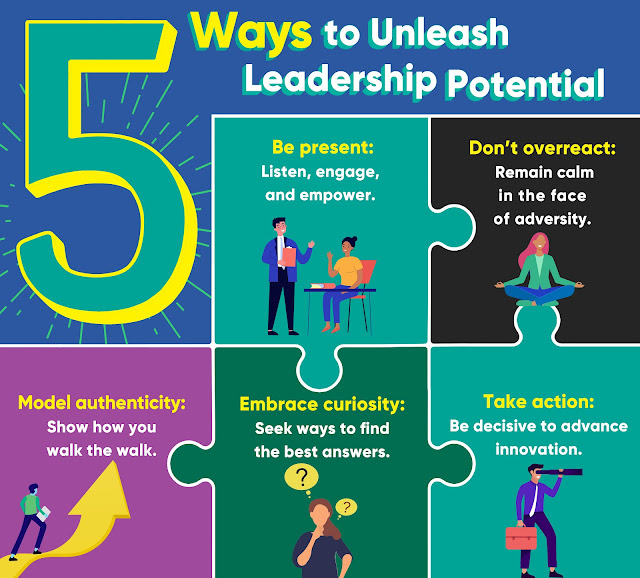
Leading is not easy.  I am a believer that leaders are not born but instead develop over time based on both the environment and learned experiences.  No matter where you are on your journey, there is the opportunity to grow and evolve.  Your potential is not set in stone.  It can be unleashed by being cognizant about where you currently are and taking the necessary steps to get to where you want, and others need you, to be.  Here are five ways to unleash your potential now and beyond. 

Be present

People by nature are very distracted creatures, and it has only gotten worse over the years.  Keeping one’s attention in the digital age can be an arduous task.  Just watch people in public places for a few minutes, and you will see countless individuals glued to their devices.  Social media and constant connectivity have evolved into both a blessing and a curse.  While you might not be able to control the actions of others fully, you can work to ensure that you are fully present during conversations, meetings, and professional learning events.  Listen intently when warranted, ask questions, avoid interrupting, use non-verbal language, and most importantly, stay off your devices.  An engaged leader is one who empowers. 

Don’t overreact

Emotions are often hard to control.  I know that I, like many others, grapple with how to hold them in check.  Losing your cool can alienate the people who are closest to you while also raising questions about your ability to lead.  The fact is that things will go wrong no matter how much you prepare.  A well-thought-out action plan will never prevent emergencies or rogue personalities from chaos every now and again.  Even though it is easier said than done, try to remain composed and not overact when something does not go your way.  The job of a leader is to help others remain calm in the face of adversity. 

Model authenticity 

People can sniff out those who are fake in both intentions and actions.  The same can be said when weaknesses are continuously masked with excuses.  Authentic leaders not only talk the talk but strive to walk the walk.  I shared the following a few years back:

Be true to yourself and others.  When you fail (and you will), showcasing your learning side will only help to strengthen the bonds with those you work with.  Being human is more important than being right all the time.  You will never have all the answers or solutions needed to move large change efforts forward.  Look to others to find answers to questions and help you achieve your change goals.  Continue to improve in ways that push you outside your comfort zone.  With authenticity on your side, finding success will be much easier.

In a world where exponential advances in technology are the norm, there is nothing more authentic than being a digital leader. 

Embrace curiosity

There are certain truths when it comes to leadership.  Not a single person has all the solutions or even the best answer to many situations.  There is immense power when a leader acknowledges that they don’t know.  It’s not always about being right or wrong but instead seeking out ways to make the best decisions for the people you serve.  Curious leaders inspire while also breaking down traditional barriers when it comes to transforming culture.  Francesca Gino shared the following after exploring research on the topic:

When curiosity is triggered, we are less likely to fall prey to confirmation bias (looking for information that supports our beliefs rather than for evidence suggesting we are wrong) and stereotyping people (making broad judgments, such as that women or minorities don’t make good leaders).  Curiosity has these positive effects because it leads us to generate alternatives.

Curiosity fuels a more collaborative and vulnerable approach that works to empower others to join the cause.  

Take action

Passiveness rarely leads to change and can negatively impact when it comes to motivating the masses.  While there are certainly times for consensus, sitting on one’s laurels when crucial decisions need to be made is something that many people often complain about when it comes to their leaders.  Navigating the change process and ushering in innovative practices requires decisiveness.  As I stated in Digital Leadership, the desire and drive to act is all that matters.  When it is all said and done, leadership is about action, not position, title, or power. 

Your potential is not set in stone.  In the words of Ralph Waldo Emerson, “The only person you are destined to become is the person you decide to be.” 


Sunday, July 11, 2021

Pedagogical Leadership

Leadership is leadership. The same essential qualities and characteristics that exemplify what great leaders do have pretty much stayed the same. What has changed are the tools, research, and societal shifts that impact the work. Leadership is both an art and science with the goal of moving the masses towards achieving a common goal. Leading is not easy, and being effective at it is easier said than done. You don’t have to be perfect nor always on your game. You do, however, have to help others achieve a common goal that gets results. There is no more important goal than to improve learning for kids. Hence the need to look at different aspects or styles to improve outcomes.  

Pedagogical leadership encompasses all the many ways to support effective teaching and learning. Instructional design is a significant component as teachers need continuous feedback on how to implement the curriculum in innovative ways that result in improved outcomes. While instruction is important, it is only one of many aspects that need attention.  Instruction is what the teacher does, whereas learning is what the student does.  Here is where a sole emphasis on instructional leadership might not lead to efficacy at scale. Pedagogical leadership focuses on numerous responsibilities and roles that work to ensure a vibrant learning culture that helps to meet the needs of all students.

The main differentiator here is a broader view that includes more attention to what the learner is doing and the supports needed for success. The pedagogical leader works to create collaborative benchmarks that lead to continuous improvement across the system.  It requires a deeper understanding of how the brain works and research-based strategies that teachers can readily implement in their classrooms. Observations, both evaluative and non-evaluative, still have immense value. However, the pedagogical leader doesn’t stop here. The use of data is extremely important. Efforts are made to help teachers analyze and use it effectively while the pedagogical leader is doing the same to find ways to close achievement gaps, scale differentiation, and create an equitable culture.  

The work doesn’t stop with the above. Investments in time and resources are made to establish ongoing and job-embedded professional learning for staff.  One-and-done, drive-by, the flavor of the month, or substanceless sessions are seen, not entertained.  Pedagogical leaders are constantly trying to ensure learner success by employing effective strategies to improve family engagement.  While working directly with teachers is of utmost importance, empowering parents and guardians to assist in the process is vital. 

The pedagogical leader…..

  • Develops relationships based on trust and mutual respect through mentoring and modeling
  • Provides research and resources to support sound pedagogy
  • Makes time to consistently be in classrooms while providing timely, practical, and specific feedback in collaboration with teachers
  • Learns alongside teachers and administrators
  • Collects and analyzes evidence to improve implementation of effective strategies


Talking the talk must be accompanied by walking the walk. It’s relatively easy for people to tell others what they should do. However, true pedagogical leaders go through the challenging work of showing how it can be done. Here is some sage advice that I learned long ago as a new principal – “Don’t ask others to do what you are not willing or have not done yourself.” If you want to improve pedagogy - and outcomes – it all starts with you.

Thursday, July 5, 2012

Change Should Be a Reality, Not a Possibility


Change in education seems to be as illusive as the Loch Ness Monster.  Everyone seems to be talking about it, but little action leading to meaningful results seems to be the mainstay in many schools.   Through my work over the years as a teacher, educational administrator,  and learner through I have identified common roadblocks to the change process.   If identified and addressed appropriately these roadblocks can be overcome.   

Image credit: http://awce2020.blogspot.com/

1 - It is too hard:  News flash, CHANGE IS NOT EASY!  Please keep this in mind as I continue this post. There is more talk about change in the field of education than actual change.  If it were easy we would see innovative programs, authentic learning experiences, successful integration of technology, and students yearning to arrive at school each day.  The fact of the matter is that nothing in life comes easy, let alone transformation change in education.  Educators must be willing to take risks, learn from mistakes, and put in the time.  Realize going in that it is going to be a difficult process, but rewarding in the end.

2 - I do not have the time for this: Ah, the old time excuse.  This is probably the most common excuse given when educators and the thought or sight of change come together.  We are in a profession to make a difference in the life of a child, leave a lasting impact, motivate students to achieve, instill a sense of life-long learning, and prepare them for success once they leave our schools.  If someone says they don't have time to work towards change that helps to achieve these goals then they should question why they are in the field of education.  Dedicated educators make the time because it is their job!  You ask any child who had a teacher that turned their life around and they will tell you that the time spent was priceless!

3- Lack of collaboration:  The field of education has been moving from a profession that hoarded ideas, lessons, and successful strategies to one that is openly willing to share this bounty with as many passionate educators as possible.  Innovation and change is a collective process and schools that get this concept have personnel who routinely collaborate amongst each other and with those outside of their schools.  "Together we are better," is the motto that change agents abide by.

4- Directive approach:  Ok, I have been guilty of this when trying to get my staff to utilize Skype.  Thankfully I learned from this mistake and have found that change occurs through shared-decision making, consensus, collaboration (see #3), and modeling.  As a leader, I had better be able to effectively model what I want my teachers to implement if I have any hopes of seeing the idea succeed and be sustainable.  In education you can't just tell someone to do something because you are mesmerized by a piece of technology, read the latest book on innovative practices, or heard a great speaker discuss PLC's.  You need to get each and every stakeholder involved in the process (see #3), properly model the strategy, and put the time forth to ensure successful implementation (see # 1 and 2).


5- Hierarchy in schools: The hierarchical structure in many schools is most often a deterrent to innovation and change.  This results in #4 being prevalent and no chance of #3 because ideas have to go through so many layers and red tape to even be considered.  Schools that have moved away from this structure support learning cultures that are innovative.  Educators need to be placed in environments where flexibility and freedom to take risks and try out new ideas and initiatives without fear of repercussion are actively fostered.

6- Lack of support:  As leaders how can we expect teachers to be innovative and move towards change if we don't support them 100% of the time? Support can come in many forms, such as release time, supplies/equipment, professional development opportunities, feedback, and just god old fashioned listening.

7- Fear of change:  This is a given, so it had better be expected.  If numbers 1-5 are addressed this will help to alleviate this feeling.  Passion for helping kids succeed on the part of administrators and teachers will always work to one's advantage when trying to subdue the fear a group might experience when trying to initiate new ideas.  Passion is what drives us!  Use it to your advantage.

8- The naysayers,  antagonists, and "self-proclaimed" experts:  Well you should have known this was coming.  Some people will never get on board with the change process for a variety of reasons (none of which we agree with).  Then there are those individuals that do not even work in schools that think they have all the answers to everything and will immediately shoot down ideas that have the potential to enhance learning just because they personally don't like them.  Those that embrace change and experience success should be celebrated, honored, and commended.  This is the best way to motivate others and inspire them to willingly become part of the process.  Ideas that work in one school might not work in another and that's OK.

9- Ineffective professional development:  How many times have we sat through training sessions that were boring, meaningless, and didn't provide any practical implementation ideas?  Professional development has to be relevant to educators, contain numerous choices, and be hands-on.  More often than not this can be done with teacher leaders present in all buildings.  If money is going to be spent make sure it is on a vetted, well-respected presenter where you will get your monies worth.

10 - Frivolous purchases:  Money does not equate into innovation and change.  Just because you purchase the latest technology doesn't mean everyone will use it correctly or productively.  Professional development (see #9) is key.

Sustainable change leading to a cultural transformation does not have to be an illusive or long, drawn out process.  Begin by identifying your own potential roadblocks that may or may not be mentioned above and focus on developing solutions instead of excuses through consensus with a variety of stakeholders.  Be a transformational leader and take people where they need to be!

Sunday, September 13, 2020

Empathetic Remote and Hybrid Learning

As almost all schools across the globe are back in session in some form or another, many have decided to begin the year remotely with the hopes that COVID-19 cases will subside in the coming months. Others have started the year with some sort of hybrid model.  There is no easy decision when it comes to determining which pathway is the most appropriate at this time. Each, in its own right, presents particular challenges. Regardless of the route taken, all learners and adults' health and safety should be the driving force that determines whether to stay the course or move in another direction.

There is a great deal of stress on students, parents, and administrators, and even more on teachers. The next few weeks, or even months, will be ridden with anxiety, fear, and at times confusion no matter how prepared a district or school is. What we have learned about COVID-19 is that it can spiral out of control at a moment's notice if social distancing and health recommendations aren't followed. However, this is not all doom and gloom. Throughout the pandemic, educators have embraced new opportunities that have materialized and taken advantage of a clean slate. Innovative practices and technology that might have been on the back-burner months ago are now front and center. Rest assured, when this is all over the resilience of teachers and administrators will help usher in a new normal that better meets the needs of all learners.

Now more than ever, empathy is needed to help everyone get through remote or hybrid learning. The reality is that successes are and have been, overshadowed by fear, stress, and anxiety at levels never experienced.  Below I will address six specific areas that can help to create an empathetic teaching and learning culture.  


Time

As I work with more and more teachers across the country, this is the number one issue that consistently comes up.  Teaching both face-to-face and remote learners at the time is not easy, but I recently developed a pedagogical framework using a station rotation model that can help. Many hybrid learning models have either an entire day (typically Wednesday or Friday) for teachers to plan, grade, provide interventions, and conference with students.  Some set aside a half-day.  Administrators can even cut any non-instructional duties to free up teachers. Remote teachers also need time, which is why having them follow a traditional school day schedule doesn't make much sense, especially when asynchronous tasks can be employed, freeing up much needed minutes or even hours.  

Support

Teachers and administrators need professional learning that aligns with the challenges they currently face and the demands of education in a COVID-19 world.  Targeted presentations can now be facilitated virtually, both live and on-demand, in time-sensitive ways.  Job-embedded coaching, which most educators yearn for, can also be facilitated virtually or face-to-face.  Asynchronous models that address the time issue above can also be used to mirror the same conditions that learners will experience either remotely or in a hybrid model.  Support can also come in the form of budget allocations for needed technology, an administrator covering a teacher's class, feedback, granting mental health days, listening to and then acting on general concerns, allocating time each day to check in with remote learners, and providing daily encouragement through inspirational messages. Another suggestion is moving around personnel so that there are dedicated teachers just for the remote learners in a hybrid model. Even though balancing both face-to-face and remote kids can be done successfully, it is still a challenge.

Grace

Depending on your position, leading and teaching with grace is the epitome of an empathetic culture. This can mean many different things to people, but overall it can be characterized by being welcoming, patient, warm, and kind. It's about emphasizing relationships over discipline or correction. For a learner, it might be giving him or her multiple chances on an assessment or to complete a project.  Or it might be a focus on restorative practices that emphasize forgiveness and the building of relationships. Leading with grace is all about service to others with a focus on humility and respect. From an administrator perspective, it means treating teachers with dignity and exhibiting generosity in addition to the characteristics listed earlier in this paragraph. When it is all said and done, continuously ask these questions when someone might be having a difficult day:

  • Are you ok?
  • Is there anything I can do for you or that you need?
  • Is your current workload manageable?
Exemplars

Empathy is about putting yourself in the shoes of others. Modeling through exemplars is a great way to help ease potential concerns, fear, and anxiety on behalf of learners, teachers, and administrators. Showing examples of sound remote and hybrid pedagogy, as well as successful implementation plans, builds confidence in that you don't have to reinvent the wheel.  Recently I shared what some Corinth School District educators in Mississippi were doing and received some very positive feedback. In particular, teachers want to see what this looks like in alignment with their grade level and content focus. 

Flexibility

For remote or hybrid to work, a flexible approach has to be prioritized. Having teachers and students follow a rigid schedule that replicates what traditional schooling has looked like for years could dramatically impact morale, attentiveness, and motivation.  Video conference fatigue is a real issue, and it just doesn't make sense to have remote learners log in from home when they could just watch the recorded highlights and then complete the same tasks that they could in class asynchronously. Teachers also get fatigued if they are on a screen too long.  If the decision has been made for all students to be remote, then at the very least, each teacher should be given a choice as to whether or not they want to teach from their classroom or home. Other areas that can show flexibility include deadlines, attendance, and general with teachers and students.

Compassion

Some might think grace and compassion are the same things. Even though they are similar, there is a difference.  Compassionate teaching and leadership consider any type of suffering and move towards specific actions to relieve it.  The pandemic has resulted in so many misfortunes that are difficult to wrap our heads around.  This is why social-emotional learning (SEL) should be integrated into any learning model, but it also has to be adapted for adults as well.  Henri Nouwen said it best, "Compassion asks us to go where it hurts, to enter into the places of pain, to share in brokenness, fear, confusion, and anguish. Compassion challenges us to cry out with those in misery, to mourn with those who are lonely, to weep with those in tears. Compassion requires us to be weak with the weak, vulnerable with the vulnerable, and powerless with the powerless. Compassion means full immersion in the condition of being human."

There is hope as educators continue to embark into the great unknown. The virus will eventually be subdued. New learning models and innovative pedagogies will take hold. Parents and students will be more comfortable with and open to different ways to learn. Resilient educators who triumphed in the face of adversity will lead education in a better direction. Empathy will not only help us get through to better days but will also help to establish a thriving school culture grounded in relationships.

Be sure to check out my entire #remotelearning series. 

Sunday, April 19, 2020

Leading in a Remote Learning World

It goes without saying that our teachers have done an incredible job when it comes to adapting to a remote learning world.  With little to no training, they are finding ways to make it work for their kids while overcoming a myriad of challenges in the process.  You could even say that they are the true leaders in a sense as their actions are leading to innovative change.  Administrators are also playing their part and rising to the occasion. Countless hours were spent planning once it was clear that schools would be shut down for an extended period of time.  Now more time is being spent refining plans as lessons are learned and, in some cases, are prepared for schools to be closed the remained of the year.


Flexibility and an Empathetic Lens

Everyone needs to understand that there is no one right way to implement remote learning. I can’t even say that mistakes are being made as this is uncharted territory for virtually everyone.  The best advice I can provide is to understand that making teachers go through the motions like it is a typical school day might not be the best course of action.  It is vital to take into consideration the pressure this is not only placing on them at home with their kids but also parents who are now working remotely. Adjustments are continually being made, and schedules are always in flux.

Additionally, teachers need to have the autonomy to make changes as needed while providing the right balance between synchronous and asynchronous instruction.  Try not to lock everyone into a one-size-fits-all plan. Regularly reflect on what is and isn’t working, adapt, listen to concerns, and most importantly, do what’s best for all the kids that you serve. In the end, flexibility will lead to success and is a hallmark of empathetic leadership.

Learn what others are doing

In times of crisis and disruptive change, you don’t need to reinvent the wheel.  By embracing digital leadership, you can connect with others near and far to find out what has been successful in other districts or schools and also veer away from roadblocks that others have encountered. So many resources are being shared daily on Twitter, Facebook, Instagram, LinkedIn, and Pinterest.  You can either lurk and learn or develop your own Personal Learning Network (PLN) to farm the best ideas and strategies that are actually working in similar demographics. 

Realistic and Fair Grading

I will admit that I am on the fence with this one.  In a previous post, I recommended that grading kids should be avoided as many have yet to complete one assignment since schools closed, and there are equity issues at a scale most have never seen before. However, I also recognize the need to help justify many of the remote learning plans in place and to support high school students, especially seniors, as they prepare for graduation.  The bottom line is there is no easy solution here. Work with teachers and other support staff to develop a responsible and equitable policy. Try to ensure that there is new content presented in a manageable fashion where students then have multiple opportunities to practice and then apply what has been learned.  Consider also eliciting feedback from parents and students themselves to create a policy that realistically and fairly depicts what has been learned.

Connect with families

You will not find an effective leader who is not an effective communicator.  In times of crisis, families need just as much support, empathy, and flexibility as teachers and students.  In Digital Leadership I recommend that all leaders consider using a multi-faceted approach that blends both digital and non-digital strategies to get the required information and updates to all stakeholders. This definitely applies now. When using social media, think about the platforms being used and mix it up by mashing together text, hyperlinks, images, and video.  Take a risk and make yourself vulnerable by delivering light-hearted messages using Snapchat and TikTok. Consider a daily or weekly YouTube video that can be embedded in a mass email to showcase how teachers are successfully implementing remote learning.  The bottom line is that you cannot overcommunicate.  

Provide professional learning support

A recent article highlighted how many teachers don't feel prepared for remote learning.  Just because schools are closed doesn’t mean professional learning should stop, especially now.  Funds have been allocated this year to provide this support for both teachers and administrators. As remote learning is a new venture for most, it is crucial to ensure that sound instructional techniques and pedagogy are embraced.  There is no better time than now to implement personalized and blended learning pathways, which really cater to a remote learning environment.  In cases where there is not equitable access, teachers need support developing and implementing non-digital strategies that challenge kids to think and apply their thinking in authentic ways.

Think about converting what would have been a face-to-face day to a virtual one.  I myself have facilitated several virtual presentations and coaching sessions with schools in lieu of being there on-site.  At Aspire Change EDU, we have modified all of our services for virtual delivery. Don’t hesitate to reach out if you want to get some more information on what can be done for your school or district. 

Make sure kids are safe

Many educators have embraced live video platforms such as Zoom and Google Hangouts/Meets. It is important that leaders make sure that requirements set for by COPPA and FERPA in the United States are being met (or the equivalent in other countries). What this means, in a nutshell, is no sharing of student information or identifiable features without permission.  In my opinion, teachers should be advised not to share video conferences or pictures from such sessions online regardless of whether or not waivers have been signed. Leaders should also update parents on the dangers of social media and online games since more and more kids are spending time in these spaces, thanks to social distancing.

Don't ignore self-care

These are stressful times for teachers. Leaders should be cognizant of this fact and encourage their staff to make time to take care of themselves.  In a previous post, I shared some ideas on how to build this in daily. It also goes without saying that leaders themselves should prioritize self-care to model for others.

Success in a remote learning world will require bold and courageous leadership.  As you grapple with decisions that have to be made, realize that everyone else is in the same boat.  Constantly reflect on where you are, but also where you want to be when the crisis ends.  The lessons learned today can help to build a brighter future and culture once schools reopen.

Be sure to check out my entire #remotelearning series. 

Sunday, July 17, 2022

Leading When You Don't Have the Answers

There is no shortage of advice on how to lead effectively. The simple fact, though, is that the process is rarely easy. Decisions must always be made, and sometimes delegation and consensus—both powerful elements in building a positive culture—are not suitable courses of action. The bottom line is that the buck stops with the one who has the title or is in a position of authority, whether we like it or not. When it comes to leadership, the person making the final decision is often second-guessed if there is a lack of communication or things don’t go as planned. I shared the following in a blog post back in 2017:

It is difficult to adequately prepare any leader for the challenges they will face as well as the decisions that will have to be made. There are so many unique variables that just cannot be taught. It’s challenging work knowing that difficult decisions sometimes will have to be made. Leaders know that it is not the work of one person that moves an organization in a positive direction but rather the collective efforts of all. The premise of every decision and action has to be geared toward the “We” instead of “I .” It’s our experiences that help all of us to develop into better leaders, coupled with the support we get from colleagues. From experience, we learn that trying to be right all the time only makes the job exponentially harder.  

One of the most uncomfortable situations a leader can confront is when people are looking for answers on the spot and the leader doesn’t have any. This was all too common during the pandemic and will continue to persist as disruptive forces change the landscape of life and work. Throw in other societal pressures impacting education and you have one big hot mess on your hands. Let me be clear: No one has all the answers, no matter how many books they have written, keynotes delivered, or years of experience under their belt. Here are some ideas on how to lead when you don’t have the answers: 


Embrace candidness

When it comes to effective leadership, honesty and vulnerability are invaluable assets. Trust and respect are developed when a leader is candid about not having an immediate response or knowing what to do at the moment. Unless there is an emergency, be candid; it will pay off greatly down the road. 

Take time to find out

While being candid is a great start, there must be a commitment to following up with a tentative date to provide an answer. The nature of the question or problem posed will determine how much time is needed to gather the right information or develop a plan for action. Telling someone you will get back to them and then either forgetting or disregarding the challenge only points to a lack of leadership that could have negative consequences down the road. 

Develop the right questions 

While questions are more important than answers, people look to a leader to have them. However, these can be a means to an end in this case. Using inquiry can help a leader dive deeply into complex issues. These can be used for reflection or asked to the person posing the question to glean more clarity. 

Leverage what you know 

Experience might very well be your greatest asset, equipping you to solve problems or placing you on the right path to obtaining the required information. If you are unsure, admitting that you don’t have an answer at this time provides you with an opportunity to sift through accumulated knowledge and experiences. It may also allow you to provide a partial answer. 

Ask a colleague

Support networks are invaluable, and every effective leader has one readily available. There is no possible way that anyone can have enough experience to be able to answer every challenging question or solve each complex problem that comes along. Reaching out to colleagues to glean their expertise and advice will always be a sound decision. 

Lean on your PLN

While looking to colleagues for advice is great, utilizing a Personal Learning Network (PLN) provides access to countless other leaders who can provide priceless guidance when you don’t have an immediate answer. Social media tools such as Twitter, LinkedIn, and Facebook allow you to ask any question and receive responses from all over the globe. Be sure to add hashtags (#) to get even more eyes on your request for help from people you aren’t even directly connected with. If you don’t have a PLN, consider creating one today. For tips and best practices, check out this post. 

All of us need to be ok with not knowing. As a leader, admitting you don’t know is a sign of strength, not weakness. While it might be easy to ignore or attempt to come up with a response on the fly when you don’t have an answer, the risk you are taking can erode the confidence others have in you. Put time and effort into not only finding the best answer but developing relationships with those you serve. 

Sunday, July 15, 2018

How to Make Better Decisions

Conversations on effective leadership are varied although they focus more or less on the same general points, yet in different contexts. One saying revolves around the notion that the buck stops with the leader. This is true in the case of important decisions that have to be made because that is just the nature of certain positions.  Gathering input from a variety of stakeholder groups is vital if the goal is to initiate and sustain transformative change. Abusing authority, not listening, or going at it alone will not lead to embracement of new ideas and strategies to move a learning culture forward.

I remember as a principal in 2010 my pursuit of a tool that I wanted to purchase to improve communications with parents and students.  A focus on growth in this area was central to our overall goal of building better relationships.  Even though I had been using Twitter for over a year by this time to do just this, the embracement by my staff as a whole just wasn’t where I wanted it to be. This new tool seemed like the perfect solution to help scale efforts to accomplish this goal.  The premise was simple.  My staff would be able to streamline communications with parents and students alike, and there would be an expectation to use the service each day.  I was so excited about the possibilities and couldn’t wait to present it to my staff and get their approval. 

Now I am not going to get into the nitty-gritty about the functionality of the tool. That is not the point of this post. What I want to discuss is how my staff reacted.  I thought this was a slam dunk going into the meeting.  In my mind, the majority was going to celebrate the fact that I was investing in a tool that would significantly support them all.  Then reality slapped me right in the face. I would say that at least half of them were entirely against the adoption of this tool. I’m not going to lie.  I was a bit uneasy with some of the adverse reactions that were shared.  Instead of reacting myself, I listened and took notes focusing on legitimate concerns.  A few of the gripes were ridiculous, but many of the comments were valid.

Instead of just listening and then making the decision to move forward because I thought it was best, I wrapped up the meeting by telling my staff that I would reflect on the conversation we had as a group.  It was also reiterated that I appreciated their feedback. If you truly listen to anyone you then take the time to reflect on what was said. I went back to my notes from the meeting and compared the concerns my staff raised to the positives that I saw.  It was a tough decision. In the end, it came down to making a decision that would best serve everyone, including parents and students.


In the end, I decided that adopting a communications tool for all my staff to use daily was not in the best interests of the school. Upon reflection, I saw validity in many of their points as well as alternatives to still achieve the outlined goal.  To successfully lead change across schools, districts, and systems we must not rush to judgment if the situation does not require it. Getting into the habit of listening, reflecting, and then deciding goes a long way towards creating a culture of trust and empowerment. By improving our listening skills, we can become better communicators in our respective positions while simultaneously building better relationships with students, colleagues, and other stakeholders. Taking the time to reflect before, and even after, decisions lead to improved performance. How one indicates is a personal decision, but it is something that must become a part of routine practice across all aspects of leadership.

There is nothing easy about leading change.  Sometimes it requires taking a deep breath or gaining the perspective of others to avoid making a rash decision. Always keep in mind that leadership is not about what is best for one person, but instead the collective. When it comes to leadership.....Listen intently, spend time reflecting, then make the best decision.

Below are some more of my thoughts:


Sunday, August 6, 2017

Avoiding Initiative Overload

As many of us know all too well, the process of change is not always a successful venture. It is fraught with twists and turns, not to mention challenges that come in all shapes and sizes. Out of the chaos excuses materialize, further complicating the process.  One common excuse, or challenge depending on your point of view, is too many initiatives at once.  In business, some estimates indicate that 70 percent of change initiatives fail. That’s right. Research has shown that up to 7 in 10 corporate initiatives have not led to sustainable change (Blanchard, 2010). 


Image credit: johnrchildress.files.wordpress.com

Initiative overload is just as common in education as it is in business. The numbers referenced above could easily correlate to education, and the percentages may even be worse. Today, schools and leaders work to juggle numerous initiatives simultaneously.  This can result in a drain on resources as well as a lack of focus on the primary task at hand – improvement of student learning. While each separate initiative is established to improve school culture, the more tasks that are added to the proverbial plate increase the likelihood that they all will not be sustained over time. For every new initiative launched, another one slows down or ceases altogether.

Tony Sinanis, a newly appointed superintendent and great friend, tackled this topic on his blog. He makes the point that many initiatives are problematic from the start.  


"I would argue that initiatives, as they are generally rolled out within education, are often doomed for failure before they even have a chance to impact educators and learners." 

Tony goes on to outline four specific reasons, based on his experience as a practicing school leader, why too many initiatives can be problematic:

  • Initiatives are about a program and not about a skill set.
  • Initiatives are piled one on top of the other.
  • Initiatives are often about doing the new "trendy" thing in education and not about doing what is best for OUR kids.
  • We are shocked when educators express feeling overwhelmed by a new initiative and are in need of more time to successfully implement it.

Tony provides some wise advice for all educators as we grapple with mandates, directors, the “flavor of the month”, and a need to innovate while also increasing achievement. A general understanding that the student learning experience must be transformed has created incredible opportunities for the future yet has simultaneously caused significant turmoil. As school leaders work to redesign their schools, they must be careful not to immerse themselves, their teams, and their students in an alphabet soup of initiatives. This is something Tom Murray and I address in Learning Transformed. In our experience, initiative overload is one of the primary reasons that transformational change fails. When making investments in the form of time and money, think about where you will get the most bang for your buck. Investing in people is the best investment one can make. That’s the key to sustainable change.

Throughout the book, we present a plethora of research, evidence, stories, and practical steps to transform learning, but school leaders cannot lead change in all areas, at all times. It’s easy for leaders to get excited about what could and should be, especially for those who are most passionate about creating new innovative opportunities for students and staff. Although well intended, too many ongoing initiatives can easily dilute the effectiveness of sustainable change. Avoiding initiative overload by maintaining a laser-like focus on what evidence indicates is required and essential for sustainable growth and transformation. 

It all comes down to this basic piece of advice. Do one thing great instead of several things just ok. Leading transformational change isn’t easy. But our kids are worth the effort. 

Sunday, February 27, 2022

The Role of a Leader in Building Capacity

When it comes to leadership, there is no one right way or quick fix.  Just like with learning, it's a process, not an event.  Another given is that no matter where your practice lies, or that of your staff, there are always areas to improve.  Herein is why I stated the following in Disruptive Thinking:

Chase growth, not perfection.

While honesty and vulnerability are necessities to get the ball rolling, action must follow to advance practice.  From a learning standpoint, this requires a focus on pedagogical leadership, something I learned over time when I was a principal, which required taking a critical lens to my practice if I was going to help my staff do the same. 

Even though I tried, the frequency of which I observed teachers rarely extended beyond the minimum expectation.  Not only was I not in classrooms enough, but also the level of feedback provided through the lens of a narrative report did very little to improve teaching and learning both in and out of the classroom.  If improvement is the ultimate goal, we as leaders need to focus on elements of our job that impact student learning.  While it is understood that management is a necessity associated with the position, it should not be something that comes at the expense of improving the learning culture. 

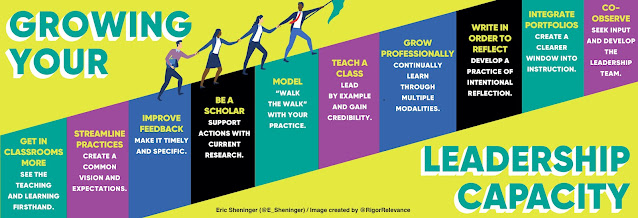
It is easy just to say how one should improve leadership or anything else for that matter.  In Digital Leadership I offered ten specific strategies implemented during my time as principal that you can adopt now, which you can read about below.


Visit Classrooms Routinely

This seems so easy yet is a constant struggle.  Consider increasing the number of formal observations conducted each year and commit to a schedule to get them all done.  We formally observed each of our teachers three times a year, regardless of experience.  Another successful strategy is to develop an informal walk-through schedule with your leadership team.  I mandated five walks a day for each member of my team, and we used a color-coded Google Doc to keep track of where we visited and the specific improvement comments provided to each teacher. 

Streamline Expectations and Eliminate Ineffective Practices

Think about establishing a shared vision, language, and expectations for all teachers.  We did this by using the Relevant Thinking Framework.  This will provide all teachers with consistent, concrete elements to focus on when developing learning activities.  Get rid of the dog and pony show ritual of announced observations.  If lesson plans are still collected, ask for them to demonstrate what will be done two weeks into the future.  Consider less of a focus on lesson plans and more on assessment by collecting these two weeks into the future. 

Improve Feedback

Provide at least one suggestion for improvement, no matter what is seen during an observation or walk-through.  There is no perfect lesson.  Suggestions for improvement should always contain clear, practical examples and strategies that a teacher can implement immediately.  Timely feedback is also essential.

Be a Scholar

Being a scholar helps you as a leader to improve professional practice and puts you in a position to have better conversations with your teachers about their own improvement.  This adds a whole new level of credibility to the post-conference.  I made an effort to align every point of critical feedback to current research.  As you come across research that supports the types of effective pedagogical techniques you wish to see in your classrooms, archive it in a document that you can refer to when writing up observations.  I spent each summer as principal reading, researching, curating, and adapting this for use during the school year.  It saved me time when it came to writing up observations and greatly improved my relationship with my staff as the lead learner. 

Model

Don't ask your teachers to do anything that you are not willing to do yourself.  This is extremely important in terms of technology integration in the classroom and professional learning to improve practice.  If a teacher is struggling with their assessments, don't just say you need to work on building better ones.  Either provide an example that you have created or co-create an assessment together. 

Make Time to Teach a Class 

This can be accomplished regularly during the year or by co-teaching with both struggling and distinguished teachers.  During my first couple of years as an administrator, I taught a section of high school biology.  This is leading by example at its best.  It also provides a better context for the evolving role of the teacher in the digital age.  A leader who walks the walk builds better relationships with staff and will be in a much better position to engage staff in conversations to improve instruction. 

Constantly Seek Out Ways to Grow

Attend at least one conference or workshop a year that is aligned to a significant initiative or focus area in your school/district (the annual Model Schools Conference is a fantastic option).  Try also to read one education book and another related to a different field such as leadership, self-help, or business.  So many powerful lessons and ideas can be gleaned once we venture outside the education silo.  To complement traditional means of professional learning, work to create or further develop a Personal Learning Network (PLN).   

Reflect Through Writing

Writing has enabled me to process my thinking resulting in a more critical reflection of my work in relation to teaching, learning, and leadership.  Our reflections assist us with our growth and can also be catalysts for our staff and others to reflect on their practice or grow professionally.  Having teachers write a brief reflection prior to the post-conference is an excellent strategy to promote a conversation on improvement that isn't one-sided.

Integrate Portfolios

Portfolios were a requirement for my teachers and complimented our observation process nicely.  They provided more clarity and detail on instruction over the entire course of the school year.  Portfolios can include learning activities, assessments, unit plans, examples of student work, and other forms of evidence to improve pedagogical effectiveness.  They can also be used to validate good practice.

Co-Observe 

During the first quarter of each year, I co-observed lessons with members of my administrative team.  This was invaluable for many reasons.  For one, we were able to utilize two sets of eyes during the observation, as some things will always be missed when done solo, no matter how much experience you have.  This also allowed me to work with my team to help them improve their leadership.  It also helped me grow as every conversation helped me further reflect on what I saw.

There is nothing more important than ensuring quality learning is taking place in our classrooms.  The ten strategies presented can be implemented immediately to improve your leadership while enhancing the practice of those you serve. 

Sunday, September 5, 2021

Trust is a Leader's Best Friend

When I began the journey to become a school administrator many years ago, I took the typical courses that were required.  These focused on topics such as school law, instructional leadership, change management, school finance, and curriculum development, among many others. While I felt adequately prepared when I finally became a building leader, I quickly realized how valuable the on-the-job training was to my growth. Truth be told, no book or course can replace authentic experience. 

Leadership is hard. Initiating and sustaining change is even harder. Below are some thoughts I shared a few years back:

It is difficult to adequately prepare any leader for the challenges they will face as well as the decisions that will have to be made.  There are so many unique variables that just cannot be taught.  It’s tough work knowing that difficult decisions will have to be made at times, including letting staff go.  Making decisions in a time of crisis is also a topic that is regularly explored in leadership courses.  The solutions addressed always sound great in theory, but their application typically isn’t very practical.   Talking the talk must be accompanied by walking the walk. That’s the hard part. It’s relatively easy for people to tell others what they should do. However, true leaders go through the challenging work of showing how it can be done. Accomplishments and success are earned through the actions that are taken that result in evidence of improvement.   Leaders know that it is not the work of one person that moves an organization in a positive direction but rather the collective efforts of all. 

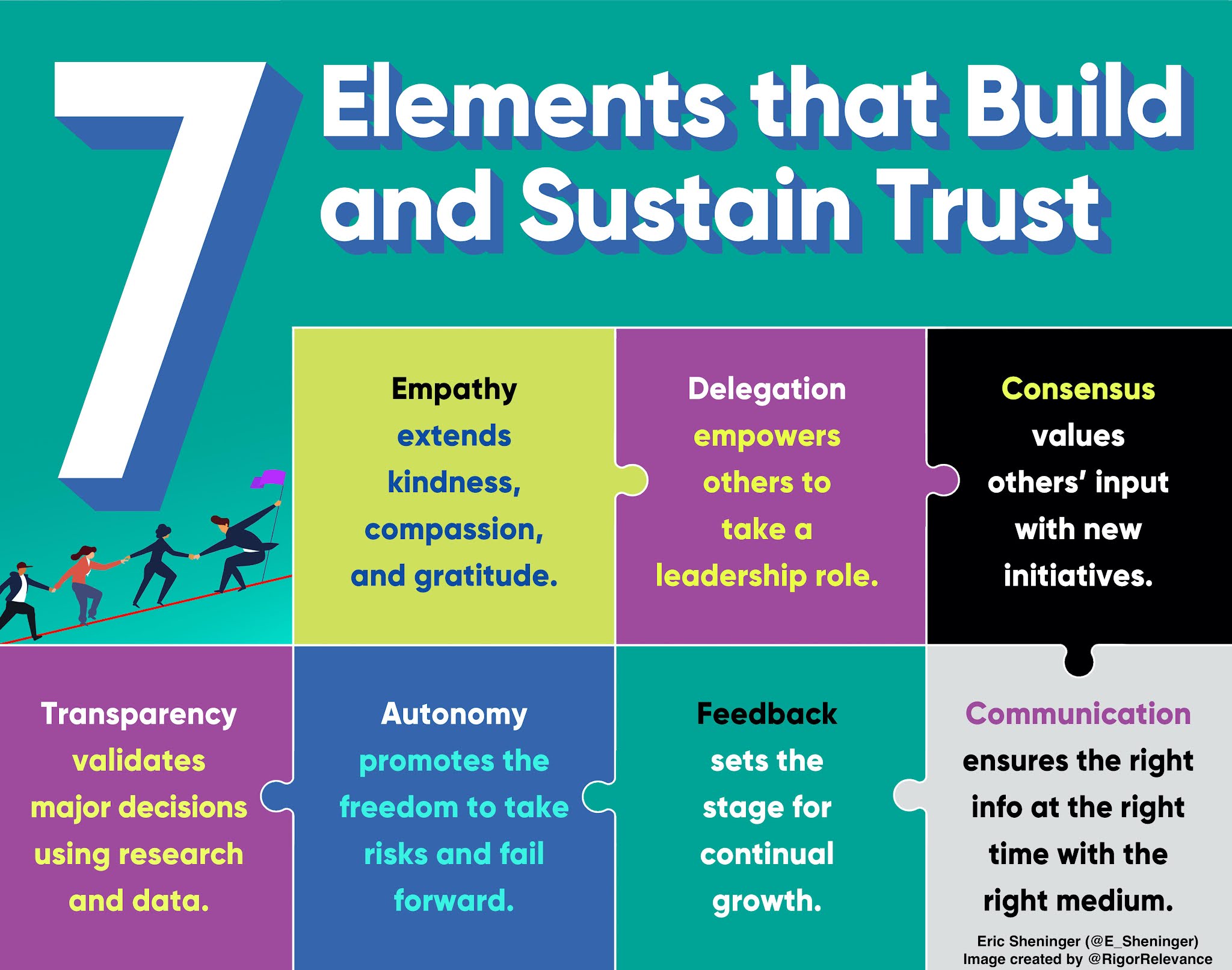
Knowing the inherent difficulties in leading, it is critical to developing an understanding of what can stymie or ensure success.  Relationships are of utmost importance, but these do not materialize out of thin air.  Trust is a leader’s best friend. Recently my publishers Jeff Zoul and Jimmy Casas, shared their views on the topic.  I encourage you to give the piece a read, as it contains some valuable insight.  As I work as a leadership coach in schools, the topic of trust comes up all the time.  The following seven elements are critical in building and sustaining trust: empathy, delegation, consensus, transparency, autonomy, feedback, and communication. 


Empathy through kindness, compassion, and gratitude is fundamental to creating powerful relationships.  Whether it is a simple thank you, consoling a staff member, or handwritten notes of appreciation, using a consistent empathetic lens pays dividends ten times over.

Delegation builds capacity by empowering others to take a leadership role. If a leader tries to do everything by themselves, the result can lead to mistrust.  Look for opportunities to develop the leadership potential in your staff.

Consensus values the input of others when implementing large-scale initiatives. When warranted, use a committee approach or create a district or school-based leadership team that contains a wide range of staff to garner input. 

Transparency validates major decisions using research and data. When there is clarity as to why decisions are made, the seeds of trust begin to take root. Transparency also infers personal accountability by a leader if things don’t work out, as a unilateral decision is made when needed.

Autonomy creates a culture that promotes the freedom to take risks and fail forward. In Disruptive Thinking, I highlighted how autonomy helps educators move beyond their fears, which leads to a pursuit of innovative practices.  Additionally, influential leaders know when to get out of the way of their staff and let them flourish. 

Feedback that is timely, specific, consistent, actionable, and focuses on a dialogue sets the stage for growth. Trust develops when leaders are always looking for ways to help their staff improve or avoid pitfalls. 

Communication, when done effectively, relies on getting the right information out at the right time using the right medium.  While disseminating information consistently and with clarity is critical, non-verbal means such as listening and body language are just as, if not more, necessary.  As I shared in Digital Leadership, you won’t find an effective leader who is not an effective communicator.

All of the elements above help a leader build trust amongst staff resulting in a positive school culture. While there is no single silver bullet, consider where there is an opportunity for growth and the actions that need to be taken to either build or strengthen relationships through trust.