Showing posts with label PIllars of Digital Leadership. Show all posts

Sunday, October 7, 2018

Build a Door for Opportunity to Knock On

If opportunity doesn't knock, build a door.” – Milton Berle

I love the quote above. It did not resonate with me early in my career as a school administrator, but later became sort of a personal mantra.  For years I always looked at the world through a “glass half empty” lens.  Challenges morphed into excuses, and in the end, nothing changed.  In a sense, I wasn’t pushed to be innovative or bring about substantive changes that genuinely impact school culture in powerful ways. The same old thinking typically leads to the same old results. However, in disruptive times a traditionalist mindset can lead our schools and us further down a path of obscurity.  


Opportunity presents itself in many ways and is defined as a set of circumstances that makes it possible to do something.  I love this definition, as there are so many apparent connections to a growth mindset, entrepreneurship, and innovation.  However, we must understand that opportunities will not just drop in our laps if a culture of possibility is not developed.  You can always wish for something, and if you are lucky, it might come true. Unfortunately, this is not realistic or practical.  On the other hand, you can act to create a different and better culture defined by actual outcomes aligned with improvement. 

David Brit provides some excellent context on discovering opportunity.
"What the caterpillar calls the end of the world, the Master calls a butterfly." 
Look for the new opportunity. 
It might be hidden; it might be obvious, but it is there. You now have an altered perspective because of what happened. Use this perception creatively to seek out the direction which will empower you in a way unlike ever before. 
Ask yourself what extraordinary thing it is that you now will be, do or have because of this? That is because "X" happened, I now will have "Y," and would never have had "Y" if "X" never happened. Therefore, "X" serves as the catalyst to put you into the advantageous position of the journey toward, and ultimately, being, doing or having "Y."
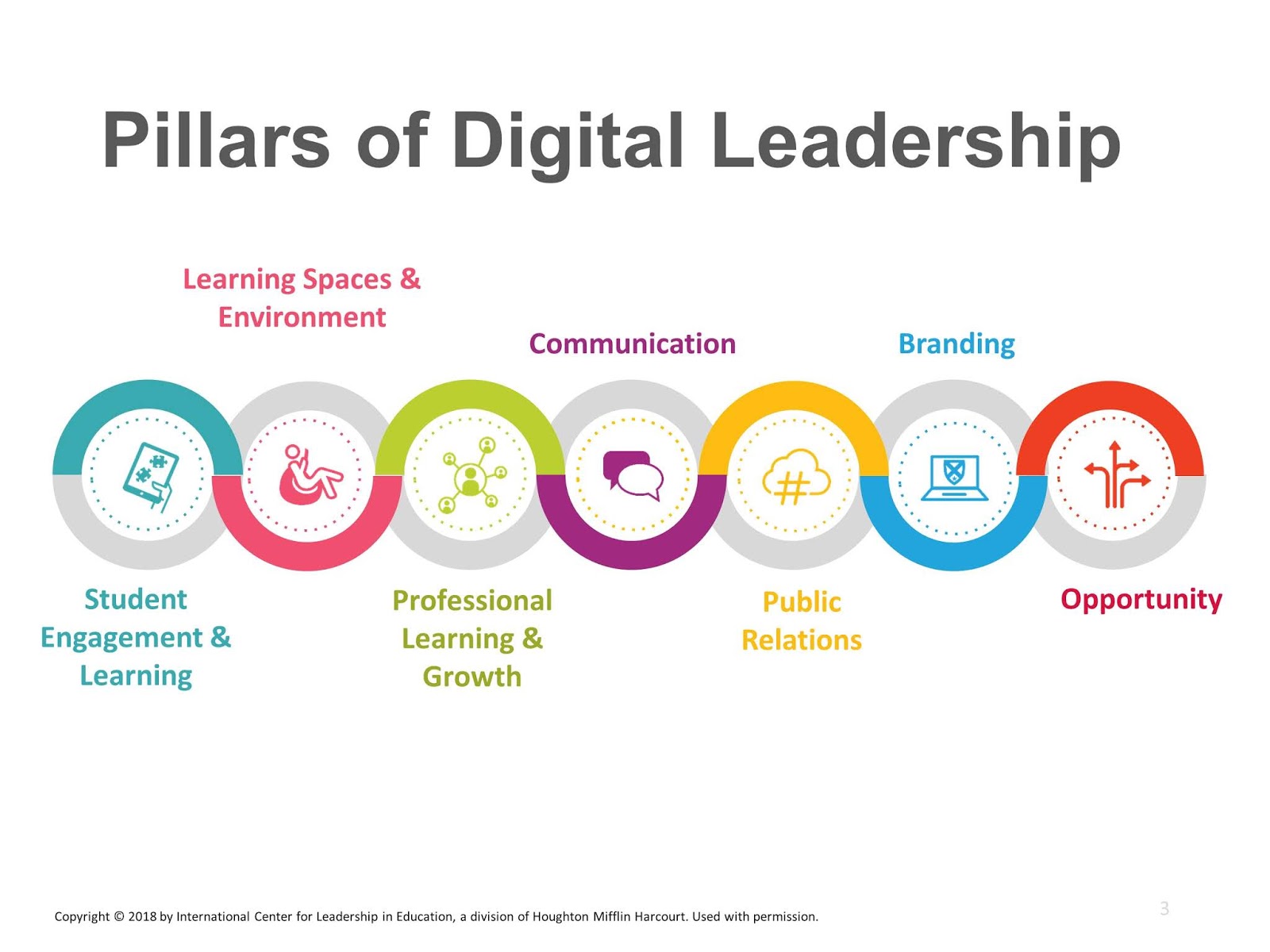
Don’t just discover opportunity, but also build doors to welcome it in.  Herein lies the lesson I learned during my journey. The Pillars of Digital Leadership provided the circumstances and conditions to create the door for opportunity to knock on. The interconnectivity and symbiotic nature of each pillar led my school and me down a path that allowed us to reap the fruits of our labor.  As you will see in the image below, each pillar lends itself to the next. Think of it as a way to build a better foundation and then scaffold from there. Here is a simple three-step approach to put this process into perspective:

  1. Improve the work (Pillars 1 - 3)
  2. Share the work (Pillars 4 – 6)
  3. Follow-up on opportunities that arise (Pillar 7)

The work is learning for our kids. It requires taking a critical lens to our practice to build pedagogical capacity that will allow innovative ideas to thrive.  After a better and stronger foundation is in place, the next step requires an evolution of the spaces and environments that influence the conditions impacting student learning. Finally, one cannot forget a commitment amongst all educators to pursue professional growth opportunities that lead to innovative changes practice.


Once efforts have been undertaken to improve the work the next step seems simple. In reality, it should be, but a focus on communications and public relations using a multi-faceted approach to meet stakeholders where they are at requires a certain level of consistency. By getting information out there and telling your story, a brand presence organically forms. It is here where opportunity arises. 

Case in point. Once we committed to improving the learning culture at my former school, we shared evidence of success, including achievement. The dynamic combination of innovation and efficacy resulted in the New York City media visiting our school 14 times in 5 years to share our story with millions of people. Our use of social media only amplified this even more. National outlets such as USA Today, Education Week, and Scholastic Administrator soon jumped on the bandwagon. Unprecedented media coverage was only one unintended consequence. During this time frame, we also received hundreds of thousands of dollars of technology, professional development, and off-site learning experiences for our students.  

There are endless opportunities available if you create the conditions for them to materialize. 

Sunday, May 8, 2016

A Paradigm Shift

The world continues to change as a result of technological advances.  Just a few years ago, it would have been near impossible to predict some of the paradigm shifts we have experienced.  It all began around 2003 when the smartphone wars started with Blackberry but were quickly taken over by the Apple iPhone in 2007.  At this point, change began to happen at a rapid pace. Disruptive innovations, such as Uber and Netflix, have begun to dramatically alter consumer behaviors, in many cases for the better. Make no mistake about it; technology is shaping the world in ways that we could never have imagined. The types of disruption we are seeing are improving effectiveness, efficiency, and results. It's a dog-eat-dog world in the digital age. Either adapt and evolve or become obsolete and extinct. The dying taxi industry and Blockbuster provide stark reminders of this fact.

With all the change the world is now experiencing, it is quite dumbfounding, to say the least, as to why schools and education remain static when it comes to change. All one has to do is walk into a school and for the most part, one will see the same structure and function that has dominated for the past 100 years. The pressure to conform to a world that solely equates school success to standardized metrics is, for all intents and purposes, the reason why we are not seeing disruptive innovation at scale. However, if schools and leaders do not take cues from history, it is only a matter of time before they suffer the same fate of obsolescence. The domino effect here could be catastrophic to our economy and the world, as we know it.


Maybe evolution is not the right approach for education, but rather a concerted focus on paradigm shifts to professional practice.  As Thomas Kuhn (1970) argues, scientific advancement is not evolutionary, but rather is a "series of peaceful interludes punctuated by intellectually violent revolutions", and in those revolutions, "one conceptual worldview is replaced by another". Thus a paradigm shift constitutes a change from one way of thinking to another to spur a revolution that transforms learning and professional practice. This sounds great in theory, but it won’t just happen. For a paradigm shift to occur and be sustained, it must be driven by change agents who are willing to disrupt the status quo embedded in the global education system.


Paradigm shifts need to be driven by change agents in classrooms, schools, districts, and other educational organizations across the globe.  In a world where technology is becoming more and more embedded by the minute, it is incumbent upon leaders, regardless of position, to replace the conceptual view of school with a more meaningful one. This is where the concept of digital leadership really comes into play. By carefully analyzing current components of professional practice, educators can begin to make the necessary paradigm shifts to replace existing practices with more effective and relevant ones. The following are some specific paradigm shifts in relation to the Pillars of Digital Leadership:


Student Engagement, Learning, and Achievement


We can ill afford to teach and lead in the same ways we were taught and led. It is important to sift through the fluffy ideas that abound as well as the allure of the tools and begin to integrate technology with purpose when appropriate. Success is contingent upon sound instructional design, quality assessments, and an improved feedback loop. To validate this paradigm shift, the concept inherent in this pillar should be aligned to actual results that exhibit improvement not just in terms of engagement and learning, but also achievement as evidenced by a Return on Instruction (ROI). When implemented correctly, digital tools can transform education.


Learning Spaces and Environments


Desks in rows, LCD projectors used as glorified overhead projectors, uncomfortable furniture, poor lighting, and inflexible arrangements have to go. To prepare our learners to think and solve problems in the real world and beyond, they need to learn in spaces and environments that most emulate this reality. Research has shown that redesign can impact student learning (Barrett et al., 2013). More importantly, it can empower our learners.


Professional Growth


Traditional forms of professional development such as “sit and get”, one-size-fits-all, a few isolated days in the school calendar, and trainings lacking accountability are all a waste of time and money. Technology now allows for professional learning to take place anytime, anywhere, and with anyone. Combining improved professional learning experiences with the power of a Personal Learning Network (PLN) sets the stage for meaningful improvement that can be transformational.


Communications 


Schools still rely on traditional means (email, newsletters, phone calls). The shift here is to begin to meet stakeholders where they are at and engage them in two-way communications. This blended approach will result in more transparency, exposure, and message amplification.  


Public Relations 


If you don't tell your story, someone else will. Do you really want to roll the dice and take a chance with this? Everyone has access to the same free video, picture, and text tools to become the storyteller-in-chief. There is such power in stories that focus on student successes and staff accomplishments. No longer does any educator have to rely on the media alone to share the daily awesomeness that occurs in classrooms and schools. 


Branding 


Here is a simple equation: Communications + Public Relations = Branding.  This is not a business-minded concept focused on selling, but instead telling stories and consistently sharing a positive narrative about education. The focus is on telling and sharing work in concert with one another to build powerful relationships with all stakeholders. This results in greater support and appreciation for the whole-child approach that many schools are focused on.


Opportunity 


As the saying goes, if opportunity doesn’t knock, then build a door. The digital world allows us to open doors like never before. The paradigm shift here will naturally result in a sustained focus on the other six pillars.


A paradigm shift in learning, teaching, and leadership is needed to improve our education system. Opinions, talk, and ideas alone will not do the trick, especially those not connected to research and evidence. Let’s raise the bar for schools and ourselves so that a scalable paradigm shift occurs and holistic improvement becomes the norm, not an exception.


Barrett, P., Zhang, Y., Moffat,J., Kobbacy, K. (2013). A holistic, multi-level analysis identifying the impact of classroom design on pupils' learning. Building and Environment, 59, 678-689


Kuhn, T. S. (1970). The structure of scientific revolutions. Chicago: University of Chicago Press.


Sunday, January 19, 2014

Why Digital Leadership? #digilead


If you haven’t noticed, I have been a tad bit excited over the past couple of weeks leading up to the release of my new book.  This is something that I could have never dreamed of prior to social media as I felt that writing was definitely not my strong suit.  Social media not only helped me find my voice, but it helped me find the voices of so many passionate and amazing educators from across the country and globe. Surrounding yourself with smart people willing to share could possibly be one of the best decisions you could make whether as a leader, educator, or learner.  Almost every chapter of Digital Leadership: Changing Paradigms for Changing Times opens up with a vignette that illustrates specific characteristics, behaviors, skills, and mindsets in action.  


Here is a breakdown:

  • Forward – Some wisdom from the great Yong Zhao.
  • Preface – What is digital leadership?
  • A Day in the Life of a Digital Leader - Summary of what a typical day for me looks like at New Milford High School.
  • Chapter 1: The Evolving Educational Landscape 
  • Chapter 2: Why Schools Must Change (Pam Moran)
  • Chapter 3: Keys to Leading Sustainable Change (Spike Cook)
  • Chapter 4: Leading With Technology (David Britten)
  • Chapter 5: Communication (Joe Mazza)
  • Chapter 6: Public Relations (John Carver)
  • Chapter 7: Branding (Trish Rubin)
  • Chapter 8: Professional Growth and Development (Lyn Hilt)
  • Chapter 9: Increasing Student Engagement and Enhancing Learning (George Couros, Patrick Larkin)
  • Chapter 10: Rethinking Learning Spaces and Environments (Dwight Carter)
  • Chapter 11: Discovering Opportunity (Robert Dillon)
  • Chapter 12: A Call to Arms (Peter DeWitt)
  • Appendix: A collection of reproducibles and resources

Their voices and stories, as well as the work of so many other practitioners mentioned throughout the book, will help guide any educator looking to initiate meaningful change in the digital age.  This is not about bells and whistles or smoke and mirrors tactics to preserve the status quo, but rather a systematic approach to transform schools in a way that works for our students and inspire those with whom we work.  It is about taking a hard look at the type of school culture leaders are currently sustaining and asking is this really preparing our students for success.

I have witnessed and been a part of a dramatic transformation process at NMHS that began in 2009 when I gave social media a try. The process continues today where a culture has been built that preserves important traditional elements while pursuing an innovative agenda for growth and improvement.  We are actively engaging a variety of stakeholders, who in turn have embraced the renaissance taking place.  It is my hope that the collective stories, strategies, and ideas in this book will help you become an agent of change.

Three Ways to Get Digital Leadership

Now that the dust has settled since the book officially became available on January 14 the electronic versions are now ready for download.  Here are the specific links:

  • Hardcopy (Corwin Press)
  • Electronic eBook (eBooks) - PDF replica of the print version and can be viewed on almost any device except Kindle.
  • Kindle (Amazon)

#DigiLead

If you want to talk about digital leadership at anytime I have created a hash tag. My hope is that we can use this on Twitter, Google+, Instagram, and Facebook to extend the conversation and our learning on this topic.  Feel free to use it to ask me questions, acquire resources, or just to chat openly about how we can all become more effective leaders in a digital world.

Virtual Book Club

There is even a Google+ Community that has been established as a virtual book club/chat for anyone to join for FREE.  This is a great way to connect with other digital leaders across the world to learn, grow, and transform our schools for the better.


Sunday, December 29, 2013

Pillars of Digital Leadership Series: Opportunity

This post is the seventh and last in a series that outlines the foundational elements of my new book, Digital Leadership: Changing Paradigms for Changing Times.  It is set to be published by Corwin Press on January 14, 2014.  Currently there is a pre-publication discount of 15% for any orders before this date.  Over the past couple of weeks I have introduced what I have come to identify as the Pillars of Digital Leadership, a conceptual framework for leaders to begin thinking about changes to professional practice.  My book will focus on each of these elements as part of a change process. It will illustrate them in action through the work of practitioners and provide implementation strategies. To view the entire series click HERE.

Pillar #7 - Opportunity

The interconnectedness of the Pillars of Digital Leadership leads to continuous improvements in school culture and professional practice. As leaders begin to craft a strategy that incorporates social media and digital tools, the shifts and changes in behavior inherent in each of the six previously discussed pillars begin to take shape. Transparency through the use of social media breeds attention to programs, initiatives, and leadership style. Good news travels fast, and social media transmit the news to numerous stakeholders who are embedded in these spaces. This attention eventually leads to numerous opportunities in the form of strategic partnerships, authentic learning experiences for students, professional development, school and professional recognition, and educational technology.  


Image credi: http://www.forbes.com/sites/chrisperry/2012/05/09/how-to-cure-social-media-paralysis/

Chapter 11 will introduce readers to Robert Dillon and the work that he has done to forge strategic partnerships with an array of stakeholders to provide learning opportunities for his students. This chapter will also provide numerous examples of how I have leveraged social media to discover opportunities for the New Milford High School community as well as myself professionally.  The possibilities are endless as digital leaders become more connected, engage in conversations about professional practice, and share the innovative work taking place in their buildings. 

As leaders adopt and embrace the Pillars of Digital Leadership, numerous opportunities will arise in an array of areas that positively impact school culture and professional practice. By leveraging social media, leaders can share school and professional successes, build strategic partnerships, present work to a wide array of audiences, and discover authentic learning experiences for students and staff alike. All of this can be done in a relatively cost-effective fashion while improving all facets of education. These opportunities will build a greater sense of community pride in the innovative work being done in education. Once understood and embraced, the Pillars of Digital Leadership will continue to work in concert with each other to bring opportunities now and in the future.

Sunday, December 22, 2013

Pillars of Digital Leadership Series: Rethinking Learning Spaces and Environments

This post is the sixth in a series that will outline the foundational elements of my new book, Digital Leadership: Changing Paradigms for Changing Times.  It is set to be published by Corwin Press on January 14, 2014.  Currently there is a pre-publication discount of 15% for any orders before this date.  Over the next couple of weeks I will introduce what I have come to identify as the Pillars of Digital Leadership, a conceptual framework for leaders to begin thinking about changes to professional practice.  My book will focus on each of these elements as part of a change process. It will illustrate them in action through the work of practitioners and provide implementation strategies. To view the entire series click HERE.

Pillar #6 - Rethinking Learning Spaces and Environments

Digital leadership looks at societal trends as inspirational elements and potential catalysts for change in the structure of the schools themselves as well as the designs of programs. It is a call to action challenging leaders to critically reflect on the learning spaces and environments that embody a school. Do they meet the needs to learners today? Do they foster and inspire creativity, provide flexible opportunities to learn, and address unique and specific interests? Are they reminiscent of what students will expect in today’s world? I will be the first one to admit that the learning environments and spaces at New Milford High School looked nothing like this prior to 2009.  Our goal now is to try our best to create a physical space and overall environment that offers flexibility, choice, and tools that our learners will experience upon graduation.  With the pedagogical shifts outlined in the last post in this series our success will be determined by the transformation of learning spaces and environments that support these instructional changes.


Clark Hall at GAHANNA LINCOLN HIGH SCHOOL (Columbus, OH)

Digital leadership drives school leaders to look past traditional constructs and incorporate trends embraced by Fortune 500 companies to transform learning spaces and environments. When energy and time are spent in this area, school will not only authentically engage students, but also better prepare them for success in today’s dynamic society. The end result will be opening the door to learning while creating global scholars. Chapter 10 of my book provides leaders with a look into how Principal Dwight CARTER spearheaded such change to create Clark Hall, a model for how schools should function and be structured in the Digital Age.  Dwight provides invaluable insight on the journey and processes involved to create an environment that students and teachers alike want to be a part of. Schools today need to focus on creating environments and spaces that:

  • provide an open, bright, and flexible space for learning
  • provide student choice
  • integrate technology to engage students
  • are flexible with time to focus on learning
  • provide students with the opportunities to express their natural creativity
  • utilize teachers as facilitators
  • promote interdisciplinary and interconnected projects
  • make learning fun

Digital leaders develop a vision and strategic plan to create schools that engage and drive learning.  Thanks to social media and the real-time Internet we all have access to design elements and ideas to transform schools into institutions where students use real-world tools to do real-world work.  This is were the foundation was laid for the evolving Makerspace at NMHS.  In addition to the successes that Dwight has had in this area the rest of the chapter will look at how schools can create their own Academies as well as create pathways to individualize and personalize learning for all students.  How have you worked to redesign learning spaces and environments at in your respective district or school?

If you have any specific questions in regards to the Academies @ NMHS, IOCS, or our Makerspace (hyperlinks in the above paragraph) feel free to reach out to me.

Sunday, December 15, 2013

Pillars of Digital Leadership Series: Student Engagement and Learning

This post is the fifth in a series that will outline the foundational elements of my new book, Digital Leadership: Changing Paradigms for Changing Times.  It is set to be published by Corwin Press on January 14, 2014.  Currently there is a pre-publication discount of 15% for any orders before this date.  Over the next couple of weeks I will introduce what I have come to identify as the Pillars of Digital Leadership, a conceptual framework for leaders to begin thinking about changes to professional practice.  My book will focus on each of these elements as part of a change process. It will illustrate them in action through the work of practitioners and provide implementation strategies. To view the entire series click HERE.

Pillar #5: Student Engagement and Learning

Many of us firmly believe in technology’s potential to transform the teaching and learning cultures of schools. Whether it is used to enhance lessons, assess learning, engage students, or unleash creativity, technology has a defined role in a variety of school functions.  Many schools and leaders still treat education as an effort to prepare students for a world that no longer exists, one in which technology is viewed as either a frill, distraction, or a non-factor in improving student achievement. For many students, school does not reflect real life. This results in various levels of disengagement during the teaching and learning process. Ask yourself this, would you want to be a student in the classrooms of our colleagues? The question then becomes, how do we move those schools that are the most irrelevant in terms of meeting the diverse learning needs of their students to begin the transformation process? This is pivotal if we are to truly begin to reform education in a way that is meaningful to our students.  It all begins with leadership, whether at the district, building, or classroom level.


NMHS students using Chromebooks and Socrative

Our students want to be creative, collaborate, utilize technology for learning, connect with their peers in other countries, understand the messages that media convey, and solve real-world problems. Schools and systems of education that do not embrace digital learning and place a high emphasis on standardization will always fail to resonate with our students. It only makes sense to harness the power of technology as a catalyst for authentic engagement and application of concepts among our learners. If schools allow students to use the digital-age tools that they are using on a routine basis outside their walls, chances are they will find more relevancy and meaning in what they are learning.

Digital leadership is a mindset and a call to transform a school’s culture into one that unleashes the creativity of students so they can create artifacts of learning that demonstrate conceptual mastery. It is about providing learners with the knowledge, skills, and confidence to succeed in college, careers, and jobs that have not even been created yet.  This is accomplished by allowing students to use real-world tools to apply what they have learned and construct new knowledge. By focusing on how specific technologies can be used to engage students, digital leaders are establishing a foundation for learning that will lead to eventual increases in student achievement. This becomes a reality when school cultures are transformed to meet and anticipate the needs of learners in the Digital Age. Chapter 9 showcases the work of Patrick Larkin and teachers at New Milford High School who have become change agents in this area. It provides leaders with the foundational elements to successfully implement digital learning across the curriculum.

It is crucial that sound pedagogical techniques and best practices are emphasized in order to effectively integrate technology to enhance teaching and learning. One of the most important questions a leader needs to answer is how the students are using technology to apply learning and demonstrate conceptual mastery. Students must always be at the center of this process. All too often technology is infused into the learning environment where the teacher is still employing a direct approach to instruction. Are you leading change in this area or abiding by the status quo?

Sunday, December 8, 2013

Pillars of Digital Leadership Series: Professional Growth

This post is the fourth in a series that will outline the foundational elements of my new book, Digital Leadership: Changing Paradigms for Changing Times.  It is set to be published by Corwin Press on January 14, 2014.  Currently there is a pre-publication discount of 15% for any orders before this date.  Over the next couple of weeks I will introduce what I have come to identify as the Pillars of Digital Leadership, a conceptual framework for leaders to begin thinking about changes to professional practice.  My book will focus on each of these elements as part of a change process. It will illustrate them in action through the work of practitioners and provide implementation strategies. To view the entire series click HERE.

Pillar #4: Professional Growth

Opportunities to grow professionally are pivotal to leaders in the digital age. However, the mounting pressure from ridiculous mandates as a result of the current education reform movement and massive budget cuts across the country, have made it a challenge to learn through traditional pathways. Without funding, many districts no longer allow leaders to travel to national/state conferences or even attend local workshops.  It is a shame that the growth of leaders, and all educators for that matter, is a trivial concern to districts and so called reformers, unless it is solely related to the Common Core, PARCC, SGO’s (in NJ at least), or a teacher/principal evaluation tool.  These are not the meaningful, rich, and relevant learning opportunities that leaders of today’s schools deserve or yearn for.


Image credit: http://www.edudemic.com/build-personal-learning-network/

The ever-increasing mandates at the state level impacting evaluation and curricular alignment to the Common Core have taken their toll as well.  To put it bluntly, leaders feel that they either do not have, or cannot find, the time to attend professional learning opportunities due to this tsunami of work that comes at the sacrifice of meaningful growth and development.  The pressure from education reform mandates is so intense that many leaders don’t even think twice about missing a day of school to learn as he/she is always thinking about the observations that could get done or the piles of paperwork that will be waiting upon their return.  Leaders should never feel that their learning and growth comes at the expense of mandates and directives that are not in line with a vision for preparing students to succeed in a digital world.

Fortunately digital leaders are not at the mercy of budget cuts or taking professional days to learn and get better.  They still can, but now have the ability to save time and money by harnessing the power of social media to learn anytime, anywhere, and from anyone they choose.  They are able to follow their specific learning passions by connecting with like-minded individuals. A connected learning model is empowering and ultimately creates a human-generated search engine for the most practical ideas and strategies being implemented in schools today.

Using the work of Lyn Hilt as a model, Chapter 8 will provide leaders with the knowledge and tools to create their own Personal Learning Network (PLN).   A PLN provides leaders with resources, knowledge, feedback, advice, support, friendships, and is a catalyst for self-directed learning.  The ability and ease to now engage in conversations with like-minded practitioners and world-renowned experts provides a meaningful and differentiated model for growth to improve professional practice.  For me, I love being able to ask a question on Twitter and then return hours later with an array of responses from all over the world. I also love being able to filter content based on my interests from a variety of information sources to one convenient location.

Digital leaders seize the opportunity to grow and learn like never before through a connected model of leadership.  To begin this journey check out some of these wonderful blogs that I highly recommend every educator read and follow:

Another great way to start is to join the Leadership 3.0 community at edWeb for free. Now more than ever leaders need to take control of their learning.  How have you gone about creating your own PLN? What advice would you give to those leaders who are looking to begin this process?

Sunday, December 1, 2013

Pillars of Digital Leadership Series - Branding

This post is the third in a series that will outline the foundational elements of my new book, Digital Leadership: Changing Paradigms for Changing Times.  It is set to be published by Corwin Press on January 14, 2014.  Currently there is a pre-publication discount of 15% for any orders before this date.  Over the next couple of weeks I will introduce what I have come to identify as the Pillars of Digital Leadership, a conceptual framework for leaders to begin thinking about changes to professional practice.  My book will focus on each of these elements as part of a change process. It will illustrate them in action through the work of practitioners and provide implementation strategies. To view the entire series click HERE.

For this post I decided to turn to Trish Rubin, my education branding expert whose work and insight I highlight in Chapter 7 of my book.  Below are her thoughts on the importance of branding in education.  She has coined the term BrandEd as a means to impart the importance of leaders to establish a positive brand presence.  This specific chapter of the book will look at the role of social media in this process. 

Pillar #3 - Branding

Today's school digital leaders get excited about bringing business tools into their school organization. What I call being a BrandED leader is one foundational way to enrich school management in a digital age. Branding is a tool that has been part of strategic business plans for years. Brand attracts attention and influences audiences. A school brand needs to be positive and crafted to convey purpose. Bringing the process of BrandED thinking into the school's plan transforms and energizes.


Image credit: http://blog.creatinemarketing.com/blog/bid/181385/Do-You-Need-a-Social-Media-Education-to-Execute-A-Social-Strategy

A school leader can create a more connected community by leading the charge to develop a school brand. Private school and college leaders have used brand thinking for years to message their faithful communities. They know the value of a clearly communicated school brand and have benefited from the support of a well-defined brand in political and economic ways. Bringing this thinking into your role as a leader isn't just about style, it's about substance. A strong Brand identity leads to better communication and influence, and in our digital world, influence can be gained at the stroke of a keyboard. Lead your stakeholders to purposefully create a deep identity for your school that uniquely defines the character of the institution.

It’s a do it yourself world, and you can do this without a Madison Avenue advertising firm. Building a school brand is a serious element of school business.  In our noisy digital world, clearly communicated identity is the key to the positioning of your school’s consistent positive presence.  A brand benefits a school's profile and even its purse! Lead your school to BrandED success by identifying the “ROO” (Return on Objective) that brand brings.  Lay out a short plan involving all stakeholders to build the unique school identity. Start by defining your own personal brand as you lead the process. Be open about the shift to brand thinking. Explain why you are investing in educational brand.

Schools must clearly communicate a consistent brand message to their stakeholders to reach standards.  This can be done using myriad communication channels, in real time and online. Your school brand may even come down to one word. Making a Brand facilitation plan is your first ROO target as a BrandED leader. Reputation management of any product or service is key to keeping faith with a loyal audience and brand is about trust and reputation.  Build a BrandED identity, and then set the next ROO: share that identity in a busy information age. Successful BrandED schools are proactive, despite the pressure of the daily digital scrutiny of their audiences. A strong brand grounds communication in what matters most to the school. Positioning a school for success starts with a leader's confident steps toward a BrandEd plan.

Sunday, November 24, 2013

Pillars of Digital Leadership Series: Public Relations

This post is the second in a series that will outline the foundational elements of my new book, Digital Leadership: Changing Paradigms for Changing Times.  It is set to be published by Corwin Press on January 14, 2014.  Currently there is a pre-publication discount of 15% for any orders before this date.  Over the next couple of weeks I will introduce what I have come to identify as the Pillars of Digital Leadership, a conceptual framework for leaders to begin thinking about changes to professional practice.  My book will focus on each of these elements as part of a change process. It will illustrate them in action through the work of practitioners and provide implementation strategies. To view the entire series click HERE.


Pillar #2 - Public Relations

If you don’t tell your story someone else will.  More often than not, when someone else tells your story, nine out of ten times, it is one that you don’t want told.  This is the reality for virtually every school leader.  In the past I feared and dreaded the roll of public relations as the typical situation played out time and time again.  No matter how much progress we made, or success we experienced, it was always that one negative story that would dominate the media coverage and sway public opinion.  I can vividly remember each news situation that completely blew things out of proportion and greatly distracted from the meaningful and significant work that was occurring on a daily basis.  


Image credit: http://smp4u.wordpress.com/author/jessicafelicekamm/

There is a fundamental problem with the mainstream media when it comes to public relations.  That problem is that they are a business.  In order to generate business they must create and promote stories that capture the attentions of their intended audience.  Make no mistake about it, the media wants and needs to make money.  When it comes to education the most controversial and negative stories are the ones that attract viewers and in turn generate revenue.  I don't know about you, but I grew quite resentful of the media in the past as they would be so quick to call my office to comment on a negative situation, but would not give me the time of day when I had a positive story for them to cover.  Sound familiar?

Thankfully this all changed in late 2009 as I discovered the power and value of using social media as a public relations tool.  I began to generate our own news related to New Milford High School and quickly learned of the many tools available that could be used at anytime from anywhere to tell our story.  In essence, I became the storyteller-in-chief.  As a result of the innovative work my students and teachers were engaged in, I discovered that there was an abundance of newsworthy content that my stakeholders craved.  Instead of reaching out to the media to cover these stories, we in essence became the media using mainstream tools such as Twitter, Facebook, YouTube.  As social media has evolved so too has our public relations strategy as we are now integrating Instagram, Pinterest, and Tumblr to tell our story.  

The end result is that the media now comes to us and/or follows our social media channels to capture our story. Since taking control of our public relations at NMHS in 2009, the NYC, CBS, and NBC affiliates as well as USA Today, USA Weekend, Education Week, and Scholastic Administrator have all reported on positive news stories.  I have literally lost count of additional media coverage, as it has become the norm.  It has also led to the establishment of professional relationships with reporters who want to tell accurate and positive stories about innovative schools.  

Chapter 6 in my book takes a detailed look at how digital leaders leverage available social media tools to enhance public relations. It places an emphasis on the work of John Carver and how he has become a public relations juggernaut for two different districts in Iowa. It also breaks down the strategies and tools that I use on behalf of my school to tell our story. Community and transparency are the bedrocks of public relations in the digital age.  This fact makes social media a natural fit.

How are you using social media for public relations?

Sunday, November 17, 2013

Pillars of Digital Leadership Series – Communication

This post is the first in a series that will outline the foundational elements of my new book, Digital Leadership: Changing Paradigms for Changing Times.  It is set to be published by Corwin Press on January 14, 2014.  Currently there is a pre-publication discount of 15% for any orders before this date.  Over the next couple of weeks I will introduce what I have come to identify as the Pillars of Digital Leadership, a conceptual framework for leaders to begin thinking about changes to professional practice.  My book will focus on each of these elements as part of a change process. It will illustrate them in action through the work of practitioners and provide implementation strategies. 

Pillar #1 - Communication

If you were to look at the many characteristics that great leaders share, effective communication would be at the top of the list.  Abraham Lincoln, Winston Churchill, and Dr. Marin Luther King Jr. were great leaders who could transfer a message like no other.  Each was able to achieve success in part due to his ability to effectively communicate.  You would be hard pressed to identify an effective leader who was a poor communicator.  Communication serves to provide information, convey our vision, lay out the elements of a strategic plan, promote values, motivate stakeholders, and quell perceptions that are not accurate.  It is an art that combines inter and intra-personal skills with mediums to amplify an intended message. The art of communication has not changed, but the tools that we have at our disposal to deliver our message has.


Image credit: http://juntaedelane.com/category/articles/articles-articles/marketing-research/

As society has evolved, the way in which the world communicates and interacts has as well.  Digital leaders understand that technology provides a variety of pathways to initiate two-way communication with stakeholders.  Traditional means, such as newsletters and email, no longer suffice as cornerstones to a communications strategy.  Digital leaders seize upon the opportunity presented by digital tools (i.e. social media, mobile apps, video conferencing) to meet stakeholders where they are in order to convey a message and elicit feedback on initiatives.  In a world where access to and consummation of real-time information is the norm, digital leaders adapt their strategy to become more effective communicators.  

This is not to say that traditional means are no longer important elements of an effective communications plan.  They are, but digital leaders understand that the rise of mobile devices in particular has dramatically changed the way that stakeholders receive and access information.  The most effective communicators in society today are those that continue to develop and refine traditional means while leveraging digital tools to have a more profound impact. Whether you are a principal, superintendent, or teacher improving how you communicate plays a role in your success as an educator.  

Chapter 5 in my book takes a critical look at how digital leaders communicate. It places an emphasis on the work of Joe Mazza and how he has increased community engagement through a variety of communication strategies involving technology. After reading this chapter any educator regardless of his/her role will have a collection of tools, strategies, and ideas to take his/her communications to the next level.  Digital leaders use technology to engage stakeholders in conversations.  These conversations become the building blocks to create and support meaningful relationships based on the positive messages embedded in our communications.  To put it simply, without effective communication, there’s not effective leadership.

How have you changed your communications strategy in the digital age?