Showing posts with label teacher. Show all posts

Sunday, May 26, 2019

The Challenges Educators Face

We live in amazing times.  Technology, most specifically social media, has flattened the world. Remember when we had to get all of our professional literature and information from journals, books, conferences, over the phone, or people that we came in direct contact with? Educators now have access anytime from anywhere to people, ideas, resources, strategies, and feedback.  As much as this has been a game-changer for so many, we now have better access to research and evidence of improved student outcomes to really hone in on the types of changes that are needed in classrooms, schools, and districts across the world. 

Even with all the positives associated with what I listed above, the truth of the matter is that much of it doesn’t matter when the realities educators face are not given the attention that they deserve.  Just because something sounds good on Twitter and during a keynote or looks good on Pinterest and Instagram does not mean whatever is being promoted will work. Context matters. Finances matter. Facilities matter. Staffing and community support matter.  I have been blessed to not only deliver keynotes and workshops but also to facilitate job-embedded coaching on a long-term basis. It is the latter component of my work where I see firsthand the challenges educators are facing regardless of zip code.  This work has provided me with a more empathetic lens and has allowed me to tailor and personalize the coaching process as well as the feedback that is delivered.  


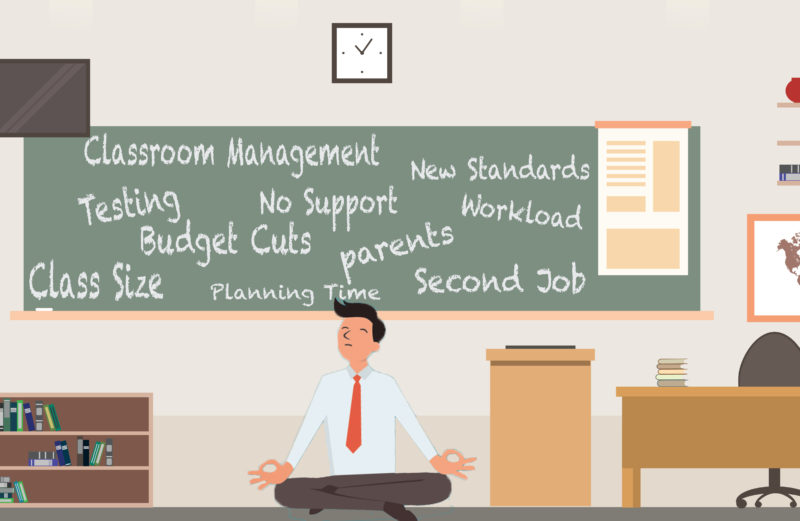
Image credit: NEA Today

How I see things is still limited and can be influenced by bias. Now don’t get me wrong. I see some significant obstacles and challenges thanks to the long-term work I am engaged in. However, I wanted to move beyond me and focus on the people who are in the trenches on a day to day basis.  This led me to pose a question on Twitter, asking educators to share their particular challenges.  You can see the tweet below. 


Here is a summary of the majority of the responses:
  • Fear of failure and willingness to fail forward
  • Helping educators understand and integrate maker-centered learning
  • Helping teachers and leaders break down silos and understand it is not a competition but a concerted push to provide students with learning experiences they need.
  • Effective strategies to remind adults we are preparing kids for the future not the adults for the future
  • The mental health of students. We don’t have the support needed for emotionally or mentally challenged students that are in the regular education class.
  • Dedicating time to fortify universal instruction and systematic procedures while continuing to attend to the intensive needs of the high volume of kids in crisis & experiencing trauma.
  • Inspiring high school students to choose teaching as a profession.
  • Attracting the best and brightest to the field
  • Boys’ achievement and engagement. There is a considerable disparity at present in our school across all years.
  • Finding the balance between "meet students where they are" and "getting them where they need to go." Many educators are clear on the former, then handhold & scaffold low expectations. Others are better at the latter then lose a good % of their class by not differentiating enough.
  • Lack of alignment of educational institutes knowledge with the practical world. Educational institutions are preparing the future leaders, and due to lack of such coordination they fail to groom themselves as per new emerging trends and increase their absorption level in industry.
  • Work-life balance 
  • Implementing Innovative student-centered learning that improves outcomes 
  • Matching sustainable grading practices that reflect learning
  • Empowering teachers and maintaining alignment to mission, vision, curriculum, etc.
  • Feeling genuinely supported in taking risks and being innovative in the classroom.
  • Students not taking responsibility. Even taking responsibility for picking trash up that they dropped.
  • Inclusion and REAL collaborative teaching... integration of universally designed practices to help all students (which covers social justice, restorative practices, SEL) and somehow helping more teachers embrace that accommodations are not cheating.
  • Screen time for students
  • Making technology purposeful, not just tech for the sake of it
  • Students don’t hold the information anymore as they can get it anywhere. There is a need to teach them not only to access safely and critically but also to apply and construct new knowledge.
  • Motivating digital immigrant teachers and administrators to have a growth mindset to try new strategies and tools.
  • Using interactive whiteboards like projectors
  • Teacher-student ratio
  • Principals seem to be regretting their decision to go into leadership as they have too much on their plate and not enough time. More supports are needed.
  • There is always a new program being purchased. It's used for a few years and then discarded, leading to a high level of initiative fatigue.
  • Real evaluation and accountability
  • School overcrowding, support of libraries by districts, and limited access to libraries
  • Principals with control issues
  • Antiquated buildings, facilities, and resources
  • Ideas that don’t align to consider the realities educators have to deal with
  • Drive-by, one and done professional development that is not on-going, job-embedded, aligned to research, have evidence to back up the investment and lacks accountability for growth.
There are a lot of challenges listed.  What would you add to the list above? 

By putting these and others front and center, efforts can be made to develop practical solutions. Before any new change or mandate, considerations have to be made as to the feasibility (and sustainability) of the idea, strategy, or investment.  Case in point. If you are asking teachers to differentiate instruction on a daily basis, class size and resources matter. Or if you are committed to blended learning, then a combination of pedagogical change as well as updated spaces is needed. It behooves all of us to consider reality when ideas are presented, whether through social media, workshops, professional development days, in books, or during keynotes and presentations.  The struggle for many is real, and they need our support.

Sunday, August 20, 2017

The Impact of an Educator

I fondly remember when I was first asked to consider what my future career path might be.  Mrs. Williams, my kindergarten teacher, asked the class to draw a picture that articulated what we wanted to be when we grew up. I immediately knew exactly what I was going to draw. That was the easy part. The difficult task, for me at least, was to then utilize what limited artistic abilities I had to create an illustration that depicted my future career. To this day I still remember the image I created of a farmer tending to his crops. This was a natural career choice for me as a six-year-old having grown up in a rural area of northwestern NJ with a farm right across from our house. I had no idea how to farm, but being outside the rest of my life was good enough for me.

As I aged the thought of becoming a farmer faded as I began to focus more on careers in the biological sciences. Growing up surrounded by nature and spending each summer at the Jersey Shore helped to kindle and sustain an interest in this area.  I never gave much thought, nor did either of my brothers, about becoming an educator. Quite honestly, I told myself, and my parents, that I would never become an educator.  My response might have stemmed from the fact that I really didn’t understand what they actually did and the impact they were having on kids. All I knew with a great deal of certainty was that a career in education was not in the cards.

My mom, after taking many years off to take care of us, eventually became an elementary teacher where she had a celebrated career.  I say celebrated because at her retirement dinner I was able to witness firsthand the impact that she had on students and colleagues alike. Their stories of her passion and dedication for helping kids learn made me so proud. My father was a successful school administrator for what seemed like forever.  He held many positions, but what I was most in awe of was the fact that he was an elementary principal at the same school for close to 30 years.  When he retired they gave him a key to the city. I don’t know if you can be more successful than that. I never knew the impact my parents had as educators until after I myself became one. Hearing story after story about their work as their careers ended taught me that sometimes the ultimate reward for an educator comes years after we have had direct impact with kids or adults. 


Image credit: http://www.teamworkandleadership.com/

Herein lies the motivation behind this post.  I recently received a text message from a former student and athlete of mine. It started off like this:

"Coach Sheninger, is this still your number?"

My response was a simple yep.

He then went on to text me the following:


"Well hey, its Spenser Brenn just in case you lost my number. Sorry if it’s super early. As sappy as this is going to sound…."

I really was not prepared for what followed next, but I can tell you that his words below touched my heart and soul.


"I was just working out with my athletes and kids yesterday and it reminded of when I was in high school. You let me workout with you and would push me in the weight room, classroom, and on the football field. I have always been asked why did you want to become a teacher and coach. To be honest, I wasn't sure of that answer until I had this moment yesterday when I realized that those seemingly trivial moments of the two of us working out at lunch or study hall were more impactful than most other moments during high school for me. You were tough on me (a pain in the butt, or at least in the eyes of a stupid high school kid), deservingly so, considering I was a pain right back to you. However, you taking me under your wing and motivating, mentoring, and challenging me (whether you knew it or not) meant and still means more to me than you probably know, or more than I knew until yesterday. So I just wanted to reach out and say this - a small gesture like working out with a pain in the butt kid meant the world to him. It showed that you cared, something he, and all people, needed at that time. Thank you. I now know why I became a teacher, a coach, and a mentor to the youth."

It goes without saying that I was totally humbled by Spencer’s message.  As educators we all chose a profession that would not lead to riches in a financial sense. We chose to become educators so that we could not only help kids learn, but hopefully impact them well beyond just grades and achievement.  Education is a calling. It is a calling to make a difference.  That’s what educators do on a day-to-day basis.  Never forget that your work matters and that each day you get up in front of a class, help lead a building, or collaborate with others to run a district that you have an opportunity to positively impact kids. This also applies to your work with adult learners. 

Below is the response I sent to Spencer.


Well you just made my day, well week actually (maybe the entire summer). Life is so much more than what we are made to think is important. Everything comes down to relationships built on trust, empathy, compassion, understanding, and honesty. I really never knew until later in my education career that one of the most important things we can do is to show kids we care. It's not until much later in life that we learn of the impact we have on our students. You will one day be in the same position as me, a proud person humbled by the feedback that you receive knowing that you positively influenced others. Thank you so much for taking the time to send that text. It meant more than you will ever know.

Why did you become an educator? Who were those people and experiences in your life that led you to your current role?  In my new role, I still see myself (and other amazing speakers and presenters) as an educator. Each day is still a calling to try to make a difference.  Whether or not I make a real difference is in the eye of the beholder. Nonetheless, I am driven by the same passion I had as a teacher and principal to help others see the greatness that is within all of us.  

Thank you to every educator out there for the work that you do.

Saturday, September 10, 2011

Do You Teach or Do You Educate?

"Education is not the filling of a pail, but the lighting of a fire" - William Butler Yeats


I am across this video recently and wish I had it for my opening day with teachers.  It is definitely a discussion starter in regards to what should be occurring in the classroom, our respective roles in the profession, and how we should be working with our students to unleash their potential.


Is there more that can be added to this discussion?

Tuesday, July 5, 2011

The Noblest Profession

Cross-posted at the Huffington Post: What is Wrong With This Picture?

All across the country, education is under attack on numerous fronts. No matter where you look, educators are to blame for the economic woes in many states.  This is extremely puzzling to me, as it is well known that this downturn in our economy was a result of misguided, unregulated, or greedy practices of the private sector.  Educators then became the scapegoats as a message of “shared sacrifice” swept the country. 

How this makes sense to anyone is beyond me.   Consider that the average starting teacher salary is $40,000 and may approach $85,000 after 25 years of service, nearing retirement.  So now, as states cry foul about their unprecedented budget gaps, educators are made to look like kings and queens because of their pensions and health benefits.  Isn’t it funny how everyone made fun of educators for choosing a profession that paid so little when the private sector was raking in the cash from the late 90’s through 2006?  Like virtually every educator in our country, I didn’t go into this profession to become wealthy.  I wanted to make a positive difference in the lives of students and hopefully inspire them, like so many of my teachers did me, to be life-long learners and pursuers of dreams.  

Recently NJ was the latest state to pass landmark employee legislation curtailing the collective bargaining rights of state employees, including educators.   It was an extremely sad day for me personally, as I saw my grandmother and parents, retired educators who dedicated themselves to helping all students learn, have their pensions targeted by politicians who have never stepped foot in a classroom.   Is this how we now treat people that made one of the most important decisions of their lives to make less money in the field of education as opposed to more lucrative positions in other lines of work?  How do we not value the work that these retirees did for our schools and children to help catapult our country to such an elite status? 

What concerns me even more is how the work of educators is being devalued to the point that no one will want to pursue one of the most rewarding careers available.  More than ever the field needs passionate individuals who have the drive, patience, and character to work with students that have diverse learning needs.  As the seemingly relentless attacks continue, the incentive to become a part of the noblest profession decreases to a point that might be irreparable. 

One might ask why I refer to education as the noblest profession.  My answer stems from the fact that education is what makes all other professions possible.  Take a minute and think about other career paths – doctors, lawyers, engineers, mechanics, scientists, politicians, entrepreneurs – and ask yourself if any level of education has had a impact on that person’s ability to perform and succeed in those jobs.  I think your answer would be a resounding yes.  It is time for the negative rhetoric, demonizing, and punishment of the education profession to stop.  If anything, we need to work harder to establish education as one of the most esteemed career paths as other countries have done.  We have to treat those people who are, or were, in the classrooms with respect and dignity.  In my opinion, blaming teachers for economic turmoil caused by others will continue to have an adverse effect on the quality of those entering the profession as well as a domino effect on every other profession.  I see something wrong with this picture, do you?

Sunday, February 20, 2011

Simply Ridiculous

I don't know about all of you, but I am really getting tired about the relentless attacks on teachers as states grapple with their budgets.  Are they kidding me? Really, educators and other state workers are to blame for out of control costs and spending?  As long as I can remember anyone that went into the field of education was ridiculed for the main reason that the profession makes no money.  Now all of a sudden we are all filthy rich, greedy, and the sole reason for the economic turmoil in this country.  The irony here is that it was the lack of oversight by these same government officials spearheading this agenda that got us into this financial mess.  Where is the accountability on their part?
Education is what makes all other professions possible.  As I have mentioned in other posts I firmly believe that teaching is the most noble profession.  Other countries recognize this and treat their teachers with respect and compensation competitive with many other professions that we see as important.  This summary of Thomas Friedman's views by Victoria Jean Terre sums it up nicely, "Friedman compares our country’s way of recruiting teachers to those countries who draw on the cream of the college student population, cultivating their academic talents and their commitment to working with children. And, I might add, compensating them well for their work and also providing social recognition of the important job they’re doing for their communities and their country."  If this isn't enough try out this recent CNN article written by Diane Ravitch entitled Why America's Teachers Are Enraged.


It is time to remind all of these state legislators and governors of how important teachers are and the countless hours that are spent to help children, including theirs', succeed.  The questions is, would they listen? Consider adding reasons why teachers should be valued, the important work they do, and examples from other countries that value the profession in the comments section.

Friday, July 9, 2010

Good vs Great Teachers: My Ravitch Response

Earlier today I read an article published in the Washington Post by Diane Ravitch entitled "Ravitch on Teachers and Her Critics".  For the most part I agree with her views on No Child Left Behind, Race to the Top, and in many other areas.  However, I was very taken aback by this statement that she made referencing 21st Century Skills, "And, to the extent that it is about pushing more technology into the schools, it is pointless, as technology will never take the place of good teachers." 

As an educational leader I feel compelled to address this statement as I am tasked with hiring, observing, mentoring, evaluating, and supporting teachers on a daily basis.  I want all of my teachers to be good and I unequivocally agree that there is nothing more important and influential to the success of a student than a good teacher.  This leads me to list some defining characteristics of a good teacher:

1.  Sound classroom management skills.
2.  Ability to actively engage all learners.
3.  Firm understanding of best practices and effective
     pedagogical techniques.
4.  Addresses the needs of all learners by differentiating
     instruction.
5.  Designs lessons that foster critical thinking skills and
     cognitive growth through authentic-based practices.
6.  Are supportive, caring, and passionate about what they do.

I could go on and on, but I think you get the point.  As Ravitch downplays the significance of educational technology and its evolving role in today's landscape I see it as an essential resource utilized by good teachers on a daily basis.  These good teachers combine the engaging and collaborative forces inherent in technology with sound pedagogical techniques in order to effectively integrate. The result is phenomenal lessons.  Through risk-taking and a determination to provide an enriched learning experience that is meaningful, these good teachers are reaching students in ways never imagined.  Students of these good teachers have now developed a love for learning and an excitement about coming to school.  They see technology as an essential tool, not a means to an end. 

No, technology will never replace good teachers.  Good teachers will be replaced by great teachers that embrace this opportunity and understand that change is the only way to prepare our students for success in the 21st Century.  Great teachers find ways to use technology when needed to challenge, support, and enhance the learning needs of all students.  It might not be on a daily basis, but the great teacher acknowledges its potential impact on and power for learning.  Technology and the need for change are not going away, and the great teacher understands this.  Thank you to all the great teachers, administrators, parents, and educational stakeholders that are actively accepting this challenge.  Do not settle for being good.  Continue to strive towards greatness as the student will greatly benefit.