Thursday, October 31, 2013

Teachers Hate Pep Rallies!

The following is a guest post by Danielle Shanley, Director of Curriculum and Instruction for New Milford Public Schools, NJ.  Here she reflects on what she say in New Milford HS on a Friday before our annual Spirit Week pep rally.

I am sure there will be plenty of people out there who will publicly chastise me for what may seem like my inner Scrooge, but the truth is most Teachers HATE pep rallies!  Let’s be real here.  Pep rallies are disruptive to the school day and to learning.  And I love learning.  That’s my priority.  Teachers have important jobs to do, and the distraction is, well, distracting.    On the day of the pep rally, the students are usually energized to the point where they have no desire to learn, to sit still for any length of time, or to engage in any meaningful academic experiences for the day.  Sometimes the “pep rally effect” begins DAYS before the rally itself, ugh.  

Of course, school spirit, colored shirts, face paint, tattered clothing, grade level competitions, posters, blow horns, drum rolls, cheers and all that good stuff is what the memories are made of for the kids.  I get it.  Don’t send me hate mail.  But trying to teach students on that day is NO easy feat.  Trying to harness that energy in a “spirited” fashion while you are trying to address “CCSS.ELA – Literacy.W.9-10.2” becomes nearly IMPOSSIBLE.  What about that very last dreaded hour of the day, moments before the pep rally is about to begin?  Feel the swell of students moving towards doorways?  Hear the rumblings of chants and distant sounds of horns?  It’s all about to erupt! …EXCEPT in this classroom. This is what Joanna Westbrook’s students at NMHS were doing moments before the insanity began:


Amazing!  These students were creating original documentaries.  They were so engaged in their work, they didn’t even notice I was taking pictures.  Every available technology was “in use” in this room. Most students were in the editing phase on the Macbooks, adding music, photos, video, audio and even subtitles from smart phones.  I hated to interrupt to ask questions, but I had never seen engagement like this.  This was JUST moments before a pep rally; I couldn’t help myself.  Usually, kids aren’t so quick to show their work.  Not these kids.  They rattled-off their methods used in the creative process, their personal experiences, human interest stories, and the inspiration for their pieces.  They were learning, creating, collaborating, applying, interacting, and proudly sharing.  I will guess Mrs. Westbrook doesn’t hate pep rallies.  They have no negative impact on the learning in her classroom.  The best defense is a great lesson.  Hats off to you, JW!  Go Knights!!     

Sunday, October 27, 2013

The Best Feedback a Principal Could Get

The following post appeared on the blog of Robert Dillon. In this piece he describes what he saw at New Milford High School during his visit while the students were present the Friday before the Edscape Conference.  His reflection has been posted with permission below. Make sure to follow Robert on Twitter (@ideaguy42). I have also added some of my personal thoughts at the bottom of this post.

There have been a thousand stories about the journey of New Milford High School toward being a connected school. All of them contain nuggets of truth that are worth exploring if you are an educational leader searching for a road map to a more dynamic, connected school, but I think that there is a larger story at New Milford that gets less attention, but most likely is the driving engine of change that allows for excellence on a daily basis.


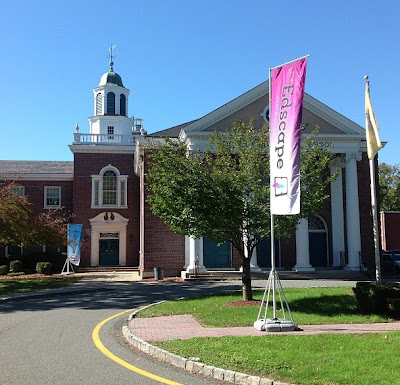
Image credit: http://www.njmls.com/NJ/BERGEN/NEW%20MILFORD-community-information

Recently, New Milford High School hosted their annual edcamp-like Saturday learning conference called Edscape. Leading into this Saturday, I had an opportunity to spend most of Friday in the halls of New Milford with students and staff observing the climate and learning throughout the day. My greatest take away from this informal time at New Milford was the deep sense of trust in the building. The principal trusted his administrative team. The staff trusted that the principal was supporting their work. The students trusted the teachers. The teachers trusted the students. The maintenance crew trusted building leadership. Trust. Trust, Trust. It was everywhere to be seen. From the evacuation drill that had students walking through the community, to the senior flex period that gave them more freedom, to the decisions that teachers were making with their instruction. Buried behind the headlines was this organic sense of trust in the building. I'm certain that there are some teachers in the building that aren't completely feeling this trust, but it is there in a way that is magnified beyond most buildings.

The second piece of New Milford that sits below the surface, beyond the television coverage, blog posts, awards, and energy of its dynamic principal, is the diversity at New Milford. This building was filled with an incredibly rich group of students. I had the opportunity to talk with three incredible students about a project that we are working on together, and they were amazing. I saw diversity under the Friday night lights on the football field, and I saw diversity in the cafeteria. New Milford isn't a sterile environment with a homogeneous population that can succeed no matter the inputs. It is a real school with real problems and real struggles to make success possible. The diversity also breeds a need for innovation. There is a sense of urgency to serve this diverse population, and there is an empathy for the needs of the students in the building.

Edscape was an incredible learning event for me. Getting a chance to meet old and new friends, finding new resources and ideas, and presenting about some of the things in which I'm passionate, but the story of my trip to New Jersey was that success for New Milford and most schools lies below the surface in the deep roots of the school, the roots that honor diversity and the roots that foster trust.

I could not be more proud of the collaborative work being done at NMHS.  As a Principal having it acknowledged this way by a colleague from another state and locally is priceless.  We do not have all the answers at NMHS.  We do not have the funds to do many of the things that we dream about.  What we do have is a commitment to build a culture that focuses on our students while providing them with a meaningful learning experience.  

This post was the first of a few Edscape reflections that really impacted me professionally and personally.  It is always great to receive feedback from colleagues that you admire as their work has had such a profound influence on mine.  As today is my 39th birthday I think that George Couros might have provided the best gift from a non-family member with his thoughts on how I lead.  His reflection and feedback really put into perspective why I do what I do, how much I love working for New Milford High School, and the vital role that my Personal Learning Network (PLN) has on my professional practice.

Thursday, October 24, 2013

The Voice: Student Edition

The following is a guest post by Cristy Vogel (@msfrenchteach).  She is a High School French Teacher in Columbia, SC, 2013-14 SCFLTA President, and #langchat Co-Moderator.  She blogs at theslantedapostrophe.blogspot.com.

This post is not about a special episode of teen singing sensations on The Voice. Hope you’re not disappointed! However, the show did come to mind when thinking about student voice. If you haven’t seen the show, essentially, it’s a contest for aspiring singers who must wow the judges and audience with their vocal abilities. The hope is that the judges will hit the buzzer and declare interest in mentoring the vocalist.  The judges are experienced and very successful celebrities who have industry insights from which the contestants can greatly benefit, in theory. 


Image credit: http://www.educationthroughleadership.com/giving-students-a-voice/

Much like our students, each contestant hopes to have his or her voice heard in order to learn, grow, and excel.  The classroom may not be a ridiculously loud contest like what we see on The Voice, but it is a place where all learners should have the opportunity to direct their learning. Recent interactions with my own students have inspired me to reflect on voice and its implications in the classroom. In fact, it has only been in the past couple of months that I have really gotten out of my comfort zone and given students the microphone so as to make decisions about their own learning.  It is my pleasure to share with you a few tips that are based on my personal experience. 

Get informed.
Giving students a voice is not an exact science, especially since each classroom is unique. There are ways to prepare yourself for such a risk-taking endeavor, so I recommend that educators take some time to engage in discussion with others who have done it before putting learners on the stage. Read a blog on the topic, talk to on-site colleagues who have success with it, ask your PLN for ideas, and maybe engage in a Twitter chat. Then, ask yourself how your students might direct their own learning in your particular environment. You know your students best!  

Tell stories.
Our learners need a little direction when we give them voice. In fact, all of us -- not just the learners in our classroom -- want to know how and why we’re doing what we’re doing. As educators, anecdotal stories can help as they have the potential to capture students’ attention and guide them to make meaningful recommendations. I tell my students that there are non-negotiable tasks that we must do in life, but we can suggest ways to tailor them to our needs.

My first anecdote this year was about the professional development sessions that our school faculty must attend every other Thursday.  I told them that the PD is non-negotiable, but that teachers can make recommendations for future meetings. I explained that I shares my ideas with our administration in hopes that we will get to try something different. Then, I transitioned into an explanation of the non-negotiable part of the project that we are doing with students at other schools.  We discussed some aspects that they could direct before I gave them a feedback form to complete. I found that the responses were more meaningful than they had been when I had made past attempts at seeking feedback, and I believe my anecdote and our discussion impacted the results.

Just as the contestants on The Voice are prepped before hitting the stage for their first performance, our learners also benefit from a little coaching. After all, don’t we want to make that empowering moment on the stage as successful as possible? Students might not have a voice in many of their classes, so make this time count!

Listen carefully and empower your learners. 
Now that your learners have spoken, reflect on what they said. Sometimes you may receive several comments that are not helpful, but concentrate on the serious ones. Stay positive! Even if only one or two students provide you with meaningful feedback, do your best to make their voices heard. Most students are going to use the power of voice at some point, and that might be when they are making individual, rather than collective, decisions. At any rate, announce the changes that you are going to make as a result of student feedback. I recommend that you let them know repeatedly how much you appreciate it.  In my own experience, learners are happy to hear, more than once, that their voice was heard and that it made a difference. 

The fact is, there is more potential for buy-in when the learning is student-directed. Let’s let our learners shine with the mic in hand!

I would like to thank Eric Sheninger (@NMHS_Principal) for inspiring and inviting me to contribute to his blog. It was my first time doing so!  He wrote a fantastic post on the need for educators to tell their classroom stories, and it inspired me to ask him about guest blogging. As a result, I wrote this post AND already invited one of my own students and colleagues to guest blog. Yet another example of the power of my PLN!

Check out Eric’s post HERE

Thank you, Eric, for giving me a voice! 

Monday, October 21, 2013

The Impact of #Edscape

This past Saturday (10/19) marked the fourth annual Edscape Conference held at New Milford High School in NJ.  The idea for this event evolved from a dire need to fill a void in the type of innovative learning experiences that educators were craving.  As a result, a partnership between Teq and New Milford HS was formed to provide a cost-effective, meaningful learning experience for attendees.   Attendees could take ideas and strategies presented during hour long sessions and implement them immediately upon return to their schools and districts.  Each year hundreds of educators from across the country descend upon my school to take part in Edscape in what I hope will be one of the best learning experiences of their year.  I realize this is a lofty goal, but if I am to ask fellow colleagues, educators, and friends to give up time with their families on a Saturday and travel great distances then I had better be able to deliver. Based upon early feedback it seems like we did.


One of the tenants of the Edscape Conference is the focus on the work of practitioners. The selection of the keynote, as well as the majority of the sessions, places an emphasis on innovative work taking place in schools across the country and beyond. It is my feeling that in a time when the national rhetoric is quite negative towards education, nothing is more inspiring and uplifting than focusing on the innovative and impactful work being done by passionate educators.  My only regret with Edscape is that I did not get to sit in on any sessions or engage attendees in as many conversations that I would have liked.  I guess this comes with the territory when hosting a conference at your school.  However, I have been digesting feedback that I have received either through email, in person, or the #Edscape hashtag and would just like to point out a few highlights from the event.  Below are some identifiable characteristics that I believe portray the success and impact of Edscape:

  • NMHS Students – I could not have been more proud of my students and how they represented my school.  Attendee after attendee commented how helpful, respectful, and enthusiastic they were.   Next year I will look for even more ways to get my students involved with Edscape.
  • The Learning – Edscape is all about professional learning.  This occurred during sessions, over conversations in lunch, in the hallways between sessions, and afterwards at the networking reception held at Jersey Boys Grill.  Each session focused on applicable takeaways that educators could implement upon their return to their schools. What was even more powerful though was the learning that took place during conversations on professional practice and through the connections that were made throughout the day. Many attendees expressed the need to a two-day conference going forward as there were too many quality sessions that they wanted to attend. You can check out all of the sessions that were offered HERE.
  • Facility – I love my school building and numerous attendees echoed this. The original building where the majority of the sessions were held was built in 1928 and you can see that from the architecture.  We continue to work on transforming learning spaces with the money that we have. At NMHS we had adequate technology available, charging stations that our students regularly use, and superior WiFi (ask any attendee).  At our max we had over 650 devices connected to the open WiFi and not one issue. There were so many complimentary comments about the charging stations, WiFi, grounds, mission statements visible in classrooms, student work displayed on walls, and the larger television that streams announcements when you enter the school.  I feel a school is the best place to engage educators in professional learning.
  • Attendees – There were close to 400 educators from 11 different states (NJ, RI, NY, CT, PA, MD, AR, MO, OH, VA, TX) as well as Canada. Numerous stakeholder groups were represented such as teachers, assistant principals, principals, curriculum directors, assistant superintendents, board of education members, parents, and members of the NJ Department of Education.  I am humbled by the fact that so many attendees and presenters traveled great distances to be at Edscape.  What was even rewarding was seeing everyone learning side by side to improve their practices and move the profession forward.
  • Global Impact – The keynote by George Couros as well as the Connected Educator panel was streamed live by Teachercast and viewed by over 500 people worldwide.  If you have not viewed his keynote you can see a recording of it HERE.  The #Edscape hashtag was trending #1 throughout the day on Twitter.  

Edscape has and always will be a labor of love for me.  The excitement, passion, and innovative work I witness each year are the catalysts needed for change in my opinion.  Edscape is not a revolutionary event in itself.  It is the ideas and strategies that educators take with them from the event and eventually implement that have the capacity to be revolutionary.  On a side note I can’t thank George Couros enough for delivering a keynote that made attendees, laugh, cry, and think.  Spending time with him at the Jets game yesterday and introducing him to tailgating was an added bonus. 


Lastly, thanks to all of YOU that inspire me each day to put on Edscape. On that note I would love to hear what your major takeaways were from the event this past Saturday.  What did we do right and what can we improve? Feel free to leave a link to your Edscape reflection in the comments if you have or plan to write one.  Planning for Edscape 2014 for next October is now under way so mark your calendars for Saturday 10/18/14.  We will soon be setting a date and then select a keynote (suggestions appreciated).  The call for proposals will go out in the spring so stay tuned. If you have any leads on sponsors for next year feel free to secure them on my behalf or send me an email. 

Be the change that you wish to see in education!