Showing posts with label Future Ready Schools. Show all posts

Thursday, July 10, 2025

Future-Proofing Education: Why the AWS Imagine Conference is a Must-Attend for School Leaders

I remember when I got my first Blackberry phone in 2007. Things sure have changed a great deal since then. The pace of change in our world is relentless, and education is no exception. As leaders, we are constantly tasked with preparing learners for a future that is volatile, uncertain, and complex. I share the following in Disruptive Thinking in Our Classrooms:

“To prepare students for the present and future they need to become disruptive thinkers where they can replace conventional ideas with innovative solutions to authentic problems.”

Sticking to the status quo is no longer a viable strategy; it’s a recipe for irrelevance. The real question we must ask ourselves is not if we should innovate, but how we can do so effectively to create future-ready schools in a cloud-based world? That’s why I’m urging every forward-thinking leader to attend the AWS Imagine Conference in Chicago July 29-20, 2025. Best of all, it’s FREE! Below are some important facts:

  • The event will be in-person, in Chicago. 
  • There is no cost to attend. 
  • Registrations must be made with a business email (i.e. .edu, .gov, or .org). 
  • You can register to attend HERE.
I am grateful that AWS partnered with me on this sponsored post to share about this game-changing event. 

This isn't just another tech conference. It's a critical gathering for leaders focused on the strategic work of genuine transformation. One of the core themes, "future-proof your organization," gets to the heart of what we do. This is about more than just buying new devices; it's about fundamentally rethinking our operating models. Researchers define digital transformation as a holistic process that involves changes to an organization's core, its processes, and its service models, all triggered by new technology (Mergel et al., 2019). The Imagine Conference provides a roadmap for this deep, structural work, moving beyond buzzwords to showcase real-world strategies from public sector and education leaders who are successfully navigating this path.

However, the most powerful technology is useless if it isn’t embraced by the people it’s meant to serve, something I address in great detail in Digital Leadership. The best-laid plans for innovation often fail at the human level. This is why the conference's focus on aligning people, processes, and cloud-based technology is so vital. It acknowledges a truth I’ve seen throughout my career: successful implementation hinges on embracement. Research on digital acceptance consistently shows that for any new tool to be adopted, users must perceive it as both useful and easy to use (Al-Emran et al., 2018). The sessions and hands-on demos at Imagine are designed to help us lead this change, providing the insights needed to create a culture where innovation is not just mandated, but welcomed.

Ultimately, leading this shift is our greatest challenge. Meaningful educational change is a complex, dynamic process that requires more than a vision; it requires a deep understanding of the mechanics of implementation and the culture of schools (Fullan, 2007). The AWS Imagine Conference is an unparalleled opportunity to connect with peers, learn from experts, and gain the practical knowledge needed to lead this charge effectively, especially when it comes to cloud-based technology. It’s where we can move from abstract ideas to concrete action plans.

If you are serious about leading change that matters, this is an event you can't afford to miss. Connect there and work together to build the future of learning for all students. 

Learn more about the event HERE.

Al-Emran, M., Mezhuyev, V., & Kamaludin, A. (2018). Students’ perceptions of using m-learning for knowledge sharing: A structural equation modeling approach. Knowledge Management & E-Learning: An International Journal, 10(3), 263–279.

Fullan, M. (2007). The new meaning of educational change. Teachers College Press.

Mergel, I., Edelmann, N., & Haug, N. (2019). Defining digital transformation: Results from expert interviews. Government Information Quarterly, 36(4), 101385.


Sunday, February 13, 2022

Strength in Vulnerability

“Vulnerability is the core, the heart, the center, of meaningful human experiences.” - BrenĂ© Brown

Change is hard.  It is even more challenging to sustain.  While there are many obstacles to individual or system growth, fear and comfort tend to lead the pack.  Both work to stymie a desire to improve for different reasons.  Often, we are afraid of taking risks or embracing new ideas because they might not work out, resulting in a decrease in performance, outcomes, or morale.  What might be will never be experienced if we are not open to trying.  Then there is comfort, which is typically the enemy of progress.  Hugh Jackman said something to this effect in The Greatest Showman.  What can materialize is a false sense that our current actions or practices are still effective.  

I shared the following in Disruptive Thinking:

Complacency has an insidious ability to inhibit our growth.  When we are in a state of relative comfort with our professional practice, it is often difficult to move beyond that zone of stability and, dare I say, “easy” sailing.  If it isn’t broke, why fix it, right?  Maybe we aren’t pushed to take on new projects or embrace innovative ideas.

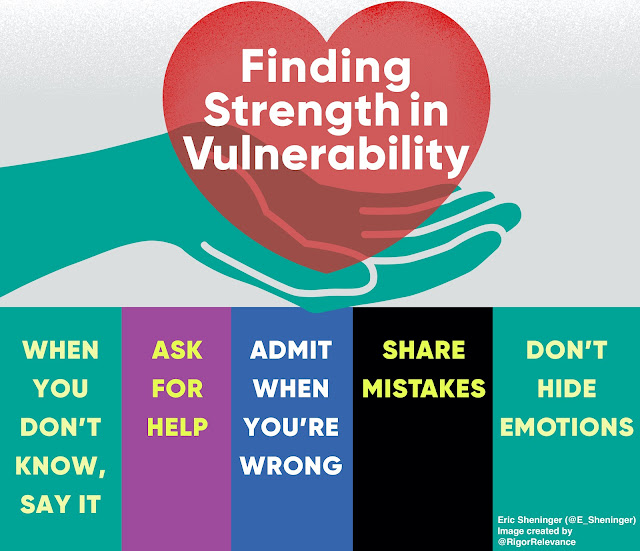
While there is no silver bullet when it comes to change and growth, both become harder to achieve when we are not vulnerable.  While the standard view is that this is a sign of weakness, it is precisely the opposite.  Strength comes from stepping into the unknown and putting yourself in a position to tackle adversity head-on as a means to an end – getting better!  Vulnerability as a catalyst for change and springboard for growth comes from:

  • Stating you don’t know
  • Asking for help
  • Admitting you were wrong 
  • Sharing mistakes
  • Not hiding emotions (it’s ok to shed a tear)

The list above is all about being human and using perceived weaknesses as a bridge to not only build powerful relationships with others but also to actively overcome fear and complacency as a result of comfort.  As I mentioned earlier, change will be even more difficult, or in some cases impossible, if vulnerability isn’t seen as an asset.  Maz Dela Cerna shares the following:

Putting yourself out there, taking that leap, and showing vulnerability take a lot more courage and strength than to keep quiet and do nothing.  It shows strength when you can swallow your pride and ask for help.  It’s perfectly natural to experience tough times and to not always be on a high.  It takes guts to put yourself out there and launch an idea.  While you may be vulnerable and open yourself up to failure, you may also succeed.

I recently joined Tom Murray on the Future Ready podcast to share some of my thoughts on the topic, which you can view below. 

There is absolutely no shame in being vulnerable when it comes to change.  In the words of Brene Brown, “Vulnerability is about showing up and being seen.  It’s tough to do that when we’re terrified about what people might see or think.” If growth is an individual as well as a collective goal, which it should be, then embrace vulnerability and be the change you wish to see in education.  

Sunday, April 3, 2016

Change Needed Today to Prepare for Tomorrow

There is always a great deal of talk about what schools need to do now. The problem though is that most of the talk is not followed with action. Then there are those who want to act, but do not have the adequate support to do so. Herein lies the issue with all the change talk, rhetoric, and opinions.  Very few people reading this post will deny that the education system has to change now or we run the risk of preparing students for a world that no longer exists. 


Change is needed today to ensure learner success in the modern era, but just as importantly to prepare them for the unique challenges of tomorrow.  The reality though is that change in education becomes a balancing act with pressure from stakeholders on one side demanding increases in achievement as measured by standard metrics such as test scores. On the other side is the need to innovate in order to successfully cultivate the next generation of thinkers, doers, inventors, and creators who will be able to solve some pretty serious global problems in the not so distant future.  We have to stop looking at each side of the balance here and begin to focus on disrupting the system with bold ideas that blend results with meaningful learning.

Hence, I come back to the need to support schools and educators in this endeavor. For over 20 years the Model Schools Conference has provided educators with a learning experience driven by the districts, schools, and educators who have closed the achievement gap.  There is no better way to learn what works in a seemingly endless debate about the needed change in schools than from those who have successfully done it.  As a Senior Fellow with the International Center for Leadership in Education, one of my responsibilities is to help provide practical strategies for accomplishing change in the digital age. As many readers of this blog know, I am a huge proponent of innovative change that leads to actual results in teaching, learning, and leadership.  This has resulted in innovative changes to the Model Schools Conference to provide attendees with the skills, tools, strategies, and mindset to initiate sustainable change. 

Here are some highlights and areas of focus for this year’s event:
  • Closing the achievement gap and digital divide – Teams from model districts and schools will present proven pedagogical and leadership strategies on how they accomplished this in challenging times. There will even be a special Future Ready Schools strand.
  • Innovative spaces for attendees to learn in – Design empowers learning, which is why we want attendees to experience this firsthand. Connections will then be made to how we can begin to transform spaces in our schools to improve student-learning outcomes. LEGO will also be on hand to lead immersion sessions on the importance of creativity in learning. 
  • Making to learn – For the second year straight there will be a working makerspace staffed by local students and outfitted by Table Top Inventing. What better why to see how making impacts learning than through our own students?
  • The power of virtual reality – As a result of Houghton Mifflin Harcourt’s strategic partnership with Google, there will be an immersion experience for attendees using Google Cardboard and Expeditions. Attendees will also be exposed to emerging ways on how virtual reality can support rigorous learning.
  • Return on Instruction – A hallmark of the conference will be a focus on the Collaborative Instructional Review (CIR) process, which will be on full display.  This process can help transform every administrator into an instructional leader, capable of unlocking the instructional power of every teacher and, in turn, the learning potential of every student.

In addition to the awesomeness listed above, numerous sessions will be led by some of the most prominent thought leaders and practitioners in education today.  Join us to get the support to initiate the change needed today to prepare for tomorrow. For the latest updates follow along on Twitter using #ModelSchools.

Sunday, January 25, 2015

Leading Schools of the Future

Portions of this post are adapted from the Future Ready Schools website with permission.

Advances in technology continue to impact society in amazing ways.  The evolution of the Internet allows anyone with access the ability to communicate, collaborate, acquire information, and learn with anyone, at anytime, and from anywhere.  Learners today have embraced this digital world and have begun to explore their passions in ways never imagined.  They thrive in this world and find relevancy and value through a variety of experiences that technology provides.  Growing up in a digital world has expanded their creative boundaries while motivating them to be self-directed learners.  With the changes in technology, virtually every facet of society has adapted in some way, with one major exception – schools.  

Image credit: http://www.schooloffinehearts.net/2012/08/be-willing-to-shift-paradigms.html

The structure and function of the majority of schools in this country is the exact opposite of the world that our learners are growing up in.  There is an automatic disconnect when students, regardless of their grade level, walk into schools due to the lack of engagement, relevancy, meaning, and authentic learning opportunities.  Our education system has become so efficient in sustaining a century old model because it is easy and safe.  The resulting conformity has resulted in a learning epidemic among our students as they see so little value in the cookie-cutter learning exercises they are forced to go through each day. The bottom line is that they are bored.  It is time that we create schools that work for our students as opposed to ones that have traditionally worked well for the adults.  Schools and districts need digital leadership.

Digital leadership takes into account recent changes such as ubiquitous connectivity, open-source technology, mobile devices, and personalization. It represents a dramatic shift from how schools have been run and structured for over a century, as what started out as a personal use of technology has become systemic to every facet of leadership. Digital leadership can thus be defined as establishing direction, influencing others, and initiating sustainable change through the access to information, and establishing relationships in order to anticipate changes pivotal to school success in the future. It requires a dynamic combination of mindset, behaviors, and skills that are employed to change and/or enhance school culture through the assistance of technology.

Creating schools that work for students requires digital leaders who articulate a bold vision for change that not only tackles the status quo embedded in the industrialized model of education, but also one that sees the inherent value of technology to enhance the teaching and learning process.  We need to realize that many traditional elements associated with education no longer prevail. How we go about doing this will vary from school to school or district to district, but the process begins with the simple notion of putting students first to allow them to follow their passions, create, tinker, invent, play, and collaborate.  Schools that work for students focus less on control and more on trust. 

Future ready schools are those focused on learning in a digital age and prepare students for the world of today and of the future.  The culture of these future ready schools is based on building a leadership team, establishing a coherent vision for change, developing a systematic action plan, modeling for leaders effective and efficient ways to leverage digital tools to increase effectiveness, and modeling for teachers how to harness tools to support students’ learning. Working smarter, not harder, by discovering natural complements to the work already being done enhances outcomes.  

Digital Leadership and Future Ready 

Recently the U.S. Department of Education and the Alliance for Excellent Education announced Future Ready Schools (FRS), which aligns seamlessly with the Pillars of Digital Leadership. FRS is a free, bold new effort to maximize digital learning opportunities and help school districts move quickly toward preparing students for success in college, a career, and citizenship. Future Ready provides districts with resources and support to ensure that local technology and digital learning plans align with instructional best practices, are implemented by highly trained teachers, and lead to personalized learning experiences for all students, particularly those from traditionally under-served communities.   If your district has not taken the pledge yet please do so by clicking HERE.  There will also be a series of free summits for district leadership teams to attend.  Leadership is central to the FRS effort.  As a coalition partner ICLE is uniquely positioned to assist leaders in transforming their districts to be Future Ready.


The Time is Now

This effort comes at a critical time as districts embrace college and career readiness as the goal for all students and recognize the potential of digital tools to help teachers personalize learning for each student. While less than 30 percent of U.S. schools have the bandwidth they need to teach using today’s technology, federal and state efforts are expanding this capacity to ensure that at least 99 percent of the nation’s students have access to high-speed internet in their schools within the next five years. Such connectivity, along with strategic planning by districts to maximize its availability, has the potential to transform the educational experiences of all students, regardless of their background.  Will your district be ready for this transition?”  District leaders must respond to these changes with thoughtful planning to align necessary technologies with instructional goals to support teaching and learning.


For more on Future Ready, visit www.FutureReadySchools.org.