Showing posts with label scaffolding. Show all posts

Sunday, May 8, 2022

4 Question Types for Deeper Learning

There are many strategies out there that an educator can use to empower learners. Possibly one of the most powerful is questioning techniques. They comprise the core of any meaningful learning experience and are at the heart of virtually every type of pedagogical approach. While the value of great questions is understood, it is also vital to examine the types that are being used regularly in the classroom. Take the following observation pulled from research by Tofade, Elsner, and Haines (2013):

Well-crafted questions lead to new insights, generate discussion, and promote the comprehensive exploration of subject matter. Poorly constructed questions can stifle learning by creating confusion, intimidating students, and limiting creative thinking. Teachers most often ask lower-order, convergent questions that rely on students’ factual recall of prior knowledge rather than asking higher-order, divergent questions that promote deep thinking, requiring students to analyze and evaluate concepts.

The above synopsis provides some food for thought. Begin by looking at the question stem to determine if it will elicit a one-word response. There is an opportunity to scaffold if it begins with who, what, where, or when. From here, there are numerous opportunities to not only bump up the level of thinking but also foster discourse and build in relevant applications. In Disruptive Thinking in Our Classrooms, I shared four types of questions that can do just that while setting the stage for deeper learning. Below is a summary:

Open-Ended

There is no better way to move students beyond stating what they know than getting them to explain their think¬ing. These types of questions naturally allow for the sharing of more information such as feelings, supporting details, attitudes, and a deeper understanding of the concepts being presented. They require learners to rationalize and reason beyond figuring out the answer by formulating a stance or opinion. Typically, there is no definitive right or wrong response. 

Evidence-Based

These types of questions empower students to justify their responses through rebuttal. The teacher provides both valid and invalid statements seeking responses that are sup¬ported with some sort of evidence. The use of evidence allows students to pull from prior learning while also enabling them to venture deeper into the content.
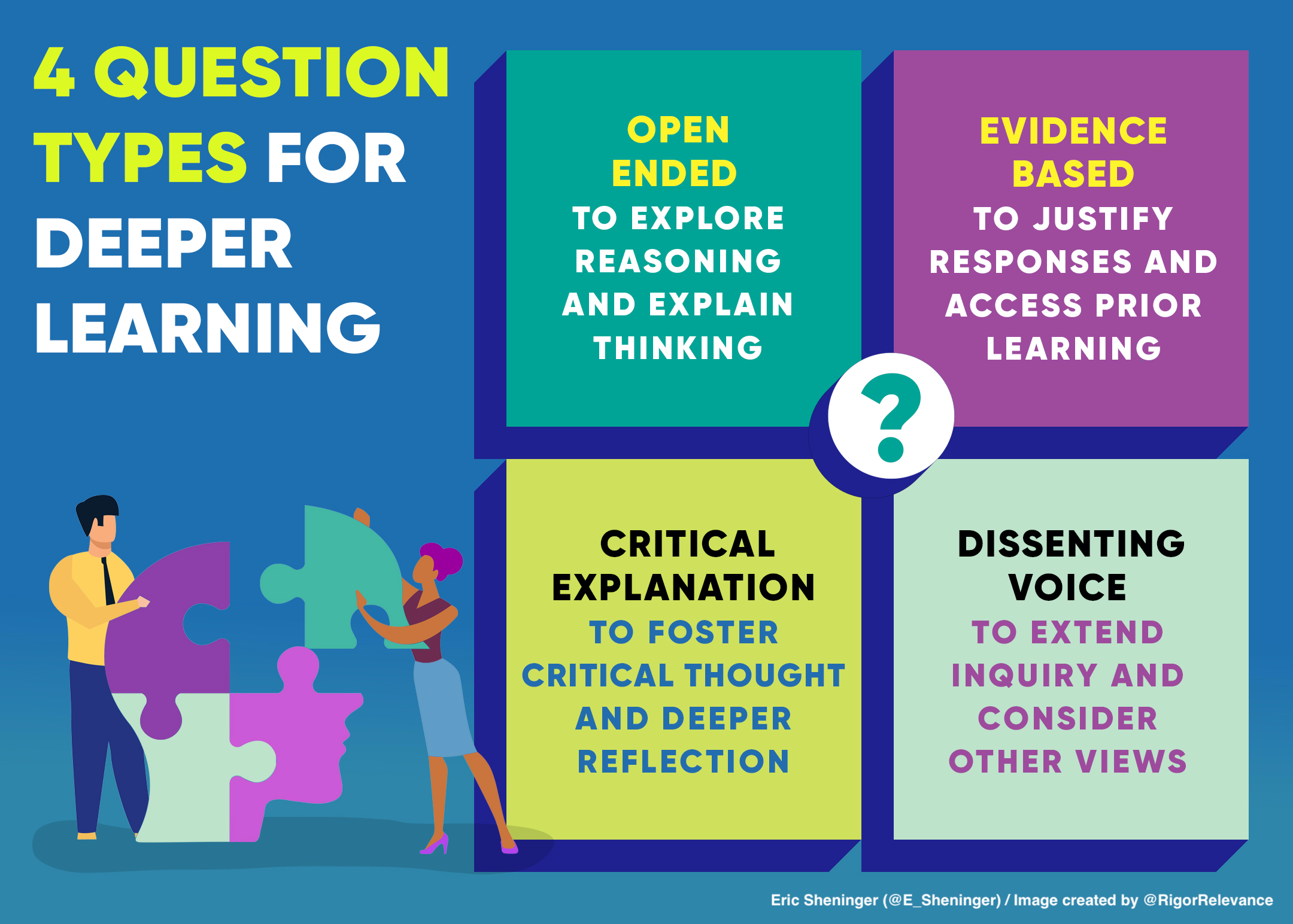

Critical Explanation 

Even if a student responds with a correct answer, this questioning technique fosters more critical thought through reasoning. All a teacher needs to do is simply ask “why?” or “how?” to have students probe their thinking a bit deeper. 

Dissenting Voice 

Questions should lead to more questions. This technique pushes the thinking of students by compelling them to consider an opposing view.

Deep learning can be a reality, but we have to look through a critical lens at the strategies that are being used. Sometimes, the most practical way is to look at what is used daily. In addition to developing better questions, consider using the Relevant Thinking Framework to empower learners to then apply what they have learned in authentic ways.  

Tofade, T., Elsner, J., & Haines, S. T. (2013). Best practice strategies for effective use of questions as a teaching tool. American Journal of Pharmaceutical Education, 77(7), 155. 


Sunday, August 1, 2021

Sparking Inquiry in the Classroom

As a kid, I loved nature.  Growing up in a rural part of New Jersey and spending summers at the beach probably played a significant role in developing this interest. My parents would buy me and my brother all sorts of field guides to help support our curiosity and genuine interest in living creatures.  We would venture out on routine quests to either observe or collect specimens for further study.  Each expedition was driven by both observations and questions.  While we loved looking at various creatures, especially those that were hard to find, such as certain salamanders and snakes, questions kept driving us to want to learn more.  

The short walk down memory lane depicted above is a reminder of one of many driving forces that compelled me to become a science teacher.  It also captures vital components of the scientific method, of which inquiry is the most critical component.  While making observations is the first step, it is the questions that are developed during the initial stages of the process that are the most important, in my opinion.  Without these, it is challenging to establish a working hypothesis to test out.  

No matter the subject taught or concepts explored, questions are more important than answers if inquiry is the goal. The reason being is that the process of developing them on behalf of the learner is typically driven by relevance.  Or a teacher can use a scaffolded approach to spark deeper exploration of a topic through knowledge construction and application.  No matter the chosen path, an inquiry-based approach can be used to cultivate ownership of learning through disruptive thinking.  I define this as replacing conventional ideas with innovative solutions to authentic problems.  

While creating tasks that empower learners to develop their own questions is the ultimate goal, teachers can use scaffolded stems to get the ball rolling.  Below is a version of a resource that can be found in Chapter 4 of Disruptive Thinking in Our Classrooms. 

Each level has numerous question stems that can assist teachers in developing checks for understanding, performance tasks, projects, and assessments.  The overall goal is to work from the base level 4 as this is where authentic inquiry resides.  In a disruptive world, preparing students for the present and future relies on fostering inquiry in the classroom. Every problem throughout history that has been solved with an innovative solution began with some sort of question that probably morphed over time as an inquiry-based approach was applied. Thus, educators can leverage this powerful catalyst to future-proof learning for all kids.  

Sunday, July 21, 2019

The Right Questions

“We get wise by asking questions, and even if these are not answered, we get wise, for a well-packed question carries its answer on its back as a snail carries its shell.”  - James Stephens

Questioning techniques are one of the easiest areas of instructional design that can be improved, at least in my opinion.  By looking at the question stems, one can determine the level of thinking our learners are expected to demonstrate.  Low-level examples almost always begin with who, what, where, when. These aren’t bad per se as you need knowledge to move up any knowledge taxonomy chart.  The problem is when questions reside here and don’t push kids to think and apply their thinking in more complex ways.  Learners also don’t find much purpose with these beyond just getting them right. 

Herein lies one of my major issues with how I see many digital game tools used in the classroom as typically comprised of low-level, multiple-choice options.  As I mentioned before, there is a time and place for this. However, it goes without saying that an emphasis on recall and memorization will not prepare kids adequately to thrive now and in the future.  Disruption caused by the 4th Industrial Revolution, and living in a knowledge economy, continues to teach us this lesson. If a student can easily Google the answer, then it goes without saying that the question isn’t very challenging.  In the end, questions are more important than answers if learning is the goal. More on this later. 


The image above provides a great visual to look at the types of questions that are asked in classrooms or on assignments and scaffold them in ways that empower learners to demonstrate high-level thinking as well as mastery of concepts.  It is important to note that each and every question doesn’t have to be at the uppermost levels of knowledge taxonomy.  The key is to try to bump them up when warranted, especially if they are at the foundational knowledge level.   If question stems begin with who, what, where, or when then there is a natural opportunity to tweak them in a way to get up to at least the understanding level.

Now don’t get me wrong; developing great questions that get kids thinking is excellent. However, the real goal should be the creation of performance tasks where learners are applying their thinking in relevant ways.  This is where the role of instructional design is critical.  When challenging learners through an authentic application where there is an underlying purpose, what results is natural inquiry.  During numerous coaching visits with schools across the country, I have seen this play out over and over again.  Students are so immersed in an activity that collaboration, creativity, and collaboration converge with thinking while they work to solve real-world predictable and unpredictable problems.  What results is that the students then develop and answer their own questions. 


The Rigor Relevance Framework, of which an iteration is pictured above, is a great tool that can assist teachers and administrators develop better questioning techniques and learning tasks to engage kids with a higher purpose.  What results is the process of inquiry, which fuels the learning process.  The right question isn’t necessarily about arriving at an answer per se, but instead it acts as a catalyst for the development of more questions.